
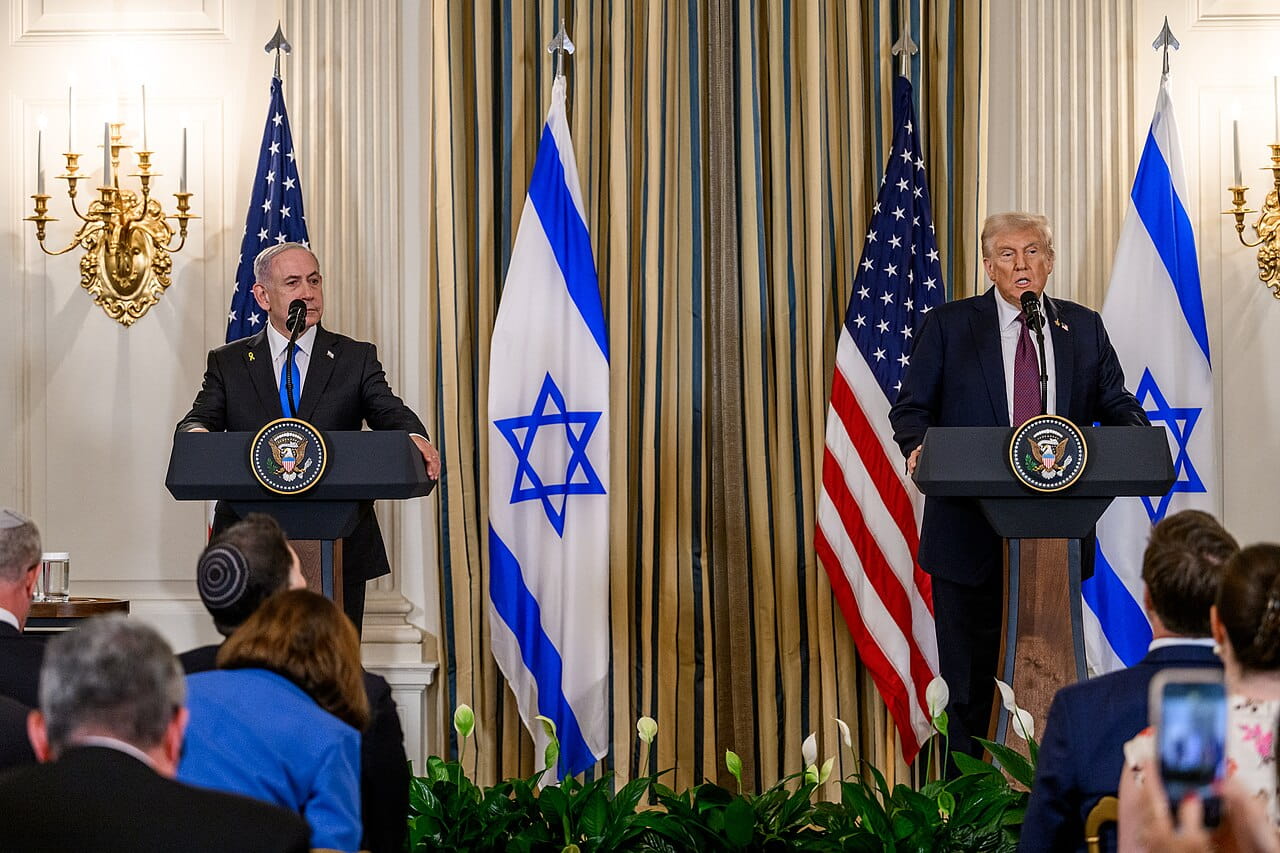
Congress is advancing a provision that would do more to intertwine US and Israeli defence than any single act in the 78-year relationship — covering everything from shared AI systems to fused battlefield data networks. The initiative passed committee with bipartisan support, but its scope has alarmed critics across the political spectrum, who warn it could lock future administrations into a structural defence relationship that is simultaneously deeper and far less transparent. The public remains largely opposed to expanding military ties with Israel, yet the legislative machinery is moving forward with minimal public debate.
What Is Actually Happening
Buried in Section 224 of the House Armed Services Committee’s version of the 2027 National Defence Authorization Act (NDAA), released on 27 May 2026, is a provision titled the “United States-Israel Defence Technology Cooperation Initiative.” If enacted as written, it would require the Secretary of Defence to designate a single senior official — an “executive agent” — to coordinate military cooperation between the two countries across virtually every domain of modern warfare.
The provision is not a symbolic gesture. It mandates bilateral research and development, co-production of weapons, joint ventures, licensing agreements, and “network integration” and “data fusion.” That last phrase is significant: it suggests the US military’s operational data could be made accessible to Israeli defence systems, and vice versa. The United States does not share its military data networks at this level with any other country — not with the UK, not with Australia, not even with the Five Eyes intelligence partners as a bloc.
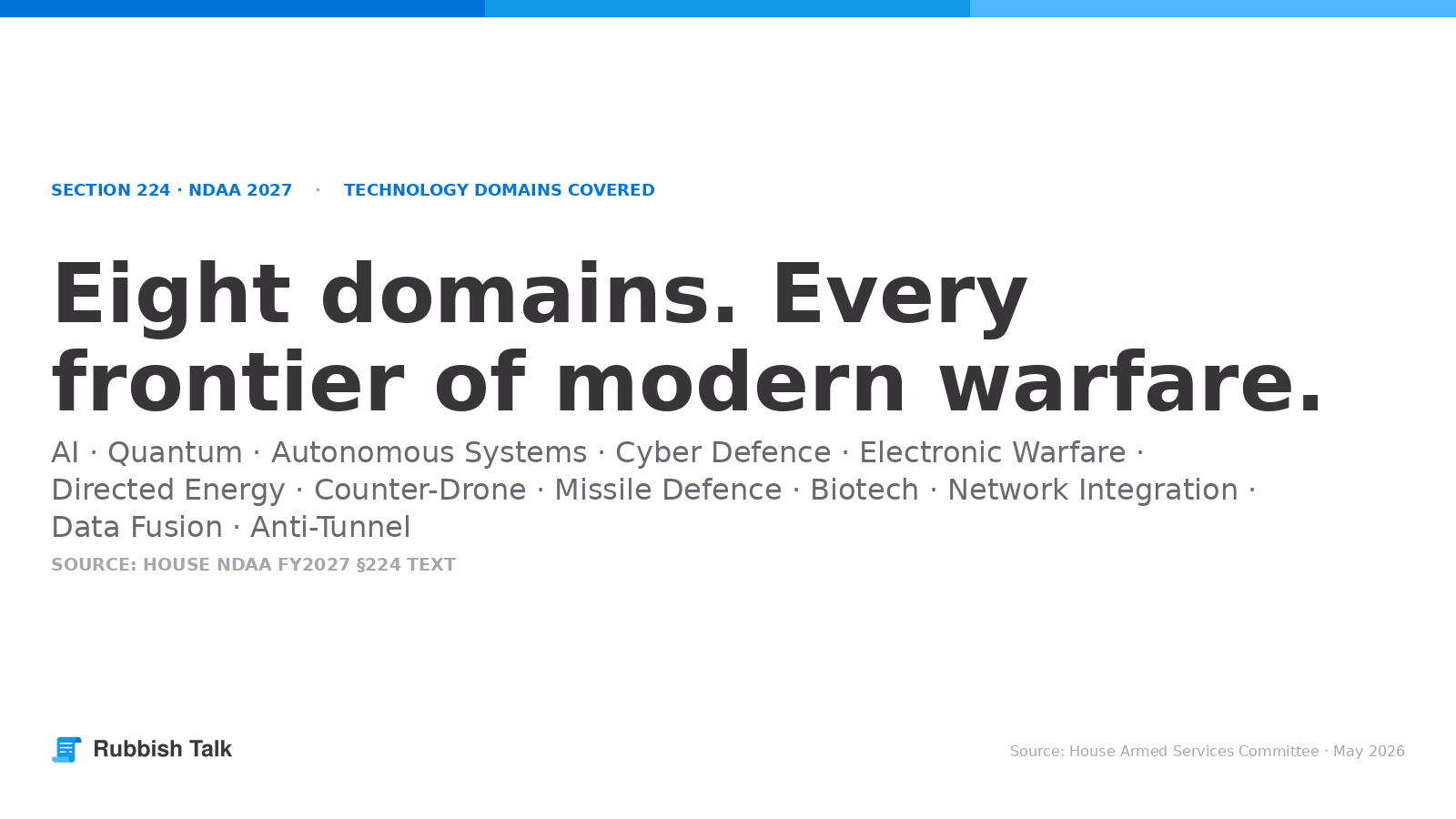
Section 224 covers an extraordinary breadth of technology: artificial intelligence, quantum computing and machine learning, autonomous systems, directed energy weapons, advanced sensing, cyber defence, electronic warfare, biotechnology, biomanufacturing, counter-drone platforms, anti-tunnelling systems, and missile and air defence. Priority areas include counter-unmanned systems across aerial, maritime, and ground platforms, with specific focus on the kinds of technologies that Israel has deployed — and tested — in Gaza and Lebanon.
The Pentagon would be required to brief congressional defence committees within 180 days, identify the designated executive agent, outline coordination with Israeli counterparts, and list early technology areas for accelerated cooperation. Annual reports through 2030 would track which technologies moved into US acquisition programmes or fielded systems.
What the Mainstream Narrative Says
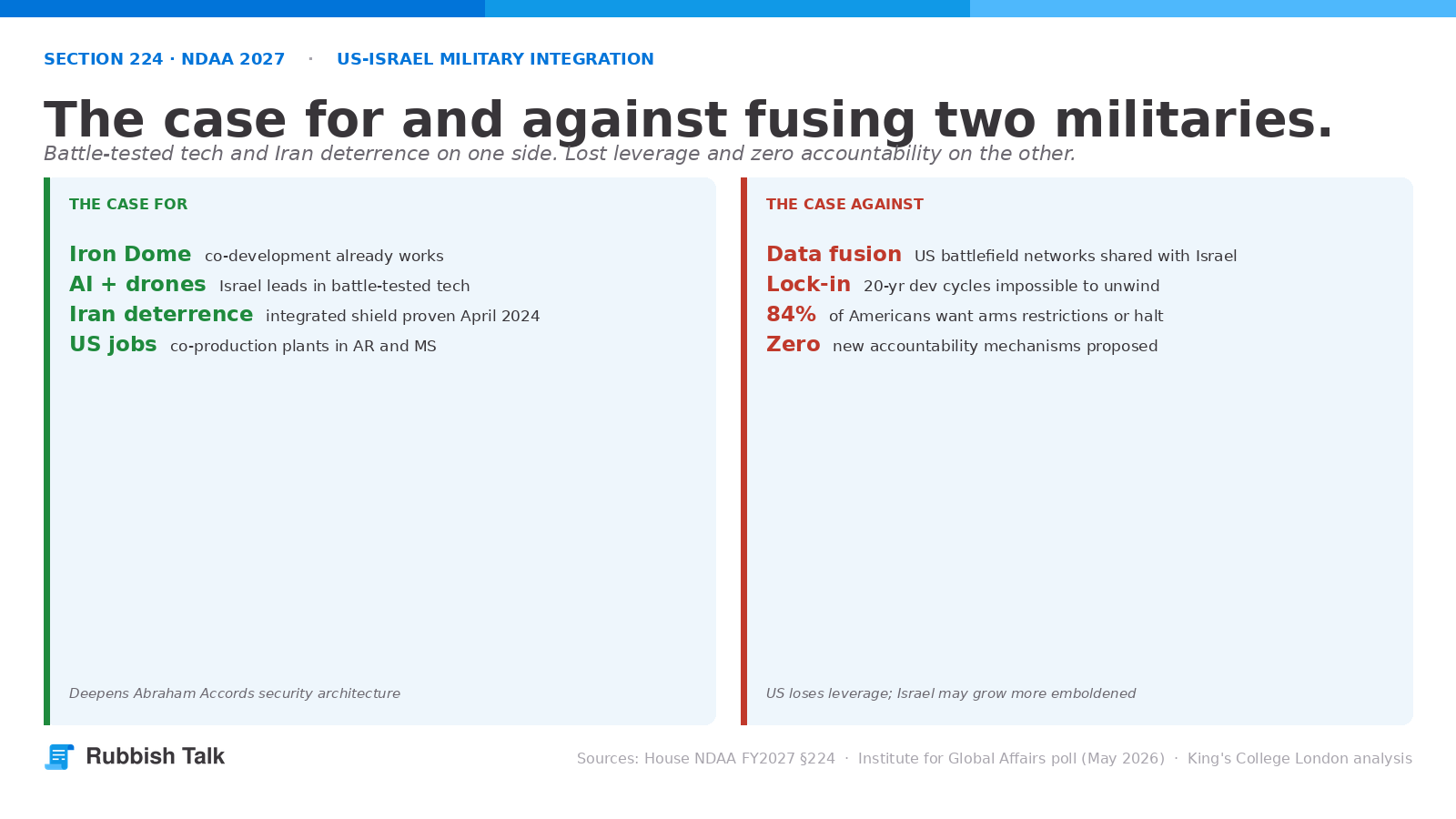
Supporters frame Section 224 as a natural evolution of one of America’s most successful defence partnerships. They point to the Iron Dome, David’s Sling, and the Arrow missile defence systems — co-developed with Israeli firms — as proof that the relationship has already produced real military value for the United States. Israel, they argue, is a technologically advanced democracy operating on the front lines of threats that directly affect US national security: Iranian ballistic missiles, Hezbollah drone swarms, tunnel warfare, and sophisticated cyber intrusions. Deeper integration, in this view, is simply sound defence strategy.
The proposal was introduced by the committee’s Republican chairman, Rep. Mike Rogers of Alabama, and its most senior Democrat, Rep. Adam Smith of Washington — giving it a rare bipartisan imprimatur at the leadership level. It incorporates elements of the US-Israel Future of Warfare Act pushed by Rep. Ronny Jackson, which had failed as standalone legislation. Supporters note the US already co-produces components of the F-35 with foreign partners via global supply chains, and that defence cooperation with allies is standard practice. Section 224, they argue, merely formalises and expands what already exists.
“While historically, the US-Israel defence relationship has included US military aid and weapons transfers, joint missile defence programmes such as Iron Dome, David’s Sling and Arrow, and intelligence and operational cooperation, the proposed agreement increases cooperation to include a wider set of emerging technologies.”
— Mark Hilborne, Senior Lecturer, School of Security Studies, King’s College London (Al Jazeera, May 2026)
What the Data Shows
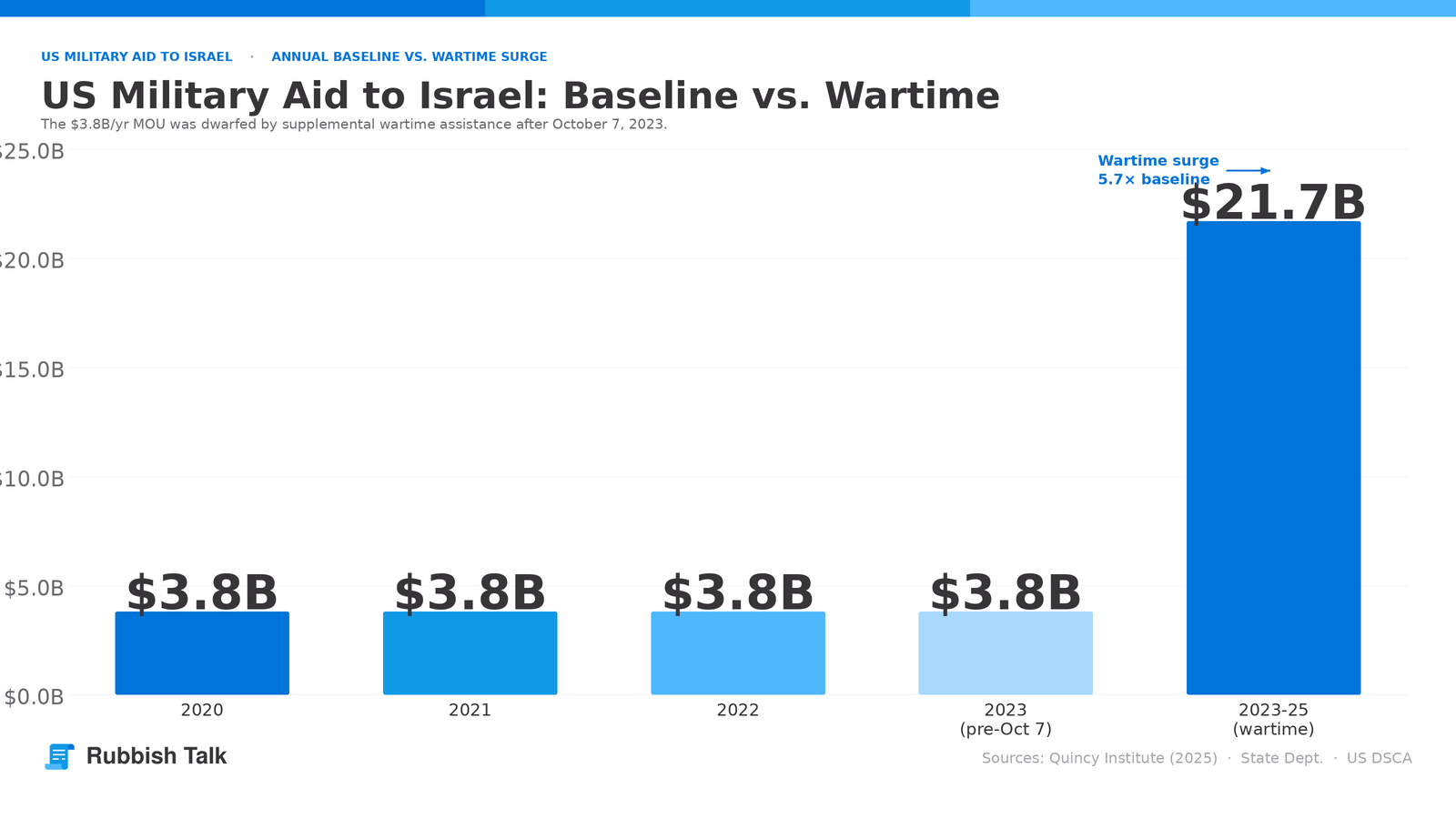
The scale of existing US military support for Israel already defies easy comparison. Under the current Memorandum of Understanding, the US provides $3.8 billion per year through 2028 — $3.3 billion in Foreign Military Financing and $500 million for missile defence cooperation. Since the October 7, 2023 attacks and the subsequent war in Gaza, that baseline has been supplemented by at least $21.7 billion in additional military aid through September 2025, according to the Quincy Institute. In total, the US has provided $174 billion in cumulative aid to Israel since 1948 — or over $310 billion adjusted for inflation.
Israel is already the largest cumulative recipient of US foreign assistance since World War II. But Section 224 is not about aid. It is about integration — and the distinction matters. The aid model, for all its scale, preserves a key political mechanism: Congress votes on it annually, creating at least nominal accountability. The integration model moves that relationship into the opaque machinery of defence acquisition and joint industrial programmes, where oversight is limited, timelines span decades, and political accountability is minimal.
What makes Section 224 structurally different from any prior arrangement is the “lock-in” dynamic. Long-cycle joint development programmes — some of which could run 10 to 20 years — would embed the Israeli defence sector into US acquisition infrastructure. Israeli firms are already building co-production facilities on American soil: Elbit subsidiary R2S opened a manufacturing facility in East Camden, Arkansas; General Atomics has partnered with Israeli defence companies at a plant in Tupelo, Mississippi. Section 224 would turbocharge this trend, creating jobs in congressional districts and thereby building political constituencies for the relationship that are independent of any foreign policy judgement.
Historical Context: From EUCOM to CENTCOM to Integration
The current proposal is the third major structural shift in the US-Israel military relationship in five years. For nearly four decades — from 1980 to January 2021 — Israel sat within US European Command (EUCOM) rather than Central Command (CENTCOM). The arrangement was explicitly political: Arab states under CENTCOM refused to be grouped with Israel, and the US maintained the fiction to protect its regional relationships. The Abraham Accords of 2020, which normalised relations between Israel and the UAE, Bahrain, Morocco, and Sudan, broke that logic. On 15 January 2021, the Trump administration transferred Israel to CENTCOM — a quiet but geopolitically significant move that formally placed Israel within the US military’s Middle Eastern command structure.
That transfer set the stage for the integrated regional air-defence shield that was put to its first major test in April 2024, when Iran launched a coordinated salvo of more than 300 ballistic missiles and drones directly at Israel. US forces participated in intercepting the attack alongside Israeli, Jordanian, and British assets. Section 224 is, in the analysis of several regional scholars, the next phase: not just operational coordination but full industrial and technological fusion, with Israel positioned as the anchor of a US-backed regional security architecture.
“The proposed US-Israeli defence integration can be seen as the next phase of the Abraham Accords: moving from normalisation toward a US-backed regional security regime centred on Israel as the dominant military and technological hub.”
— Imad Salamey, Professor of International Relations, Lebanese American University (May 2026)
Who Benefits, Who Is Exposed
For the US defence-industrial complex, Section 224 represents a significant expansion of the addressable market. Co-production agreements mean domestic jobs, long-term contracts, and access to battle-tested Israeli technology in areas where the US has gaps — particularly in counter-drone systems, tunnel detection, and urban warfare tech that has been refined across decades of conflict. The provision would give Israeli firms deeper access to the US procurement system, and gives US prime contractors deeper access to Israeli-developed technology.
For Israel, the benefits are strategic and political. Embedding joint development cycles into US defence acquisition creates a structural dependency that future American administrations would find enormously costly to unwind. It also creates political leverage within the US system: manufacturing jobs in key congressional districts translate into sustained political support regardless of any given administration’s foreign policy stance. The concern raised by critics at Responsible Statecraft is explicit: this arrangement would give the Israeli government “the opportunity to greatly expand one of the most powerful levers of influence in US politics: jobs in the US.”
Who is exposed? The analysis from King’s College London’s Hilborne is pointed. “If joint R&D produces more effective technology, then systems related to surveillance, autonomous vehicles, AI and targeting, and various counter-drone or counter-missile technology would be improved, providing a capability boost to Israeli forces operating in Gaza or the West Bank.” At the same time, deeper integration reduces Washington’s leverage. “The deeper integration may also mean that the US loses some degree of leverage over Israel, as it would be less able to withhold certain capabilities from Israel,” Hilborne told Al Jazeera. “As a consequence, Israel might be emboldened in its policies.”
The accountability argument also cuts sharply. Human rights organisations, including Amnesty International and Human Rights Watch, have documented instances in which US-supplied weapons were used in strikes raising serious questions under international humanitarian law. With integration replacing aid, the political mechanism for conditioning or withholding military assistance — the annual congressional vote — disappears into a web of joint programmes that no single administration can easily reverse.
What Is Being Overlooked
The debate over Section 224 has focused heavily on the Israel-Palestine dimension, but the provision’s broader geopolitical implications have received less scrutiny. The “data fusion” language is the most consequential and least-discussed element. The US maintains the world’s most sophisticated integrated battle management networks — systems that link satellite feeds, radar arrays, communications, targeting systems, and command infrastructure. Genuine network integration with Israel would be unprecedented: even within NATO, the US does not share this level of data access with allies.
The public opinion gap is also striking. A May 2026 New York Times/Sienna poll found that just 30% of Americans supported Trump’s decision to go to war with Iran — the conflict that has animated much of this defence ramp-up — while 64% opposed it. An Institute for Global Affairs poll in the same week found only 16% of Americans support continuing weapons transfers to Israel without restrictions; 38% support stopping weapons transfers entirely. Congress is moving in the opposite direction from the public, under conditions of minimal debate and maximum opacity.
The bipartisan opposition that has emerged — libertarian Republican Thomas Massie and progressive Democrat Ro Khanna jointly pledging to introduce amendments removing Section 224 from the NDAA — reflects genuine unease that cuts across ideological lines. But both Massie and Marjorie Taylor Greene, another vocal critic of unconditional Israel support, were defeated in recent Republican primaries in contests where pro-Israel lobby spending was a significant factor.
What Comes Next
Section 224 must still clear the full House, survive Senate debate, and be reconciled in conference before it can become law. That process will extend through the autumn of 2026. The provision may be amended, stripped, or significantly weakened in that process — the Massie-Khanna coalition will push for its removal, and there are enough swing votes in the Senate to create uncertainty.
But the trajectory is clear. Even if Section 224 fails in its current form, it has already shifted the terms of debate. The idea of a formal executive-agent framework, dedicated to permanent military integration with Israel across the full spectrum of emerging technologies, is now on the table as mainstream legislative text with leadership backing from both parties. The next attempt will start from that baseline.
The practical question for the defence industry, for military planners, and for the American public is whether a relationship of this depth can be managed through existing accountability mechanisms — or whether, as critics argue, it will simply become too structurally embedded to be subject to normal democratic oversight at all. Based on the precedents from NATO co-production, from joint nuclear programmes, and from the existing missile defence partnerships, the answer is likely the latter. Once the industrial pipelines, the data networks, and the career incentives of a generation of defence professionals are tied to the relationship, unwinding it becomes less a policy choice and more an engineering problem.
Sources:
- Congress quietly moves to integrate US and Israeli militaries — Responsible Statecraft
- Congress advances US-Israeli military integration plan — Al Jazeera
- US Congress moves to deepen military ties with Israel: Why it matters — Al Jazeera
- US measure to deepen Israel military cooperation faces bipartisan pushback — Al Jazeera
- Lawmakers quarrel over effort to boost defense tech integration between US and Israel — Military Times
- 2027 NDAA Provision Seeks Sweeping US-Israel Defense Tech Integration — Military.com
- Massie and Khanna rail against defense bill provision to integrate US military with Israel — Denver Gazette
- Democrat, Republican lawmakers team up against US-Israel military tech synergy — Times of Israel
- US-Israel integration is far from ‘America First’ — Responsible Statecraft
- Five Years Since Israel’s Transfer to CENTCOM — INSS
- U.S. Military Aid and Arms Transfers to Israel, October 2023–September 2025 — Quincy Institute
- U.S. Aid to Israel in Four Charts — Council on Foreign Relations
- Section 224: The National Defense Authorization Act FY 2027 — A New Policy