

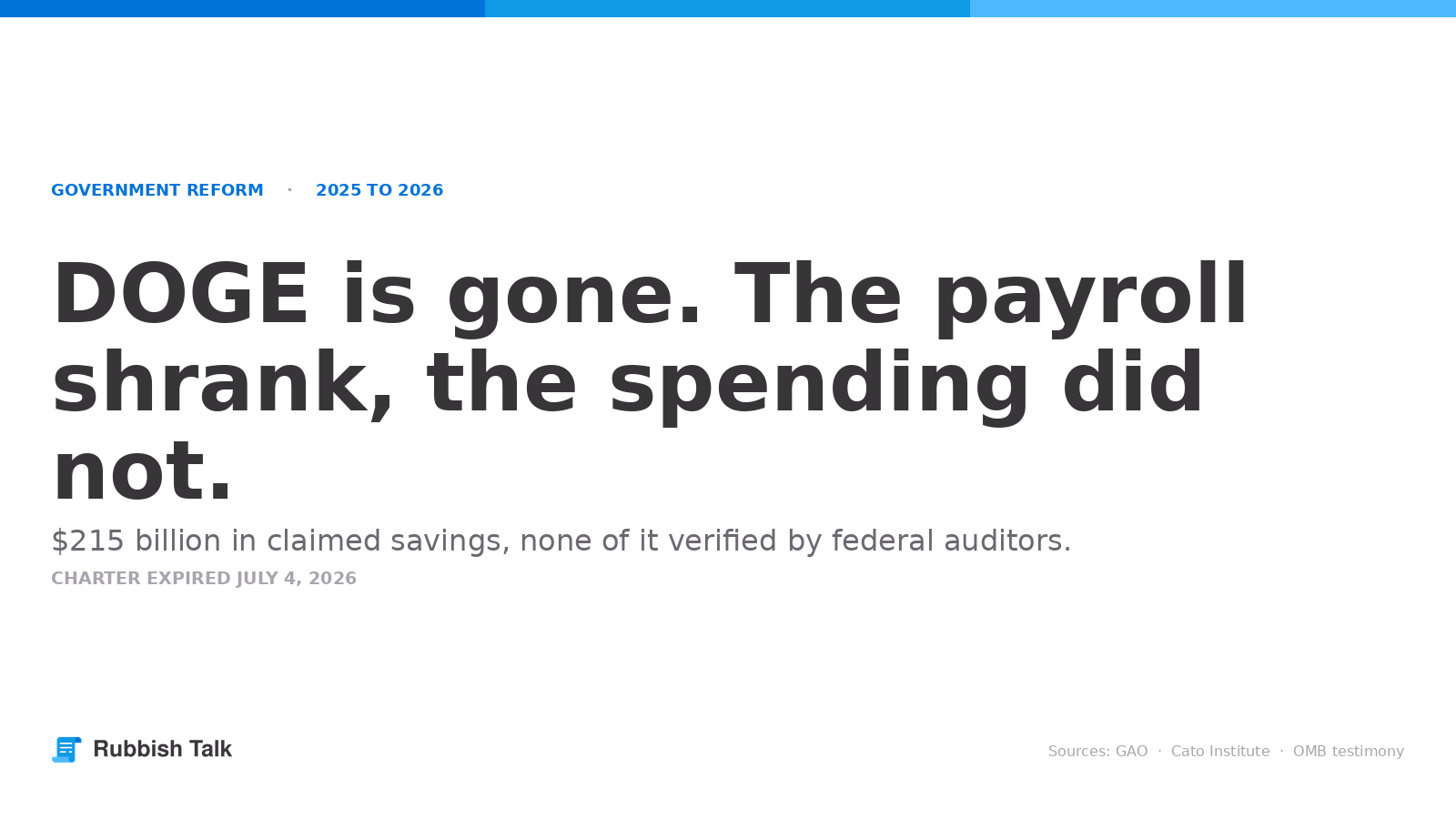
The Department of Government Efficiency launched on Inauguration Day 2025 with a promise to cut $2 trillion from federal spending. When its charter expired on July 4, 2026, it claimed $215 billion in savings, a figure its own records could not fully document and that Congress’s own auditors could not verify. DOGE did deliver one measurable result: the fastest peacetime cut to the federal workforce on record. What it did not deliver was lower spending, which rose over the same period. This is the gap between the pitch and the receipts, and why the experiment ended quietly rather than in triumph.
What DOGE actually was
DOGE was created by Executive Order 14158 on January 20, 2025, the first day of Donald Trump’s second term. It was not built from scratch. The order reorganized an existing body, the United States Digital Service, and renamed it the United States DOGE Service, then attached a temporary organization set to dissolve on July 4, 2026. Trump had announced the concept in November 2024, naming Elon Musk and Vivek Ramaswamy as co-leads. Ramaswamy dropped out before inauguration, leaving Musk as the public face.
The structure mattered more than the branding. DOGE embedded small teams inside federal agencies, typically a lead, an engineer, a human resources specialist, and an attorney, staffed in part by special government employees. By February 20, 2025, its budget was roughly $40 million, funded through transfer payments from other agencies under the Economy Act of 1932. A second order, Executive Order 14210 of February 11, 2025, directed agencies toward large workforce reductions. The mission, as proponents framed it, was to shrink the government, cut spending, and modernize its aging software.
The problem it claimed to solve
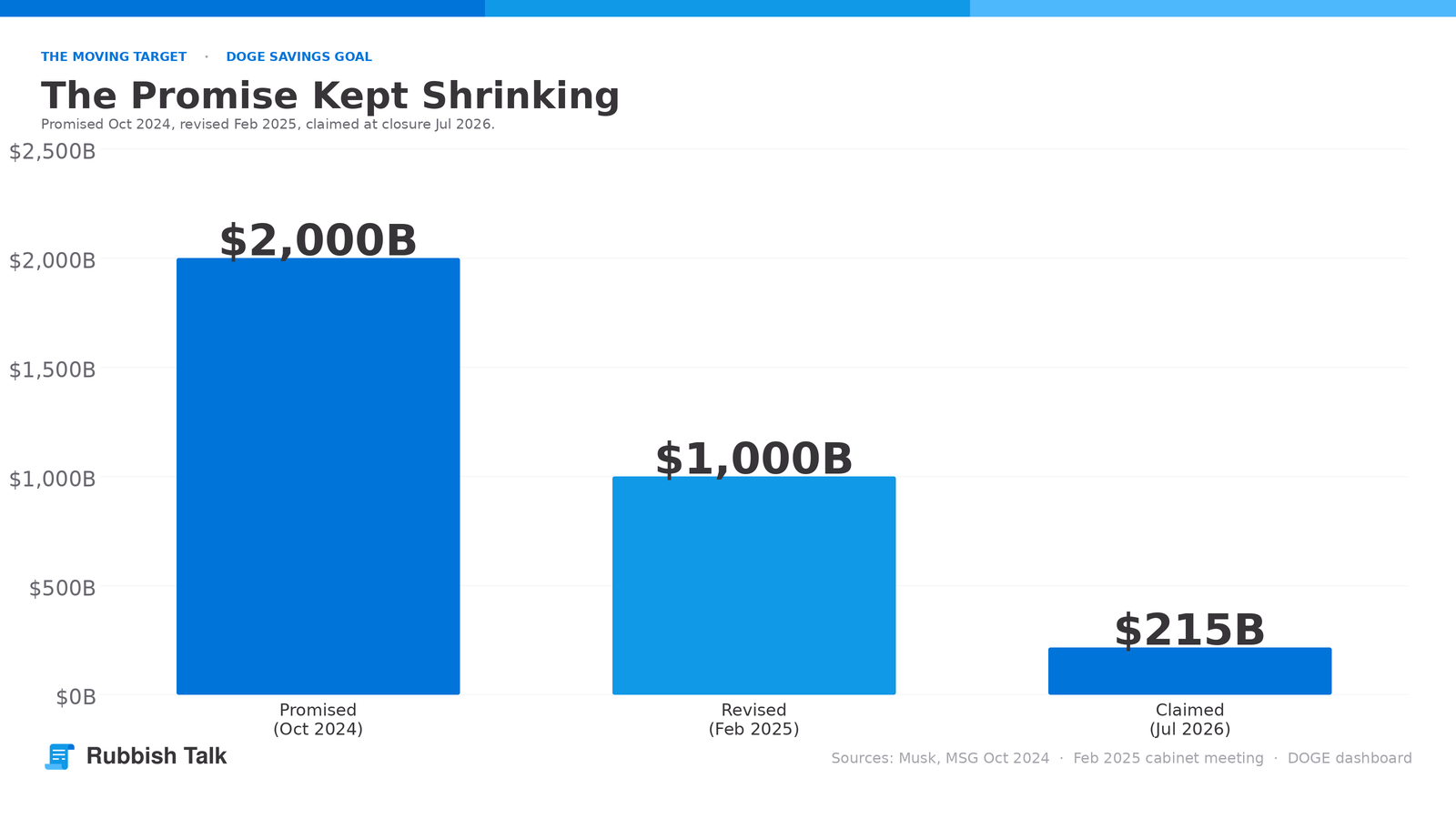
The scale of the promise was the story from the start. Speaking at a Trump rally at Madison Square Garden in October 2024, Musk said DOGE could reduce federal spending by “at least” $2 trillion. That figure was larger than the entire federal discretionary budget for 2023. Supporters pointed to real numbers on the other side of the ledger: the federal government spends roughly $7 trillion a year, and congressional hearings cited an estimated $2.7 trillion in improper payments accumulated across the government since 2003.
Those are genuine problems. Improper payments, duplicative contracts, and unused office leases are not inventions. But the gap between a headline figure of $2 trillion and the mechanics of the federal budget was the flaw baked in from day one. Most federal spending is not salaries or discretionary line items that a task force can simply cancel. It is transfer payments: Social Security, Medicare, Medicaid, interest on the debt. The Cato Institute estimated that even a 10 percent cut to the entire federal workforce would save only about $40 billion a year. The math of the mission never matched the size of the promise.
What the numbers came to
The target moved steadily downward. At the first cabinet meeting in February 2025, Musk revised the goal to $1 trillion, which he called 15 percent of the budget. By April 2025 he said $150 billion had been cut, a figure fact-checkers disputed. Blake Moore, a Republican congressman who led the House DOGE caucus, was blunt about the original number.
“We always knew it was a massive exaggeration.”
– Blake Moore, U.S. Representative (R-Utah), speaking on June 5, 2025
By the time the charter expired, the public dashboard listed roughly $215 billion in claimed savings, drawn from cancelled software licenses, terminated diversity, equity and inclusion grants, and ended office leases. The problem was verification. The Government Accountability Office, Congress’s spending watchdog, could not determine how much money was ultimately saved or lost. Reporters and analysts found duplicate entries, arithmetic errors, and a habit of counting the maximum “ceiling” value of a contract rather than what the government actually expected to spend. Only a small share of the contract claims could be independently confirmed.
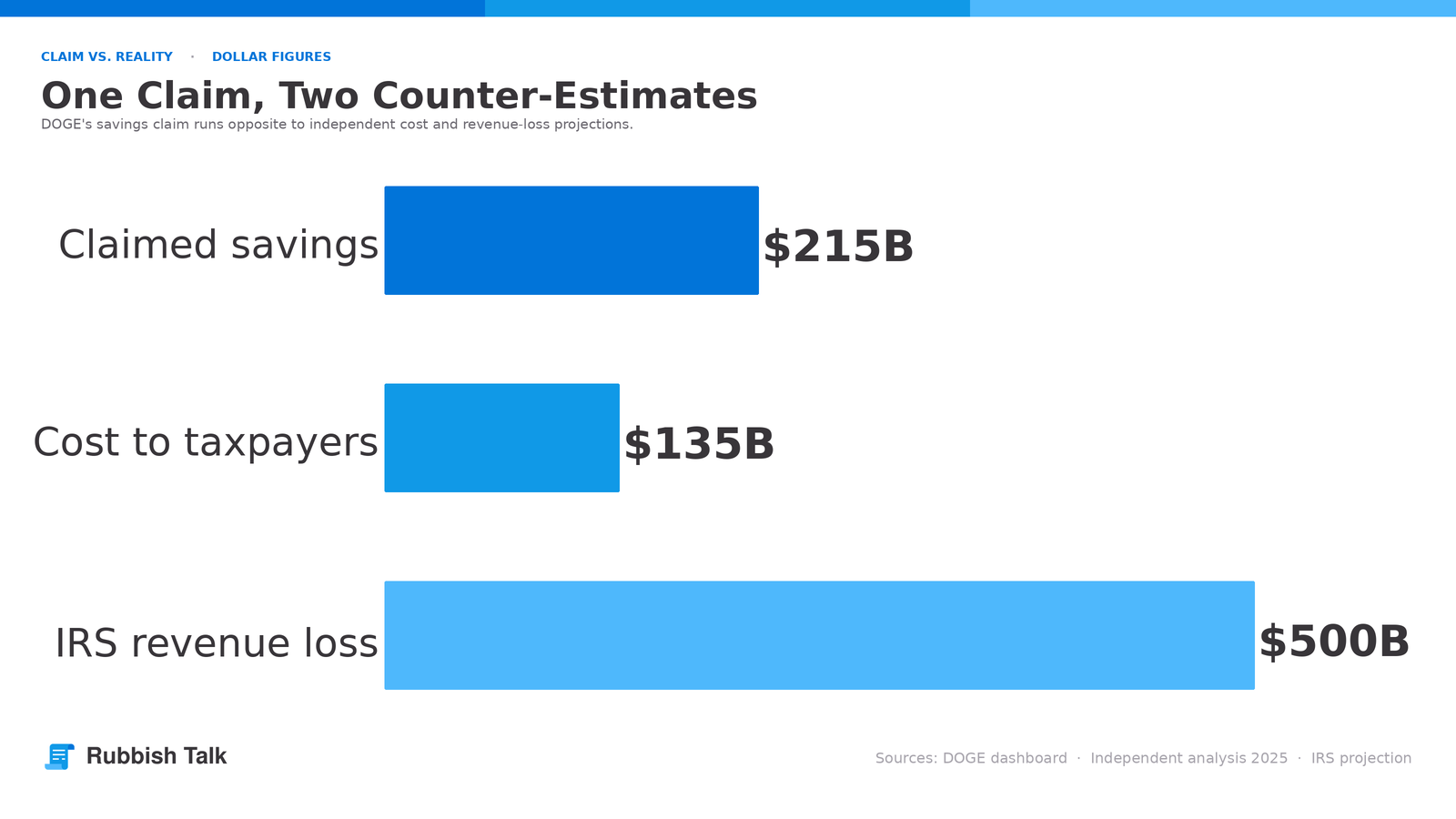
Independent estimates ran the other direction entirely. One analysis projected that DOGE’s cuts would cost taxpayers about $135 billion once lost productivity, rehiring, and litigation were counted. The Internal Revenue Service projected more than $500 billion in lost revenue tied to DOGE-driven cuts to tax enforcement. Federal spending itself did not fall. It rose by roughly $248 billion year over year by late 2025.
The one result that held up
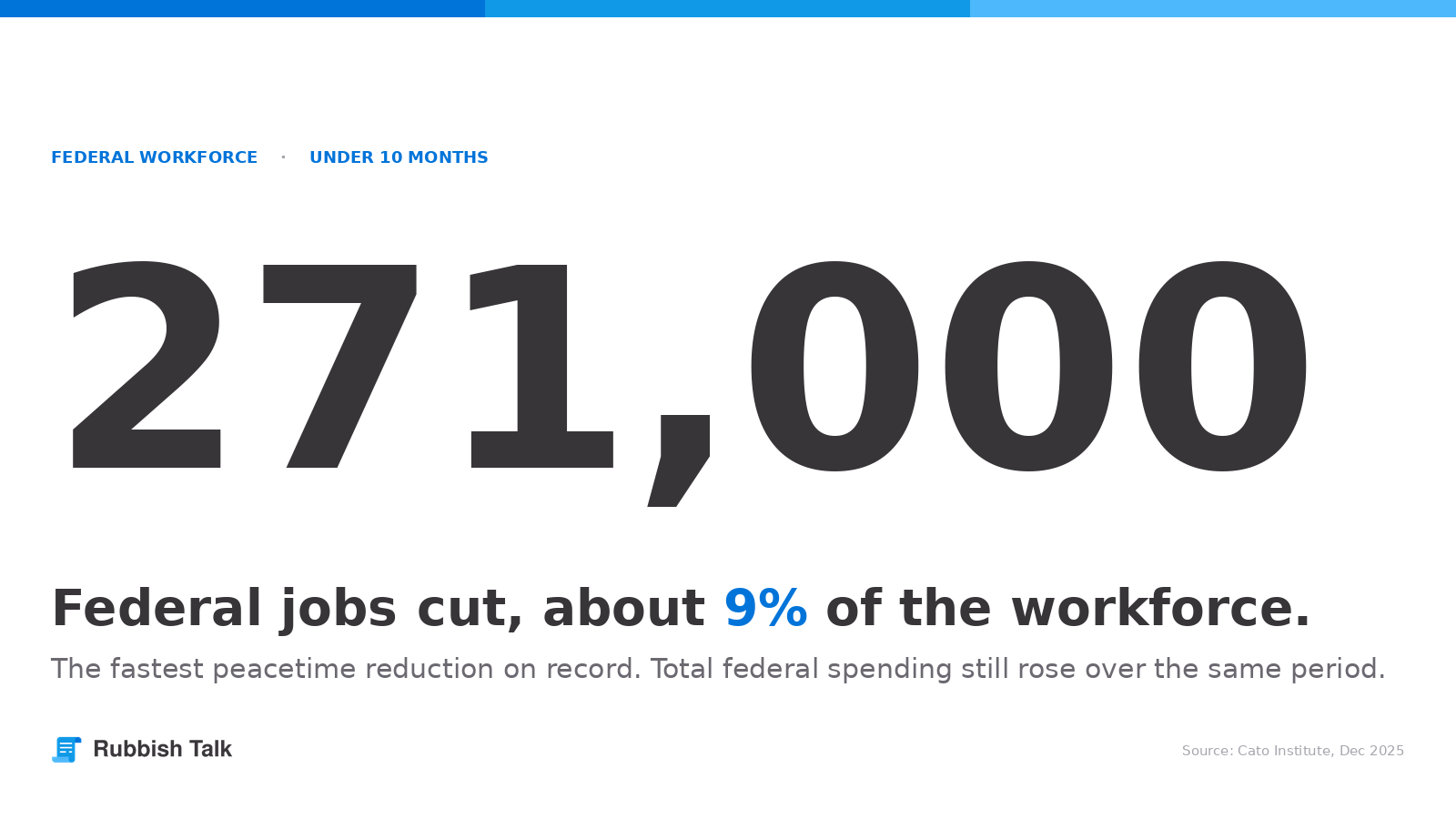
There is a real accomplishment, and it is not the one on the dashboard. DOGE presided over the fastest reduction of the federal workforce in peacetime history. The Cato Institute put the figure at a 9 percent cut, about 271,000 jobs, in under ten months, the sharpest pace since the Carter administration and likely earlier.
The tallies vary by source and date because the cuts came through layoffs, buyouts, and attrition at once. By May 2025 the New York Times counted more than 58,500 confirmed cuts, over 76,000 buyouts, and more than 149,000 additional planned reductions, together about 12 percent of the 2.4 million civilian federal workforce. By late August 2025, the nonpartisan Partnership for Public Service said just under 200,000 workers had already left. The workforce genuinely shrank. The budget did not follow, because payroll was never where the trillions lived. That disconnect is the central lesson of the whole exercise.
Who supported it, and who did not
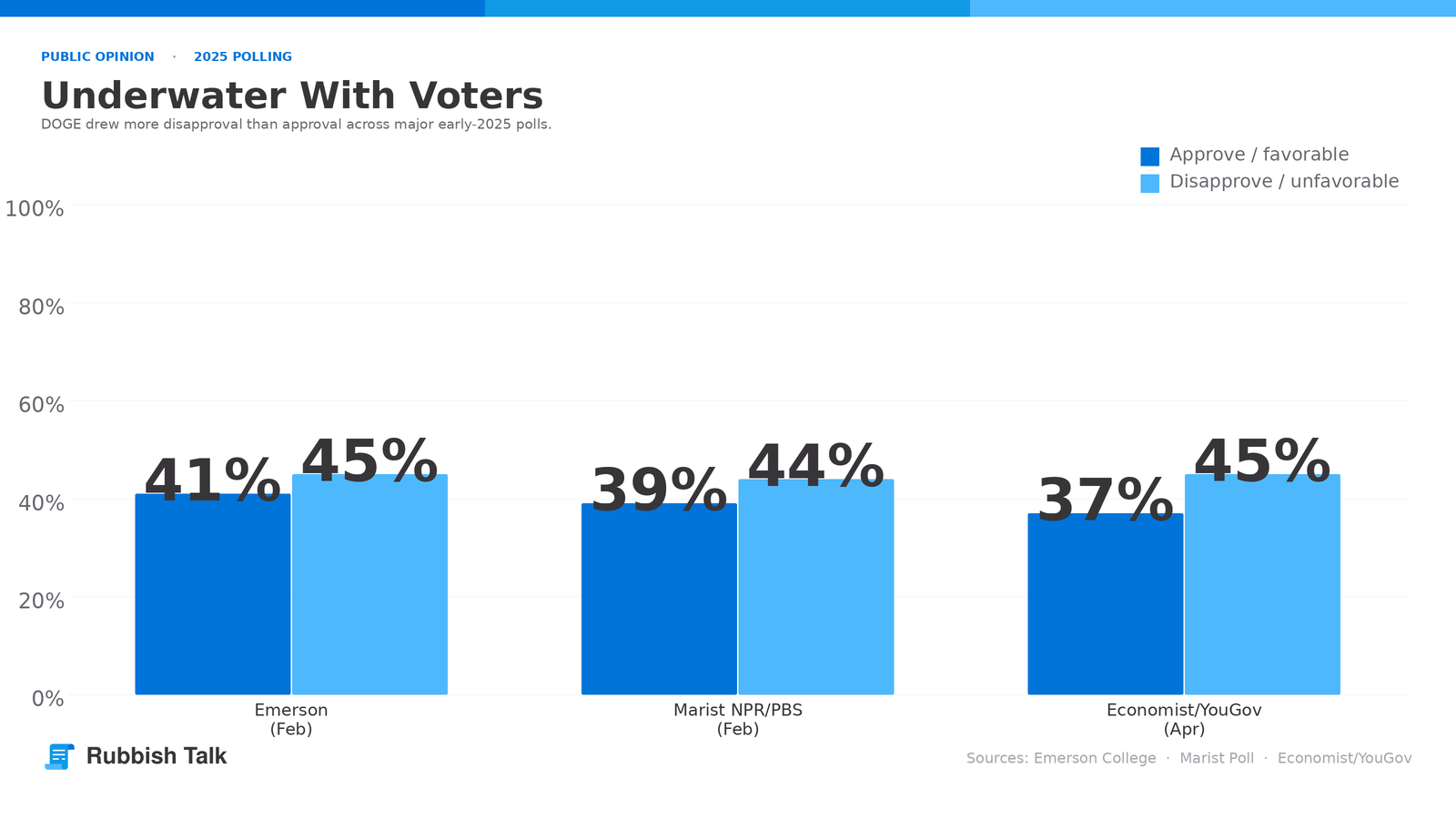
Public opinion on DOGE was mixed at best and split sharply along party lines. An Emerson College poll in mid-February 2025 found 41 percent approved of Musk’s work at DOGE and 45 percent disapproved. A Marist poll for NPR and PBS in late February found 39 percent favorable to 44 percent unfavorable. By late April, DOGE’s net favorability sat around negative 8, roughly 37 percent approve against 45 percent disapprove. Musk’s personal numbers were worse, with about 36 percent favorable and 52 percent unfavorable.
The partisan gap was extreme. Surveys typically found 70 to 85 percent of Republicans viewing DOGE favorably and under 20 percent of Democrats doing the same. A poll Musk himself posted on X in March 2025 showed 81 percent support, but online polls of a leader’s own followers are not representative and tell you little. The more useful finding came from AP-NORC: support for DOGE was divided, yet a majority of Americans still believed corruption, inefficiency, and government red tape were real and serious problems. The public wanted the problem solved. It was not convinced DOGE was solving it.
Why it ended the way it did
DOGE’s decline began before its official expiration. Musk left his role in late May 2025 after legal setbacks and clashes with the cabinet, then publicly attacked Trump’s signature spending bill. On June 3 he called it “a disgusting abomination,” and a running feud between the two men played out across X and Truth Social through the summer. The most powerful alliance behind the project collapsed, though the cost-cutting idea outlived the partnership.
“We have no plans to do kind of a closing DOGE report.”
– Russell Vought, Director of the Office of Management and Budget, at a House appropriations hearing, June 30, 2026
That admission, days before the charter expired, is the fitting epitaph. When the July 4, 2026 deadline arrived, DOGE dissolved on schedule with no final accounting. Some outlets reported its website going dark; others found the dashboard still live, still listing $215 billion. Critics had long argued the effort was ideological rather than fiscal. Bill Hoagland, a former Republican staff director of the Senate Budget Committee, put it plainly: the DOGE playbook “has not been for the dollar savings, but more for the philosophical and ideological differences conservatives have with the work these agencies do.” Nine of the fifteen agencies DOGE first targeted had been flagged for elimination or downsizing in the Project 2025 blueprint.
What comes next
DOGE the organization is gone, but the approach is not. The mass workforce reductions are real and will shape federal capacity for years, from tax enforcement to air traffic staffing to Social Security administration. The unresolved question is cost. If independent estimates are right that the cuts lost more revenue than they saved, the fiscal case for DOGE inverts entirely: a program sold as deficit reduction may have widened it. Watch three things: whether agencies quietly rehire for functions they cannot do without, whether any credible audit of the $215 billion claim ever appears, and whether “efficiency” survives as a governing brand now that its numbers have been tested and its founder has walked away.
Sources:
- Department of Government Efficiency – Wikipedia
- Establishing and Implementing the President’s DOGE – The White House
- DOGE self-deletes on July 4th. The grand experiment fell apart long before that. – E&E News by POLITICO
- DOGE website goes dark on July 4 after claiming $215B in federal cuts – Fox Business
- As DOGE formally sunsets, its public record is still evolving – Nextgov/FCW
- DOGE Produced the Largest Peacetime Workforce Cut on Record, but Spending Kept Rising – Cato Institute
- DOGE staffer says Musk’s agency was unable to lower the federal deficit – Fortune
- A look at the misleading and incorrect claims on DOGE’s ‘wall of receipts’ – PBS News
- DOGE team’s ‘wall of receipts’ shows errors in tallying billions in savings – CBS News
- Although support for DOGE is mixed, a majority believe corruption, inefficiency, and red tape are major problems – AP-NORC
- Is Elon Musk’s DOGE ‘very popular’? That’s not what the polls say – PolitiFact
- Musk and DOGE underwater with some voters in recent polling – Axios
- What has DOGE done in Trump’s first 100 days? – NPR
- Federal agencies are rehiring workers and spending more after DOGE’s push to cut – NPR
- Trump-Musk feud – Wikipedia
- Department of Government Efficiency (DOGE) – Britannica