
Archer Aviation reports Q1 2026 results on Monday, May 11. Wall Street expects a loss of roughly $0.25 per share on $1.66 million in revenue — a number small enough to be a rounding error against the company’s $4.4 billion market cap. The mainstream story focuses on FAA milestones and a $6 billion order backlog. The harder questions — how much shareholder value has been destroyed by the dilution funding that backlog, and whether Archer or Joby actually crosses the commercial finish line first — are getting less attention than they deserve.
What is Actually Happening
Archer Aviation will release its first-quarter 2026 operating update and financial results after the market closes on Monday, May 11, 2026, with a webcast at 2:00 p.m. Pacific Time. The consensus analyst expectation is a loss of $0.25 per share on revenue of just $1.66 million. ACHR closed at $5.84 on May 5, putting the stock down roughly 33% over the past twelve months and within striking distance of its 52-week low of $4.80.
Management has already pre-announced the rough shape of the quarter. In its Q4 2025 release, Archer guided to an adjusted EBITDA loss of $160 million to $180 million for Q1 2026, citing stepped-up investment to support certification, manufacturing scale, and the planned UAE and U.S. pilot programs. That is roughly a half-billion-dollar annualised burn rate against a company that, by its own admission, is still pre-revenue.
The numbers that will actually matter on the call are not the headline EPS miss or beat. They are the cash position, the run-rate of share issuance, and any concrete update on a Type Inspection Authorization (TIA) date — the FAA milestone that has to clear before paying passengers can board a Midnight aircraft on U.S. soil.
What the Mainstream Narrative Says
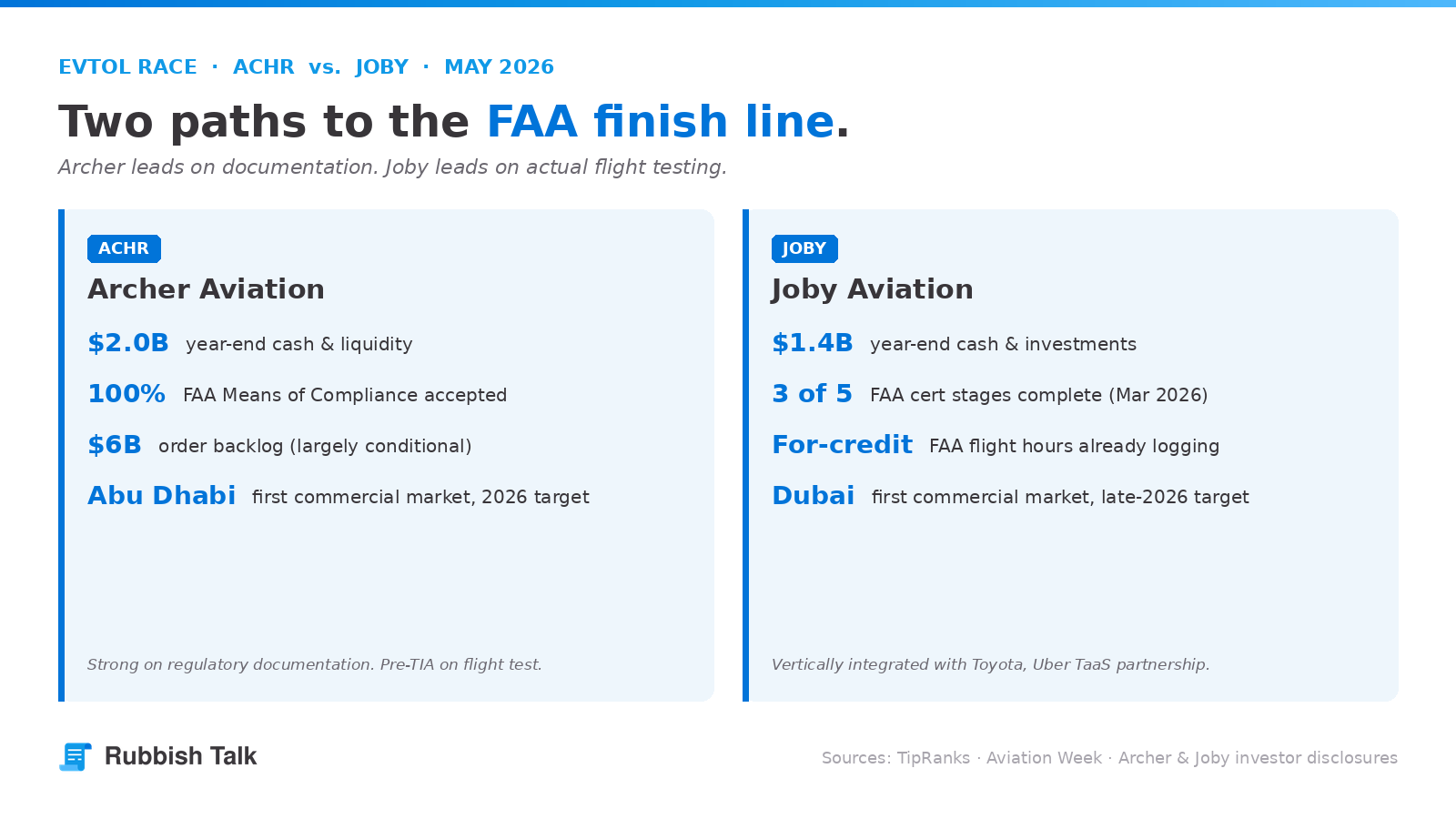
Coverage of Archer typically leads with three points: the company’s $2.0 billion year-end 2025 liquidity (the highest in its history), its $6 billion order backlog, and its status as the first eVTOL maker to win 100% FAA acceptance of its Means of Compliance — the document set defining how Midnight will be certified.
Layered on top is a steady drumbeat of partnership announcements. United Airlines has committed to up to 200 Midnight aircraft, with options for another 100, in a deal valued at as much as $1.5 billion. The U.S. Air Force has a $142 million contract for up to six aircraft. Archer has paired with Anduril on hybrid military variants. In Abu Dhabi, the company has stitched together a consortium with Abu Dhabi Aviation, Etihad Aviation Training, Falcon Aviation, JetEx, and Air Chateau to run the “Launch Edition” pilot programme. A flight test campaign at Al Ain Airport, completed earlier this year, demonstrated Midnight’s full flight envelope in desert conditions.
“We continue to make significant progress towards our goal of launching commercial Midnight operations later this year.” — Adam Goldstein, Founder and CEO, Archer Aviation, on the Q4 2025 earnings call
Read together, the picture analysts paint is of a company on the cusp of revenue generation, well-funded, with a clear path to certification in two jurisdictions.
What the Data Actually Shows
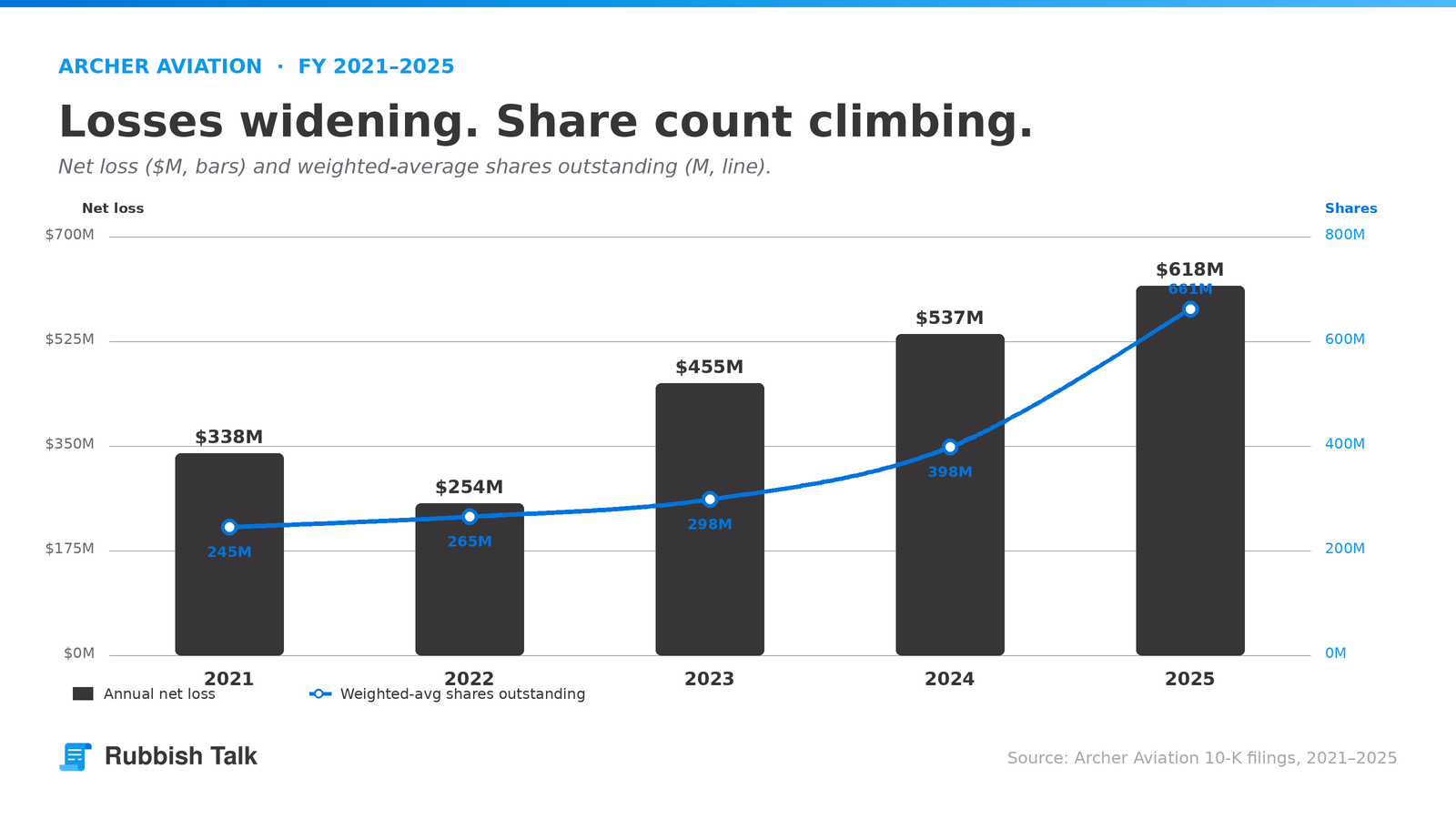
The data tells a more complicated story. Archer posted a 2025 net loss of $618.2 million, up from $536.8 million in 2024 — a 15% deterioration year-over-year despite no commercial operations to support. Free cash flow burn is running close to $500 million annually. The $2 billion cash buffer that headlines the bull case is, on current burn, somewhere between three and four years of runway — assuming costs do not escalate as the company moves from prototype work to series production and pilot operations.
The order backlog deserves scrutiny too. A $6 billion figure sounds decisive, but a meaningful portion is conditional. The United Airlines agreement, for example, is structured as a conditional purchase agreement — deliveries depend on Archer hitting certification and production milestones that have not yet been cleared. Backlogs in pre-revenue aerospace ventures are option contracts as much as firm commitments, and they tend to thin out as commercial reality intrudes.
The FAA milestone is real and worth crediting, but it is also widely misread. Hitting 100% Means of Compliance acceptance is necessary but not sufficient — it defines how Archer will prove airworthiness, not that it has done so. The Type Inspection Authorization, the gate that opens for-credit flight testing with FAA pilots aboard, is targeted no earlier than 2026 and remains the harder hurdle. Until TIA is in hand, the certification timeline is a forecast, not a schedule.
The Dilution Problem Nobody is Putting in the Headline
The most overlooked element of the Archer story is the rate at which the cap table is expanding. Weighted-average shares outstanding rose 66% year-over-year in Q3 2025, from 398 million to 661 million. Total outstanding shares are up roughly 171% since the company went public via SPAC in 2021. Last June’s $850 million offering issued 85 million new shares at $10. A subsequent $650 million raise in late 2025 funded the Hawthorne Airport acquisition and further Georgia plant expansion. Each round was rationally defensible in isolation. Cumulatively, they have sharply lowered the per-share claim that early investors hold on whatever Archer eventually becomes.
“We are committed to maintaining a strong balance sheet to support our path to commercialisation, and we will continue to raise capital opportunistically as needed.” — Mark Mesler, CFO, Archer Aviation, in Q4 2025 commentary
There is nothing dishonest about that approach, but it has a mathematical consequence: even if Archer succeeds operationally — even if Midnight enters service on schedule and the order book converts — the per-share economics will only matter if the equity base stops expanding faster than the underlying business. On current trajectory, additional raises are likely before commercial revenue ramps. Anyone modelling 2028 earnings power on today’s share count is almost certainly wrong.
Where Archer Sits Relative to Joby
The race that matters is the one to fly the first paying passenger. Here, the evidence pointing to Archer being ahead is thinner than its narrative suggests. Joby has completed three of the five FAA certification stages as of March 2026 and is already flying its FAA-conforming production aircraft (registration N547JX), logging for-credit flight hours with FAA pilots on board. That is a stage of certification work Archer has not yet reached. Archer leads on Means of Compliance acceptance; Joby leads on actual flight testing under FAA supervision — and the latter is closer to the finish line.
On the commercial side, both companies are targeting the UAE for first revenue. Joby is aiming at Dubai by late 2026; Archer is aiming at Abu Dhabi on a similar timeframe. Either could slip. Joby ended 2025 with roughly $1.4 billion in cash, less than Archer, but with a more vertically integrated model — manufacturing partnership with Toyota, an exclusive transport-as-a-service deal with Uber, and tighter control over its ride-hailing economics. Archer’s OEM-plus-fleet-operator model spreads risk across more partners but also depends on a wider cast of counterparties executing in tandem.
The honest read is that this remains a two-horse race with both horses still on the track, and whichever crosses first will likely set the cost of capital for the other for the rest of the decade.
Who Benefits, Who is Exposed
The clearest beneficiaries of an Archer success scenario are the strategic partners who locked in early: United Airlines (which gets fleet access at SPAC-era pricing), Stellantis (Archer’s manufacturing partner), and the UAE government bodies positioning Abu Dhabi as the world’s first commercial eVTOL hub. A successful launch would also vindicate the broader urban air mobility thesis and pull capital into the sector.
The most exposed are retail equity holders who bought above $10. With the share count climbing and the stock at $5.84, the gap between the average analyst price target ($14.25) and current pricing reflects a wide cone of outcomes — not a high-conviction call. Bond and convertible holders are better protected, but only modestly. And a competing breakthrough by Joby on FAA certification could compress Archer’s valuation regardless of how its UAE pilot performs.
What to Watch on May 11
Five things will matter more than the EPS print itself.
First, cash and liquidity at quarter-end, and the cash burn run rate. If burn accelerated meaningfully against the $160-180 million adjusted EBITDA guide, the next capital raise moves closer.
Second, any specific update on TIA timing. Vague language (“on track for 2026”) would suggest slippage; a concrete quarter would be a genuine catalyst.
Third, the UAE timetable — particularly whether Archer is sticking to its target of first commercial passenger flights this year or quietly pushing it into 2027.
Fourth, conversion of backlog into deposits or firm orders. A backlog that converts is real; one that simply renews is not.
Fifth, share count guidance and any signal about further offerings. Management rarely pre-announces dilution, but the absence of reassurance on this point would itself be informative.
The Archer story is not unsalvageable — the technology works, the regulatory path is open, and the addressable market for short-range electric aviation is real. But the gap between the bull case as it appears in headlines and the unit economics as they appear in the 10-K is wider than mainstream coverage typically acknowledges. May 11 is an opportunity for management to close that gap with specifics. If they cannot, the burden of proof shifts further toward the next quarterly report — and the cash clock keeps ticking.
Sources:
- Archer To Report First Quarter 2026 Operating Update and Financial Results on May 11, 2026 — BusinessWire
- ACHR Earnings Preview: Archer’s 2026 Launch Timeline Faces a Key Test — TipRanks
- Archer Q1 2026 results set for May 11 webcast — StockTitan
- ACHR Stock Up 1.2% on May 5, 2026 Ahead of Q1 Earnings — Meyka
- Archer Announces Fourth Quarter and Full Year 2025 Results — Archer Investor Relations
- Archer Aviation posts record cash but rising losses in 2025 — Zag Daily
- Archer Aviation: Navigating Dilution to Build Long-Term Value — AInvest
- Joby (JOBY) vs. Archer (ACHR): Which eVTOL Stock Is Winning the Race Right Now? — TipRanks
- Archer, Joby Advance UAE Commercial Launches In 2026 — Aviation Week
- Archer to fly eVTOL passengers in 2026 as UAE becomes second home — Aerospace Global News
- Archer Aviation doubles down on defense aircraft with $300M raise — TechCrunch