
The US economy entered May 2026 with an uncomfortable split at its core. Corporate earnings are at record margins, the S&P 500 has clawed back to 7,365 after a volatile start to the year, and Q1 GDP printed at 2.0% annualised — a solid rebound. But beneath those headlines, household debt has hit $18.8 trillion, consumer delinquencies are at their highest since 2017, confidence has collapsed, and the Federal Reserve sits paralysed between stubborn inflation and mounting recession risk. The official story is resilience. The data tells a more complicated tale.
What is Actually Happening
The headline GDP number for Q1 2026 — 2.0% annualised growth — looks reassuring after the 0.5% crawl of Q4 2025. But the composition matters. Private payroll growth surged in Q1, more than doubling the monthly average seen through 2025, yet the unemployment rate still drifted to 4.6% according to Congressional Budget Office projections, suggesting the labour market is absorbing workers without the tightness of the prior cycle.
Inflation refuses to behave. Core PCE — the Fed’s preferred gauge — sits at 3.2% year-on-year. Headline PCE hit 3.5% in March, driven by an energy price shock that saw oil surge more than 76% between late February and early April following the escalation of the war in Iran. The Fed’s 2% target is not approaching; it is receding.
What the Mainstream Narrative Says
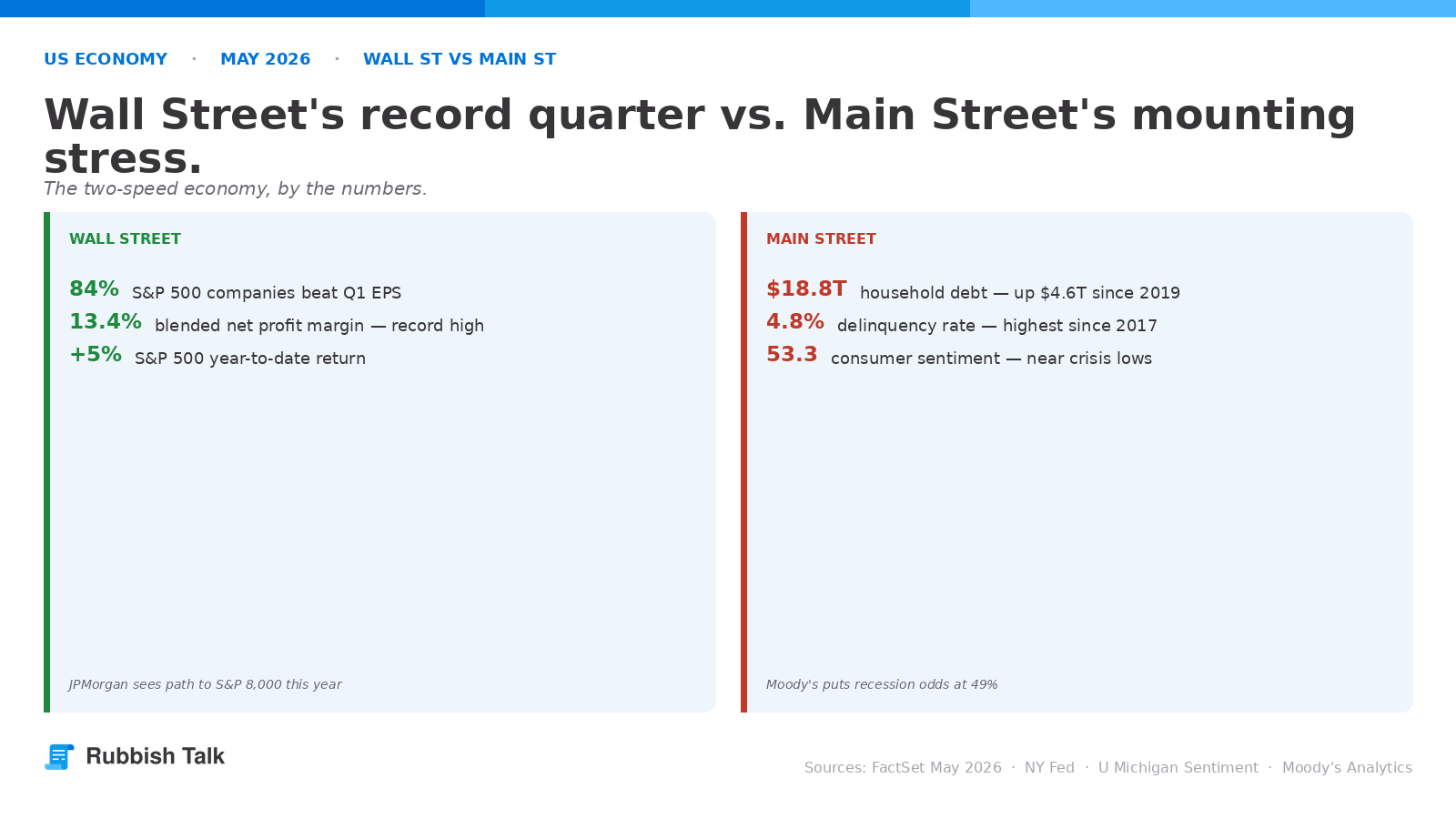
The dominant market narrative through early May is cautious optimism. Q1 2026 earnings season has delivered the strongest results since FactSet began tracking the data in 2009: 84% of S&P 500 companies beat EPS estimates, and the blended net profit margin for the index hit 13.4% — a record. The S&P 500 is up roughly 5% year-to-date after recovering from deep negative territory in March, and JPMorgan has upgraded its outlook, putting 8,000 as a plausible year-end target.
The IMF projects full-year 2026 GDP growth of 2.4%, Deloitte sees 2.2%, and the labour market’s Q1 strength has been cited across mainstream outlets as evidence that the economy remains fundamentally sound. Federal officials have been careful to emphasise the word “resilience.”
What the Data Shows Underneath
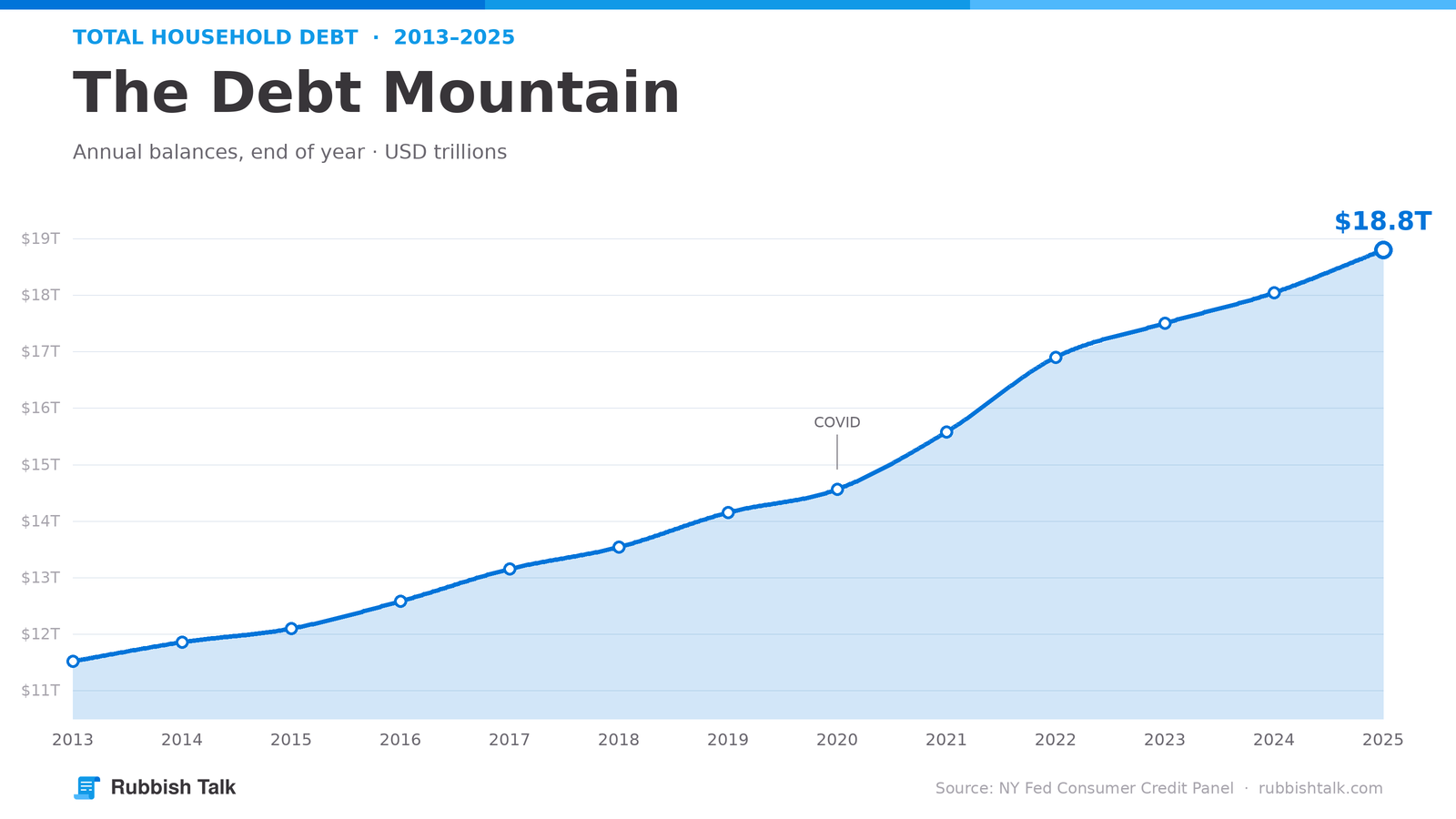
Corporate margins and household balance sheets are moving in opposite directions. Total US household debt reached $18.8 trillion at end-2025 — up $4.6 trillion since the end of 2019. Credit card balances stand at $1.28 trillion, the highest on record since the New York Fed began tracking the data, with the average interest rate on revolving balances at 22.3%. Consumer delinquencies across all debt categories hit 4.8% of outstanding balances in Q4 2025, the highest since 2017, driven disproportionately by lower-income and younger borrowers.
Consumer sentiment tells a similar story. The University of Michigan index fell to 53.3 in March 2026, down sharply from 61.7 in July 2025. Retail sales have held up, but analysts note the composition: households appear to be spending out of necessity rather than confidence — sustaining consumption with borrowed money at punishing interest rates.
“The data are definitive. The tariffs have done significant damage to the economy.”— Mark Zandi, Chief Economist, Moody’s Analytics (May 2026)
Historical Context: The Stagflation Parallels
The combination now facing the US — slowing growth, elevated inflation, and a central bank unable to cut — has a name that policymakers prefer not to use: stagflation. The last sustained experience of this was the 1970s, when supply shocks (then oil embargoes, now an active war in the Middle East plus tariff-driven import cost increases) intersected with monetary policy that had already lost credibility.
The Trump tariffs represent, in the words of the Tax Foundation, “the largest US tax increase as a percent of GDP since 1993.” The effective burden translates to an average increase of $1,500 per US household in 2026. The cumulative drag on GDP has been estimated at 1.1 percentage points over 2025–29, with 2026 alone absorbing a 0.9-point hit. These are not rounding errors; they are structural headwinds with no obvious near-term reversal.
A significant legal development in February complicated the picture further. The Supreme Court ruled 6-3 that the International Emergency Economic Powers Act (IEEPA) does not authorise tariffs. The administration pivoted to Section 232 and other statutes, stabilising the effective tariff rate at roughly 12% — but the legal uncertainty injected another layer of business investment paralysis into an already cautious environment.
Who Is Exposed
The stress is not evenly distributed. Low-income and younger households — those with higher debt burdens relative to income and less liquid savings — are the epicentre of the delinquency surge. Import-dependent businesses, particularly in retail and consumer goods, are caught between tariff-inflated input costs and consumers who are already pulling back on discretionary spending.
“The tariffs are the largest US tax increase as a percent of GDP since 1993, and amount to an average tax increase per US household of $1,500 in 2026.”— Tax Foundation (April 2026)
The sectors showing resilience are those insulated from tariff exposure and consumer cyclicality — technology, defence, energy, and financial services. That concentration is exactly what is driving the record S&P 500 margins: a handful of sectors carrying an index whose less-favoured components are quietly struggling. The headline number flatters the reality underneath it.
What Is Being Overlooked
The Iran war’s role in the current economic picture is being underweighted in the mainstream conversation. The 76% oil price surge since late February has directly reignited inflation at a moment when the Fed was hoping to declare gradual victory. It has also upended the rate-cut narrative: interest rate markets now price in no cuts for the remainder of 2026, with the federal funds rate sitting at 3.5%–3.75% after three consecutive holds. The Fed is in a position it explicitly did not want — unable to ease into a growth slowdown because inflation is still accelerating.
Beneath the record S&P earnings headline is another detail worth scrutinising. The 13.4% blended net margin figure is an aggregate. Strip out the mega-cap technology companies, and the picture across the broader index is materially weaker. A bull market driven by margin concentration in a handful of companies is not the same as a healthy broad economy — but it reads the same way in the headlines.
What Comes Next
The risks ahead are concrete. Recession probability estimates range from 30% (Goldman Sachs) to 49% (Moody’s Analytics), with J.P. Morgan analysts saying a contraction in real activity “is more likely than not.” The tax drag from tariffs will continue compounding through 2026 whether or not policy shifts. The Fed’s next move — whenever inflation relents enough to permit it — will be reactive rather than pre-emptive.
“The prospect of a recession is a closer call, though we still think a contraction in real activity later this year is more likely than not.”— J.P. Morgan Global Research (2026)
The things to watch in the coming months: June CPI and PCE prints for signs of energy-driven inflation persistence; the next FOMC meeting for any signal of a policy shift; and consumer credit data for Q1 2026, which will confirm whether the delinquency trend is accelerating. If oil prices stabilise and the Iran situation de-escalates, the recession risk retreats materially. If they don’t, the Fed’s paralysis turns from uncomfortable to dangerous.
The S&P at 7,365 and household delinquencies at a nine-year high can both be true at the same time. Right now, they are.
Sources:
- BEA — Bureau of Economic Analysis
- Federal Reserve — FOMC Statement, April 29, 2026
- Household Debt Balances Grow Modestly; Early Delinquencies Level Out — NY Fed Consumer Credit Panel
- A year on from Liberation Day, Trump’s tariffs have done ‘significant damage’ to the U.S. economy — Fortune / Moody’s
- Tariff Tracker: 2026 Trump Tariffs & Trade War by the Numbers — Tax Foundation
- S&P 500 Earnings Season Update: May 8, 2026 — FactSet
- US Tariffs: What’s the Impact? — J.P. Morgan Global Research
- US Consumer Delinquencies Jump to Highest in Almost a Decade — Bloomberg
- Shot of two American or USA flags on a high rise building — magnific.com – Designed by Magnific