
Western economies are structurally dependent on BRICS nations and the broader Global South for critical minerals, manufactured goods, agricultural commodities, labour, and technology components. The dependency was built deliberately, over decades, in pursuit of lower costs. Reversing it will take far longer than political rhetoric suggests — and the costs of the reversal may be higher than those of the dependency itself.
What Is Actually Happening
The West is waking up to a dependency it spent decades building. From the cobalt in its EV batteries to the code running its back offices, from the grain feeding its cities to the rare earth magnets in its fighter jets — the developed world’s economy runs, to a degree it rarely admits publicly, on the labour, resources, and manufacturing capacity of countries it now calls geopolitical rivals.
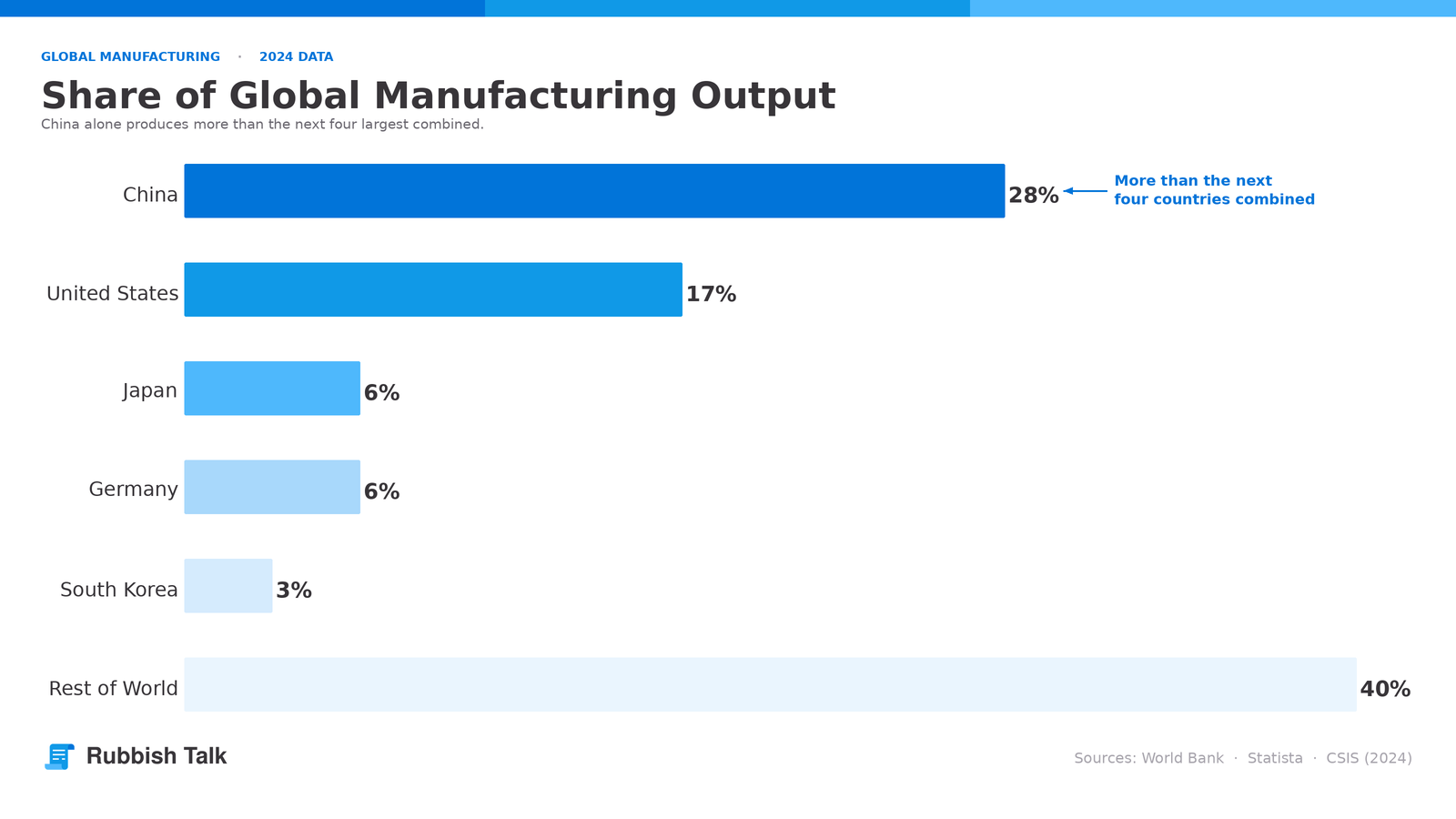
China accounts for roughly 28% of global manufacturing output — more than the United States, Germany, Japan, and South Korea combined. It mines over 60% of the world’s rare earth elements and controls more than 90% of the downstream processing and refining capacity that turns those raw materials into usable industrial inputs. It produces around 90% of the world’s high-performance rare earth magnets — components that sit inside F-35 jet actuators, EV drivetrains, wind turbines, and Virginia-class submarines.
The Democratic Republic of Congo supplies over 70% of the world’s cobalt. India provides 40% of all over-the-counter and generic prescription drugs consumed in the United States. BRICS nations as a bloc hold 75% of global manganese, 50% of graphite, 28% of nickel, and — with the recent addition of Saudi Arabia, Iran, and the UAE — more than 40% of global crude oil production.
This is not a coincidence. It is the architecture of four decades of globalisation, built on a single premise: that lowest-cost production, wherever it was located, was optimal. That premise is now under pressure.
What the Mainstream Narrative Says
The dominant Western political narrative frames this dependency as a security vulnerability that can be corrected with sufficient willpower and public spending. “Reshoring,” “nearshoring,” and “friend-shoring” have become policy buzzwords from Washington to Brussels. The CHIPS Act, the EU’s Critical Raw Materials Act, and the Inflation Reduction Act are all premised on the idea that the West can rebuild domestic supply chains for strategically critical goods within a political cycle or two.
The narrative is not entirely wrong. Political will matters. Investment in domestic capacity matters. But the timeline assumptions embedded in most policy discussion are, according to analysts and industry experts, wildly optimistic.
What the Data Shows
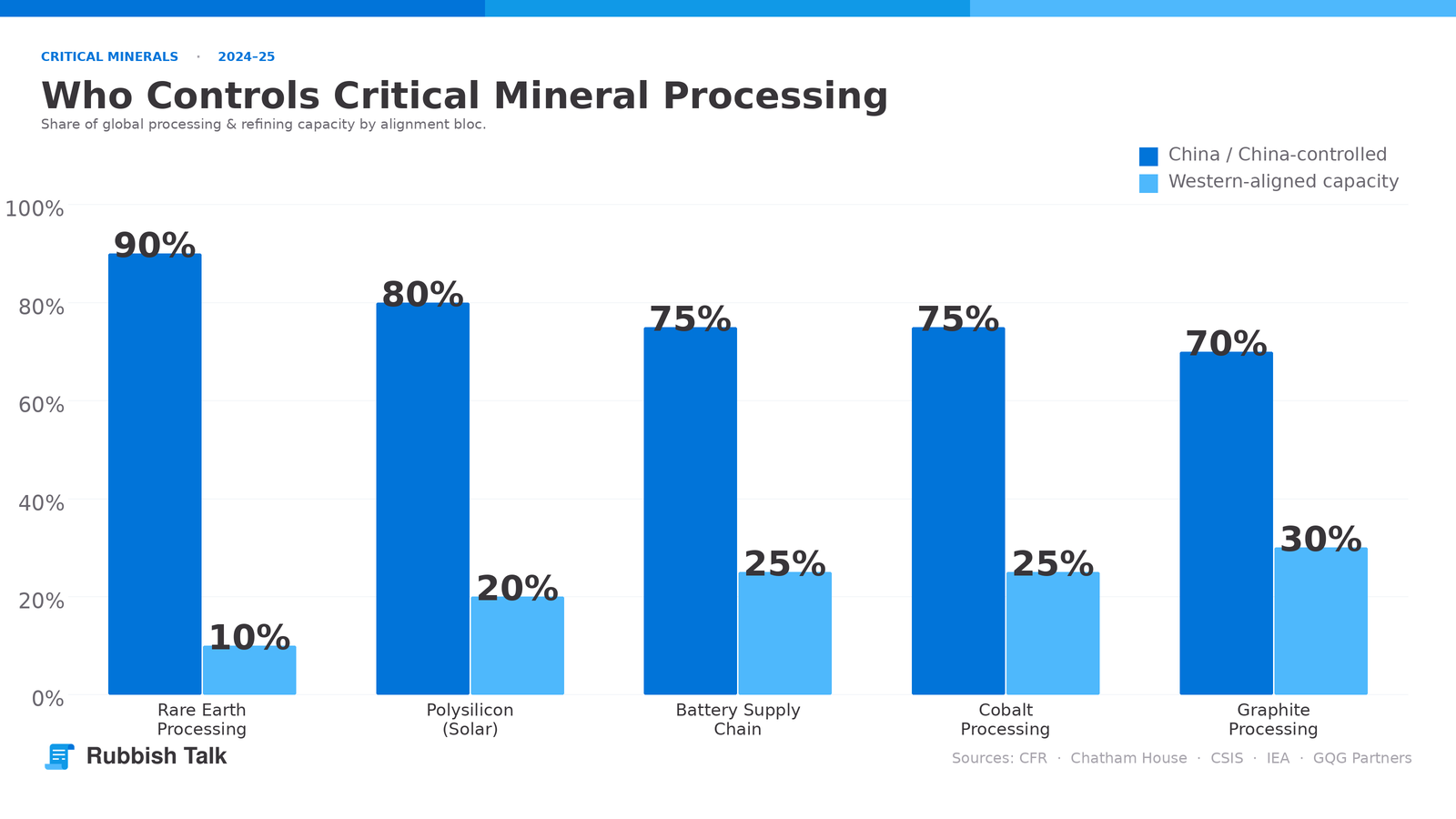
Breaking China’s control over rare earth processing alone — not mining, just refining — is expected to take at least a decade, even with sustained political will and billions in investment, according to analysts cited by Al Jazeera. Western countries hold an estimated 35–40% of global mineral reserves. They account for only 10–15% of refining and processing capacity. That gap cannot be closed with a press release.
In pharmaceuticals, the dependency runs through India, but India itself relies on China for approximately 72% of its bulk drug inputs and intermediates. The supply chain is layered: Western pharma depends on Indian generics producers who depend on Chinese chemistry. Diversifying one link without the other changes little.
In agriculture, BRICS nations account for 42% of global grain production and approximately 40% of global agricultural export value. Russia alone is the world’s largest wheat exporter. The expansion of BRICS has now drawn in major commodity producers — Iran, the UAE, Ethiopia, Egypt — creating a resource bloc with explicit ambitions to price and settle agricultural trade outside Western-dominated exchanges like Chicago and London.
“The West, particularly in Europe and particularly around EVs, is looking to be incorporated into China’s supply chains. For the first time in two centuries, the West is no longer the leader in future technology, but the follower.”
— Phenomenal World, analysis of BRICS in 2025
The semiconductor picture is more nuanced. Here, the West retains real leverage: U.S. and allied firms control roughly 90% of global semiconductor manufacturing equipment and approximately 92% of overall supply chain value. China remains dependent on Western chip design tools and lithography equipment. Washington has exploited this with escalating export controls since 2022. But the leverage is not permanent — China is investing $200 billion in domestic chip capacity, and its researchers are making meaningful progress.
Historical Context
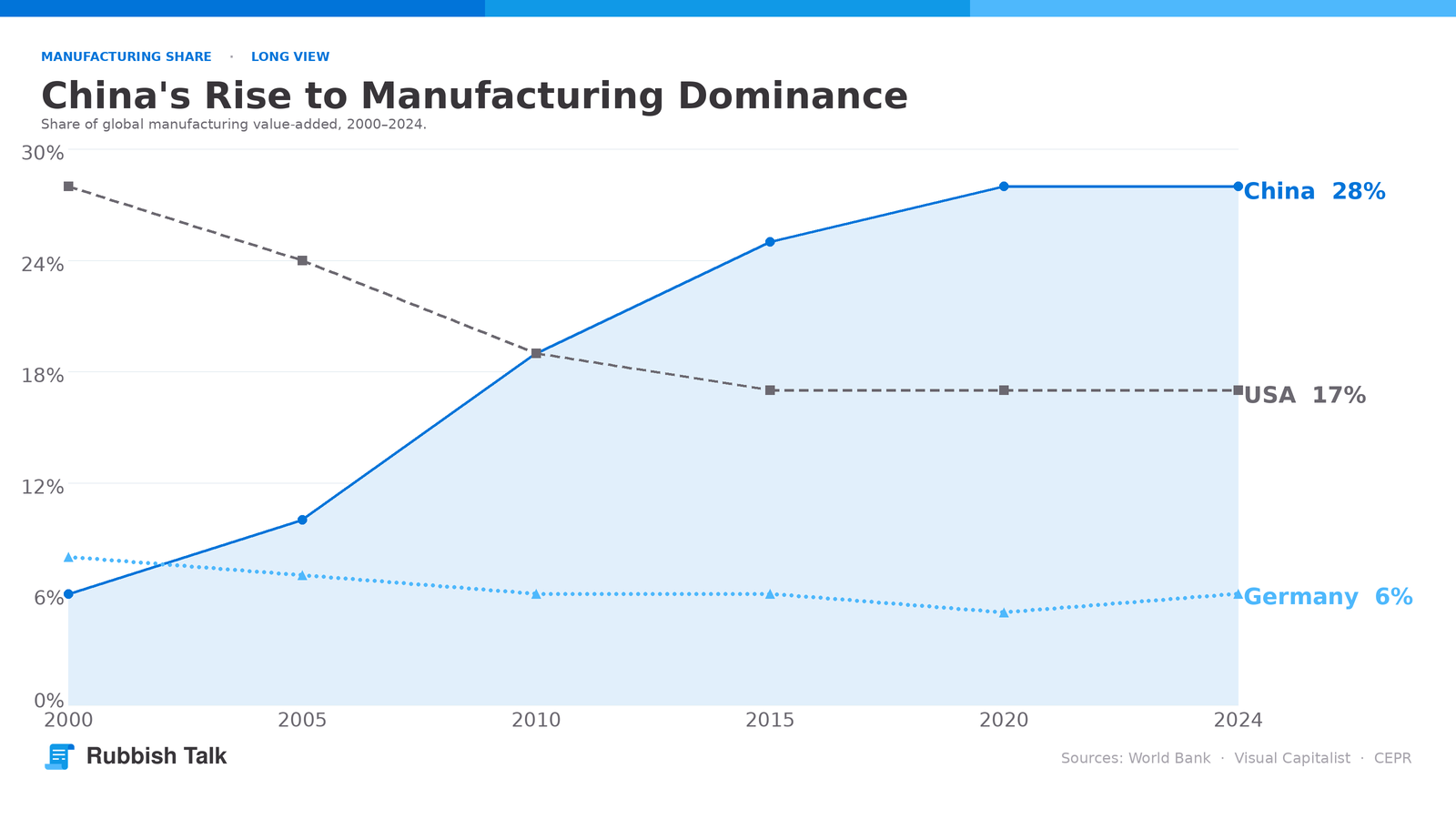
The dependency was not forced on the West. It was chosen. From the 1980s onward, Western corporations systematically moved manufacturing to lower-cost jurisdictions — first to Mexico and Southeast Asia, then overwhelmingly to China — because shareholders demanded margin expansion and consumer markets demanded cheap goods. Governments enabled this with trade liberalisation agreements that reduced tariff barriers and created the legal infrastructure for global supply chains.
The assumption was that political openness would follow economic integration — that China, as it grew wealthier, would become more like the West. That assumption proved incorrect. What it actually produced was a China that was simultaneously economically integrated with the West and politically determined to reshape the international order on different terms.
The strategic error was identified by analysts as early as the mid-2000s. It was not corrected, because the benefits were immediate and broadly distributed — cheaper goods, higher margins — while the costs were diffuse and long-dated. The bill is now arriving.
Who Benefits, Who Is Exposed
The exposure is not uniform across the West. The European Union is more exposed than the United States in several respects — more dependent on Russian energy (pre-2022), more reliant on Chinese inputs for its automotive and industrial sectors, and with less domestic capacity in critical minerals processing. The EU imports 98% of its rare earth requirements, with China as the dominant source.
“Critical minerals moved to the centre of geopolitics in 2025, with China’s near-total control over many critical minerals and willingness to weaponize that dominance putting the world on notice.”
— Rare Earth Exchanges, 2025
Within the United States, the exposed sectors include defence (rare earth magnets for weapons systems), clean energy (cobalt and lithium for batteries, polysilicon for solar panels — China controls 80% of global polysilicon production), and healthcare (generic drug supply chains running through India and China).
The beneficiaries of the status quo include Western consumers, who have enjoyed a multi-decade subsidy in the form of goods priced below their true geopolitical cost, and Western corporations, whose margins were structurally enhanced by access to cheap labour and raw material inputs. The cost of reversing the dependency will be borne by those same consumers and corporations — through higher prices, capital expenditure, and supply disruption during any transition period.
What Is Being Overlooked
Most public discourse on Western supply chain dependency focuses on China. The more uncomfortable reality is that the dependency is systemic and multi-nodal. Remove China and you still have a West that depends on the DRC for 70% of its cobalt, on India for 40% of its generic drugs, on Brazil for agricultural exports, on BRICS+ for 40% of its oil, and on a network of low-wage economies from Bangladesh to Vietnam for the labour that produces its clothing, electronics, and consumer goods.
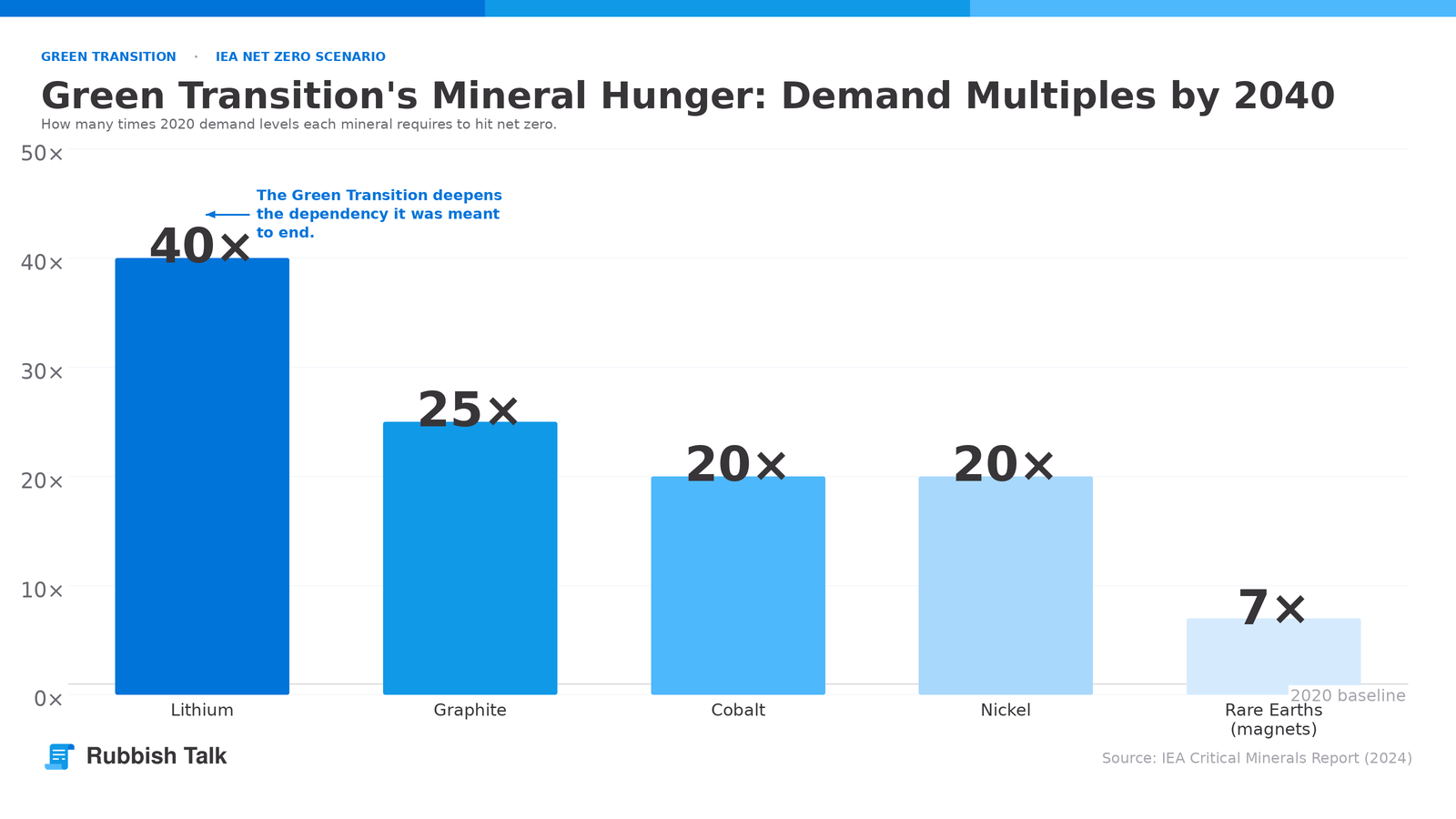
The Green Transition adds urgency and complexity. The IEA projects that manufacturers of clean energy technologies will need 40 times more lithium, 25 times more graphite, and 20 times more nickel and cobalt by 2040 than they used in 2020. The overwhelming majority of those minerals are located in, or processed by, countries in the Global South or China. The West’s clean energy ambitions and its supply chain independence ambitions are in direct tension with each other — a tension that policy frameworks have so far failed to resolve honestly.
“China holds a monopoly on the separation of dysprosium and terbium — critical for manufacturing permanent magnets capable of withstanding high temperatures, which are key components in F-35 jet actuators, Tesla’s humanoid robots, and Virginia-class submarines.”
— GQG Partners analysis, 2024
There is also the labour dimension. Global apparel, electronics assembly, and agricultural supply chains are built on wage differentials that have not narrowed materially. Reshoring these industries to Western wage levels would require either automation at a scale not yet deployed, or consumer prices that political systems in Western democracies are unlikely to accept.
What Comes Next
The window for managed diversification is open, but it is narrowing. China’s export restrictions on seven critical elements, imposed in April 2025 in response to U.S. tariff escalation, demonstrated that Beijing is prepared to use its supply chain position as a geopolitical instrument. The restrictions sent shock waves through defence supply chains and clean energy manufacturing that are still being absorbed.
Three dynamics will define the next decade. First, the pace of Western investment in alternative supply chains — particularly in allied or politically stable mineral-producing countries like Canada, Australia, and parts of Africa — will determine how quickly the concentration risk is reduced. Second, China’s progress in semiconductor self-sufficiency will determine how long the West retains its most significant source of leverage in the relationship. Third, the cohesion of BRICS as an economic bloc will determine whether the Global South can translate resource endowments into genuine pricing power.
What is already clear is that the transition will be measured in decades, not years. A KPMG survey of 250 senior U.S. executives found that while 69% expect their supply chains to be Americas-based within a few years, the infrastructure, workforce, and regulatory environment required to support domestic manufacturing of critical goods does not yet exist at the required scale. Analyst consensus on rare earth supply chain diversification alone points to a minimum of ten years of sustained effort.
The political rhetoric is running considerably ahead of the industrial reality. That gap — between what is being promised and what can actually be delivered — is the single largest risk in the West’s supply chain story.
Sources:
- Critical Dependence on Rare-Earth Minerals — GQG Partners
- Leapfrogging China’s Critical Minerals Dominance — Council on Foreign Relations
- China’s New Restrictions on Rare Earth Exports Send a Stark Warning to the West — Chatham House
- Despite US Push, China Poised to Dominate Rare Earths for Years — Al Jazeera
- The West’s China Dependency Crisis Is No Longer Theoretical — Rare Earth Exchanges
- China Dominates Global Manufacturing — CSIS
- China’s Rise to Manufacturing Dominance Over 30 Years — Visual Capitalist
- BRICS Countries: Their Growing Influence on Global Markets in 2025 — Bookmap
- BRICS: World Heavyweight in Agricultural Trade — Intereconomics
- Six New BRICS: Implications for Energy Trade — CSIS
- BRICS in 2025 — Phenomenal World
- Healing the World: A Roadmap for Making India a Global Pharma Exports Hub — Bain & Company
- Cobalt, Congo, and China: Battery Power as Political Power — The Diplomat
- Green Energy’s Dirty Secret: Its Hunger for African Resources — Foreign Policy
- Africa at the Core of Critical Minerals — B20 South Africa
- The Limits of Chip Export Controls in Meeting the China Challenge — CSIS
- Decoupling Risks: How Semiconductor Export Controls Could Harm US Chipmakers — ITIF
- U.S. Manufacturing Resurgence: Exploring Challenges and Factors Driving Onshoring — Cushman & Wakefield
- From Single-Hub Dependence to Multi-Nation Supply Nets: Lessons From 2025 — Global Trade Magazine
- Why Russia Wants a BRICS Grain Exchange — Asia Society
- Foto: Bb3015 / Lizenz: CC BY-SA 4.0