
The FAA is rolling out SMART — an AI system designed to predict air traffic conflicts hours or even months in advance. With a $32.5 billion price tag and the wreckage of the NextGen program still fresh, the question isn’t whether AI can help run America’s skies. It’s whether the agency tasked with deploying it has learned anything from two decades of failed modernization.
What SMART Actually Is
The Strategic Management of Airspace Routing Trajectories — SMART — is the FAA’s most ambitious attempt yet to apply artificial intelligence to the management of US airspace. At its core, the system is built around a deceptively simple ambition: extend the window in which air traffic controllers can predict and prevent conflicts from the current 15-minute ceiling to a full two hours, and eventually, for planning purposes, months ahead.
Today, controllers work within narrow time horizons. By the time a weather system, scheduling conflict, or equipment failure registers as a problem, options for rerouting aircraft are already limited. SMART is designed to break that constraint. Using high-fidelity four-dimensional trajectory modelling — tracking every aircraft in three-dimensional space, moving through time — the system would ingest data on weather forecasts, flight schedules, equipment status, and historical traffic patterns, then surface predicted bottlenecks before they materialise on radar screens.
The system would manage approximately 55,000 daily IFR (Instrument Flight Rules) flights across the national airspace. The stated goal is not to replace human controllers but to reduce the cognitive load of routine monitoring, freeing them to focus on what the FAA calls “exceptions” — the anomalies that genuinely require human judgment.

Transportation Secretary Sean Duffy confirmed on April 17, 2026, that three vendors had been selected to build competing prototypes: Palantir Technologies, Thales Group, and Air Space Intelligence — a Silicon Valley startup. All three are under contract to deliver operational prototypes by late 2026.
The Crisis That Made SMART Urgent
SMART did not emerge from a position of strength. It is, in significant part, a response to an operational crisis that has been building for years. The FAA is currently running roughly 3,000 controller positions below its own safety targets — the worst staffing deficit in more than two decades. At New York TRACON, which sequences arrivals and departures for JFK, LaGuardia, and Newark, some shifts have operated at just 54 percent of target staffing levels.
The physical infrastructure is in similar shape. The average age of FAA control towers is 40 years. Most radar systems are also approaching that threshold. Government audits released since 2024 describe a significant proportion of the systems underpinning national airspace as “unsustainable,” citing aging hardware, patchwork upgrades, and legacy software that complicates daily operations. A radio and radar outage affecting Newark arrivals in April 2025 exposed this fragility to a wider public audience. A deadly midair collision near Washington, D.C., in January 2025 identified staffing levels and the combination of controller responsibilities as contributing factors.
“The FAA has reduced its staff, including critical safety analysts and support personnel, raising concerns that fewer employees mean the agency might miss important safety risks — particularly as air traffic becomes more complex.”
— FedScoop analysis of FAA AI deployment challenges, 2025
This is the operational context in which SMART is being built. The system is not a luxury upgrade for a well-resourced agency; it is being developed while the organisation managing it is understaffed, working with obsolete equipment, and recovering from high-profile safety incidents. That context matters when assessing how realistic the deployment timeline actually is.
Three Companies, Three Very Different Bets
The vendor selection reveals something about the FAA’s uncertainty regarding what kind of system SMART needs to be.
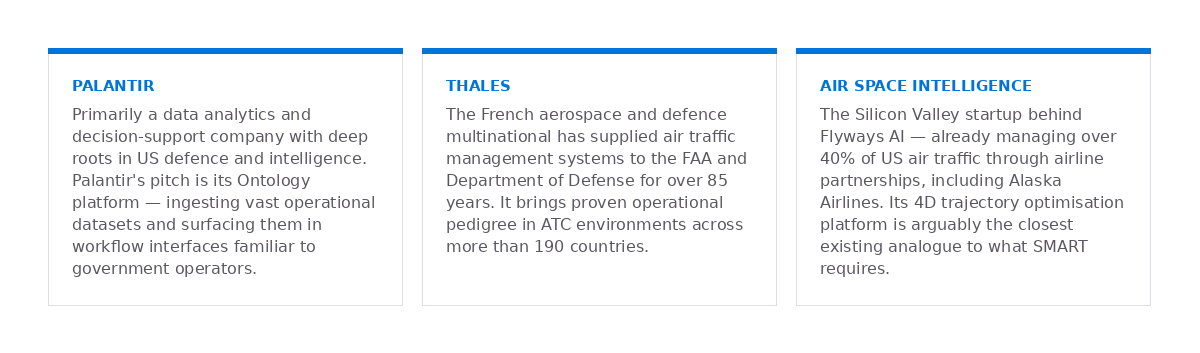
These are not equivalent bids. Palantir brings data infrastructure credibility but limited operational ATC experience. Thales has the hardware and regulatory track record but is a European firm in a politically sensitive government contract. Air Space Intelligence has live commercial deployment at scale — but is a startup competing against trillion-dollar-valued and century-old institutions for a safety-critical contract.
The fact that the FAA is running three parallel prototypes rather than selecting a single vendor signals genuine uncertainty about which approach will perform under operational conditions. That is a reasonable engineering posture. It is also expensive and introduces integration risks if the final contract must reconcile architectures developed on divergent assumptions.
The NextGen Shadow
No honest analysis of SMART can ignore what came before it. NextGen — the Next Generation Air Transportation System, launched in 2003 — was supposed to be exactly this: a comprehensive modernisation of US airspace using satellite technology, digital communications, and advanced automation. It was billed as transformative. It wasn’t.
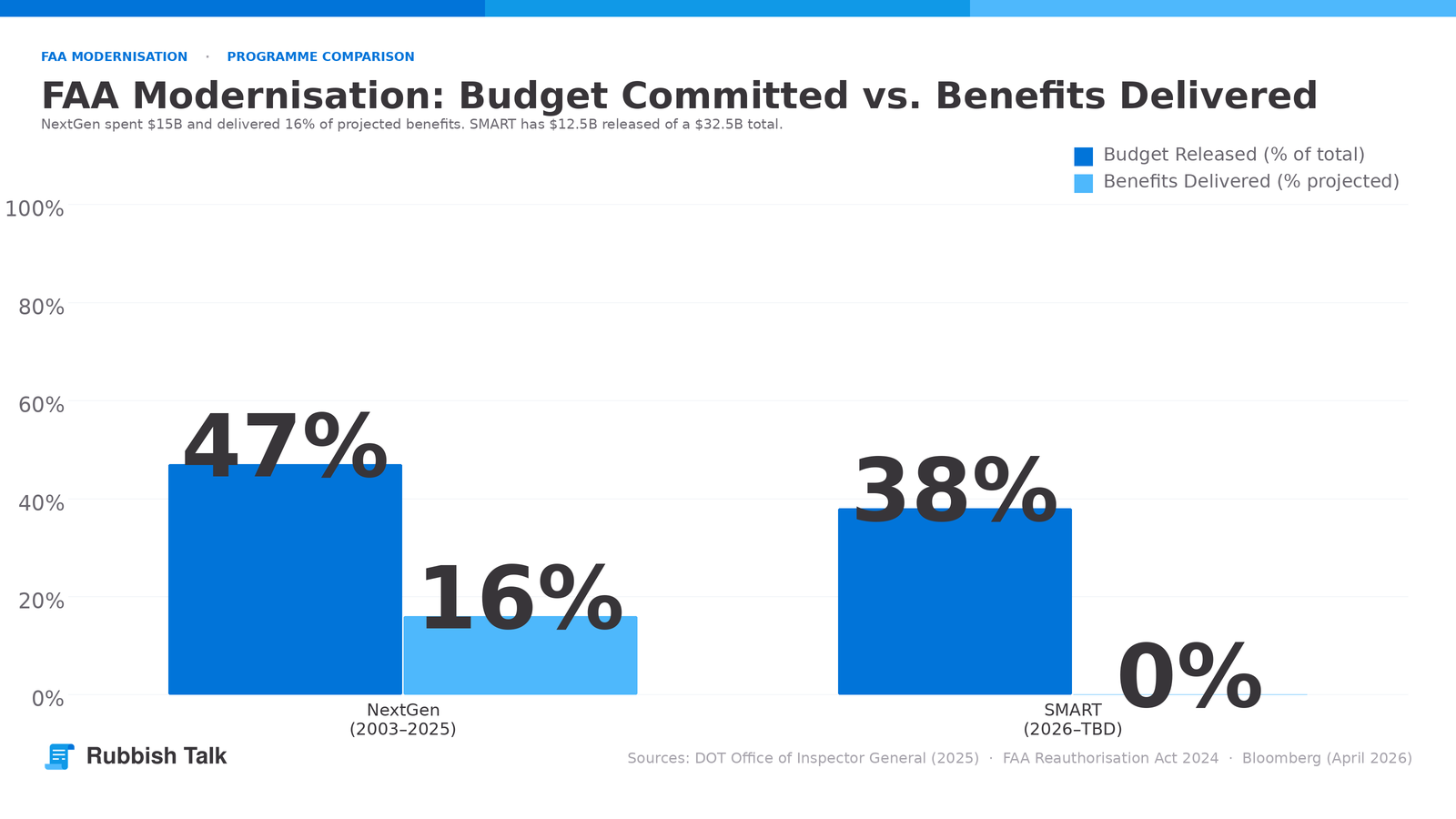
By the time a Department of Transportation Office of Inspector General audit landed in late 2025, NextGen had consumed more than $15 billion and delivered just 16 percent of its originally projected benefits. Programs including Data Communications, the NextGen Weather Processor, and the Terminal Flight Data Manager all ran years behind schedule and over budget. The NAS Voice Switch — intended to modernise controller communications — was cancelled outright, pushing needed upgrades off by a decade. The FAA is scheduled to close its NextGen office by the end of 2025.
“NextGen’s life cycle cost estimate had not been updated since 2017, and the agency lacked a comprehensive risk mitigation plan.”
— Government Accountability Office review of FAA NextGen programme, cited in multiple OIG reports
The structural failures were not primarily technical. They were managerial: poorly defined requirements, ineffective contractor oversight, a GAO finding that the FAA took an average of four years and seven months to establish basic cost, schedule, and performance baselines for modernisation investments, and a lack of meaningful accountability when programmes slipped.
SMART is being developed against this institutional backdrop. The same agency that took four-plus years to baseline a programme is now committing to operational SMART prototypes by late 2026. Ambition and history are in direct tension.
The Real Risks: Safety, Oversight, and the Human-Machine Problem
The FAA’s approach to SMART is framed as AI-assisted, not AI-autonomous. Controllers remain in the loop; SMART is a decision-support tool, not a decision-making one. This framing addresses the most obvious objection — that putting AI in charge of aircraft routing is dangerous — but it does not eliminate the subtler risks.
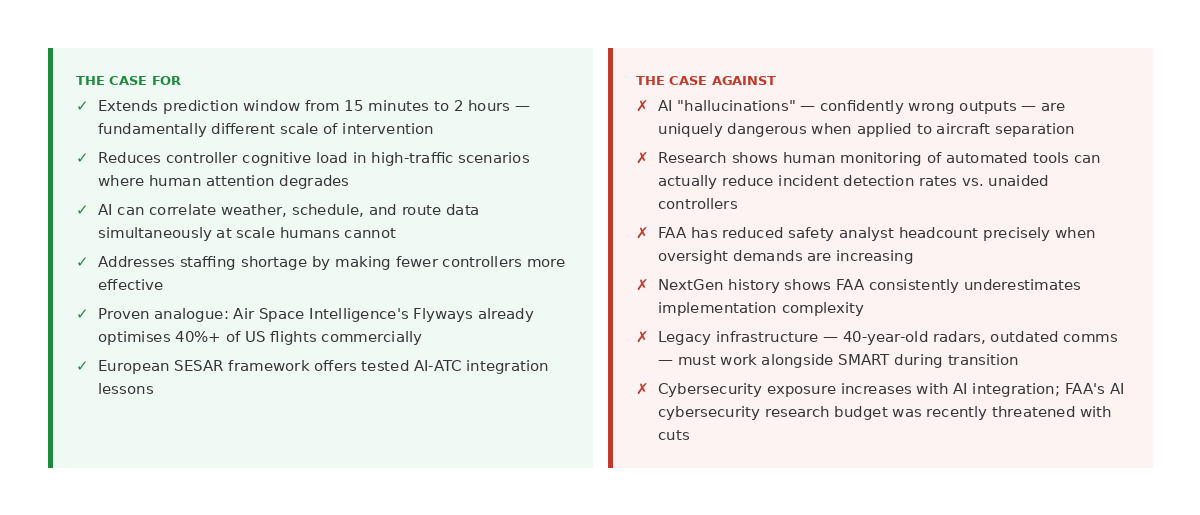
Research dating to the early 2000s on human-automation interaction in ATC environments found something counterintuitive: controllers working alongside unreliable automation were less likely to detect incidents than those working without it. The mechanism is “automation complacency” — when humans trust a system to catch problems, they reduce their own vigilance. If SMART achieves 95 percent accuracy in conflict detection, that remaining 5 percent may be systematically missed because controllers are no longer looking for it.
This is not a theoretical concern. It is the central design challenge for human-machine systems in safety-critical environments, and it is one that the FAA’s published plans for SMART do not yet address in detail. The system’s interface design, the conditions under which it escalates to human attention, and the training controllers receive to maintain independent situational awareness while using SMART will matter as much as the underlying model’s accuracy.
What Europe Got Right — and What the US Can Learn
The SESAR programme — the Single European Sky ATM Research initiative — offers the closest operational parallel to what the FAA is attempting. SESAR has been integrating AI-assisted trajectory management into European airspace since the mid-2010s, coordinating across 42 national air navigation service providers, with a deployment horizon extending to 2030 and a planning framework stretching to 2040.
Europe’s approach differs from the US model in ways that matter. SESAR is designed as an interoperability framework first — its specifications mandate that any AI decision-support tool must be auditable, must provide confidence intervals on its outputs, and must degrade gracefully to human-only operation if the AI component fails. It also operates under a regulatory philosophy that requires explicit certification of AI tools before operational deployment, not after.
The FAA’s regulatory framework for AI in ATC is still being developed. The agency’s Technical Discipline guide for AI/ML acknowledges the challenge but does not yet specify certification standards equivalent to SESAR’s. For a programme targeting operational prototypes in late 2026, that gap is notable. Certification typically takes years — not months — in safety-critical aviation environments.
What Comes Next — and What to Watch
SMART’s vendor competition will produce competing prototypes by late 2026. A contract award is likely in 2027, with phased deployment beginning sometime after that. Congress has released $12.5 billion of the $32.5 billion total — the remaining $20 billion requires future appropriation in a political environment where aviation funding competes with other priorities.
Things to Watch
- Vendor selection and contract structure. Which of the three — Palantir, Thales, or Air Space Intelligence — wins the final contract, and whether the contract includes meaningful performance benchmarks with real financial consequences for delay or underperformance.
- AI certification framework. Whether the FAA establishes explicit certification standards for SMART before or after operational deployment begins. The former is safer; the latter is faster. The agency’s track record suggests it will push toward the latter.
- Controller union response. NATCA (National Air Traffic Controllers Association) has historically been a significant force in shaping how new technology is introduced to ATC environments. Their stance on SMART’s human-machine interface will influence both the design and the deployment timeline.
- Congressional appropriations. The $20 billion gap between current funding and programme requirements is not guaranteed. A political shift or competing budget priority could reduce SMART’s scope significantly.
- Staffing trajectory. AI decision-support tools perform best when human operators understand the system deeply. If the controller shortage continues to deepen — retirements outpacing hiring — SMART may be deployed in conditions where the human oversight layer it depends on is chronically understaffed.
The case for SMART is real. American airspace runs 55,000 flights a day on infrastructure built in the 1970s, managed by an agency 3,000 controllers short of its own safety targets. The status quo carries its own risks — and the January 2025 collision near Washington made those risks visible and fatal. AI-assisted trajectory management, done well, could meaningfully improve both efficiency and safety.
The case for scepticism is also real. The FAA has spent $15 billion on NextGen and delivered 16 percent of what it promised. It is now being asked to deploy a more complex system, faster, with a reduced workforce and on a budget that is 60 percent unfunded. The technology may be ready. Whether the institution deploying it is ready is a different question — and it is the one that will determine whether SMART becomes a genuine upgrade or the next chapter in a long history of expensive, underdelivered modernisation.
Sources:
- FAA quietly developing AI-enabled predictive air traffic management system — The Air Current
- Palantir, Thales, and a startup are competing to build the FAA’s predictive air traffic AI — The Next Web
- FAA accepting bids for AI system to assist air traffic controllers — UPI
- In deploying AI, the Federal Aviation Administration faces unique challenges — FedScoop
- NextGen Stalls Out After $36 Billion Push — Flying Magazine
- FAA NextGen External Factors Final Report — DOT Office of Inspector General (July 2025)
- Why US air traffic control is stretched so thin — CNBC
- FAA Air Traffic Controller Shortage Reaches Crisis Point — Altitudes Magazine
- America’s Air Traffic Control Crisis Exposes FAA’s Struggles — Avionics International
- FAA Faces Tough Questions: Are AI and Job Cuts Threatening Airspace Safety? — DroneLife
- AI Air Traffic Management Systems: $37B NextGen & SESAR Investment Analysis — Axis Intelligence
- SESAR — SKYbrary Aviation Safety
- Palantir, Thales Among Companies Competing on FAA AI Tool — Bloomberg
- FAA Picks Palantir, Thales, And Air Space Intelligence To Build AI That Predicts Flight Conflicts Two Hours Out — DroneXL
- FAA’s AI-Powered Cybersecurity Research Faces the Axe — Aviation Tech Today
- Foto: Windmemories / Lizenz: CC BY-SA 4.0, via Wikimedia Commons