
The April CPI came in hotter than expected on all fronts — headline, core, and energy — cementing the end of the Fed’s easing cycle and raising the first serious discussion of rate hikes since 2023. Markets took it calmly. They probably shouldn’t have.
What the Numbers Actually Say
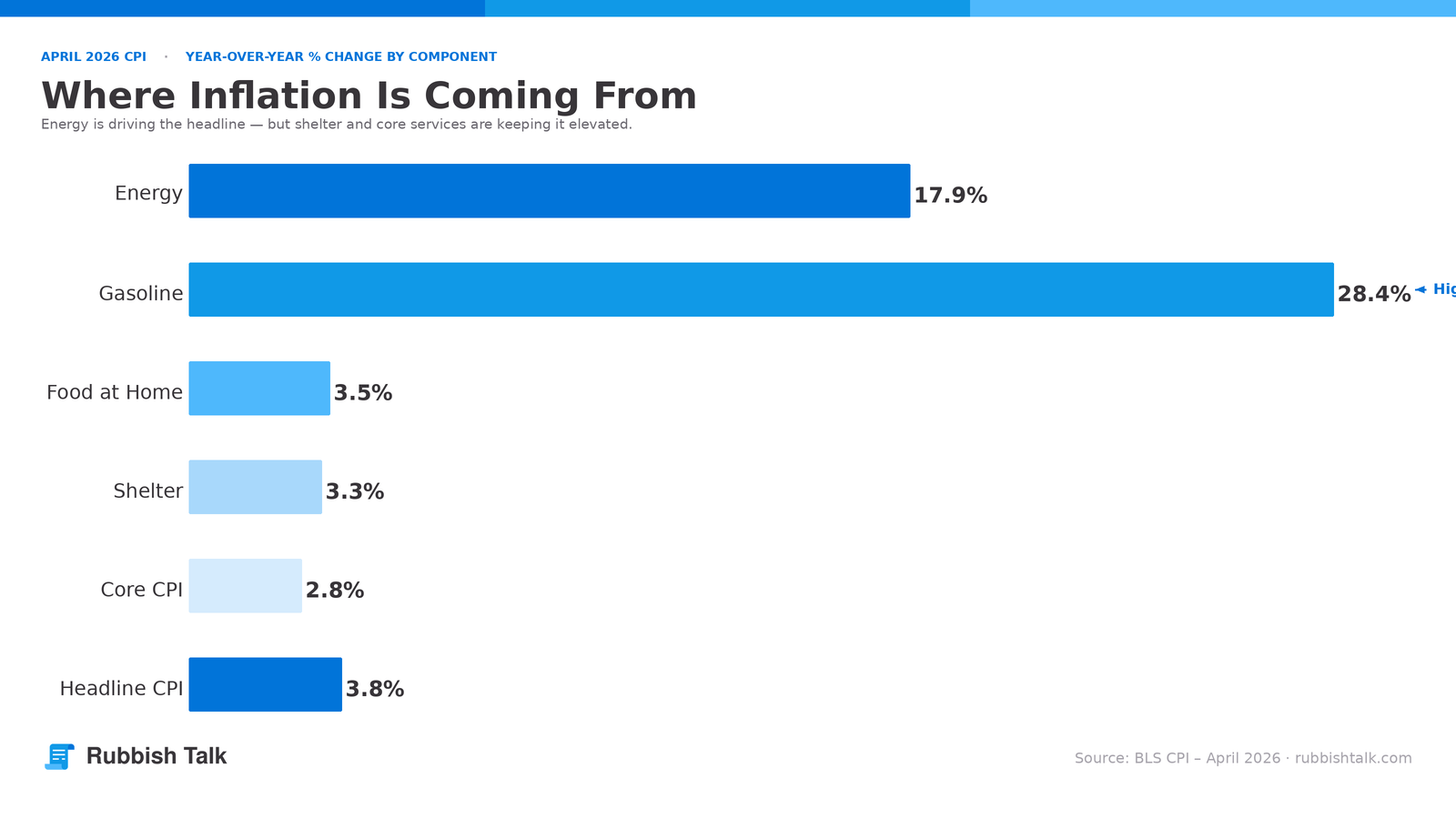
The Bureau of Labor Statistics released April’s Consumer Price Index this morning, and it delivered a clean sweep of upside surprises. Headline inflation rose 3.8% year-over-year — the fastest pace since May 2023 — up sharply from 3.3% in March. Month-over-month, prices increased 0.6%, as expected, but the annual number came in a tenth above the 3.7% consensus.
Core CPI, which strips out food and energy, offered no relief. It rose 0.4% on the month — a full tenth above the 0.3% forecast — and 2.8% year-over-year, against an expected 2.7%. That is the number that matters most to the Federal Reserve. Core inflation running at nearly three times the Fed’s 2% target, accelerating, and increasingly broad-based is not the story of a transitory energy shock. It is the story of an economy where higher fuel costs are working their way into everything else.
Energy was the biggest single driver — the index rose 3.8% in April alone, and 17.9% over the past year — but the composition of the core reading is what should concern policymakers. Shelter rose 0.6% for the month (3.3% annualised), food at home climbed 0.7%, and services inflation remains stubbornly elevated. Real average hourly earnings fell 0.5% in April. Workers are falling further behind.
The Mainstream Narrative: It’s All Iran
The dominant media framing is straightforward: the war with Iran has disrupted Middle East oil flows, gasoline has surged, and the CPI is reflecting that one-time shock. The implication, running through most coverage this morning, is that once the conflict stabilises, energy prices will retrace and inflation will come back down on its own. The Fed, meanwhile, is wise to sit on its hands and wait for clarity.
There is truth in this. The outbreak of the Iran conflict in late February 2026 triggered the largest geopolitical oil supply disruption in modern history — the Dallas Fed estimates it is two to three times larger than the 1973 oil embargo or the 1990 Gulf War shock. Gasoline prices in the US rose 7.5% to $3.20 per gallon in the immediate aftermath. Crude oil is now up more than 40% from pre-war levels. That shows up directly in the CPI.
“Inflation is moving higher again as the war in Iran — and the associated closing of the Strait of Hormuz — is impacting both the headline number as expected, but also the core, which was even higher than the +0.3% expected.”
— Market analyst, quoted by US News & World Report, May 12, 2026
What the Data Shows
The Iran-as-sole-cause explanation underweights something important: core inflation was already sticky before the war began. March’s CPI showed prices rising 3.3% annually, and the Fed had already paused its cutting cycle after trimming rates three times in late 2025. The war added fuel — literally — to a fire that was already burning.
More telling is where the core pressure is coming from. The 0.4% monthly core reading is not explained by energy pass-through alone. Shelter, which has a roughly one-third weighting in CPI, is rising at 0.6% per month. That is a rate that compounds to over 7% annualised, and it reflects the lagged response of market rents from 2024 and 2025, not oil prices. Services inflation — airline fares, medical care, education — remains elevated across the board.
The April jobs report, released earlier this month, adds context: payrolls grew by only 115,000 in April against a backdrop of slowing hiring, and the unemployment rate held at 4.3%. A softening labour market alongside accelerating inflation is a genuinely difficult combination for the Fed. It is not stagflation yet, but it is the same uncomfortable direction of travel.
“Given that inflation is heading in the wrong direction and the labour market is holding up, it’s very unlikely that the Fed will be able to lower interest rates any time soon, and it’s possible we may start pricing in rate hikes for next year.”
— Senior economist, TheStreet, May 12, 2026
Historical Context: The Commodity-Shock Trap
The Fed has been here before. In 1973 and again in 1979, it chose to look through energy-driven inflation, treating it as a supply-side problem that monetary policy could not fix. Both times, that decision allowed inflation expectations to become unmoored. By the time Paul Volcker was appointed in 1979, bringing rates to 20% and triggering a deep recession was the only way to restore credibility.
The situation in 2026 is different in important ways — inflation is at 3.8%, not 13%, and the Fed has a degree of institutional credibility it lacked in the 1970s. But the parallel worth flagging is this: energy price shocks don’t just raise headline CPI. They raise production costs across the economy, which businesses pass on. They raise transportation costs, which elevate food prices. And when workers see their purchasing power eroded, they demand higher wages, which feeds back into services inflation. That transmission process is already visible in April’s data.
The OECD has revised its US inflation forecast for 2026 to 4.2%, up 1.2 percentage points from its pre-war projection. If that proves accurate, the Fed will have held rates steady through a period in which annual inflation climbed from 3.3% to over 4%, with real rates declining and financial conditions loosening. The historical record on that playbook is not encouraging.
Market Reaction: Calmer Than It Should Be
Equities fell modestly after the release — the S&P 500 slipped 0.37%, the Nasdaq dropped 0.65%, the Dow lost 0.21% — while the Russell 2000, which is more sensitive to a domestic economy muddling through than to the rate path, actually gained 0.33%. Bond markets were more forthright: the 10-year Treasury yield rose 4 basis points to 4.45%, and the 2-year yield climbed 3 basis points to 3.98%.
The subdued reaction in stocks is partly explained by the fact that markets had already priced out Fed rate cuts for 2026 heading into this report. There were no cuts to mourn. But it also reflects a degree of complacency that is worth examining. With the 10-year at 4.45% and headline inflation at 3.8%, real long-term rates are just 65 basis points. That is not a tight-money environment. It is barely restrictive.
Markets currently price a roughly 70% probability of rates remaining on hold for the rest of 2026. A minority of analysts are beginning to discuss hikes. Neither scenario is particularly good for growth assets trading at elevated multiples — but so far, that arithmetic has not fully registered in equity prices.
What Is Being Overlooked
The coverage today is focused almost entirely on headline CPI and the Iran war. Two things are getting insufficient attention.
First, the secondary inflation transmission from the war is still in its early stages. The initial commodity shock hits gasoline directly and quickly. But the downstream effects — higher trucking costs feeding into retail food prices, higher jet fuel costs feeding into airfares, higher input costs compressing or eliminating margins for small manufacturers — take three to six months to fully flow through the price system. April’s 0.4% core print may be the beginning of that transmission, not the peak.
Second, the Fed is now caught in a bind it has limited tools to escape. Raising rates into a slowing labour market risks tipping a 4.3% unemployment rate higher and triggering a recession. Holding rates steady while inflation runs at 3.8% and rising risks allowing expectations to drift. The Minneapolis Fed published a note last month asking how long the central bank can “look through” the commodity shock. The honest answer implicit in today’s data is: not much longer.
What Comes Next
Several things are worth tracking over the coming months.
The June FOMC meeting (June 17–18) will be the first real decision point. The Fed has held at three consecutive meetings in 2026. Another hold is the base case, but the May CPI release — which captures a second full month of war-era energy prices — will be published on June 11, one week before the decision. If it shows core inflation at 0.4% or higher again, the “looking through” language becomes very hard to sustain.
Strait of Hormuz developments are the single biggest wildcard. If the conflict de-escalates and oil flows partially normalise, energy prices could retreat, giving the Fed political and economic cover to hold. If the disruption deepens or spreads, the OECD’s 4.2% forecast for 2026 may prove optimistic.
Consumer expectations data — particularly the University of Michigan’s one-year inflation expectations — will be closely watched. The moment those expectations detach from the Fed’s target range, the argument for holding steady collapses quickly.
Corporate earnings in Q2 will reveal how much of the input-cost pressure companies absorbed versus passed on to consumers. If profit margins are holding, inflation pressure in goods is building, not dissipating.
The April CPI report is not a crisis. It is a warning sign. The question now is whether the Fed and the market treat it as one.
Sources:
- Consumer Price Index Summary – 2026 M04 Results
- CPI Inflation April 2026: Prices Rose 3.8% Annually — CNBC
- April CPI Rises More Than Expected; Bond Yields Climb — US News
- Inflation Spikes in April CPI Report on Higher Energy Costs — Kiplinger
- Implications of the Iran War for U.S. Inflation — Dallas Fed
- How Long Can We “Look Through” the Iran War Commodity Shock? — Minneapolis Fed
- Economic Impact of the 2026 Iran War — Wikipedia
- Stock Market Today (May 12, 2026) — TheStreet
- April 2026 CPI Preview — CEPR
- World Bank Commodity Markets Outlook — April 2026
- Treasury Yields Push Higher After CPI — CNBC
- May 2026 Economic and Market Update — Crestwood Advisors
- Foto: AgnosticPreachersKid / Lizenz: CC BY-SA 3.0, via Wikimedia Commons