

The Pentagon is calling Detroit’s CEOs. Stockpiles are dangerously depleted. And Washington is dusting off a World War II playbook. But 2026 is not 1942 — and the obstacles are far more complex than swapping a car door for a missile casing.
The Crisis That Started the Conversation
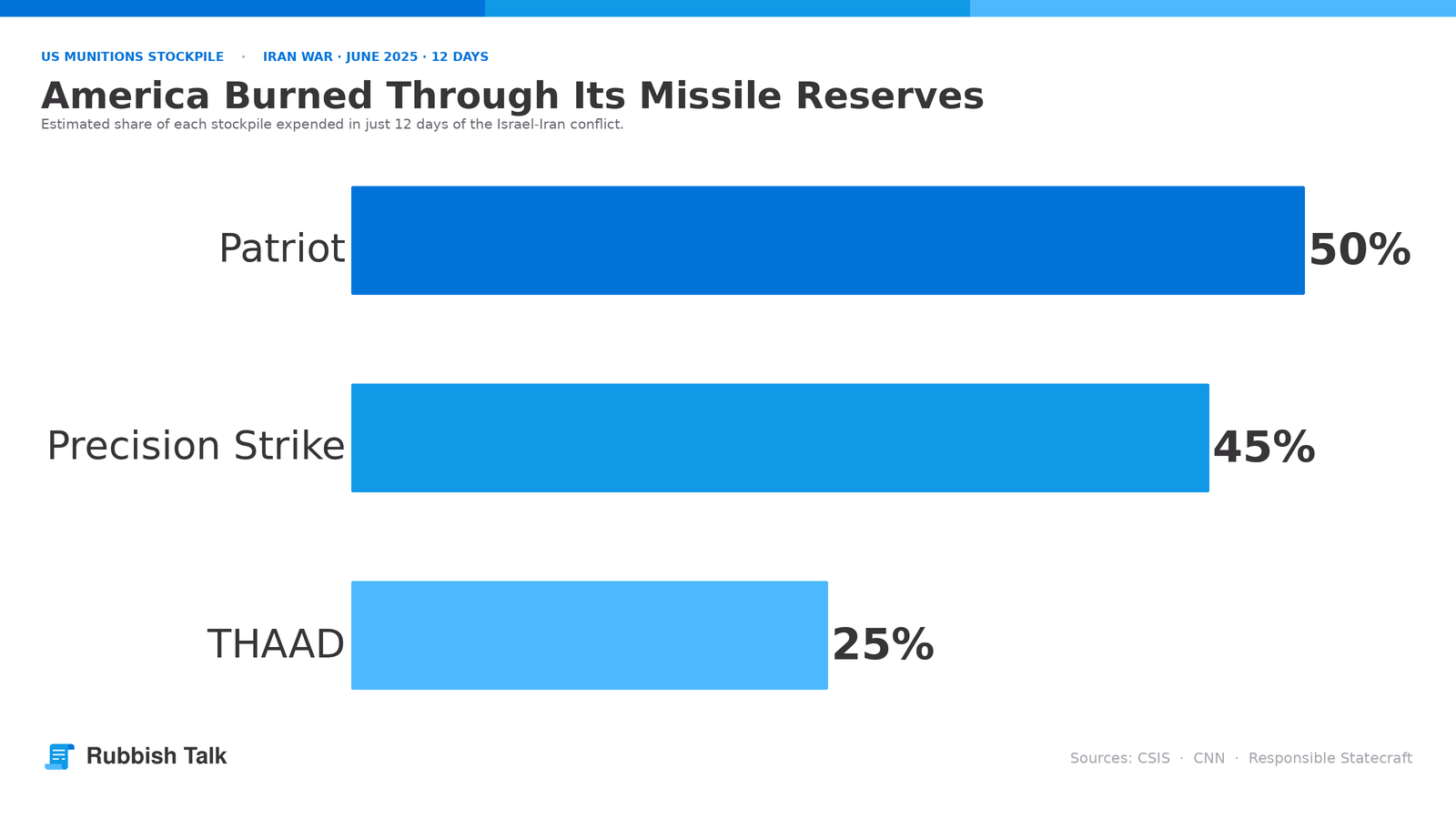
In June 2025, the United States fired roughly 150 THAAD interceptors during Israel’s 12-day war with Iran. That is approximately one quarter of every THAAD interceptor the Pentagon has ever purchased — burned through in under two weeks. Each one costs $12.7 million and takes three years to deliver after a contract is signed, even under an accelerated schedule.
It was the sharpest single demonstration of a problem the Pentagon has known about for years: America’s defence industrial base cannot produce weapons fast enough to keep pace with the rate at which they are being used. The Iran campaign also consumed at least 45% of the US stockpile of Precision Strike Missiles and nearly half its Patriot air defence interceptors. Taken together, the numbers alarmed defence planners in a way that Ukraine had not quite managed to.
By April 2026, the Wall Street Journal reported that senior Pentagon officials had held preliminary conversations with executives from General Motors, Ford, GE Aerospace, and Oshkosh about whether their factories — and their workers — could be redirected toward weapons production. The discussions remain early-stage. No contracts have been signed. But the intent is unmistakeable.
What the Pentagon Is Actually Asking For
Defence Secretary Pete Hegseth has framed the initiative in stark terms. In a November 2025 speech at the National Defense University, he declared:
“We’re not just buying something. We are solving life and death problems for our war fighters. We’re not building for peacetime. We are pivoting the Pentagon and our industrial base to a wartime footing.”
— Pete Hegseth, Secretary of Defense, National Defense University, November 2025
The formal policy vehicle is Executive Order 14265, signed in April 2025, which directs the Pentagon to reform its acquisition process with “speed, flexibility, and execution” as the overriding priorities — shifting away from a decades-old system optimised for cost control and bureaucratic compliance, toward one capable of rapid industrial scaling.
Officials asked the automakers’ CEOs — Mary Barra of GM and Jim Farley of Ford — to identify specific barriers to defence work: contracting requirements, security clearance hurdles, bidding complexity. The Pentagon has stopped short of invoking the Defence Production Act, which would allow it to compel private industry to manufacture goods deemed critical to national security. For now, it is asking. Whether it ends up compelling is a separate question.
The scope, critically, is not asking Ford to build missiles. It is asking whether auto manufacturers can produce components, logistical vehicles, mechanical sub-assemblies, and parts that feed into larger weapons systems — freeing up dedicated defence contractors to focus on the high-end, classified hardware.
The WWII Comparison: What Actually Happened
The historical parallel being invoked — almost reflexively — by politicians and commentators is World War II’s “Arsenal of Democracy.” The facts from that era are genuinely staggering.
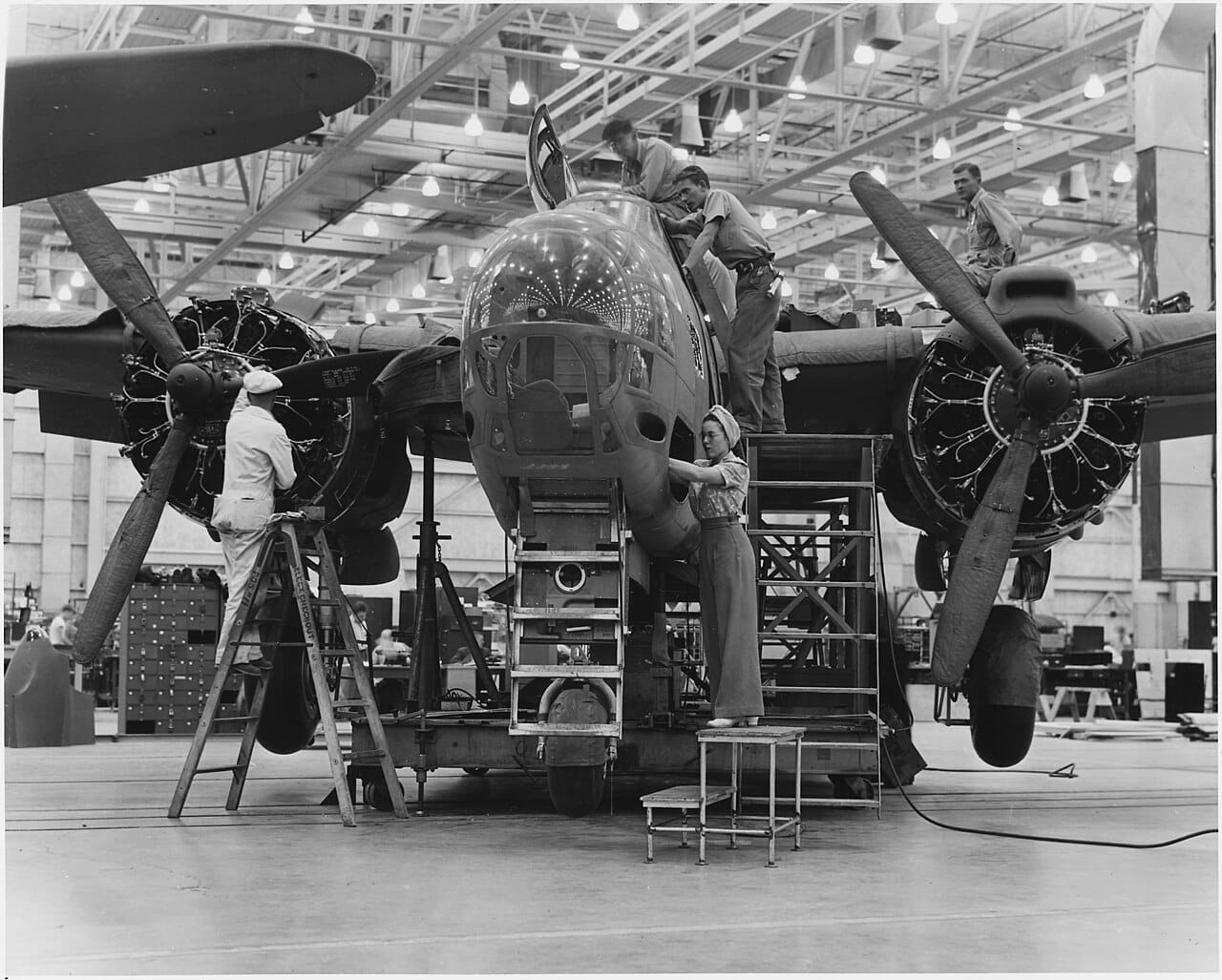
After Pearl Harbor in December 1941, all US passenger automobile production ceased by February 1942. Within months, the same factories that had built Chevrolets were producing tanks, aircraft engines, artillery shells, and military trucks. General Motors alone — by the end of the war — had generated more than $12 billion in war contracts, producing 119 million artillery shells, 206,000 aircraft engines, 38,000 tanks and tank destroyers, and 13,000 Navy fighter planes. At the peak of the US war effort in late 1943 and early 1944, American factories were manufacturing almost as many munitions as all their allies and enemies combined.
The transformation was possible for reasons that are worth examining carefully, because most of them do not apply today.
First, the manufacturing base of 1941 was enormous, vertically integrated, and still largely analogue. A factory floor full of metal presses, lathes, and welding equipment could be repurposed with relatively modest retooling. Second, the entire economy was placed on a command footing — price controls, material rationing, labour direction. There was no market logic to navigate. Third, the workforce was abundant, cohesive, and rapidly trained. Rosie the Riveter was not a metaphor; she was a production strategy. Fourth, the weapons systems themselves — rifles, shells, Jeeps, propeller-driven aircraft — were mechanically complex but not electronically classified. A machinist who could build a car engine could learn to build an aircraft engine.
Why 2026 Is Not 1942
The gap between then and now is not merely technological — it is structural.
The US defence industrial base has been systematically hollowed out since the end of the Cold War. In 1993, then-Deputy Secretary of Defense William Perry convened what became known as “the Last Supper” — a meeting at which he told defence industry executives that post-Cold War budget cuts meant the government could no longer sustain the existing number of contractors. The message was clear: consolidate or disappear. The result: the number of major prime defence contractors fell from 51 to 5 within a decade. Lockheed merged with Martin Marietta. Boeing absorbed McDonnell Douglas. Dozens of mid-tier suppliers and sub-contractors vanished.
“In 30 years, the Pentagon went from a defense industry it considered too large to sustain, to one now too small to surge.”
— DoD Report on Defense Industrial Base Consolidation
The consequences are now acute. The US defence manufacturing sector faces a shortage of approximately 800,000 workers, with 250,000 skilled trades positions alone going unfilled. Projections suggest this could widen to over 2 million unfilled roles within five years if the trend is not reversed. These are the welders, machinists, precision assemblers, and electronics technicians who actually build things.
Modern weapons systems compound the problem. A THAAD interceptor is not a shell casing. It contains sensitive electronics, classified software, and materials that require secure facilities, specialised tooling, and workers with security clearances. An auto assembly line — however sophisticated — is not equipped for that environment. One defence analyst quoted in coverage of the GM/Ford talks was blunt: “You’re not going to make F-150s next to planes and tanks.“
What the Automakers Could Realistically Do
This does not mean the Pentagon’s outreach is pointless — but it does mean expectations need calibrating.
GM already operates a defence subsidiary, producing a lightweight infantry squad vehicle based on the Chevrolet Colorado platform. It is a leading contender for the Army’s next-generation vehicle to replace the Humvee. That is the realistic template: logistics vehicles, mechanical platforms, transport systems, and sub-components that do not require classified facilities. Ford’s manufacturing expertise in large-scale assembly, precision metal fabrication, and supply chain management could similarly feed the lower tiers of the defence supply chain rather than its apex.
The Pentagon’s Congress-backed funding for the industrial base tells the same story. Congress has approved $6 billion to expand shell production and modernise existing factories — focused on expanding the capacity of existing, dedicated munitions facilities rather than creating new civilian crossover. The Army is investing $742 million specifically in HIMARS rocket system production. Lockheed Martin has announced plans to increase THAAD interceptor output from 96 per year to 400 — but even that expansion takes years to materialise.
“Even if the Pentagon increases current orders, it still takes three years between the date a contract is awarded and when the interceptors are delivered.”
— CSIS, Depleting Missile Defense Interceptor Inventory analysis
The Structural Problem Nobody Wants to Say Plainly
There is a tension at the centre of this entire discussion that mainstream coverage tends to skate past.
The Trump administration has simultaneously pushed tariffs that raise the cost of raw materials and components critical to manufacturing, while pursuing defence spending increases that assume a rapid industrial surge. Steel and aluminium tariffs increase production costs for the very manufacturers being asked to scale output. Workforce initiatives — like the Pentagon’s Operation Next programme, which certified 40 adult learners in advanced manufacturing — are commendable but nowhere near the scale required. Forty workers is not a wartime mobilisation. It is a pilot.
The Defence Production Act remains uninvoked. Without it, the Pentagon is asking private companies to take on costly, complicated, low-margin defence work in a commercial environment where auto manufacturers are already managing their own financial pressures — Ford and GM both face demand uncertainty from the EV transition, tariff exposure on imported parts, and tightening consumer credit conditions. The business case for voluntary defence conversion is genuinely unclear.
What is missing from most coverage is a frank acknowledgement that the WWII analogy, however emotionally resonant, may be more political theatre than operational strategy. The real industrial mobilisation story of 2026 is slower, more expensive, and far less dramatic: it is about multi-year contracts with existing prime contractors, incremental expansion of established munitions facilities, and a workforce pipeline that will take a decade to rebuild — not factories converting overnight.
What to Watch
The key signals worth tracking over the next 12–18 months: whether the Pentagon invokes the Defence Production Act (which would mark a fundamental shift from persuasion to compulsion); whether any formal contracts emerge with GM, Ford, or GE Aerospace for defence components; and whether Congress uses the 2027 National Defense Authorization Act — which leadership has already flagged as focused on industrial base capacity — to mandate and fund large-scale civilian manufacturing conversion.
If stockpile depletion continues at the rate seen during the Iran operations, the voluntary phase of this initiative will be short. The question then becomes not whether America can rebuild an arsenal of democracy — but how much it will cost, how long it will take, and whether the political will exists to see it through.
The WWII answer to those questions was: total war, total mobilisation, total commitment. Nobody in Washington is saying that yet. Whether events force them to is the story of the next decade.
Sources:
- Ford, GM could be about to make weapons for the first time since WWII — Newsweek
- Pentagon Taps Ford, GM to Boost Weapons Production — Fox Business
- Pentagon explores automaker role to boost weapons production — Investing Live
- Defense officials ask GM, Ford for military manufacturing bump — Detroit News
- US used about 25% of its THAAD missile interceptors during Israel-Iran war — CNN
- The Depleting Missile Defense Interceptor Inventory — CSIS
- Last Rounds? Status of Key Munitions at the Iran War Ceasefire — CSIS
- Putting the Industrial Base on a Wartime Footing — CSIS
- Modernizing Defense Acquisitions and Spurring Innovation in the Defense Industrial Base — White House
- Chapter 8: Strengthening the United States’ Defense Industrial Base — White House Economic Report 2026
- How Detroit Factories Retooled During WWII to Defeat Hitler — HISTORY
- DOD Report: Consolidation of Defense Industrial Base Poses Risks to National Security — OLDCC
- State of Competition Within the Defense Industrial Base — DoD
- Review Warns Defense Industrial Base Faces ‘Unprecedented Set of Challenges’ — CSIS
- The Pentagon Wants Automakers To Build Fewer Cars And More Weapons — Jalopnik
- Pentagon asks Ford and GM for Assembly Assistance — Assembly Magazine
- From DAS to WAS: Secretary Hegseth’s Acquisition Overhaul — Inside Government Contracts
- Military production during World War II — Wikipedia
- America’s Scale Problem — Foreign Policy Research Institute
- DOD-Supported Workforce Development Program Pushes Manufacturing Careers — Military.com