
The commercial drone industry is one of the fastest-growing technology markets on earth — and one of the most strategically contested. A single Chinese company, DJI, controls roughly 70% of the global market. Its hardware flies over American farmland, power lines, oil pipelines, and disaster zones. In June 2025, President Trump signed Executive Order 14307, titled Unleashing American Drone Dominance, directing federal agencies to sever that dependency and build a domestic drone industrial base from scratch. The ambition is large. The timeline is aggressive. The manufacturing gap it needs to close is enormous.
The Scale of the Industry
The commercial drone market is growing fast enough that analysts struggle to agree on its size — estimates for 2025 range from $11 billion to $84 billion depending on whether you count hardware only or fold in software, services, and data analytics. The hardware-focused consensus sits around $12–14 billion globally in 2025, with projections reaching $44–182 billion by 2035 depending on the scenario. Even the conservative end implies a near-quadrupling of the market inside a decade.
The growth is driven by three structural forces: the collapse of drone hardware costs over the past decade, the maturation of autonomous flight software, and a regulatory environment that has finally begun to accommodate commercial Beyond Visual Line of Sight (BVLOS) operations at scale. In August 2025, the U.S. Department of Transportation issued a proposed rule enabling BVLOS operations for commercial and public safety drones — a milestone that unlocks the delivery and wide-area inspection use cases that were previously confined to controlled trials.
The global drone services market — everything operators earn from flying commercially — surpassed $16.5 billion in 2025 and is projected to reach $142 billion by 2035, growing at roughly 24% compounded annually. For context, that would make commercial drone services a larger market than global air freight revenue today.
What Drones Are Actually Doing
The image of a drone as a camera in the sky is outdated. Commercial drones in 2025 are precision instruments embedded in industrial workflows, and their applications fall into four dominant verticals.
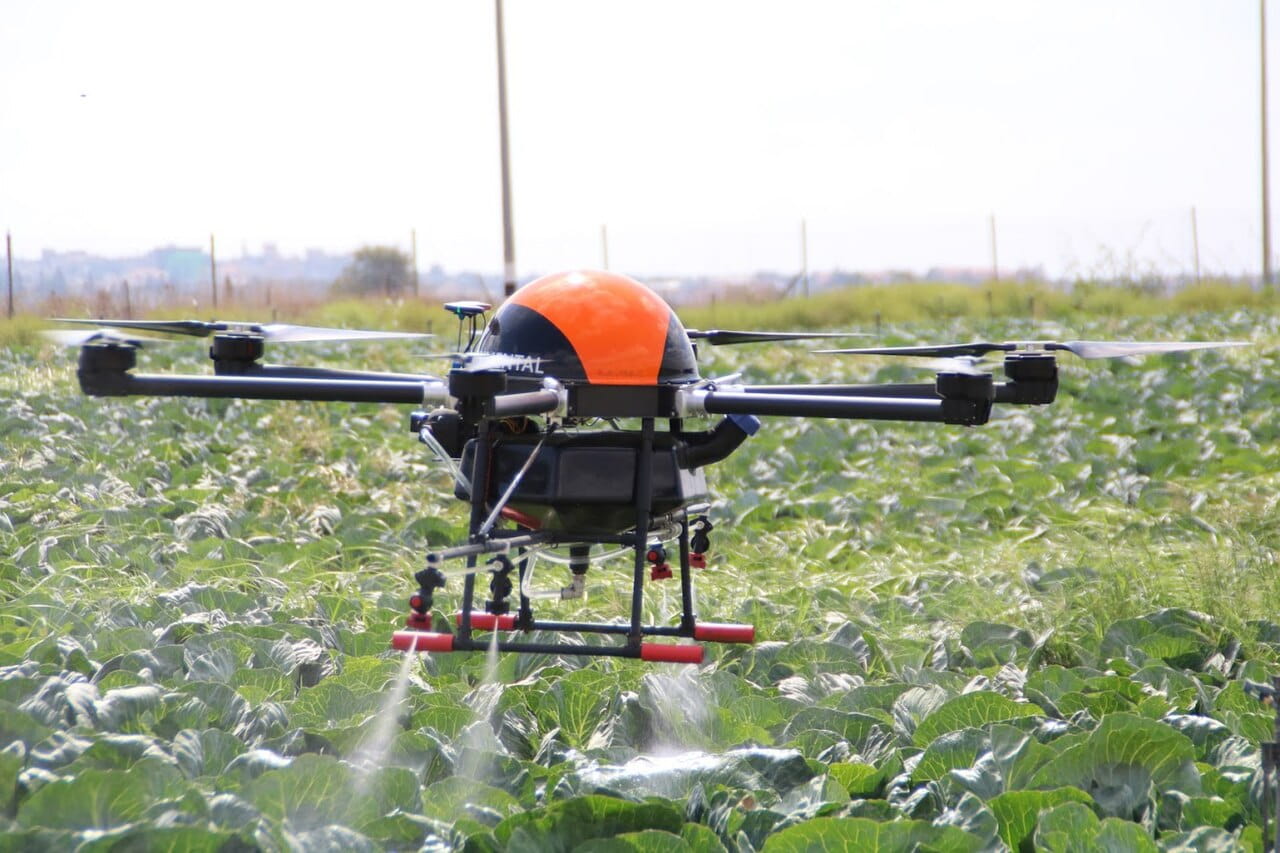
Agriculture is the highest-volume use case by unit count, particularly in China, Southeast Asia, and increasingly the United States. Agricultural drones — led by DJI’s Agras series — spray pesticides, spread seed, and map crop health using multispectral sensors. The DJI Agras T50, which retails between $15,000 and $22,000, covers up to 80 acres per hour autonomously. More than 30% of large farms worldwide are estimated to be using drones for field operations in 2025. The agricultural drone segment alone is projected to grow from $2.63 billion in 2025 to $10.76 billion by 2030.
Infrastructure inspection is the fastest-growing commercial segment by revenue. Utilities, energy companies, and transport authorities are replacing manual inspection — which required helicopters, scaffolding, rope access teams, or simply going without — with drone platforms that carry thermal, LiDAR, and high-resolution cameras. A drone can inspect a transmission tower or a pipeline segment in minutes that would take a field crew hours, and it produces a structured data output rather than a clipboard report.
Logistics and delivery remains early-stage by volume but is generating the most speculative attention. Wing (Alphabet), Amazon Prime Air, Zipline, and Chinese competitor SF Express are all operating commercial delivery programs. Zipline has become the most mature, delivering medical supplies in Rwanda, Ghana, and the United States. True mass-market drone delivery — where drones replace last-mile van trips at scale — remains a 2027–2030 story, dependent on airspace management infrastructure that does not yet exist at the necessary density.
Public safety, mapping, and surveying round out the commercial landscape. Police departments, fire services, search-and-rescue teams, and construction companies are routine users. Photogrammetry software has turned drone footage into survey-grade 3D models of construction sites, eliminating weeks of traditional ground survey work per project.
Who Makes the Drones — and Where
The manufacturing geography of commercial drones tells an uncomfortable story for Western policymakers.
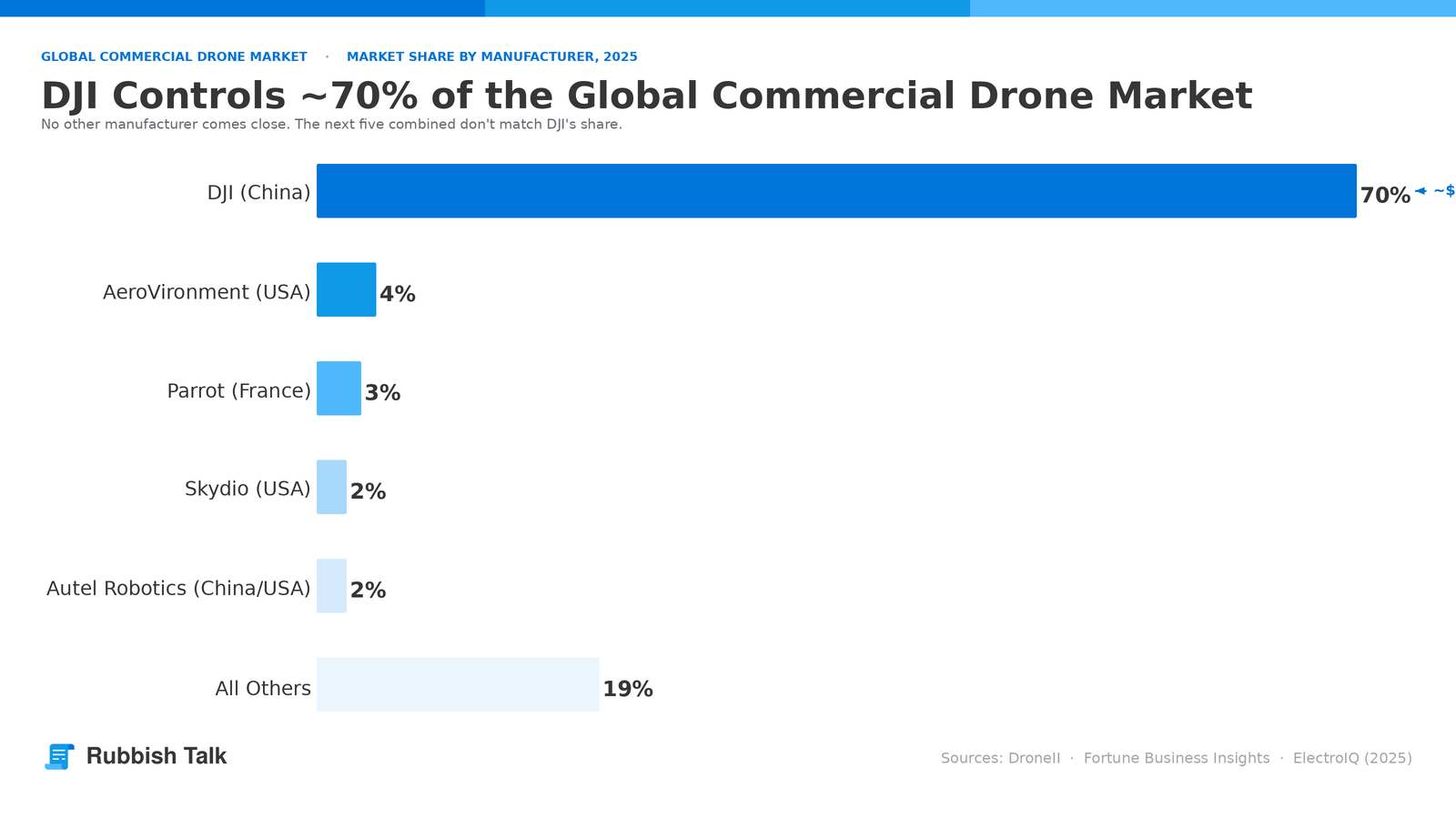
DJI — Da-Jiang Innovations, headquartered in Shenzhen — controls an estimated 70–90% of the consumer drone market and roughly 70% of the overall commercial segment. Its revenues were estimated at $3.5–4 billion in 2025. The next largest player, France’s Parrot, generated €112 million in drone-related revenue in fiscal 2025 — less than 3% of DJI’s scale. AeroVironment, one of the strongest American competitors, reached $540 million in fiscal 2025 drone revenue, driven partly by military platforms. Skydio, the most prominent pure-play U.S. commercial drone manufacturer, has not disclosed revenues publicly but is widely valued as a significant but still niche player.
Beyond DJI, the major Chinese manufacturers include XAG (agricultural drones), EHang (autonomous passenger aircraft), and Autel Robotics — the last of which operates a U.S. entity but manufactures in China. The supply chain concentration runs deeper than the brand names suggest: electronic speed controllers, motors, battery cells, GPS modules, and the image sensors that power drone cameras are overwhelmingly manufactured in China or rely on Chinese-controlled rare earth material processing. A domestically assembled drone is not necessarily a domestically sourced one.
The most widely deployed commercial models and their approximate costs:
- DJI Agras T50 (agricultural spraying): $15,000–$22,000
- DJI Matrice 350 RTK (inspection/enterprise): $12,000–$18,000
- DJI Matrice 400 RTK (enterprise): $15,000–$20,000
- Skydio X10 (U.S.-made, autonomous inspection): ~$15,000
- XAG P100 (agricultural): $18,000–$25,000
- Parrot ANAFI USA (Blue UAS listed, government): ~$7,000–$10,000
The Jobs Drones Are Replacing — and Creating
The honest answer to “are drones replacing jobs?” is: yes and no, and it depends heavily on the sector.
In agriculture, drones are reducing the demand for manual crop spraying — a task previously performed by manned helicopters or ground-based workers. In China, where DJI’s Agras fleet has penetrated at scale, the impact on agricultural labour has been material. In the United States, where labour costs are higher and the workforce for manual field work was already constrained, drones are more often augmenting existing farm operations than displacing large numbers of workers.
In infrastructure inspection, the displacement is clearer. Rope access technicians, manned helicopter charter services, and scaffolding crews are all facing structurally lower demand as drone inspection becomes standard practice. A drone inspection of a wind turbine blade — previously requiring a specialised rope access team spending a full day on the structure — can be completed autonomously in under an hour. The Bureau of Labor Statistics has not yet broken out drone-related displacement as a distinct category, but inspection and survey roles in engineering and utilities have seen headcount growth stall as drone adoption has accelerated.
The industry’s counter-narrative — that drones create new jobs — is also true, but the jobs are different. The FAA Part 107 commercial drone pilot certification was held by over 350,000 individuals in the U.S. by early 2026. Average commercial drone pilot salaries run around $75,000 annually. However, 60% of licensed commercial operators work as independent contractors or small business owners, not salaried employees, which means the income is variable and the work is often gig-structured.
“Drones are not a job killer — they’re a job changer. The question is whether the transition happens fast enough for the workers who are displaced to catch the next wave.”
— Sally French, The Drone Girl, April 2026
“Unleashing American Drone Dominance”: What the Executive Order Actually Does
Executive Order 14307, signed on June 6, 2025, is structured around three pillars: integrating drones into the national airspace through risk-based rulemaking, commercialising U.S. drone technology at scale, and strengthening the domestic industrial base. The language is aspirational; the mechanisms are concrete.
The order directs federal agencies to prioritise procurement of American-made drones, which in practice means the Department of Defense’s Blue UAS Cleared List becomes a de facto procurement standard across government. It also accelerates BVLOS rulemaking — the DOT’s August 2025 proposed rule was a direct result — and instructs agencies to establish testing corridors and remove regulatory barriers to commercial drone deployment.
The order arrived alongside a sweeping FCC action. On December 23, 2025, the FCC added all foreign-produced UAS and their critical components to its Covered List — the agency’s log of equipment that cannot be authorised, marketed, or sold in the United States due to national security risk. The practical effect was a ban on new DJI models entering the U.S. market. Existing DJI drones can still be operated; it is new sales authorisations that are blocked.
“The Department of Defense must be able to procure, integrate, and train using low-cost, high-performing drones manufactured in the United States.”
— President Donald Trump, Executive Order 14307, June 2025
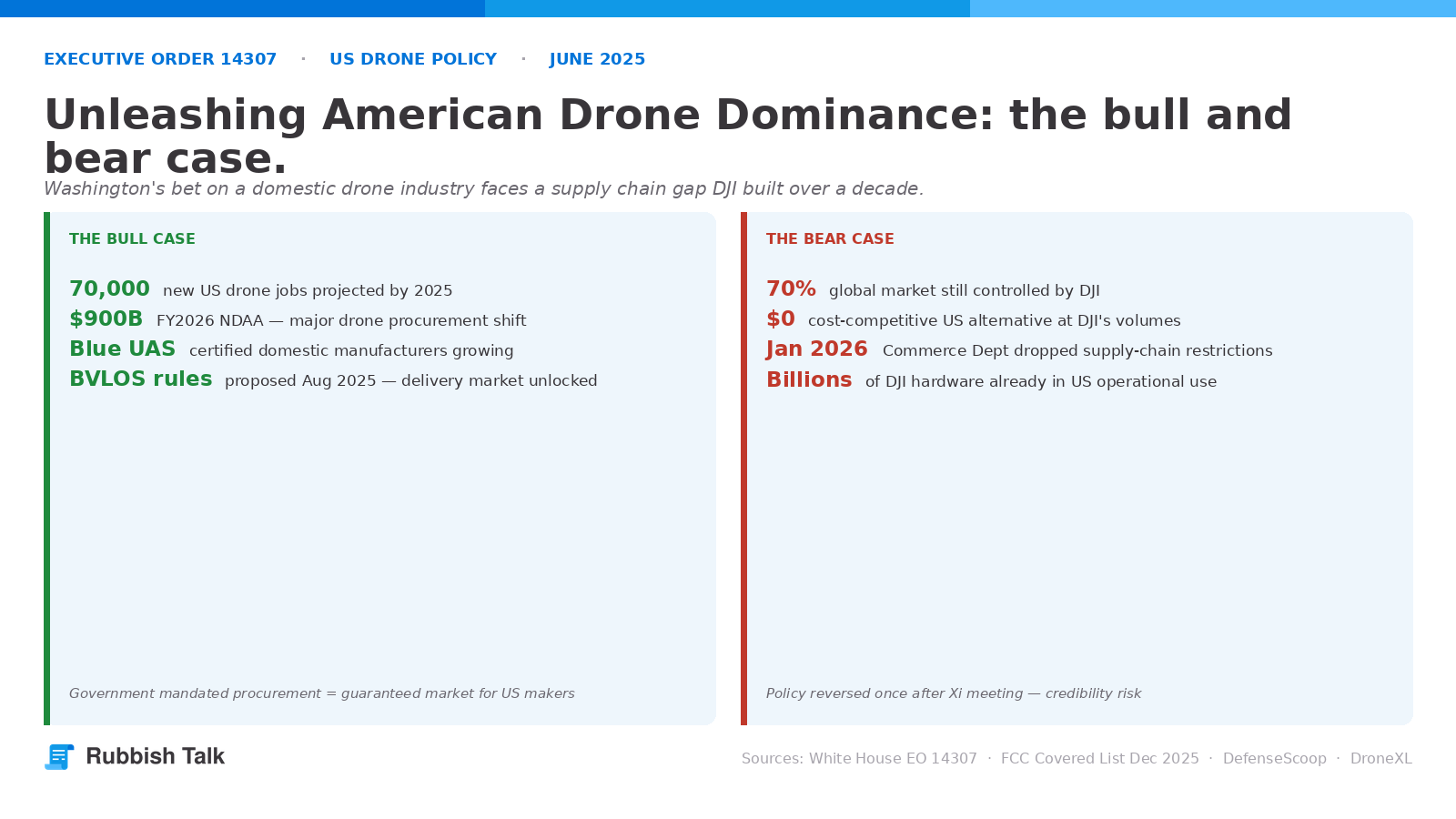
The politics are messier than the text suggests. In January 2026, the U.S. Commerce Department quietly withdrew its own separate plan to impose supply-chain restrictions on Chinese drones — reportedly a concession connected to a trade truce reached at a Trump-Xi meeting in Busan in October 2025. The FCC’s Covered List action stands, but the episode illustrates the tension between national security hawks who want a hard decoupling from Chinese drone hardware and a White House managing broader trade diplomacy with Beijing.
Who Benefits, Who Is Exposed
The immediate commercial winners are the companies on the Blue UAS Cleared List: Skydio, Parrot, AeroVironment, Teledyne FLIR, AgEagle Aerial Systems, and a handful of others. They are receiving a government-mandated market that DJI cannot compete in — at least for federally procured missions. Private-sector operators are not subject to the same restrictions, which means the commercial market remains effectively open to DJI hardware from existing stock and, depending on enforcement, grey-market channels.
The losers in the near term are the industries — agriculture, construction, public safety — that have built operational workflows around DJI equipment and now face uncertainty about the long-term availability of replacement units, firmware updates, and spare parts. A large agricultural operation in the U.S. Midwest that has invested $200,000 in a DJI Agras fleet is not going to replace that fleet overnight, regardless of what Washington mandates.
The deeper structural problem is the supply chain. Building a domestically manufactured drone is one challenge. Building one that does not depend on Chinese rare earth magnets for its motors, Chinese lithium cells for its batteries, or Chinese-fab image sensors for its cameras is a different and harder problem. The EO gestures at supply chain diversification but does not resolve it.
“The FCC has drawn a line on the hardware. But the components inside the American-made drone still tell a different story.”
— Analysts at the Special Competitive Studies Project, 2025 Gaps Analysis
What Mainstream Coverage Gets Wrong
Most coverage of the drone EO frames it as a clean break — America building its own industry, China locked out. The reality is more complex in three ways.
First, DJI’s installed base in the United States is enormous, and there is no legal mechanism to remove it. Fire departments, police agencies, farmers, construction firms, and media companies have billions of dollars of DJI hardware in active use. The ban on new authorisations does not touch this fleet, which means DJI’s operational influence in U.S. airspace will persist for years regardless of the regulatory posture.
Second, the domestic alternatives are not yet cost-competitive at scale. A Skydio X10 starts at around $15,000 — comparable to a DJI enterprise unit — but Skydio does not yet manufacture at the volume required to fill the gap in agricultural and logistics applications. The price parity at the high end disguises a capability and availability gap in the mid-market.
Third, the geopolitical maths are unresolved. The Commerce Department’s January 2026 reversal on supply-chain restrictions, following the Busan summit, shows that drone policy is embedded in a larger trade negotiation. A future truce or deal with Beijing could soften the regulatory posture at any point. Domestic drone manufacturers investing in capacity expansion are, in part, betting on a policy environment that has already shown it can move.
What Comes Next
The BVLOS rulemaking process will define the commercial drone market’s next five years. If the DOT finalises rules that enable routine beyond-visual-line-of-sight operations without a dedicated observer, it unlocks the delivery and wide-area inspection applications that are currently confined to waivers and pilot programmes. That is the catalytic event the market is waiting for.
On the geopolitical side, watch the FCC’s Covered List enforcement closely. The carve-out for drones meeting a 65% domestic content standard — extended until January 2027 — is a pressure release valve that gives the industry breathing room. When that deadline approaches, expect renewed lobbying from both domestic manufacturers pushing for a hard line and industries dependent on affordable hardware pushing for extensions.
The $900 billion National Defense Authorization Act for FY2026 expands the scope of Chinese drone restrictions to unmanned ground vehicles, signalling that the regulatory architecture will keep broadening. The defence industrial policy question — whether the U.S. can build a drone manufacturing base that is genuinely competitive on cost, not just on government preference — remains open.
For operators, the practical near-term advice is simple: document your existing fleet, understand your compliance exposure on federally funded projects, and watch the Blue UAS list for new entrants. The hardware market is bifurcating. One lane runs through Washington’s approved list. The other runs through the open commercial market where, for now, DJI hardware from existing stock is still legal to buy and fly.
Sources:
- Unleashing American Drone Dominance — The White House
- Fact Sheet: President Donald J. Trump Unleashes American Drone Dominance — The White House
- Unleashing American Drone Dominance (Executive Order 14307) — Wikipedia
- What Trump’s order on ‘unleashing American drone dominance’ means for the U.S. military — DefenseScoop
- FCC Adds Foreign-Made Drones and Components to Covered List — DroneLife
- FCC Drone Ban — What the New ‘Covered List’ Means for DJI and Pilots — Scientific American
- Commerce Department Drops Drone Restrictions As Trump Prioritizes Xi Diplomacy — DroneXL
- DJI Ban in US 2026 Update, Timeline and Effects — ABJ Drone Academy
- Legal Report: How a DJI Ban Could Impact the Drone Industry — ASIS International
- U.S. Drone Executive Order 2025: Impact on DJI and Domestic Industry — The Drone U
- Commercial Drones — Special Competitive Studies Project, 2025 Gaps Analysis
- Commercial Drone Market Revenue Trends and Growth Drivers — MarketsandMarkets
- Commercial Drone Market Size, Share 2035 — Global Growth Insights
- Global Commercial Drones Market 2025–2032 — MMR Statistics
- Drone Services Market Reach USD 142.22 Billion by 2035 — Yahoo Finance / GlobeNewswire
- Top 10 Drone Manufacturers in the World (2025) — ElectroIQ
- How Much Does a Drone Cost? Drone Prices by Type for 2026 — Drone Pilot Ground School
- Top 5 Agricultural Drones of 2025: Features, Prices, and Reviews — IA Precision Blog
- What is the state of drone jobs in 2026? — The Drone Girl
- Drone Pilot Job Outlook and Salary Expectations 2026 — Aerial Northwest
- Regulatory Changes to Foster US Drone Supply Chains — Capstone DC
- Responding to President Trump’s Recent Executive Orders on Drones — RAND
- Foto: Agridrones Solutions Israel / Lizenz: CC BY-SA 4.0, via Wikimedia Commons
