
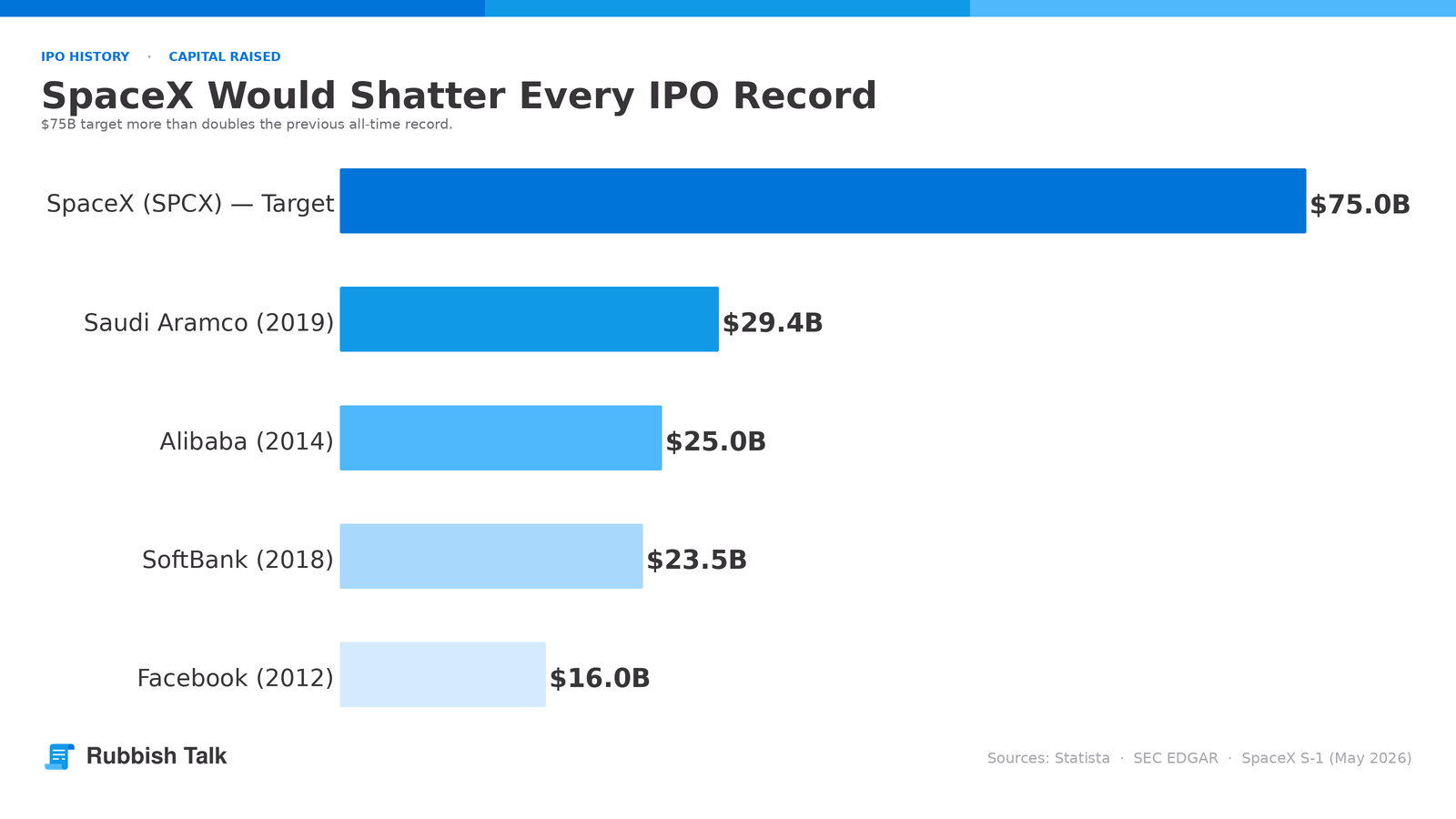
On May 20, 2026, SpaceX filed its S-1 prospectus with the SEC, targeting a June 12 Nasdaq debut under the ticker SPCX at a valuation of up to $1.75 trillion and a $75 billion raise — more than double the previous IPO record. The headline story is a rocket company going public. The real story is more complicated: a satellite internet business propping up a deeply unprofitable AI company, all controlled by one man with 85% of the votes. Investors buying into the hype need to read what the S-1 actually says before June 12.
Three Companies. One Price Tag. Know What You’re Buying.
The coverage of SpaceX’s IPO has mostly treated it as a single story. It is not. The S-1 combines three fundamentally different businesses — each with a different financial profile, a different growth trajectory, and a different set of risks — and asks investors to price them as one number at $1.75 trillion.
In February 2026, SpaceX completed an all-stock merger with xAI, Elon Musk’s AI company, which had itself absorbed X (formerly Twitter) a year earlier in March 2025. Because these deals occurred between entities under common control, US accounting rules required SpaceX to recast every historical period to include all three businesses combined. The result is that virtually every headline figure you’ve read about SpaceX’s IPO — the $18.7 billion in 2025 revenue, the $4.9 billion net loss — represents a newly assembled conglomerate, not the rocket-and-satellite company most people have in mind.
Standalone SpaceX generated closer to $15–16 billion in 2025 revenue. The gap is xAI and X. And that gap comes carrying enormous losses.
Here is how the three segments actually performed in 2025:
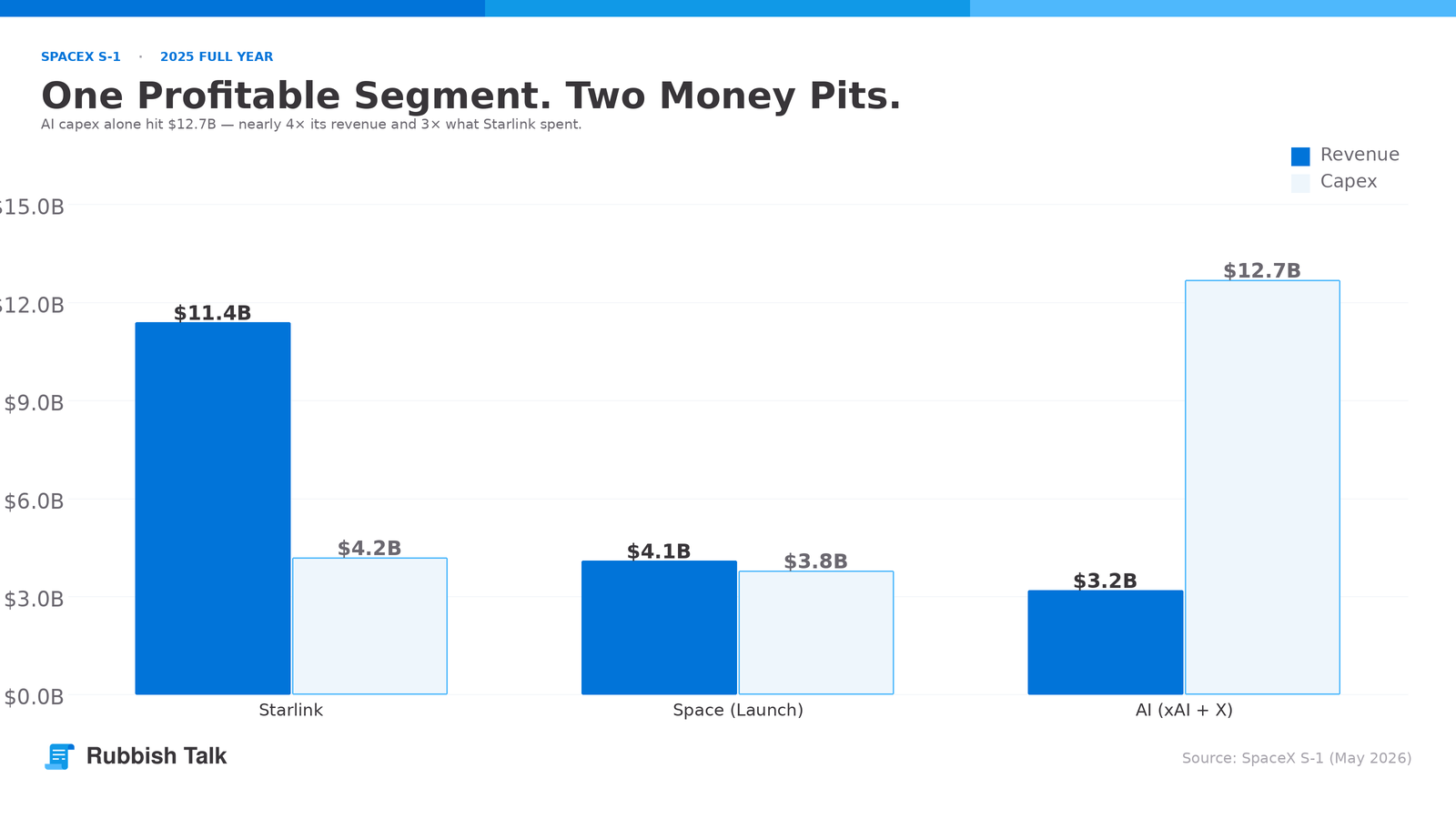
Connectivity (Starlink): $11.4B revenue / $4.4B operating income / $4.2B capex
Space (launch): $4.1B revenue / -$657M operating income / $3.8B capex
AI (xAI + X + Grok): $3.2B revenue / -$6.4B operating income / $12.7B capex
The consolidated operating loss of $2.6 billion disappears when you separate the three. Starlink is highly profitable. Launch reinvests deliberately. AI bleeds at scale. To price this IPO honestly, you have to separate them — because the market is currently pricing all three as if they are the same business.
Starlink: The Only Thing Making Money
Starlink is the investment case. Full stop.
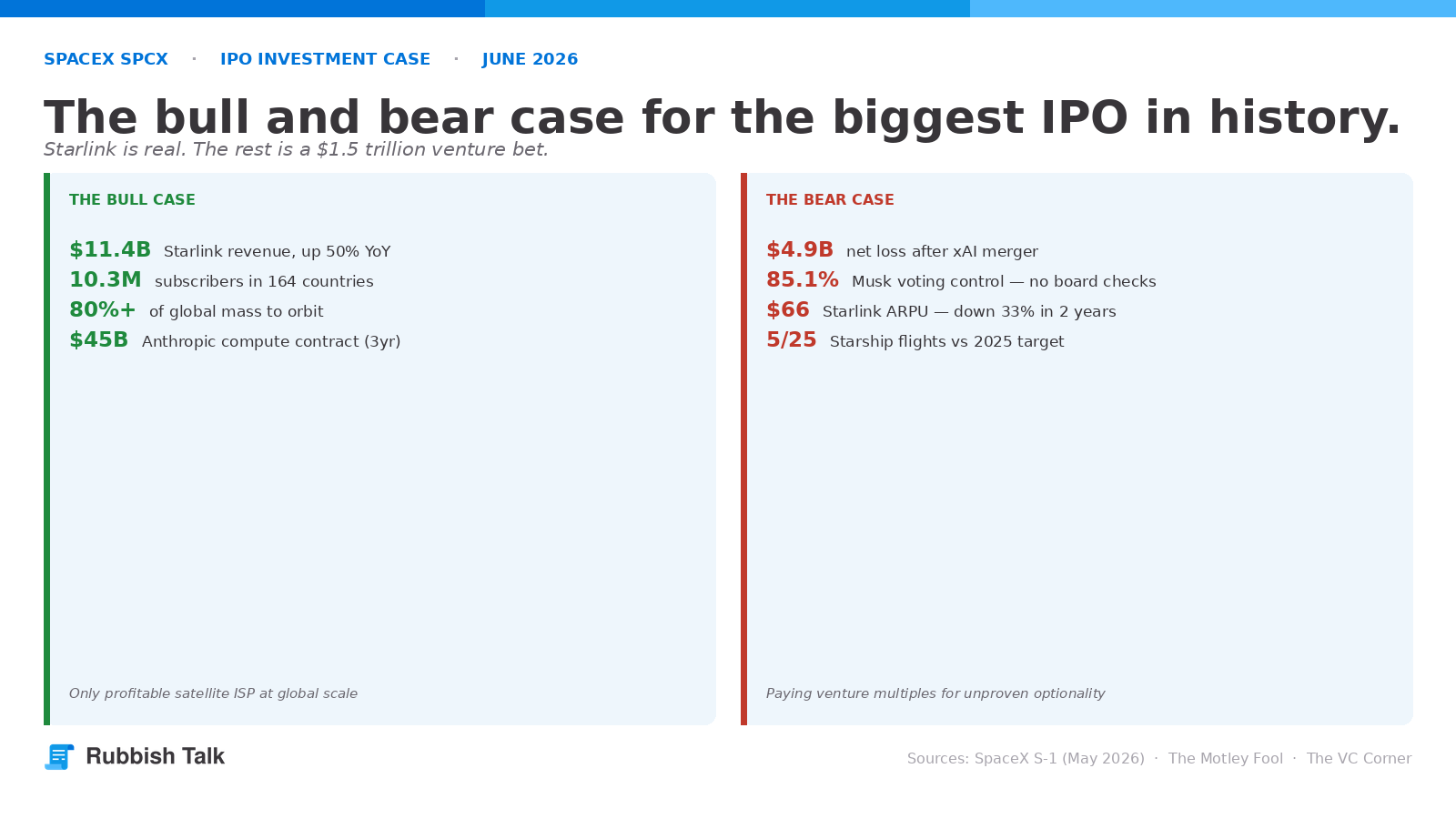
The connectivity segment generated $11.4 billion in 2025 revenue — 61% of the consolidated total — growing 49.8% year over year, with $4.4 billion in operating income and $7.2 billion in segment-adjusted EBITDA. It is the only segment in the entire filing that produces GAAP profit. In Q1 2026, Starlink generated $3.26 billion in revenue and $1.19 billion in operating income — more than four times the revenue of the launch business in a single quarter.
The scale of what SpaceX has built is genuinely remarkable. As of Q1 2026, Starlink serves 10.3 million subscribers across 164 countries, backed by a constellation of over 9,600 satellites — roughly 75% of them active and maneuverable. Terminal manufacturing costs fell 59% in 2025 alone, improving the unit economics of adding new customers significantly.
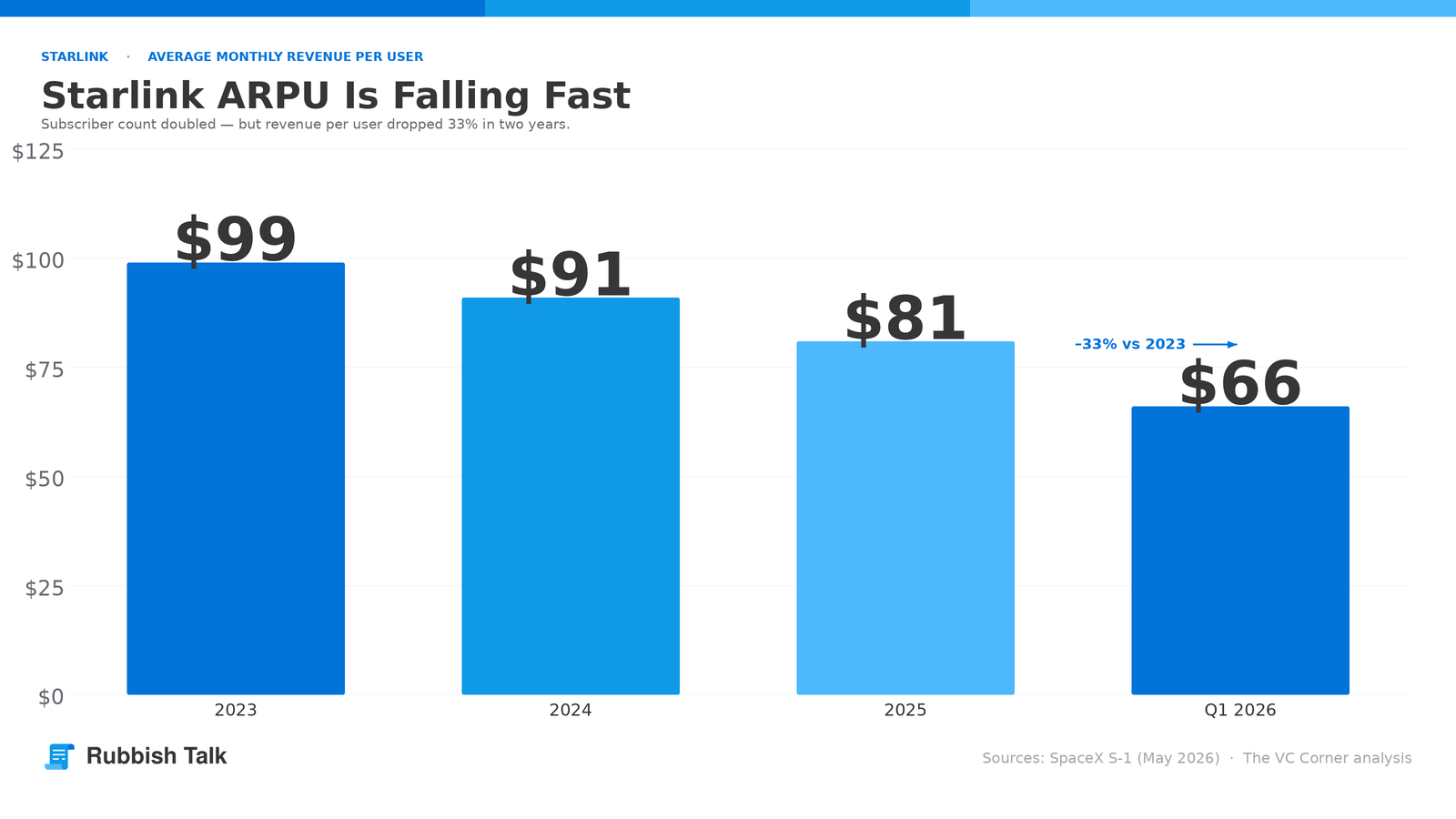
But there is a warning sign buried in the subscriber metrics that most coverage has glossed over. Even as the subscriber count doubled from 5 million in Q1 2025 to 10.3 million in Q1 2026, average monthly revenue per user has been falling consistently:
- 2023: $99/month ARPU
- 2024: $91/month ARPU
- 2025: $81/month ARPU
- Q1 2026: $66/month ARPU — a 23% year-over-year decline
Volume is currently outrunning the price compression, keeping headline revenue growing. But at a valuation north of 90 times revenue, the direction of that per-subscriber line matters enormously. Starlink’s growth story is shifting from price-and-volume to volume-only as it pushes into lower-priced international and consumer markets. That is a materially different business than the one implied by the top-line numbers.
At $1.75 trillion, SpaceX would trade at roughly 110 times standalone 2025 revenue — a multiple that dwarfs every aerospace comparable. Morningstar pegs the valuation at around 94 times 2025 revenue even at their more conservative $1.5 trillion reference price. Traditional aerospace primes like Boeing and Lockheed Martin trade at roughly 1–1.5 times revenue and single-digit to low-teens EV/EBITDA; the broader aerospace and defence sector averages around 14 times EBITDA. SpaceX is being priced as a tech platform, not a manufacturer.
The xAI Merger: Profitable Company Becomes a Loss Machine
In 2024 — the last full year before the xAI merger — standalone SpaceX posted $791 million in net income. It was a profitable company with a clear path to increasing that profitability as Starlink scaled.
In 2025, after recasting to include xAI and X, the combined entity posted a $4.94 billion net loss. In Q1 2026 alone, a single quarter produced a $4.28 billion loss — driven almost entirely by the AI segment, which burned $6.4 billion in operating losses in 2025 and accelerated to $7.7 billion in capex in Q1 2026, an annualized pace exceeding $30 billion.
The cash math is stark. SpaceX’s cash fell from $24.7 billion to $15.9 billion in a single quarter. Operating cash flow remained positive at $1 billion in Q1, but investing outflows hit $16.7 billion. The company bridged the difference with $7.1 billion in new financing, on top of $29.1 billion in total principal debt and a fresh bridge loan signed in March 2026.
At that burn rate, the $75 billion IPO raise looks less like ambition and more like operational necessity. The company needs public capital to keep building at the speed it has chosen.
The merger turned a profitable company into a loss-maker overnight. In 2024, standalone SpaceX posted $791 million in net income. The S-1 then recasts 2025 to include xAI, and the same company now reports a $4.94 billion net loss — a swing of nearly $5.7 billion driven entirely by one segment that did not exist inside the filing a year earlier.
The S-1 also discloses a deal that has received surprisingly little attention: in May 2026, SpaceX signed Cloud Services Agreements with Anthropic — a direct xAI competitor — for access to its COLOSSUS and COLOSSUS II AI compute infrastructure at $1.25 billion per month through May 2029. That is roughly $15 billion a year, up to $45 billion over the term. Either party can terminate on 90 days’ notice. xAI built the largest coherent AI training cluster on Earth, then started renting spare capacity to a competitor. It converts idle compute into immediate revenue, but it also hands Anthropic world-class infrastructure on a very short leash.
Launch: A Deliberate Money-Loser With a $15 Billion Bet
The space segment — the rocket launches that made SpaceX famous — posted a $657 million operating loss in 2025, driven by approximately $3 billion in Starship research and development costs. This is not a business in trouble; it is a deliberate strategic choice. SpaceX has spent more than $15 billion developing Starship, and everything downstream depends on it.
The launch track record is genuinely extraordinary. SpaceX completed 165 orbital launches in 2025, its sixth consecutive annual record, carrying over 80% of global mass to orbit. More than 85% of missions used reused boosters, with the 500th Falcon 9 launch featuring a booster flying for a record 29th time. No competitor is close.
But Starship, the vehicle on which SpaceX’s entire long-term strategy rests — V3 satellite constellations, satellite-to-mobile coverage, orbital data centers — has badly missed its own milestones. SpaceX completed 5 Starship test flights in 2025 against a publicly stated target of 25, a fivefold miss. The S-1 targets 2H 2026 for the first commercial-grade Starship flights. If that slips, nearly every growth narrative in the filing — from Starlink V3 to orbital AI compute — slips with it.
Governance: You Get One Vote. Musk Gets Ten.
The governance structure of the SpaceX IPO is worth reading carefully before the roadshow hype takes over.
SpaceX uses a dual-class share structure in which Class B shares carry ten votes each. Elon Musk controls 85.1% of combined voting power, owning 12.3% of Class A shares and 93.6% of Class B shares. He will serve simultaneously as CEO, CTO, and Chairman after the IPO. SpaceX qualifies as a “controlled company” under Nasdaq rules and opts out of several key governance requirements, including the requirement for an independent-majority board.
In plain terms: public investors can buy shares and participate in any upside, but they cannot meaningfully influence how the company is run, who sits on its board, or how capital is allocated across three businesses with very different financial profiles. If the xAI strategy burns cash without building value, shareholders have no mechanism to course-correct.
The risk factor section runs to 38 pages, and it is unusually direct about Musk-specific risks. Divided attention is listed explicitly — Musk simultaneously runs Tesla, Neuralink, The Boring Company, and his own government advisory role. The 2024 Brazilian government asset seizure — triggered by disputes over Musk’s conduct rather than SpaceX’s operations — gets its own risk factor. And the filing discloses approximately $530 million in potential legal liabilities, including an Irish Data Protection Commission GDPR investigation into Grok’s handling of children’s data and allegations that the chatbot generated nonconsensual sexualized imagery.
Government revenue is another concentration risk that often gets buried under the bigger numbers. About 20% of 2025 revenue came from US federal agencies, including NASA (over $13 billion in cumulative contracts), the Pentagon, and the Space Force. DOGE-related budget pressures have cut spending across federal agencies — but not at SpaceX, a fact that has drawn scrutiny and conflict-of-interest questions given Musk’s simultaneous role as a government cost-cutter.
The Valuation: A $28.5 Trillion Dream Priced at 94x Revenue
SpaceX describes its total addressable market as “$28.5 trillion — the largest actionable TAM in human history.” Broken down: Space at $370 billion, Connectivity at $1.6 trillion, and AI at $26.5 trillion. AI accounts for 93% of the entire claimed TAM. Enterprise AI applications alone — $22.7 trillion — dwarf every other category combined.
The S-1 itself concedes that several of these target markets, including in-orbit manufacturing, lunar energy production, and asteroid mining, do not yet exist.
At $1.75 trillion, SpaceX would trade at roughly 94 times its 2025 consolidated revenue — a figure that inflates to around 110 times if you strip xAI out and look at standalone SpaceX revenue. For comparison, Boeing trades at roughly 1x revenue; Lockheed Martin at 1.5x; even high-growth tech giants rarely sustain price-to-sales ratios above 20–30x for long. SpaceX’s combined market cap would exceed Boeing, Lockheed Martin, Northrop Grumman, and Airbus combined.
That premium reflects not the business SpaceX has built, but the business it plans to build: Starship at scale, Starlink V3, orbital data centers by 2028, a chip-manufacturing initiative called Terafab (currently a non-binding framework agreement with Tesla and Intel), and an option to acquire the AI coding tool Cursor at a $60 billion implied valuation. Each of these is a venture bet. Priced together inside a single public company at 94x revenue, sold to retail investors through Schwab, Fidelity, and Robinhood at the same price as institutions.
“It’s less of a space exploration company and more of a satellite communications company that is propping up a deeply unprofitable AI and social networking company.”
— Leo Sun, The Motley Fool, May 2026
What Investors Should Watch Before June 12
The five most important things to track before SpaceX prices its IPO:
1. The price range. The S-1 cover page lists blank price fields. The range — and the real market verdict on whether $1.75 trillion holds — arrives during the roadshow in early June.
2. Starship flight twelve. Any slip past 2H 2026 hits every growth narrative simultaneously: V3 satellites, satellite-to-mobile, orbital compute. This is the single biggest binary risk in the filing.
3. ARPU trend. A continued slide below $66/month signals Starlink is entering volume-only growth territory. At 94x revenue, how per-unit economics evolve matters more than most coverage suggests.
4. AI segment burn acceleration. Q1 2026 AI capex hit $7.7 billion. Watch whether any amended S-1 filings show Q2 accelerating further. At $30 billion annualized, the $75 billion raise has a shorter runway than it appears.
5. The Anthropic contract. A 90-day-cancellable $15 billion-per-year deal is a single-counterparty swing factor in AI segment revenue. Any change in that relationship between now and June 12 changes the picture materially.
The SpaceX IPO is genuinely historic. The launch infrastructure is unrivalled. Starlink is a real, profitable, and fast-growing business. But investors are being asked to pay a venture price for the optionality — Starship, orbital data centres, Grok, enterprise AI — inside a company where they hold one vote for every ten Musk holds. That is not necessarily a reason to avoid it. It is a reason to price it with both eyes open.
Sources
- SpaceX S-1 Filing — SEC EDGAR (May 2026)
- SpaceX Just Filed the Biggest IPO in History — The VC Corner
- Here Are 7 Important Things Investors Learned from SpaceX’s S-1 Filing — The Motley Fool
- Blast Off: SpaceX Finally Files IPO Prospectus — Fortune
- SpaceX S-1: Starlink’s Cash, Starship’s Burn, and a 2 Trillion Dollar Bet — Capital Blueprint
- Inside SpaceX’s S-1: Three Companies. One Profit. $1.75 Trillion — SatNews
- Does SpaceX’s Sky-High Valuation Make Sense? — Morningstar
- 6 Charts on SpaceX’s Pre-IPO Financials — Morningstar
- SpaceX’s IPO Filing Has a Whopping 38 Pages of Risk Factors — MoneyWise
- SpaceX Government Contracts: $22 Billion in Federal Awards — Fed-Spend
- To Trillion(s) and Beyond: A SpaceX IPO Odyssey — Aswath Damodaran
- SpaceX Has Spent More Than $15 Billion on Starship — The Next Web
- Starlink Generates Over $11 Billion in Revenue — Crypto Briefing