

MicroStrategy has accumulated over 818,000 Bitcoin using stock sales, convertible bonds and preferred shares — creating a financial flywheel that amplifies both the upside and the downside for ordinary shareholders.
What Is Actually Happening
MicroStrategy — now rebranded as simply Strategy — has executed one of the most audacious corporate treasury transformations in modern financial history. Since August 2020, when co-founder and executive chairman Michael Saylor placed the company’s first $250 million bet on Bitcoin, the firm has never stopped buying. As of 11 May 2026, Strategy holds 818,869 Bitcoin acquired at an average cost of $75,540 per coin, representing roughly 3.9% of the total Bitcoin supply that will ever exist.
The vehicle for this accumulation is a financial structure that most traditional analysts still struggle to categorise. Strategy raises capital through three primary instruments: at-the-market (ATM) equity offerings that sell freshly issued common stock (MSTR) directly into secondary markets; convertible senior notes — effectively bonds that can be converted into MSTR shares at a predetermined price; and more recently, preferred shares (STRK and STRF) carrying fixed dividend obligations. Every dollar raised flows into one asset: Bitcoin.
The company has articulated this as a “21/21 Plan” — a three-year initiative announced in late 2024 to raise $42 billion by 2027, split evenly between equity sales and fixed-income securities, earmarked entirely for further Bitcoin purchases. By May 2026 the plan is well advanced, and the share count has ballooned from 76 million in 2020 to over 310 million today — a four-fold dilution that sits at the centre of every legitimate critique of the strategy.
The Mechanics: How the Flywheel Works
The machine has a self-reinforcing logic that Saylor calls a “Bitcoin yield” flywheel. Here is the core loop: Strategy sells new shares or bonds, uses the proceeds to buy Bitcoin, the Bitcoin purchase pushes the narrative of institutional adoption, MSTR’s stock price rises (often at a premium to the underlying BTC value), which makes the next equity raise cheaper and faster, which funds the next Bitcoin purchase. Repeat.
The convertible bond piece is particularly elegant from a capital markets standpoint. Strategy has issued approximately $8.2 billion in convertible senior notes across multiple tranches at a weighted average coupon of just 0.421% — several tranches carry a 0% coupon, meaning bondholders receive no interest whatsoever. This is possible because the bonds embed an equity conversion option: hedge funds buy the notes, short MSTR stock, and use the embedded optionality to profit from MSTR’s extreme volatility regardless of price direction. With MSTR’s 30-day implied volatility sitting around 106% — compared to roughly 60% for Bitcoin itself and just 15% for the S&P 500 — that embedded option is enormously valuable, allowing Strategy to borrow at near-zero cost.
The equity ATM programme works differently — selling MSTR shares at market prices when MSTR trades at a premium to its net asset value (NAV). At the height of the cycle in late 2024, MSTR’s NAV premium hit roughly 2.5× — meaning the market was paying $2.50 for every $1 of underlying Bitcoin. Selling overvalued stock to buy undervalued-by-comparison Bitcoin is, in that scenario, mathematically accretive per share. As of early May 2026, the mNAV on a market-cap basis has compressed to approximately 0.97×, meaning the premium has evaporated — a structural shift with significant implications for the flywheel’s efficiency.
“Bitcoin is the exit strategy. Every dollar of capital we raise is another dollar allocated to the hardest asset in human history.”
— Michael Saylor, Executive Chairman, Strategy (MicroStrategy), multiple investor communications
Shareholder Mathematics — Who Is Benefiting and How
The long-term return figures are striking. Since Strategy pivoted to its Bitcoin treasury model in mid-2020, MSTR stock has delivered annualised returns of approximately 100.5%, compared to Bitcoin’s annualised return of roughly 59.2% over the same period — a significant outperformance on a compound basis. Over the five-year window, MSTR’s Sharpe ratio has been higher than Bitcoin’s, meaning shareholders were, by that measure, better compensated for the risk they took.
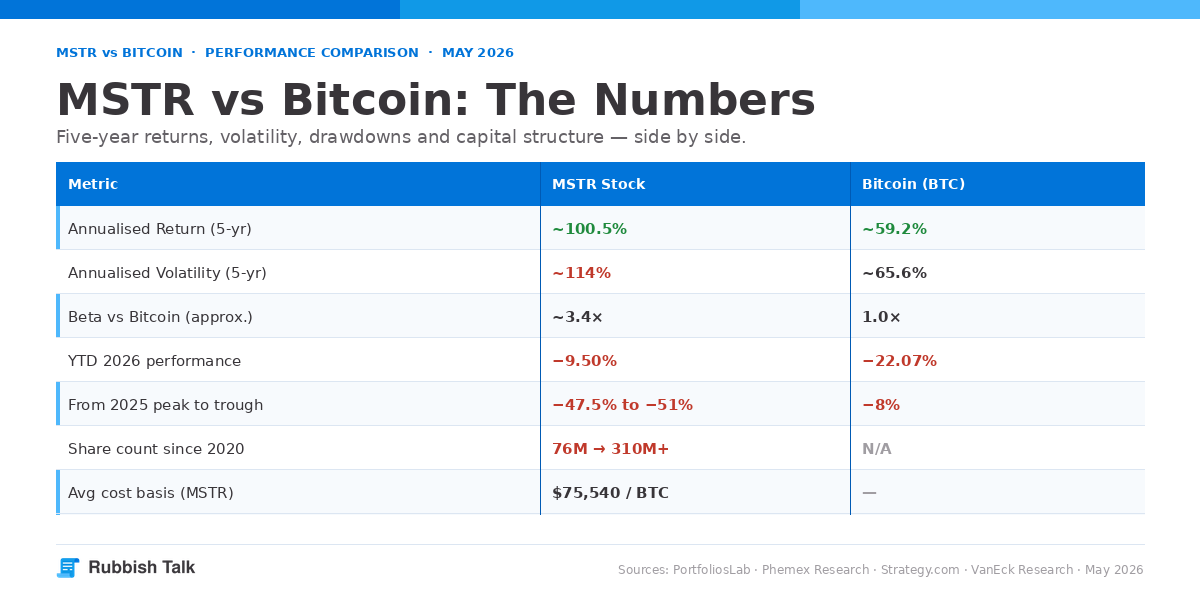
The picture is more nuanced than the headline five-year returns suggest. MSTR is not Bitcoin — it is a leveraged, dilution-exposed, debt-laden proxy for Bitcoin. In the up-cycle from 2020 to late 2024, leverage amplified gains. In the down-cycle from the 2025 peak to early 2026, the same leverage amplified losses: MSTR lost over 50% from its highs while Bitcoin declined just 8% over the same stretch. The beta cuts both ways.
The preferred share obligations add another layer of complexity. STRK dividend payments were projected to rise from $217 million in 2025 to $904 million in 2026 — commitments that sit above common shareholders in the capital structure. Common MSTR holders sit at the bottom of that stack. They benefit from the upside last, and absorb losses first.
MSTR vs. Just Buying Bitcoin — The Honest Comparison
The fundamental question for any potential investor is simple: should I buy MSTR or just buy Bitcoin? The answer depends entirely on which scenario materialises.
If Bitcoin enters a sustained multi-year bull cycle, MSTR historically outperforms BTC significantly — the leverage effect, combined with the premium-to-NAV mechanics that allow accretive share issuances, creates genuine per-share Bitcoin growth that pure BTC holders do not receive. In this scenario, the dilution is offset by the BTC yield, and common shareholders end up with more economic exposure to Bitcoin appreciation than if they had simply bought the underlying asset.
If Bitcoin stagnates or falls, the calculus reverses sharply. MSTR holders face the dilution from ongoing share issuances without the offset of per-share BTC accumulation at accretive prices. They face preferred dividend obligations draining cash that might otherwise service debt. And they face a NAV premium that can compress — or turn into a discount — further eroding the stock’s value relative to underlying BTC. Buying Bitcoin directly sidesteps all of this: no coupon risk, no dilution, no preferred share seniority, no debt maturities.
“The question is not whether you believe in Bitcoin. The question is whether you believe in this particular financial structure’s ability to enhance Bitcoin exposure without destroying it through leverage and dilution.”
— Matthew Sigel, Head of Digital Assets Research, VanEck (analysis published 2025)
For the five-year holder who bought MSTR in mid-2020, the answer is definitively: MSTR was the better trade. For anyone who bought near the November 2024 peak when the NAV premium was at 2.5×, MSTR has been a significantly worse outcome than simply holding Bitcoin. The entry point and the prevailing NAV premium at time of purchase are arguably the most important variables in the analysis.
The Downside Scenarios — What Can Break This
Debt maturity wall: Approximately $8.2B in convertible notes matures primarily between 2027 and 2030. If Bitcoin is in a bear market during those windows, refinancing becomes expensive or impossible — and liquidation of BTC holdings at depressed prices cannot be ruled out.
NAV premium collapse: The flywheel depends on issuing shares at a premium to NAV. As of May 2026, that premium has effectively disappeared (mNAV ≈ 0.97×). New equity raises are no longer obviously accretive — and could be dilutive to per-share BTC.
Preferred dividend cascade: STRK obligations of ~$904M in 2026 represent a fixed cash drain regardless of Bitcoin’s price, putting direct pressure on the company’s liquidity position.
Regulatory or custody risk: A significant adverse regulatory ruling on Bitcoin’s classification or a custody event (exchange failure, government seizure) would directly impair the treasury.
Forced selling spiral: If BTC drops sharply during a debt maturity window, forced BTC sales could suppress Bitcoin’s price further, creating a self-reinforcing liquidation spiral in both MSTR and BTC markets.
The debt structure is more resilient than it first appears. Strategy holds approximately 712,647 unencumbered Bitcoin — coins not pledged as collateral — giving it significant flexibility to manage maturities without forced near-term selling. Bulls argue that even if Bitcoin fell to $8,000, the company could meet its convertible note obligations from its holdings. Bears counter that S&P Global’s October 2025 junk credit rating assignment reflects a structurally fragile situation where debt maturities and Bitcoin down-cycles can coincide with devastating effect.
Critically, in May 2026 Saylor broke from his previously absolute no-sell stance, acknowledging for the first time that the company would consider selling Bitcoin if necessary to service obligations. That shift — however hypothetical in tone — represents a structural change in the risk profile that any shareholder should factor into their analysis.
What Is Being Overlooked
Most mainstream coverage frames the MSTR trade as a binary: brilliant visionary or reckless gambler. The more interesting analytical question is structural: what does it mean for Bitcoin’s price dynamics when a single corporate entity controls 3.9% of supply and is actively leveraging public capital markets to accumulate more?
Strategy’s buying programme provides a persistent, programmatic demand signal that Bitcoin ETFs — passive vehicles that simply track price — do not. Every capital raise, regardless of market conditions, is designed to translate into more Bitcoin purchased. This structural buying pressure is genuine and has contributed to price support during periods of market stress. Whether it represents a systemic vulnerability — a single point of forced selling that could cascade through the market — is a question the crypto ecosystem has not yet had to answer with real data.
The second overlooked dimension is the corporate treasury contagion effect. Strategy’s model has attracted imitators: Metaplanet in Japan, Semler Scientific, Genius Group, and others have adopted similar Bitcoin treasury frameworks. The aggregate supply pressure these firms represent is not trivial, and correlates their stock prices with Bitcoin in ways that reduce portfolio diversification benefits for institutional holders who own multiple names in the space.
What Comes Next
The immediate pressure point is the NAV premium. With mNAV near parity, Strategy’s ability to issue equity at accretive prices is constrained. The BTC Yield target of 15%+ for the coming year becomes harder to achieve through share issuances alone when those issuances are no longer buying Bitcoin at a discount to their share price. The company will likely need Bitcoin to appreciate materially — or the premium to re-expand — before the flywheel returns to its most efficient configuration.
The debt maturity schedule of 2027–2030 is the medium-term test. If Bitcoin is above the company’s average cost basis of $75,540 per coin when those notes mature, refinancing is manageable and the thesis remains intact. If not, the company faces a choice between issuing highly dilutive equity, selling Bitcoin at a loss, or a restructuring that would crystallise losses for common shareholders in a way the five-year return data does not capture.
For shareholders today: MSTR is not a Bitcoin substitute. It is a Bitcoin-leveraged operating company with a complex capital structure, preferred share obligations, and significant execution risk around capital markets conditions. Investors who understand that distinction — and price it accordingly at a time when the NAV premium has compressed — may find it a more interesting entry point than at any moment since 2022. Those who mistake it for a simple Bitcoin proxy without accounting for that structural complexity are taking a risk they may not fully appreciate.
Sources
- Bitcoin Purchase History — Strategy
- Strategy Holdings & Analysis — Bitcoin Treasuries
- Deconstructing Strategy: Premium, Leverage, and Capital Structure — VanEck
- What Could Go Wrong as MSTR and Others Go Billions in Debt for More Bitcoin — CoinDesk
- MicroStrategy and Its Convertible Debt Scheme — Advisor Perspectives
- MSTR Deep Dive: Navigating the 2026 Bitcoin Yield Strategy — FinancialContent
- MSTR Stock Down 50% vs Bitcoin Down 8%: Why the Gap Widens — Phemex
- MSTR vs BTC-USD Performance Comparison — PortfoliosLab
- MicroStrategy vs Bitcoin: 5-Year Performance Comparison — IncomeShares
- Strategy Debt Wall Puts Bitcoin Treasury Discipline Under Review — Investing.com
- Strategy (MSTR) Q1 2026 Earnings Call Transcript — Motley Fool
- Michael Saylor’s Bitcoin Stack Is Officially Underwater (Jan 2026) — CoinDesk
- MSTR vs BTC: Price, Chart, CAGR & DCA — Bitbo
- Strategy Acquires 535 Bitcoin for $43 Million (May 11, 2026) — CryptoTimes
- Photo: Gage Skidmore from Surprise, AZ, United States of America — CC BY-SA 2.0, via Wikimedia Commons