
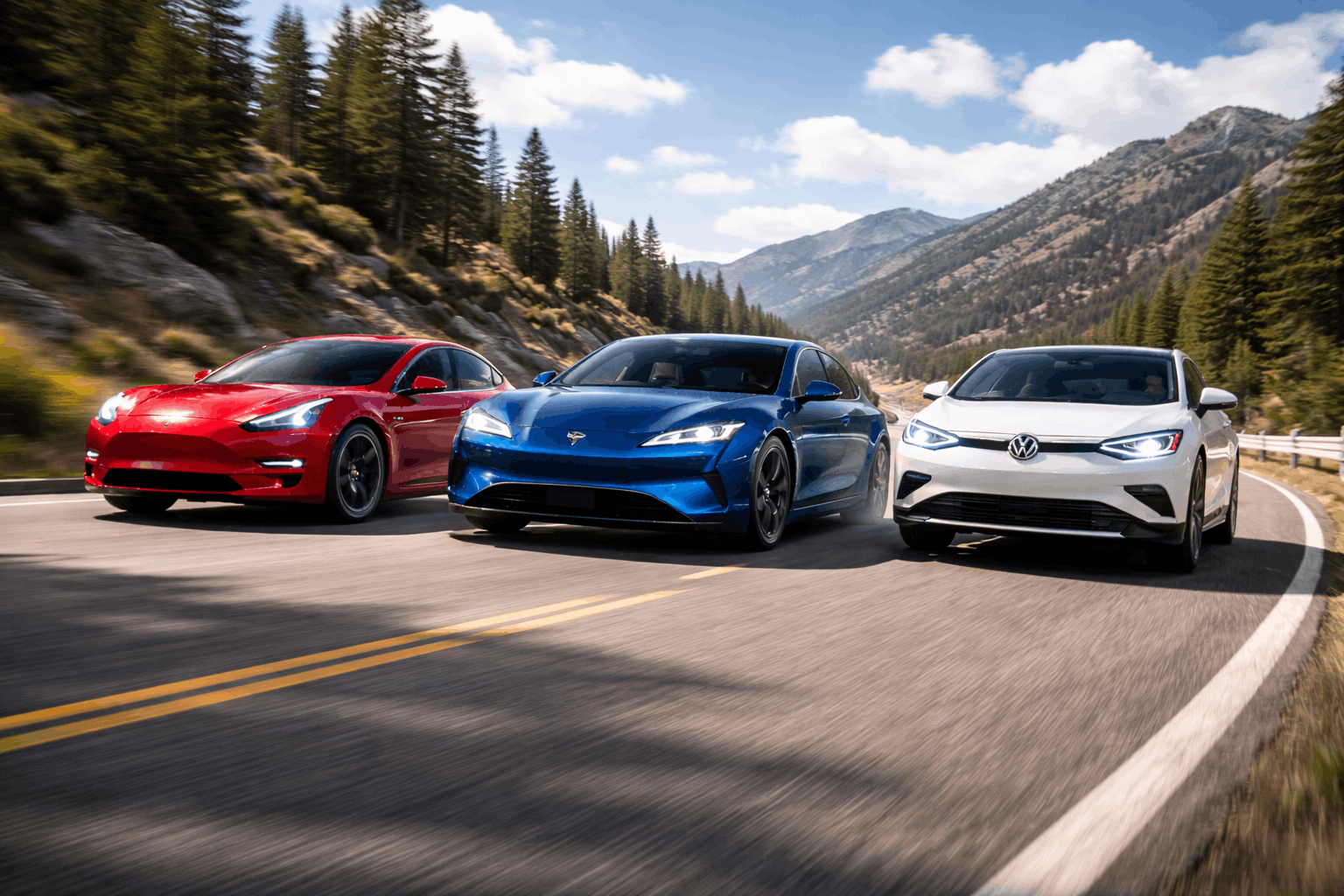
China has built an insurmountable battery cost advantage. The US is weaponising industrial policy. Europe is caught between protecting its automakers and embracing cheap Chinese cars. The global electric vehicle race is no longer about who invented the technology — it is about who controls the supply chain, the chemistry, and the price point.
What Is Actually Happening
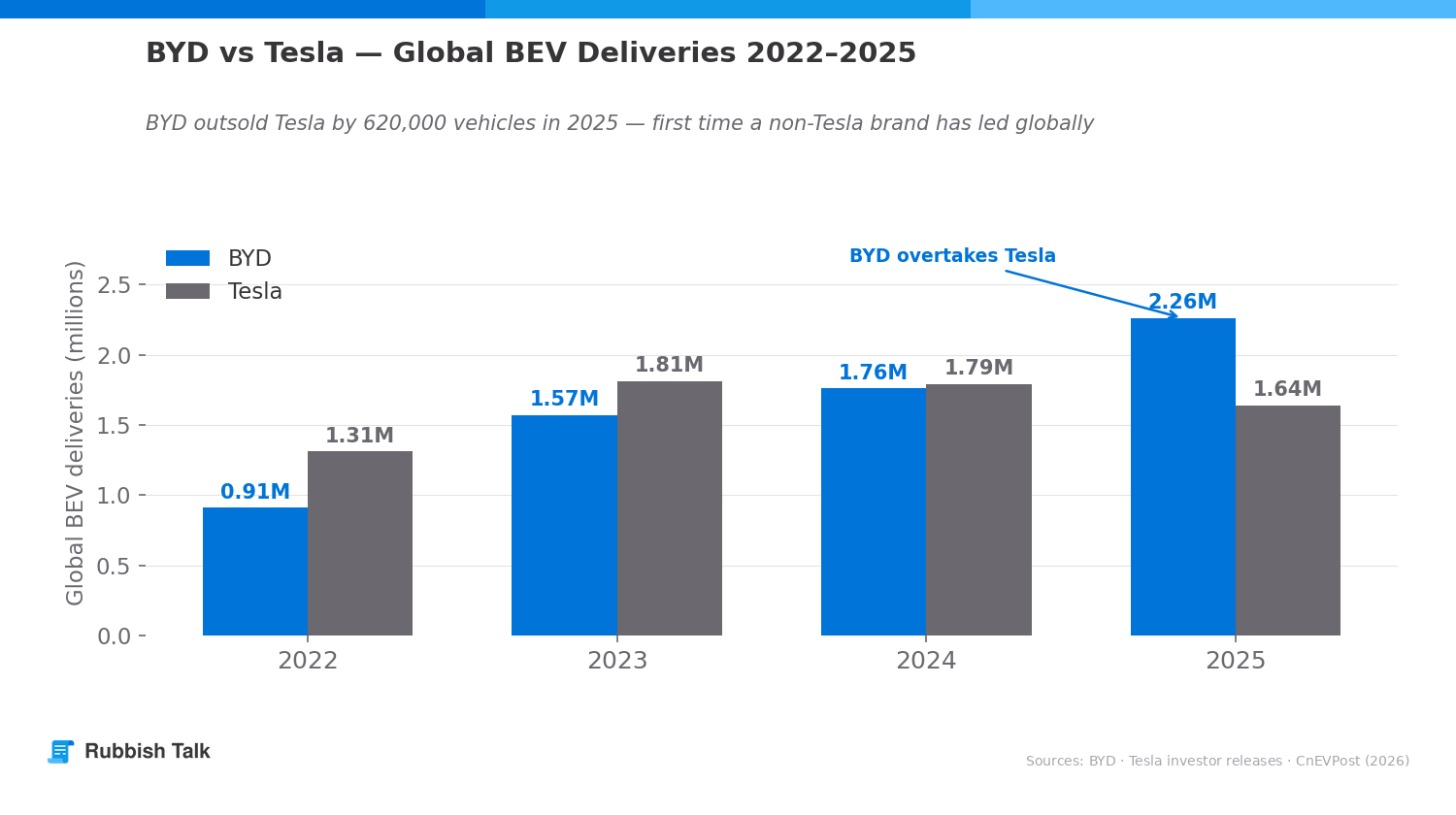
In 2025, BYD sold 2.26 million battery electric vehicles globally, overtaking Tesla’s 1.64 million deliveries to claim the world’s top-selling EV crown for the first time. It was not close. BYD outsold Tesla by more than 600,000 units, and its overseas sales topped one million vehicles — up 150% year over year. Meanwhile, Tesla’s global deliveries fell 8%, driven by a 15.6% collapse in Q4 alone.
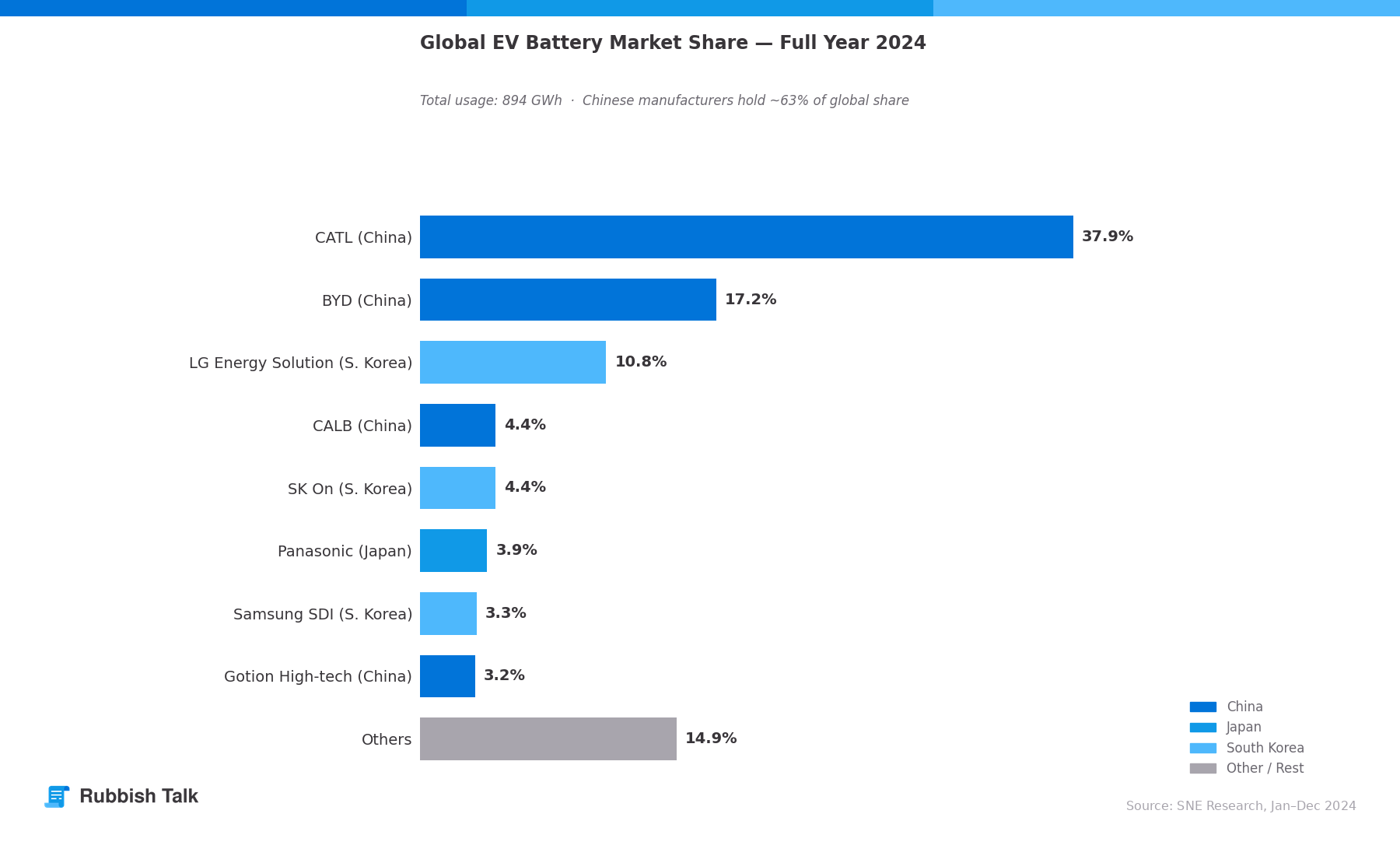
This is not simply a story about one Chinese company. CATL, the world’s largest battery manufacturer, ended 2025 with a 39.2% share of the global EV battery market, installing 464.7 GWh — a 35.7% increase on 2024. Six Chinese companies collectively controlled 68.9% of all EV battery installations worldwide. The upstream of the entire global EV industry — the cells that power virtually every electric car sold, from Munich to Michigan — runs through China.
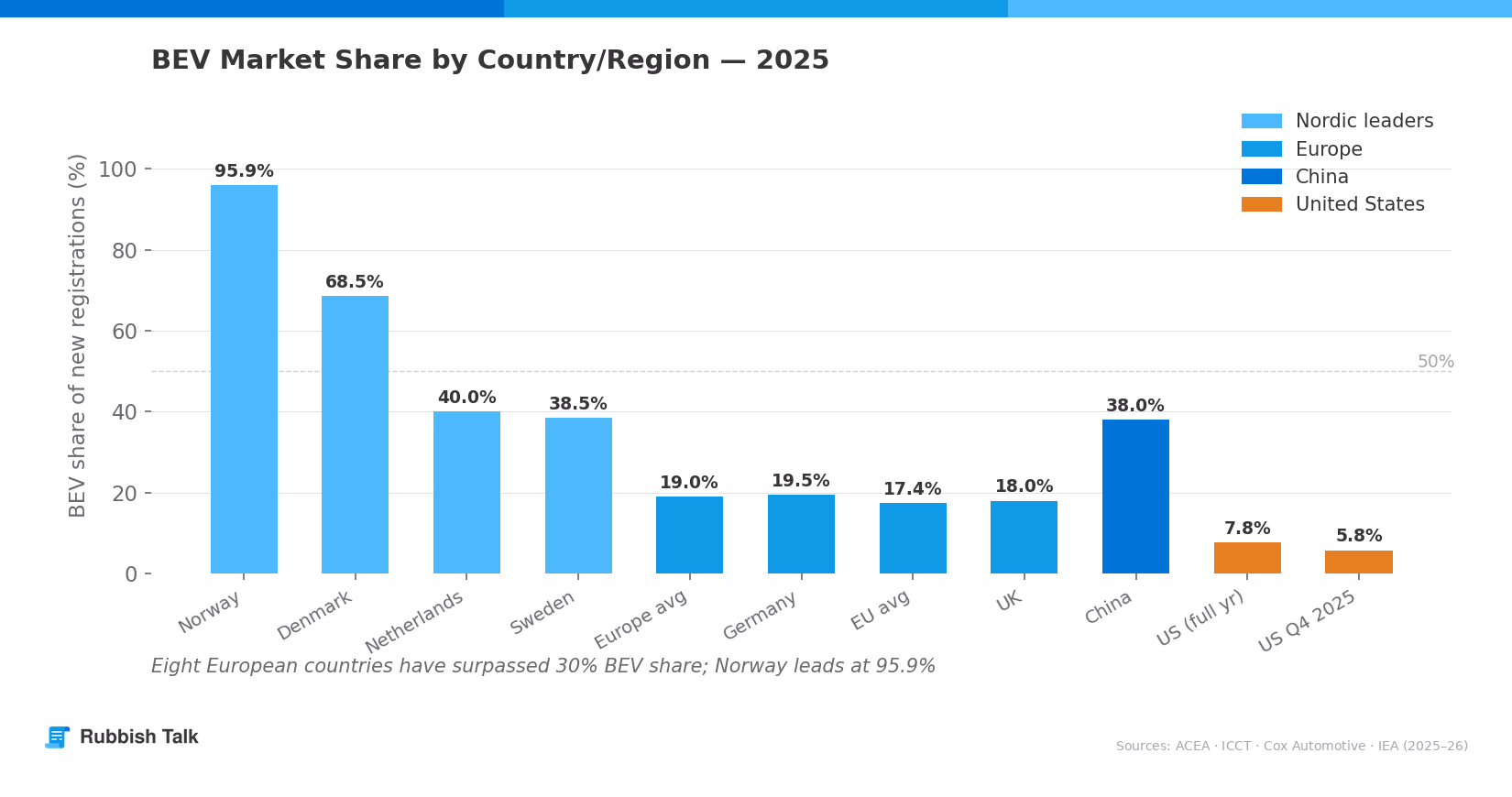
In Europe, battery electric vehicles hit a 17.4% market share in 2025, up from 13.6% the year prior, with 2.58 million EVs sold. Germany, the continent’s automotive heartland, posted a 43% surge in BEV sales. In the United States, EVs held a 7.8% market share for the full year — but that figure masks a dramatic Q4 collapse to 5.8% after the $7,500 federal tax credit was eliminated, raising immediate questions about how much US EV adoption is driven by consumer conviction versus government subsidy.
The Mainstream Narrative
The prevailing Western media framing treats the EV race as an ongoing competition: the US has Tesla and its Gigafactories; Europe has Volkswagen, BMW, and a strong industrial tradition; China has scale but questionable quality and faces trade headwinds. Tariffs are doing their job. The race is still open.
This framing is outdated. It confuses presence in finished vehicle markets — where competition is still genuinely contested — with leadership in the foundational technology layer, where China’s advantage is already structural, not cyclical.
What the Data Shows
The single most important number in the EV industry right now is battery cost per kilowatt-hour. In 2025, Chinese manufacturers achieved average battery pack prices of $84/kWh, down 13% from the prior year. Lithium iron phosphate (LFP) batteries — the dominant chemistry in China — hit $81/kWh, versus $128/kWh for NMC chemistry still prevalent in Western vehicles. Battery prices in North America and Europe were 44% and 56% higher, respectively, than in China.
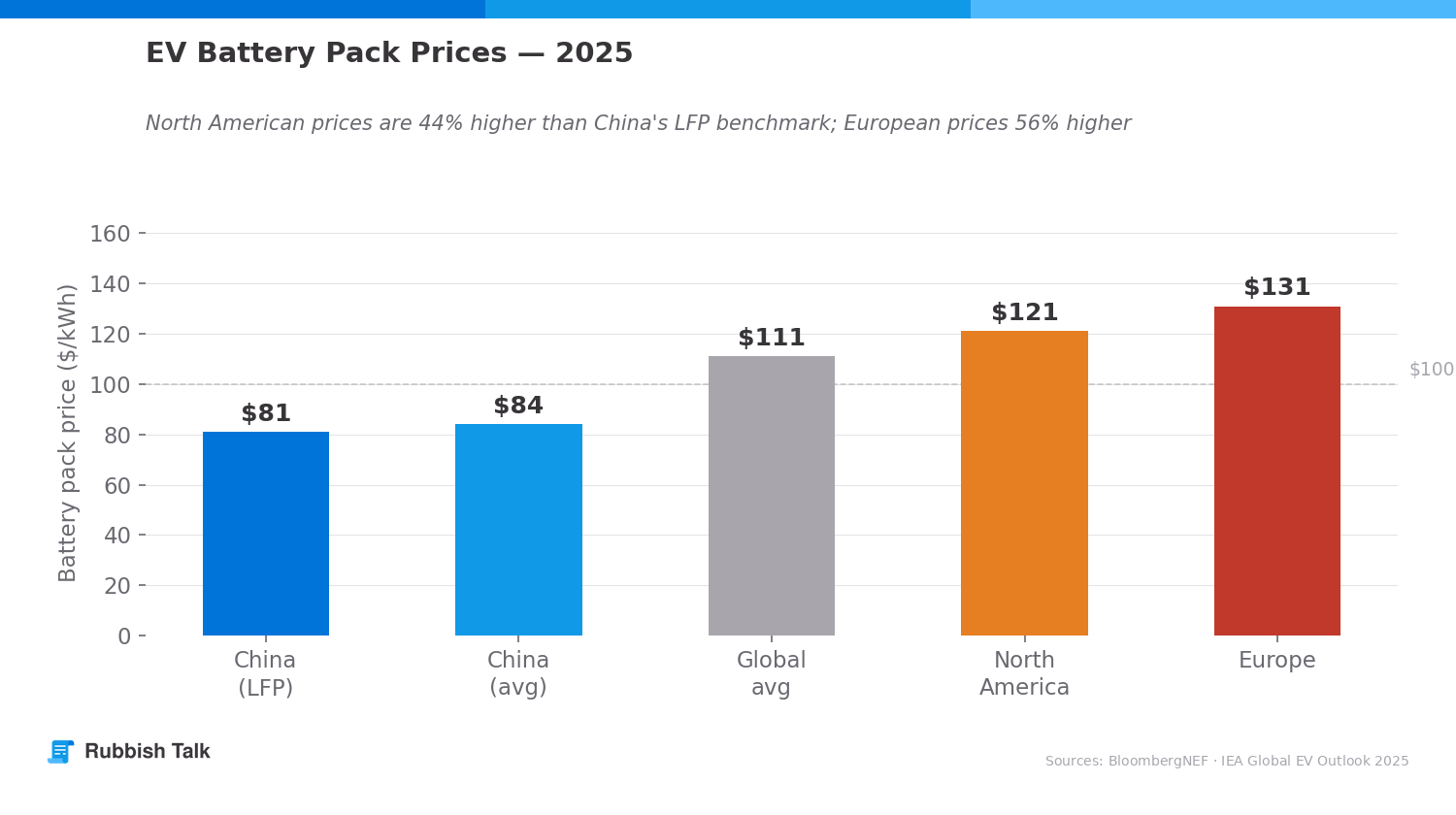
This gap is not a temporary inefficiency. It reflects China’s control of approximately 80% of global battery cell production capacity, its decades-long investment in the full LFP supply chain, and a ruthlessly competitive domestic market that has compressed margins while driving yield improvements. In short: Chinese EV manufacturers can build a competitive electric car at a price point that Western OEMs structurally cannot yet match.
BYD has used this advantage to push Chinese EVs below gasoline price parity in its domestic market — a threshold that European and US manufacturers are still years from reaching at scale. While Western automakers debate the profitability of their EV lines, BYD’s vertically integrated model — it manufactures its own batteries, semiconductors, and core components — has turned cost leadership into a competitive moat.
“The headlines and the 10-K tell different stories. BYD’s vertical integration isn’t just a manufacturing story — it’s a margin story. Every battery cell BYD makes is one it doesn’t have to buy.”
— Analyst commentary, Carbon Credits, January 2026
The US Response: Industrial Policy Over Market Competition
Washington’s answer to China’s structural advantage has been unambiguous: the Inflation Reduction Act. Since the IRA’s passage in 2022, the automotive industry has announced approximately $125 billion in US EV and battery manufacturing investment, with more than 84,000 jobs created or announced in the first year alone. The IRA’s $7,500 consumer tax credit — now cancelled under the new administration — was explicitly designed to stimulate demand while domestic supply chains were built out.
The IRA also introduced a harder edge from 2025 onward: eligible EVs may not contain critical minerals extracted, processed, or recycled by a “foreign entity of concern” — a category that includes China. This is industrial policy with geopolitical intent. It aims to decouple the US EV supply chain from Chinese inputs, accelerating domestic lithium, nickel, and cobalt sourcing even at significantly higher cost.
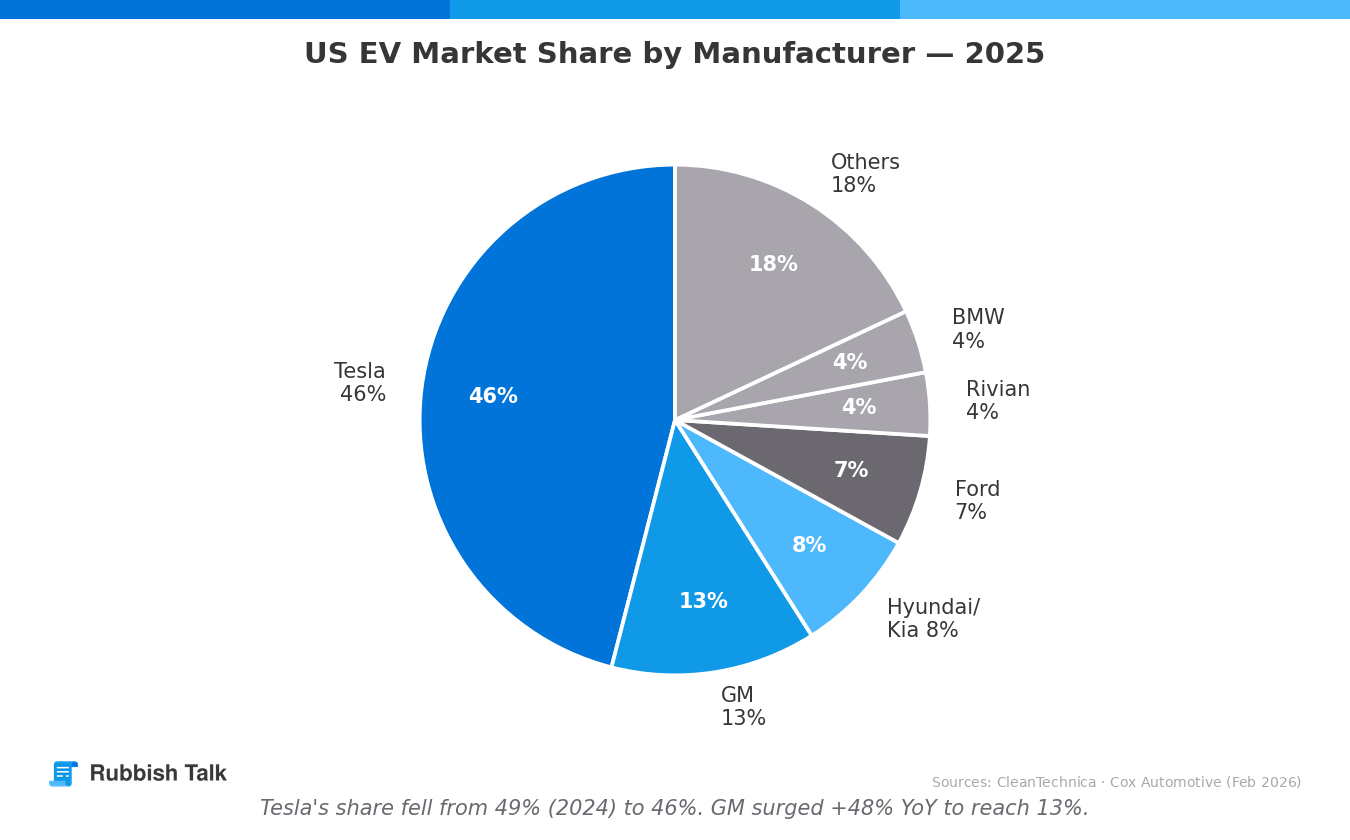
The results are mixed. GM posted 150,000 US EV sales in 2025, up 48% year on year, capturing 13% of the American market — a genuine industrial achievement. Tesla held 46% of US EV market share, down from 49%, facing intensifying competition from both domestic rivals and, via parallel imports, Chinese-made vehicles. But the abrupt Q4 2025 sales collapse — from 10.5% EV market share in Q3 to 5.8% in Q4 — after the tax credit expiry exposed a structural dependence on subsidies that American manufacturers have not yet overcome.
“EV realism is here. The question for 2026 is not whether EVs are the future — it is who pays for the transition, and who captures the margin when it arrives.”
— CNBC analysis, December 2025
Europe: Torn Between Protection and Access
Europe’s position is the most complex of the three. European EV adoption is accelerating — 19% of all new car registrations in 2025 were battery electric, the highest annual share ever recorded, with Norway at 95.9% and Denmark at 68.5% leading a continent-wide shift. But beneath these headline numbers lies a structural crisis in European automotive manufacturing.
Chinese EVs had achieved one in ten car sales in Europe by December 2025, outselling Audi and Renault in certain markets. The EU responded in 2024 with provisional tariffs of 17% to 35.5% on Chinese electric vehicles, citing unfair state subsidies. By early 2026, however, the EU had already begun retreating from the blunt tariff approach, pivoting instead to a minimum price floor system. Under this mechanism, Chinese manufacturers like BYD, SAIC, and Geely commit to a minimum selling price in exchange for tariff suspension.
Volkswagen was the first major automaker to agree to a minimum price arrangement — covering its China-made Cupra EVs — in return for suspension of a 20.7% tariff. The irony is pointed: a German manufacturer using Chinese production to sell Chinese-assembled cars in Europe, benefiting from a policy designed to protect European industry.
“By allowing Chinese manufacturers to commit to a price floor instead of facing 35.5% tariffs, the EU has effectively hit the reset button on the global EV market — but on terms that favour Chinese volume over European competitiveness.”
— Brussels Signal, January 2026
The Next Battleground: Solid-State Batteries
The one area where the outcome remains genuinely open is next-generation battery technology. Solid-state batteries — which replace liquid electrolytes with solid compounds, enabling higher energy density, faster charging, and improved safety — are the probable architecture of the post-2030 EV market.
Here the race is genuinely competitive. Toyota has announced commercialisation targets for 2027–2028, promising 1,000 km range and 10-minute charging. QuantumScape, backed by Volkswagen, reports volumetric energy density of 800 Wh/L and is targeting late-decade vehicle integration. CATL has announced advances in lithium metal battery endurance using a new lithium salt electrolyte, doubling cycle life while maintaining energy density. A CATL-backed solid-state electrolyte pilot received Chinese regulatory approval in early 2026.
The solid-state battery market was valued at $1.6 billion in 2025; forecasts project $27.7 billion by 2035 at a 38% CAGR. Whoever wins this race does not just win a technology award — they reset the entire cost and performance curve of the global EV industry.
China’s incumbency in conventional battery production gives it a structural advantage in scaling whatever chemistry emerges next. But incumbency can also breed complacency, and Japan’s precision manufacturing ecosystem — combined with US capital markets depth — means the solid-state race is far from determined.
What Is Being Overlooked
Most analysis focuses on vehicle-level competition: Tesla versus BYD, Volkswagen versus Chinese entrants. The more consequential battleground is invisible to most consumers: the battery supply chain, critical mineral processing, and cell manufacturing capacity.
China processes approximately 60% of the world’s lithium, 70% of its cobalt, and dominates the anode and cathode material supply chains that neither the US nor Europe has yet replicated at scale. The IRA’s “foreign entity of concern” restrictions are an attempt to address this dependency — but building alternative supply chains takes a decade, not a policy cycle.
Europe’s minimum price floor arrangement, meanwhile, is being sold as a protection for European industry. In practice, it locks in Chinese volume at a regulated price, delays the urgency for European manufacturers to close the cost gap, and does nothing to address the upstream supply chain dependency. It buys time without building capability.
What Comes Next
The near-term picture is clearer than the decade view. In 2026, Cox Automotive projects US EVs will hold approximately 8% of total new car sales — roughly flat with 2025, constrained by the tax credit removal and consumer uncertainty about charging infrastructure. New affordable models — the Chevrolet Bolt 2026, Rivian R2, refreshed BMW EV lineup — will compete for share, but the absence of a federal incentive removes a significant demand lever.
In Europe, the minimum price floor system will define competitive dynamics through 2026–2027, with the Commission reviewing model-by-model pricing. Entry-level Chinese EVs will face the largest relative price increases, which may create an opening for European manufacturers — if they can deliver competitive products fast enough.
In China, BYD and CATL will consolidate their global positions. BYD is targeting broader European and Southeast Asian expansion. CATL is building battery plants on multiple continents — including a Germany facility — to supply Western OEMs directly and sidestep tariffs through local production.
The structural question for the next decade is whether Western industrial policy — the IRA in the US, the Green Deal in Europe — can close a battery cost gap that took China fifteen years and hundreds of billions in coordinated state-industry investment to build. The honest answer, based on current trajectories, is that it probably cannot do so within the timeframe that the automotive transition demands.
Sources:
- Global EV battery market share in 2025: CATL 39.2%, BYD 16.4% — CnEVPost
- China Now Controls 69% of the Global EV Battery Market — Carbon Credits
- BYD Overtakes Tesla as World’s Biggest EV Seller in 2025 — Carbon Credits
- Tesla Had 46% of US EV Market in 2025 — CleanTechnica
- Despite Q4 Collapse, 2025 EV Sales Decline Only 2% — Cox Automotive
- New car registrations: Battery-electric 17.4% market share in 2025 — ACEA
- Europe’s battery electric car market closes 2025 at 19% average — ICCT
- EU replaces China EV tariffs with a price floor — Brussels Signal
- The Great EV Truce of 2026 — Torque News
- Electric vehicle batteries — IEA Global EV Outlook 2025
- New Record Lows for Battery Prices — BloombergNEF
- Solid-state EV batteries take another big step forward in China — Electrek
- How the IRA is driving US job growth across the EV industry — ICCT
- EV realism is here — CNBC
- BYD officially crushes Tesla in all-electric sales for 2025 — Electrek