Summary
The state visit is billed as a trade reset. But China’s real asks — on Taiwan, on technology controls, on the Strait of Hormuz — will be decided behind closed doors while the world watches a Boeing deal get announced.
The mainstream coverage of Donald Trump’s state visit to Beijing (May 13–15) has settled on a tidy narrative: after years of tariff warfare, the world’s two largest economies are pressing reset. A massive Boeing deal is expected. Soybean and energy purchases are likely. The CEOs of Tesla, Apple, BlackRock, Goldman Sachs, and a dozen other American giants are on the plane. Xi Jinping will host a state banquet at the Temple of Heaven. Markets are pricing in relief.
That narrative is not wrong. It is just incomplete. Beneath the ceremonial choreography sits a negotiation over Taiwan’s security, chip export controls, and China’s leverage over the Iran conflict — concessions that won’t appear in any joint communiqué but will shape the strategic landscape for years.
What Is Actually Happening
Trump departs Tuesday for a three-day state visit, with bilateral talks with President Xi Jinping scheduled for May 14–15. It is his first visit to China as a sitting president in this term, and the pomp is deliberate: a welcome ceremony at the Great Hall of the People, a tour of the Temple of Heaven, and a state banquet. The symbolism of the venue matters — it signals that Beijing is treating this as a full diplomatic event, not a transactional side meeting.
The corporate delegation is unprecedented in scale. Alongside Musk and Cook, the trip includes Blackrock’s Larry Fink, Goldman Sachs’ David Solomon, Citigroup’s Jane Fraser, Boeing CEO Kelly Ortberg, GE Aerospace’s Larry Culp, Blackstone’s Stephen Schwarzman, Mastercard’s Michael Miebach, Visa’s Ryan McInerney, Qualcomm’s Cristiano Amon, and Micron’s Sanjay Mehrotra — among others. The message it sends is unmistakable: American capital wants to do business with China, and the White House is the broker.
The headline deal in the works is a Boeing order reportedly covering up to 500 737 MAX jets plus widebody aircraft powered by GE engines — China’s first major Boeing purchase since 2017, and potentially the largest airplane order in commercial aviation history. Agricultural and energy purchases are also expected to be formalised.
The Official Narrative
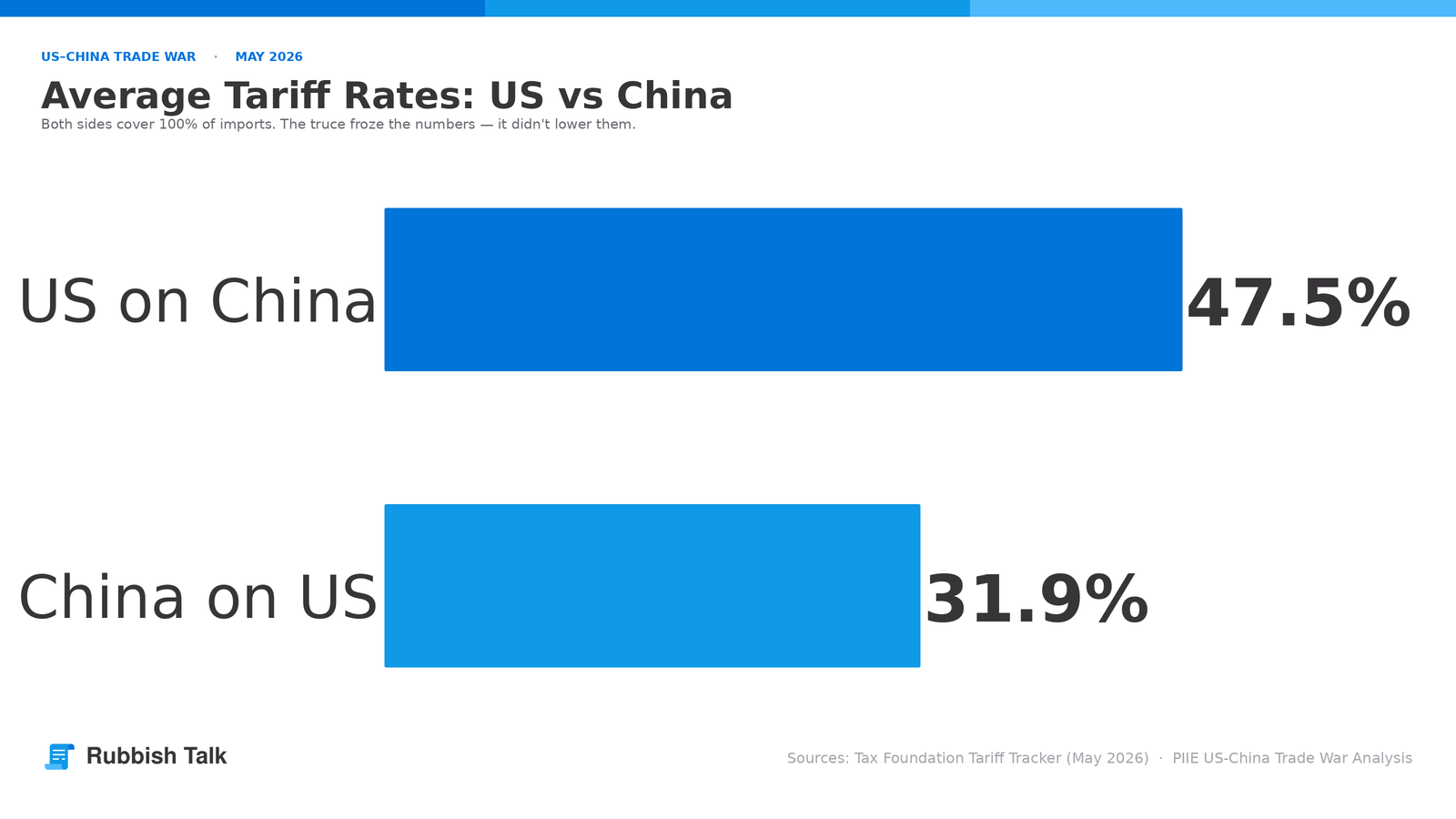
The Washington consensus framing is that this summit represents a pragmatic de-escalation after the tariff spiral of 2025, which pushed effective US tariffs on Chinese goods to 47.5% — covering 100% of imports. A trade truce struck in June 2025 paused the sharpest levies, and a November extension kept the framework in place through November 2026. Both governments have an interest in presenting the visit as proof that the relationship can be managed.
The corporate delegation reinforces this story. American business has made clear it does not want permanent decoupling. Apple generates roughly 17–18% of its global revenue from Greater China. Tesla’s Shanghai Gigafactory accounts for a substantial share of its global vehicle output. Bringing these CEOs to Beijing sends a signal that Wall Street and Silicon Valley are aligned behind engagement.
Officially, the agenda covers trade normalisation, cooperation on Iran and the Strait of Hormuz, and discussions on AI and technology competition. Both sides have framed the meeting as an opportunity to “stabilise” the relationship.
What the Data Shows
The trade truce has not resolved the underlying tensions — it has frozen them. Average US tariffs on Chinese goods remain at 47.5%, and China’s tariffs on American exports sit at 31.9%. The Supreme Court’s February 2026 ruling that the president cannot use IEEPA to impose tariffs unilaterally has also narrowed Trump’s leverage, pushing the administration toward Section 301 investigations rather than executive action. The trade architecture is more constrained than it looks.
On rare earths, China’s 2025 decision to impose export controls on rare earth permanent magnets and key semiconductors sent shockwaves through global automotive and electronics supply chains. The US convened ministerial meetings on critical minerals in early 2026, but alternative supply infrastructure is years away from maturity — a structural vulnerability we’ve examined in depth here. China retains structural leverage in this area that no Boeing deal resolves.
“The Trump-Xi summit hides simmering trade tensions under the surface.”
— Industry experts cited by the South China Morning Post, May 2026
The chip controls question is live. Beijing is reported to want loosened restrictions on advanced US semiconductor exports — AI chips, chipmaking equipment, jet turbine technology — as part of any Iran cooperation deal. Jensen Huang of Nvidia was conspicuously absent from the CEO delegation, a signal that the AI chip export control issue is being held at arm’s length from the commercial dealmaking.
For Trump, It’s Iran. For China, It’s Taiwan.
This is the most important asymmetry in the room, and the one most underreported in mainstream coverage.
Trump’s most urgent ask is Chinese pressure on Iran. The Iran-Hormuz conflict is straining US military logistics, threatening oil flows through one of the world’s critical choke points, and complicating every other foreign policy priority. Beijing has given private assurances it will not transfer weapons to Tehran, but it has been careful not to actively pressure Iran — China depends on Iranian oil and counts Middle Eastern nations among its largest trading partners. The Chatham House assessment is blunt: China will not help open the Strait of Hormuz without something “extremely valuable” in return.
China’s price, by most analyst accounts, is movement on Taiwan. Beijing’s top diplomat Wang Yi has described Taiwan as “the biggest point of risk” in the bilateral relationship. Chinese scholars and officials are pressing for a shift in US declaratory policy — ideally a move from “does not support” Taiwan independence to “opposes” it. They also want pre-negotiation on US arms sales to the island. Either concession would be a significant retreat from the framework set by the Reagan administration’s Six Assurances, and from four decades of bipartisan policy.
“For Trump, the Beijing trip is about Iran. For China, it’s about Taiwan.”
— Analysis reported by MS Now, May 2026
Taipei is watching closely. Japan and South Korea are watching closely. The concern among regional allies is that Trump, under pressure on Iran and drawn by the appeal of a commercially successful summit, may make verbal or informal concessions on Taiwan that are not visible in any official text but that Beijing will treat as binding.
The CEO Delegation: Follow the Incentives
The presence of Elon Musk and Tim Cook deserves scrutiny beyond the photo opportunity.
Musk’s Tesla is deeply embedded in China — the Shanghai Gigafactory is central to the company’s global production strategy, and Tesla competes directly with Chinese EV manufacturers in the world’s largest EV market. Any improvement in US-China trade terms, any relaxation of tariffs on batteries or EV components, directly benefits Tesla’s bottom line. Musk is simultaneously Trump’s most prominent corporate ally, a quasi-official US government advisor through DOGE, and a CEO with significant financial exposure to Chinese goodwill. That is a conflict of interest with no precedent in American diplomatic history.
Cook’s position is different in degree but similar in kind. Apple’s supply chain diversification toward India and Vietnam is proceeding, but Greater China remains critical to both production and revenue. Cook has navigated US-China tensions for years by offering investment commitments and rhetorical diplomacy — his presence in Beijing is a continuation of that strategy, with Trump providing the convening power.
“There’s a schism within the White House between Trump’s personal instinct for unfettered dealmaking with China and administration officials more hawkish on national security.”
— Reported by Yahoo Finance / BNN Bloomberg, May 2026
The Council on Foreign Relations has gone further, arguing that China will have the upper hand at this summit — because Trump needs a win (the Boeing deal, the Iran breakthrough, the optics of CEO dealmaking) more than Xi does. Xi enters the meeting from a position of relative domestic stability and with more negotiating patience than his counterpart.
The Taiwan Risk Nobody Is Pricing
The geopolitical context is worse than the cheerful summit coverage suggests.
America’s military focus on Iran has drawn resources and attention away from the Pacific. Georgetown University analysts have noted — on record — that if China were ever to contemplate coercive action toward Taiwan, “this might be the opportune moment.” US military inventories are under strain. The 7th Fleet’s operational tempo has increased. Taiwan’s own defence investment is accelerating, but the island remains acutely aware that American strategic bandwidth is finite.
Against this backdrop, any informal concession Trump makes on Taiwan’s status — even language that seems minor in the context of a joint statement — carries outsized signalling weight. Beijing is skilled at using American presidential statements to gradually shift the diplomatic baseline. A US president saying he “supports” peaceful unification rather than simply “not opposing” it is not a policy change on paper. In practice, it is a green light Beijing will cite for years.
The mainstream coverage is focused on the Boeing order and the agricultural purchases, both of which are real and commercially significant. What it is largely missing is that China is running a longer game — using this summit to extract concessions on the dossier that actually matters to its leadership: the timeline and conditions under which Taiwan can be absorbed.
What Comes Next
Three things to watch in the days after the summit closes:
The joint statement language on Taiwan. Read it word by word. Any deviation from the standard “one China policy” boilerplate — any new phrase about “peaceful resolution” or opposition to independence — is a concession, regardless of how the White House frames it.
The chip controls outcome. If the post-summit briefings include any signal of relaxed semiconductor export restrictions toward China, it will confirm that Beijing extracted a technology concession in exchange for Iran cooperation. Nvidia’s absence from the delegation does not mean chips were off the table — it may mean they were kept off the commercial stage intentionally.
Whether Boeing delivers. The deal is reportedly close, but “close” has described China-Boeing talks since 2017. China has used Boeing orders as a diplomatic lever before — announcing, then delaying, then resuming based on the state of the relationship. If the order is signed, it is a genuine win. If it is announced “in principle” with delivery timelines TBD, watch for the asterisks.
The summit will produce good photos, a large headline number from the Boeing deal, and carefully drafted language about “stability” and “mutual respect.” What it will not produce — what no two-day state visit can produce — is a resolution of the structural competition between the two largest economies on earth. That competition has a timeline measured in decades, not summits.
Sources:
- Xi, confident in China’s power, is ready to host an unpredictable Trump — Washington Post
- 2026 state visit by Donald Trump to China — Wikipedia
- Trade and Iran war are on the agenda for Trump’s state visit to China — NPR
- Trump-Xi Summit in Beijing: Managing the World’s Most Important Relationship — CSIS
- What’s at stake for trade, Taiwan and Iran in Trump’s high-risk summit — CNBC
- Trump invites Elon Musk, Tim Cook, Larry Fink and other CEOs to join China trip — CNBC
- At the Trump-Xi Summit, China Will Have the Upper Hand — Council on Foreign Relations
- For Trump, the Beijing trip is about Iran. For China, it’s about Taiwan — MS Now
- The Trump–Xi summit: can progress be made on Iran? — Chatham House
- Trump-Xi Summit hides simmering trade tensions — South China Morning Post
- Tariff Tracker: 2026 Trump Tariffs & Trade War by the Numbers — Tax Foundation
- Musk, Tim Cook Join Trump’s China Delegation; Jensen Huang Excluded — Seoul Economic Daily
- Trump’s Policy toward Taiwan — Global Taiwan Institute
- Trump Prepares for High-Stakes China Summit as Taiwan Concerns Intensify — YourNews