
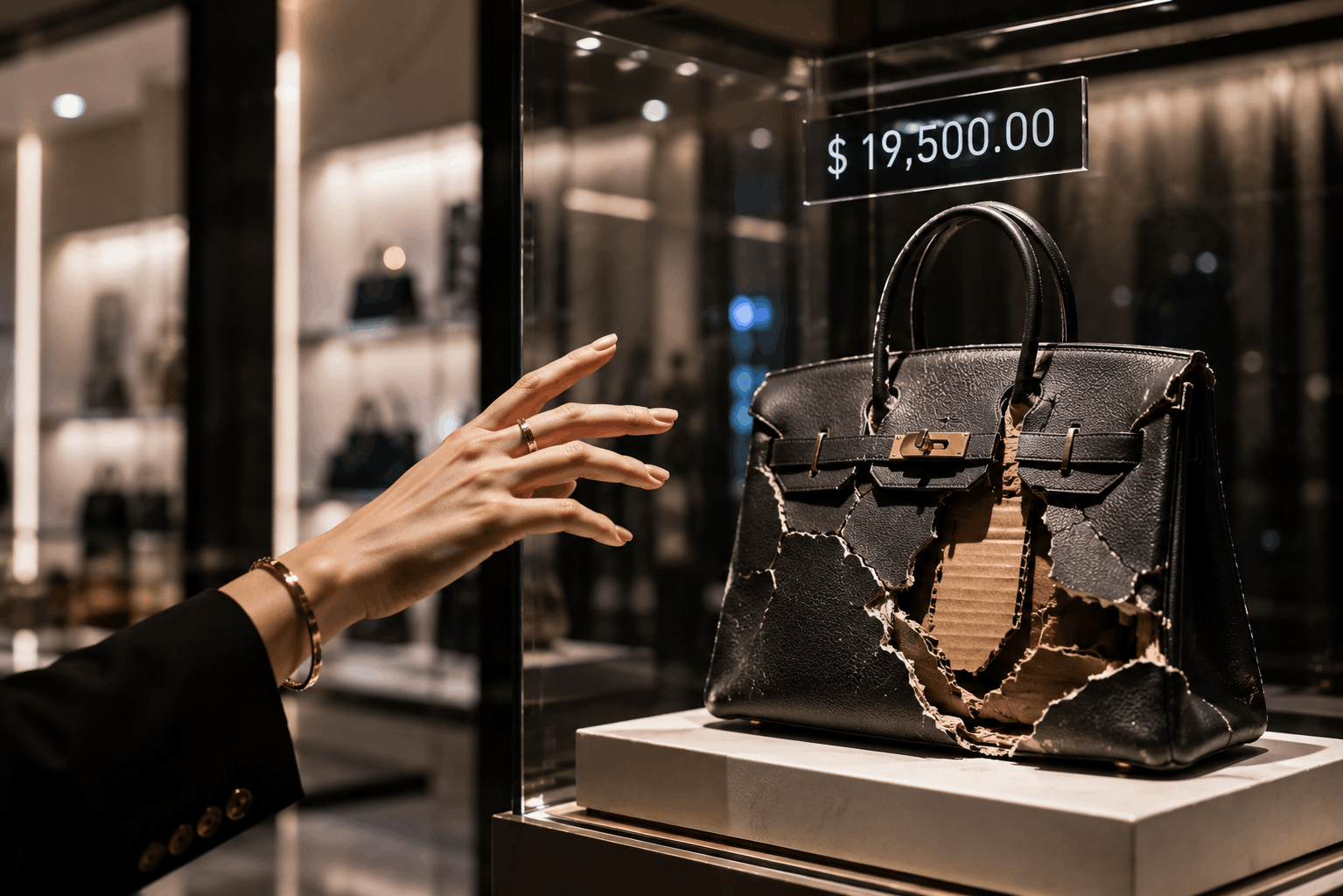
Across cars, fashion, consumer tech, food and even exclusive apps, the gap between what luxury brands pay to make a product and what they charge for it is enormous, often ten times or more. The industry sells superiority, yet independent testing shows many luxury goods are no better, and sometimes worse, than mainstream rivals, while court cases in Italy have exposed handbags retailing above 2,000 euros being assembled for as little as 53 euros. This is the story of how the markup is manufactured, how “Made in Italy” can legally mean “mostly made elsewhere,” and why, knowing all of this, we still hand over the money.
The markup machine
Start with the numbers, because the numbers are where the myth begins to crack.
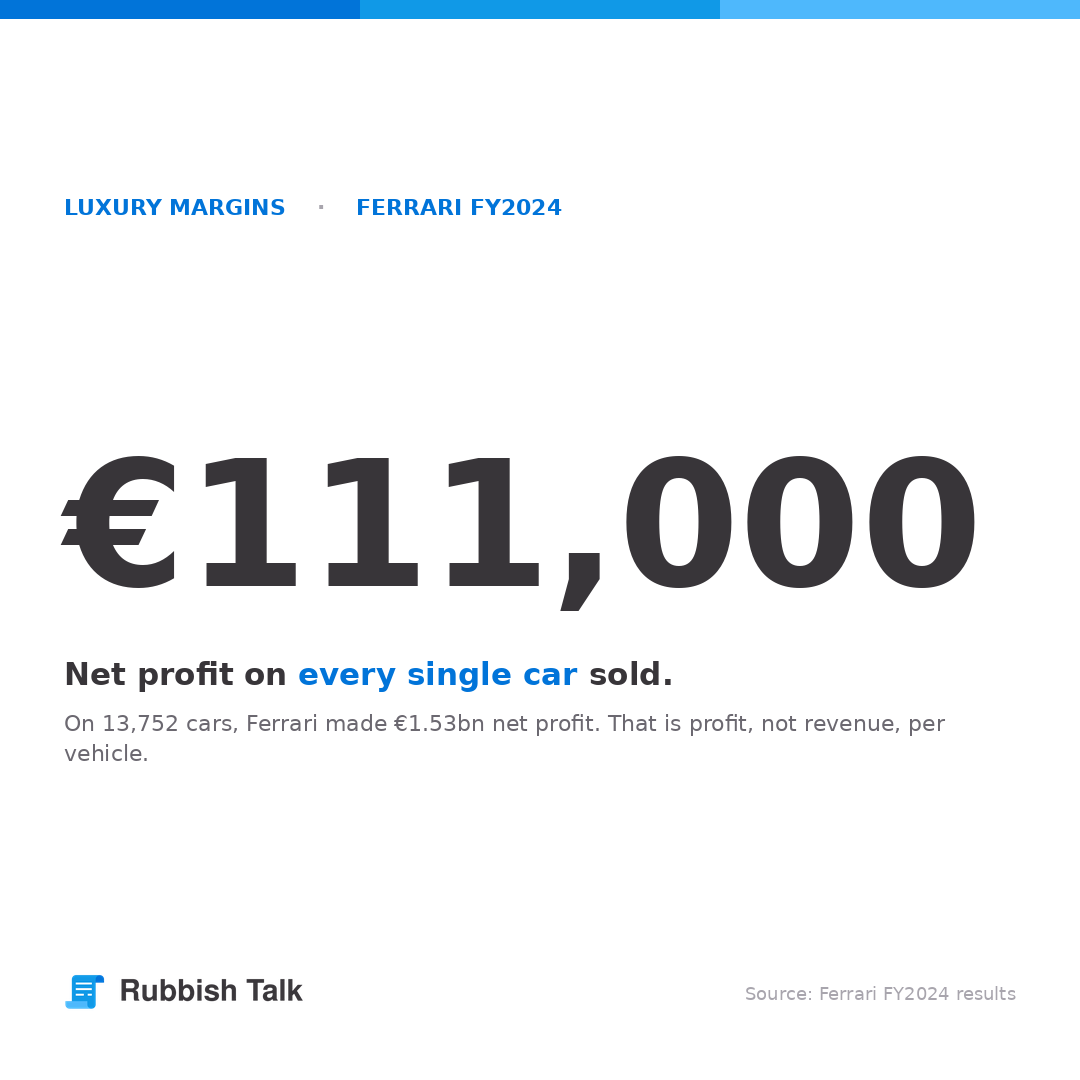
Ferrari is the cleanest example of luxury economics working exactly as designed. In its 2024 full-year results the company reported net revenues of 6.68 billion euros on just 13,752 cars shipped, a gross margin of 50.1 percent and net profit of 1.53 billion euros. Divide the profit by the cars and Ferrari earned roughly 111,000 euros of net profit on every single vehicle it sold. Not revenue: profit. The company has openly built its strategy around keeping volumes low so that demand always exceeds supply, which is the opposite of how almost every other manufacturer on earth operates.
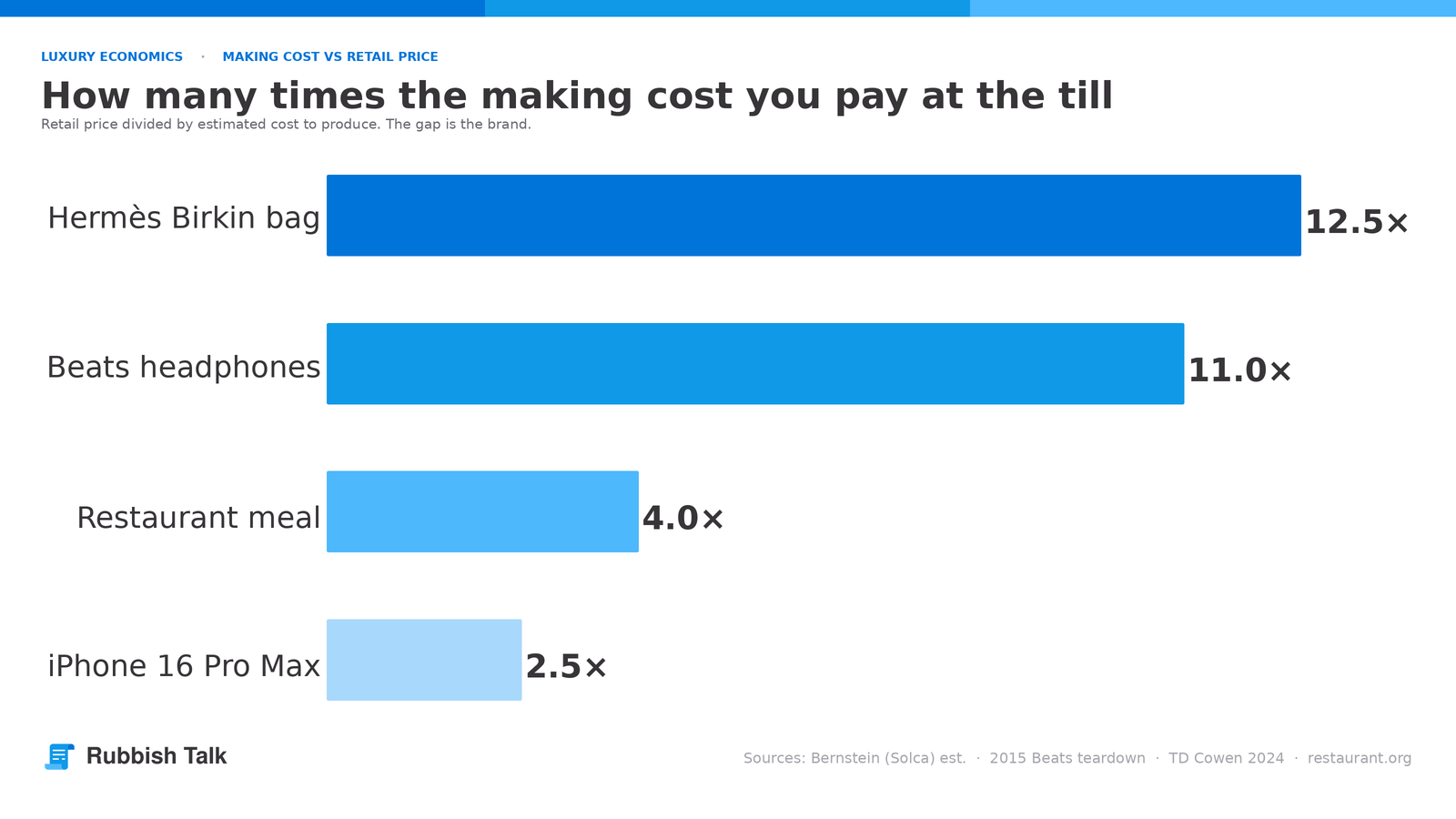
Fashion is where the gap gets spectacular. Analysts who follow Hermès, including Luca Solca of Bernstein, have estimated the production cost of a standard leather Birkin bag at somewhere in the region of 800 dollars. The same bag retails from roughly 9,000 to 12,000 dollars for entry leathers, and far more for exotic skins. That is a markup of ten times or more before a single crocodile is involved. At the group level, LVMH’s Fashion and Leather Goods division, which houses Louis Vuitton and Dior, ran an operating margin close to 40 percent in 2023, a level of profitability most industrial companies can only dream about. The group as a whole turned 84.7 billion euros of 2024 revenue into 19.6 billion euros of recurring operating profit.
Consumer tech runs the same play with better PR. When TD Cowen analysts tore down the iPhone 16 Pro Max in 2024, they put the total bill of materials, components, box and assembly, at about 485 dollars for the 256GB model. Apple sells that phone for 1,199 dollars, implying a gross margin near 60 percent on the hardware alone. To be fair to Apple, a teardown is not the whole cost: chip design, iOS development, marketing, retail stores and logistics are all real and none of them show up when you unscrew the back. But the direction is unmistakable. The physical object costs a fraction of the price on the tag.
Then there is food, where the trick is smaller objects and faster turnover. Restaurants typically mark food up around 300 percent over cost, and wine is often sold at three times or more its wholesale price. Bottled water is the purest illustration: a 500ml bottle of a premium brand such as Evian or Fiji costs a few cents of water plus packaging and shipping, yet sells for anywhere from 1.50 to 5 dollars. For the price of one bottle, you could buy on the order of a thousand gallons of municipal tap water that is, in many places, chemically indistinguishable.
Even the internet has a luxury tier. The dating app Raya reportedly accepts fewer than one in ten applicants, an admissions rate the New York Times once described as harder to crack than Harvard Business School, and charges roughly 20 to 50 dollars a month for the privilege of exclusivity. Software costs almost nothing to deliver to one more user, so what Raya sells is not a service. It is a velvet rope.
Are luxury goods actually any better?
Here is the question the marketing never answers directly: for all that markup, do you get a better product? The honest answer is sometimes, and often no.
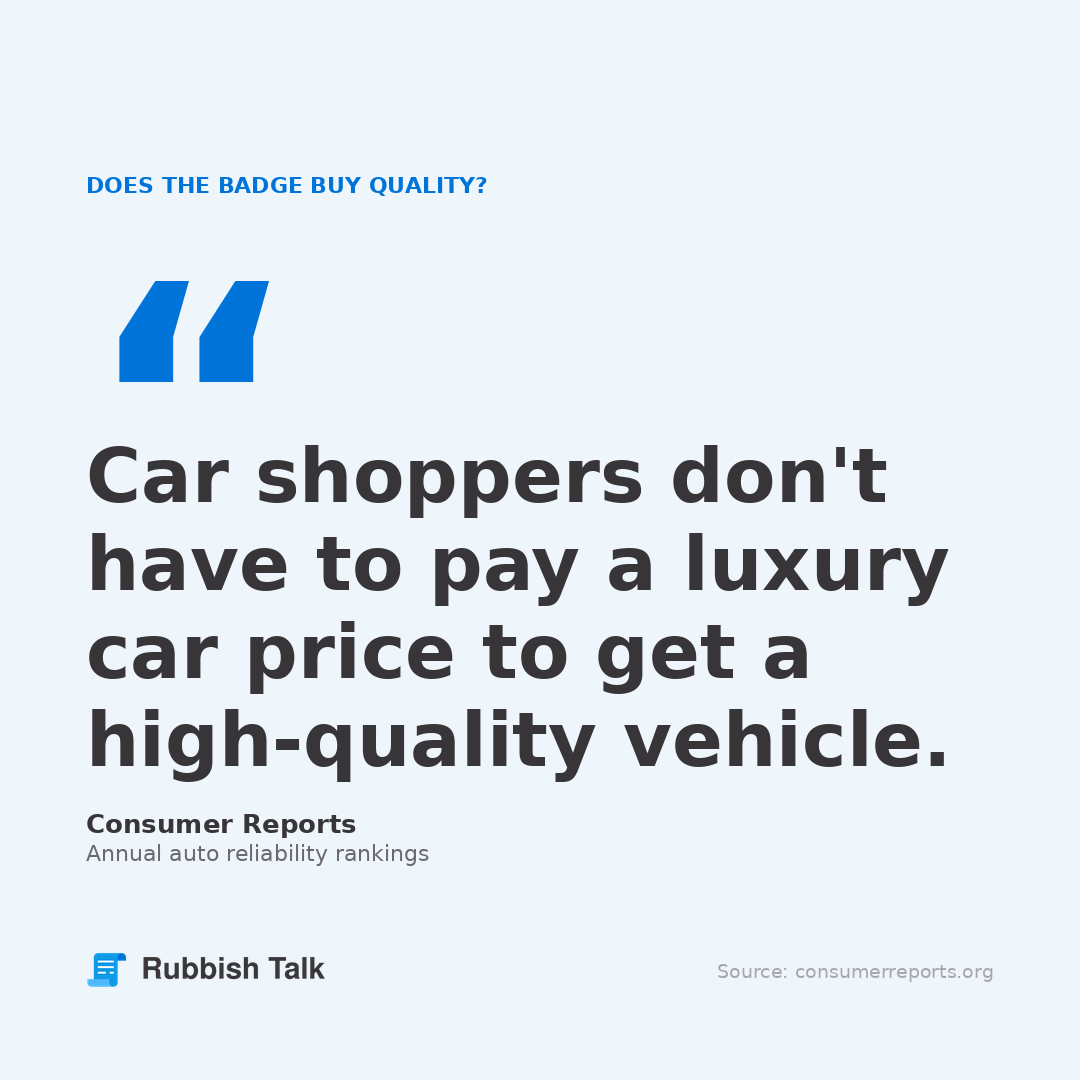
In cars, Consumer Reports’ reliability data year after year finds that a luxury badge is no guarantee of a better car. In its rankings, five of the ten most reliable brands are typically mainstream names, not luxury marques, and the organisation has stated plainly that shoppers do not need to pay luxury prices to get a high-quality, dependable vehicle. Lexus, a luxury brand, sits near the top, but so does Toyota, its mass-market parent, and several European luxury brands rank poorly on reliability while costing thousands more to maintain. Paying more buys you leather, badge and dealership coffee. It does not reliably buy you fewer breakdowns.
Consumer tech tells a similar story. The most infamous case is Beats by Dre. A widely cited 2015 teardown estimated the cost of parts in a pair of Beats headphones at under 20 dollars, against a retail price around 199 dollars. More revealing than the cost was the engineering choice it exposed: analysts found that a significant share of the headphones’ weight came from small metal parts that served no acoustic function at all. They were there to make the product feel heavy, solid and therefore expensive in the hand. The sound, reviewers consistently noted, was bettered by cheaper rivals from Sony and others. The premium was not in the audio. It was in the heft and the logo.
Even taste, supposedly the most personal of judgements, bends to the price tag. In 2001 the researcher Frédéric Brochet ran two experiments at the University of Bordeaux that have haunted the wine world ever since. In the first, he served 54 oenology students a white wine dyed red and asked them to describe it. Every one of them described it using the vocabulary of red wine, berries and tannins. In the second, he poured the same mid-range Bordeaux into two bottles, one labelled cheap table wine and one labelled grand cru. The tasters rated the “expensive” pour markedly better. Later neuroscience work using brain imaging confirmed the mechanism: being told a wine is expensive genuinely increases the brain’s registered pleasure, even when the liquid is identical.
“None of the 54 students noticed the ‘red’ wine was in fact a white wine dyed with a flavourless colouring.”
Findings of Frédéric Brochet, University of Bordeaux (2001)
The uncomfortable conclusion is that a meaningful part of what luxury delivers is not in the product. It is in your own expectations, which the price is deliberately engineered to raise.
The label game: how “Made in Italy” can mean made elsewhere
If the product is often ordinary, the origin story is at least European, right? Not necessarily.
Under long-standing trade rules used by the World Trade Organisation and the European Union, a product’s country of origin is determined by where its “last substantial transformation” took place. That phrase is the entire loophole. A handbag can be cut, stitched and largely assembled in China, Vietnam or elsewhere, then shipped to a workshop in Italy or France for a final step, attaching a handle, sewing in a lining, fixing the clasp, adding the label, and legally leave that workshop stamped “Made in Italy.” The letter of the law is satisfied because something did happen on Italian soil. The spirit of what a customer assumes, that the object was crafted by European artisans, is quietly abandoned.
The contrast with the United States is stark. The Federal Trade Commission’s Made in USA Labeling Rule, finalised in 2021 and codified as 16 C.F.R. Part 323, requires that “all or virtually all” of a product be made domestically before an unqualified “Made in USA” claim is allowed, meaning final assembly plus all significant processing plus nearly all components must be American, with civil penalties of up to 43,280 dollars per violation. Europe, home to most of the world’s luxury houses, has no equivalent origin standard for the “Made in” claim itself. The most prestigious labels in the world operate under the looser rule.
None of this is fraud in the strict legal sense, and that is precisely the point. The system is not being broken. It is working as written, and the writing favours the brand.
The hidden cost: forced labour and the subcontracting chain
The label loophole would be a curiosity if it only concerned geography. What makes it serious is what the outsourcing sometimes conceals.
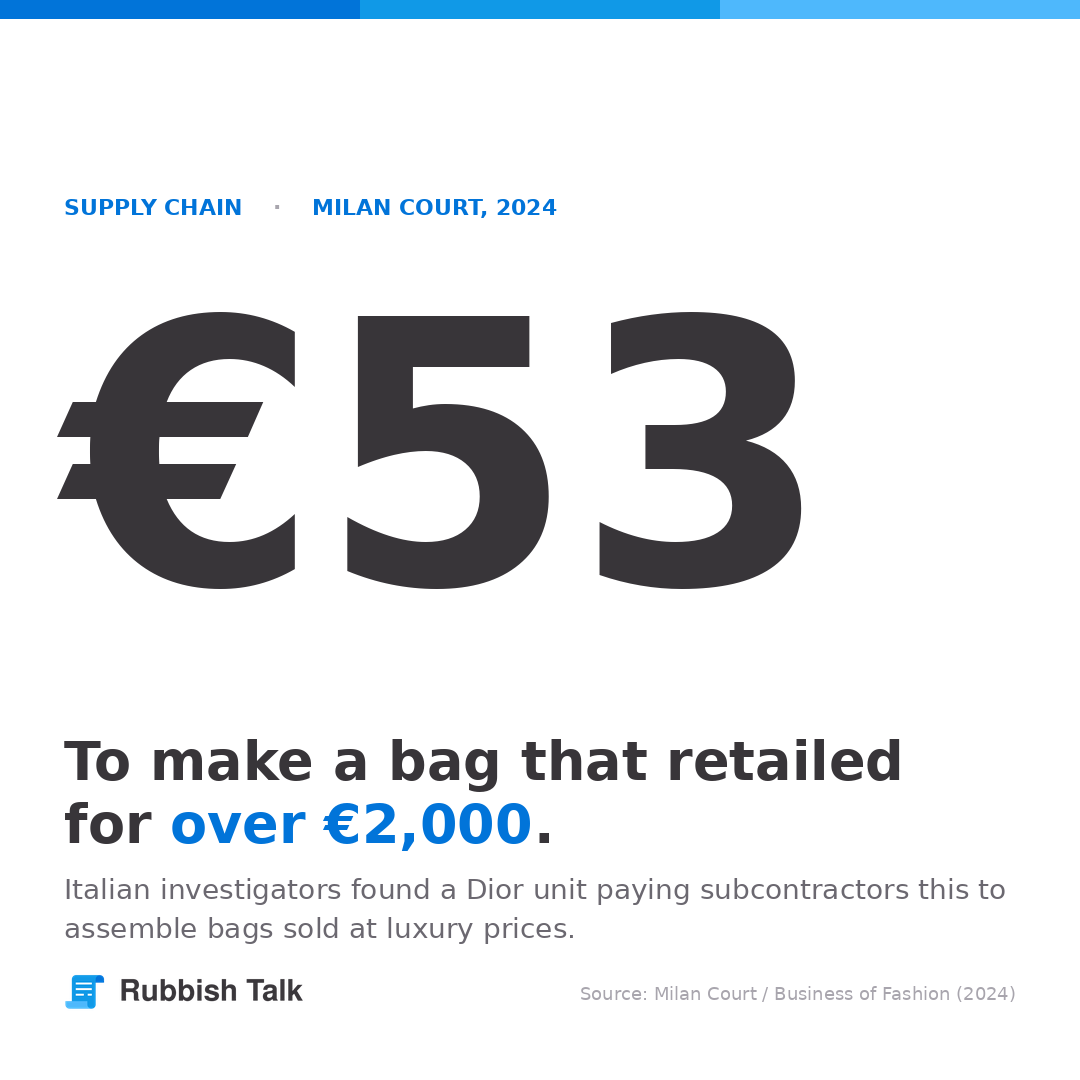
In 2024, prosecutors in Milan pulled back the curtain on the supply chains of some of the biggest names in fashion. An Italian court placed a manufacturing unit of Dior under judicial administration after investigators found it had failed to properly vet suppliers, that workers had been hired illegally, and that workshops were unsafe. The financial detail that travelled around the world was this: the Dior unit was found to be paying its subcontractors roughly 53 euros to produce bags that retailed for well over 2,000 euros. In a parallel case, investigators found that Armani-branded bags retailing around 1,800 euros were being produced by a Chinese-owned subcontractor for about 93 euros, then sold on to the group by an intermediary for 250 euros. Similar measures touched other companies, including units linked to Valentino and Alviero Martini. Dior’s unit exited court administration in early 2025 after meeting compliance conditions, and the companies have generally denied wrongdoing or stressed remediation, but the numbers spoke for themselves.
The most haunting evidence of hidden labour has come not from courts but from customers. In 2017, shoppers in several countries found handwritten notes sewn into Zara garments by workers at Bravo Tekstil, an Istanbul subcontractor that had shut down overnight, leaving staff unpaid for clothes they had already produced for Zara, Mango and Next. One note read simply:
“I made this item you are going to buy, but I didn’t get paid for it.”
Note sewn into a Zara garment by a Bravo Tekstil worker, Istanbul (2017)
Zara is fast fashion rather than luxury, and the distinction matters: the documented “cry for help” notes have surfaced in mass-market supply chains, not inside Birkins. But the Milan cases show the two worlds are closer than the price tags suggest. A 2,000-euro bag and a 20-euro shirt can pass through the same kind of opaque, multi-layered subcontracting network, where the brand that collects the margin claims not to have known what happened three tiers down.
The rules, and where they stop
Regulators have begun to respond, slowly. The European Union’s Corporate Sustainability Due Diligence Directive, formally Directive 2024/1760, entered into force on 25 July 2024. It will require large companies to identify and address human rights and environmental harms, including forced labour and modern slavery, across their global value chains, with penalties that can reach 5 percent of worldwide turnover and the possibility of civil claims from those harmed. A separate EU Forced Labour Regulation is designed to ban products made with forced labour from the EU market entirely.
The catch is timing and political will. The due diligence rules phase in only from around 2027 to 2029, and only for the largest companies, those above roughly 1,000 employees and 450 million euros in turnover. Worse, by 2025 the EU was already moving to water the directive down through its “omnibus” simplification push, prompting human rights groups to warn that hard-won protections were being unpicked before they had taken effect. On paper, the law is a genuine shift. In practice, the biggest brands have years to prepare and a lobbying machine actively working to soften it.
Public opinion, meanwhile, is ambivalent in a very particular way. Surveys repeatedly show consumers say they care about ethical sourcing, yet the luxury market kept expanding through years of well-publicised scandals. Which brings us to the real question.
Why we still pay
If luxury goods are often no better made, are frequently produced far from where the label claims, and sometimes carry a hidden human cost, why does the industry keep growing?
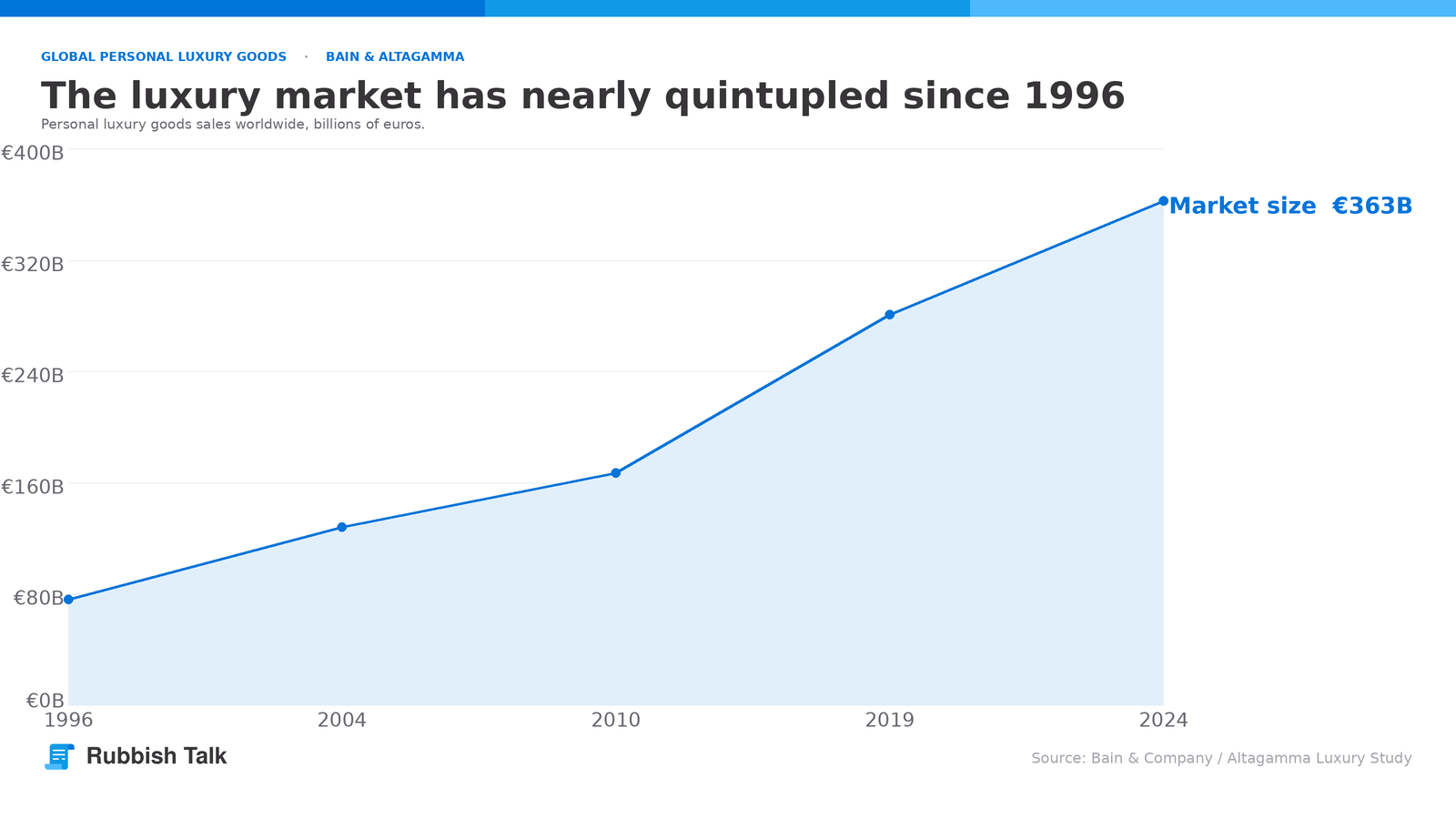
The scale of the thing is worth stating plainly. According to the annual Bain and Altagamma study, the global personal luxury goods market grew from 76 billion euros in 1996 to 281 billion in 2019 and around 362 to 363 billion in 2023 and 2024, a compound growth rate of roughly 6 percent a year over more than two decades. Total luxury spending, including travel and experiences, is now near 1.5 trillion euros. This is not a niche indulging a few. It is one of the most reliably profitable consumer industries on the planet.
The answer to why is more than a century old. In 1899 the economist Thorstein Veblen coined the phrase “conspicuous consumption” to describe buying expensive things precisely because they are expensive, as a visible signal of wealth and status. Economists still call these “Veblen goods”: products whose demand rises as the price rises, because the high price is the product. A Birkin that cost 800 dollars to make is desirable partly because it costs 12,000 to buy. Cut the price and you would destroy the very thing the buyer is purchasing.
“Conspicuous consumption of valuable goods is a means of reputability to the gentleman of leisure.”
Thorstein Veblen, The Theory of the Leisure Class (1899)
Modern research has confirmed that this signalling actually works in the buyer’s favour. In a series of experiments, psychologists found that people wearing visible luxury labels received more cooperation, more compliance and better treatment from strangers than the same people in ordinary clothes. Luxury is a costly signal, in the strict biological sense: it is expensive precisely so that it cannot easily be faked, which is what makes it a credible display of resources. Buyers are not stupid. They are paying for a social effect that, measurably, they receive.
That is the honest resolution of the paradox. Luxury brands are not primarily selling superior leather, superior sound or superior horsepower, and the moment you test those claims directly, many of them wobble. They are selling identity, belonging and status, delivered through scarcity, ritual and price. The profit margins are enormous not because the goods are ten times better, but because a logo, unlike stitching, has no cost of goods. The most valuable material in the entire luxury industry is the story, and the story is the one thing the customer brings with them.
What to watch
Three things will shape the next decade of this argument. The first is enforcement: whether the EU holds its nerve on due diligence and forced labour rules, or lets the omnibus process gut them. The second is transparency: the Milan cases showed that once the subcontracting chain is exposed, the gap between price and cost becomes politically radioactive, and more disclosure is coming whether brands like it or not. The third is the consumer, especially younger buyers who research supply chains and resale values before they buy, and who may prove less willing to pay purely for a name. The markup machine has run beautifully for thirty years. It has never been better documented, or more exposed, than it is right now.
Sources:
- Ferrari N.V. Full Year 2024 Financial Results
- Ferrari Gross Margin 2015-2025 (Macrotrends)
- Cost to Manufacture a Birkin Bag (A Simple Model)
- LVMH Reports 84.7bn euros in Sales for 2024 (The Fashion Law)
- 2023: New record year for LVMH
- iPhone 16 Pro Max BOM reveals manufacturing cost of $485 (Android Headlines)
- Apple earns 60% gross margin on the iPhone 16 Pro Max (PhoneArena)
- $200 Beats headphones actually cost just $18 to make (TechSpot)
- Beats Headphones Reportedly Contain Metal Weights To Make Them Feel Premium (Tech Times)
- Here’s How Much Restaurants Mark Up Your Food (Yahoo Finance)
- Raya Statistics: Acceptance Rate, Pricing, Waitlist (DoULike)
- Raya (app): Wikipedia
- Who Makes the Most Reliable New Cars? (Consumer Reports)
- The Legendary Study That Embarrassed Wine Experts (RealClearScience, on Brochet 2001)
- Neuromarketing: How the Price of a Wine Can Influence Its Taste (Worldcrunch)
- EU Law, “Last Substantial Transformation,” and the Truth Behind Luxury Labels (The Daily Scrum News)
- ‘Made in Italy’ may not mean what you think it does (Marketplace)
- FTC Issues Rule to Deter Rampant Made in USA Fraud (Federal Trade Commission)
- Made in USA Labeling Rule (Federal Register)
- Italian Court Reveals Dior’s Unethical Supply Chain (Forbes)
- Dior Unit Put Under Court Administration in Italy Over Labour Exploitation (Business of Fashion)
- Luxury brands, labour exploitation and sham subcontractors (Law Society Journal)
- Turkey: Shoppers at Zara find notes from unpaid factory workers (Business & Human Rights Resource Centre)
- The Real Story Behind Those Desperate Notes That Zara Workers Left In Clothes (Fast Company)
- EU adopts Corporate Sustainability Due Diligence Directive (White & Case)
- EU moves to weaken corporate sustainability rules (Walk Free)
- Global luxury spending to land near 1.5 trillion euros in 2024 (Bain & Company)
- Bain-Altagamma Luxury Goods Worldwide Market Monitor 2024
- Veblen good: Wikipedia
- Social benefits of luxury brands as costly signals of wealth and status (ScienceDirect)