
Big tech has committed over $1 trillion to data center construction. Nearly half of the projects planned for 2026 have been cancelled or delayed. Meanwhile, the communities closest to these facilities are contending with higher electricity bills, drained water supplies, unrelenting noise, and tax breaks that cost states billions. The mainstream coverage has focused almost entirely on the investment numbers. Almost none of it has followed the money to see what actually gets built — and who pays when it doesn’t.
The Announcement Machine vs. The Construction Site
The numbers big tech has been publishing are staggering. Microsoft has budgeted $190 billion in capital expenditure for 2026. Amazon sits at $200 billion. Google has committed $75 billion. Meta is projecting up to $145 billion. The collective commitment across just these four companies exceeds $600 billion for a single year — a figure that has been reported breathlessly as proof that the AI infrastructure boom is real, unstoppable, and already underway.
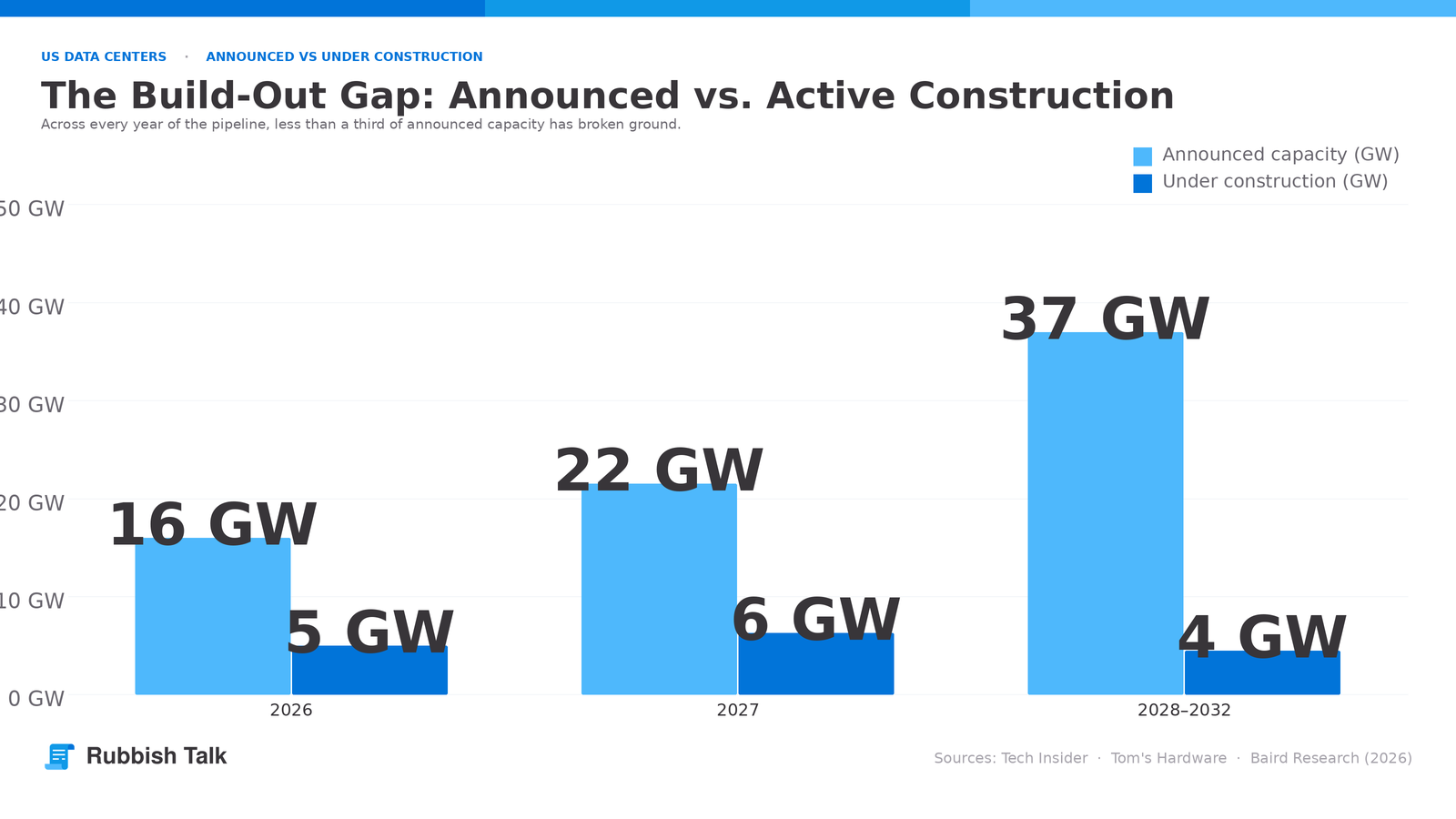
The problem is that announcements and groundbreakings are not the same thing. According to industry tracking data, the full announced pipeline for U.S. data centers in 2026 is pegged at 16 gigawatts of capacity. The amount actually under construction is approximately 5 gigawatts. For 2027, the gap widens: 21.5 GW announced, 6.3 GW with a shovel in the ground. Looking further out, an additional 37 GW of planned infrastructure across 2028–2032 lacks firm completion dates, with just 4.5 GW under construction. The cumulative shortfall across all timeframes exceeds 50 gigawatts of announced-but-unbuilt capacity.
Microsoft alone has cancelled up to 2 gigawatts of data center projects, according to TD Cowen analysis — following earlier reports that the company had walked away from 200 megawatts of signed leases as recently as early 2025. The cancellations are not due to lack of capital. They are due to a constraint set that the announcement press releases never mention: transformers, switchgear, battery cells, and grid interconnection capacity. Lead times for custom electrical transformers have stretched to 52–86 weeks. Parts dependent on Chinese manufacturing are subject to tariff disruption. And in many cases, the local power grid simply cannot support what the data center would need to draw.
“If one piece of your supply chain is delayed, then your whole project can’t deliver.”
— Data center developer, quoted by TechRadar, 2026
The result is a construction sector that looks, on paper, like it is executing a historic infrastructure build-out, and in practice is cancelling or delaying roughly half of what was publicly committed. According to Baird analyst Justin Hauke, cancellations on data center builds jumped to 25 in 2025 from just six in 2024, as state governments began mulling moratoriums and community opposition intensified.
What Community Opposition Actually Looks Like Now
At least 188 local opposition groups now operate across 40 U.S. states, according to Baird research. $64 billion worth of data center projects have been blocked or delayed by local opposition over the past two years, according to Data Center Watch — $18 billion in outright blocked projects and $46 billion delayed. A recent Gallup survey found 71% of Americans would oppose a data center in their community, a higher disapproval rate than for nuclear plants or gas facilities. This is not a fringe movement.
As of April 2026, 69 jurisdictions have active moratoriums on new data center construction, according to the U.S. Data Center Moratorium Tracker. Denver has imposed a one-year pause. Baltimore City passed a one-year moratorium. Minneapolis enacted a six-month pause on facilities over 350,000 square feet. Arkansas’ most populous county approved a moratorium in May 2026. Maine came within a veto override of becoming the first state in U.S. history to impose a statewide moratorium. Ohio voters may be next: a citizen initiative is gathering signatures to ban data centers requiring 25 megawatts or more of power statewide.
The opposition is striking for how evenly it spans the political spectrum. In many states, the same residents who disagree on almost everything else agree that they don’t want one of these facilities near their home. The reasons are concrete, local, and documented.
The Electricity Bill Nobody Mentioned
The most direct financial hit on local communities comes through electricity. Data centers are among the most power-hungry structures humans have ever built. A single large hyperscale facility can draw as much electricity as a small city. When dozens cluster in a region — as they have in Northern Virginia, Phoenix, and parts of Texas — the impact on grid infrastructure and consumer rates becomes significant.
In Virginia, where Loudoun County now hosts 199 data centers with another 117 in development, Dominion Energy has proposed a 14% rate increase for residential customers in 2026. The company also proposed its first base-rate increase since 1992, adding $8.51 per month per household in 2026. The capacity auction clearing price for the 2025–2026 period increased by 833% from the previous year. Utilities nationally requested more than $29 billion in rate increases in the first half of 2025 — double the figure from the same period in 2024. Average electricity prices across the U.S. rose 27% between 2019 and late 2025, and are projected to increase a further 40% by 2030.
In May 2026, Electrek reported the starkest example yet: a Nevada utility told 49,000 Lake Tahoe residents it would redirect 75% of their electricity supply to data centers — giving them less than a year to find a new power source. The reason: NV Energy needed the capacity for Google, Apple, and Microsoft facilities being built around the Tahoe-Reno Industrial Center.
The macro picture is just as stark. U.S. data center electricity demand is projected to nearly double between 2025 and 2028, from 80 to 150 gigawatts. To meet that demand, natural gas and coal together are expected to supply over 40% of the additional electricity. Fifteen coal-fired power plants that had announced retirement dates have had those retirements postponed. The U.S. Department of Energy issued emergency declarations in 2025 to halt the retirement of eight coal units totalling more than 17 gigawatts of capacity. Big tech’s green energy pledges — RECs, PPAs, net-zero targets — are running directly into the physics of grid management: when you build demand this fast, the marginal source of electricity is almost always fossil fuel.
Water: The Resource No Press Release Mentions
The environmental impact most commonly omitted from data center coverage is water. Cooling a large facility requires enormous quantities of it. A typical data center uses as much water as three hospitals or more than two 18-hole golf courses. All data centers in Northern Virginia consumed close to 2 billion gallons of water in 2023 — a 63% increase from 2019. Loudoun County alone used approximately 900 million gallons that year. Texas data centers are projected to use 49 billion gallons in 2025, rising to as much as 399 billion gallons by 2030.
Globally, accelerated AI adoption could result in an additional 4.2 to 6.6 billion cubic metres of water withdrawal by 2027. If current water-use intensity holds, U.S. data centers collectively may require between 697 and 1,451 million gallons per day of additional water supply through 2030 — comparable to New York City’s average daily consumption. In drought-prone states including Arizona and Texas, where substantial new data center capacity is planned, this is not an abstraction. It is a direct competition between industrial cooling and residential water supply, agricultural irrigation, and ecosystem function.
What makes this worse is the opacity. Local governments and water managers cannot effectively plan for this demand because operators are not required to disclose site-specific usage in most states. Of 32 states with data center subsidy programmes, 20 disclose annual subsidy costs. The remaining 12 do not. Water disclosure requirements are even less common. California, Iowa, and Michigan have introduced bills requiring operators to report their water use — but as of mid-2026, most states have nothing.
The Tax Break Arithmetic That Doesn’t Add Up
The standard pitch from data center developers to state and local governments runs as follows: we will bring investment, construction jobs, and long-term tax revenue. In exchange, we ask for sales tax exemptions on equipment, reduced property taxes, and accelerated permitting. Forty-three states now offer some form of data centre incentive. The cost has grown far beyond what any state initially projected.
Virginia’s sales and use tax exemption for data centres cost the state more than $1 billion in foregone revenue in fiscal year 2024, with the projected loss for fiscal year 2025 estimated at nearly $1.94 billion. Texas estimated its data centre exemption would cost $130 million; actual cost in fiscal year 2025 is approximately $1 billion. Georgia’s exemption cost $10 million in 2020. It cost $625 million in 2026. Illinois went from $10 million to $370 million in four years. Good Jobs First, which tracks corporate subsidies, has described American data centre tax exemptions as “out of control.”
The jobs argument used to justify these subsidies does not survive scrutiny. The construction phase of a large data centre does employ significant numbers of workers — typically 800 to 3,000 people — but these are temporary positions, frequently filled by specialist tradespeople who travel between projects nationally rather than being drawn from the local workforce. Once operational, a large data centre typically employs between 50 and 200 permanent staff. A US Chamber of Commerce analysis found the average operational data centre provides 157 permanent jobs. The tax revenue foregone to attract those jobs often exceeds any plausible valuation of the economic contribution they represent.
“Over the last year, Virginia and Georgia have given up more than a billion dollars’ worth of revenue as a result of tax breaks. That’s money that is being handed back to the industry rather than going into public funds that could pay for infrastructure, schools, or healthcare.”
— Ben Green, Assistant Professor, University of Michigan School of Information and Public Policy, Harvard Gazette, April 2026
Living Next to the Machine
Beyond the aggregate statistics are the specific and documented experience of living adjacent to a large data centre. The noise is the most immediate complaint. Cooling towers, backup diesel generators, HVAC arrays, and transformer hum operate continuously, 24 hours a day, seven days a week. Most residential noise ordinances were written for party noise and construction hours — not for permanent low-frequency industrial hum that does not turn off. Residents near a New Jersey data centre filed a lawsuit in 2025 over noise preventing them from sleeping and using their outdoor spaces. Similar litigation has emerged in Virginia, Texas, and Georgia.
Health research is beginning to catch up with these complaints. A 2026 peer-reviewed study published in Frontiers in Climate examined health implications of the rapid rise of data centres in Virginia. A separate independent analysis found that emissions from permitted on-site power systems at a single Loudoun County data centre could result in $53–99 million per year in health-related damages, driven primarily by premature mortality from air pollution and respiratory and cardiovascular disease. The average carbon intensity of analysed data centres is 548 grams of CO₂ equivalent per kilowatt-hour — approximately 50% higher than the U.S. national average electricity mix.
The property value picture is more complicated. Data centres can benefit landowners who sell sites at inflated prices, and commercial property taxes in some counties do generate local revenue. But residential properties within range of noise and visual impact often tell a different story. In Loudoun County, land values have risen 45% in a year — driven by data centre demand rather than residential desirability — pushing property taxes up for homeowners who receive no direct benefit from the facilities.
What Is Actually Being Overlooked
The mainstream framing of the data centre story is almost entirely supply-side: how much is being spent, which company is building where, which GPU is going into which rack. The demand-side story — who is actually using all this capacity, whether the revenue justifies the cost, and what happens to the communities that host it — has received a fraction of the coverage.
The announcement-to-build gap matters because the capital numbers driving the AI investment narrative are partly fictional. When Microsoft announces $190 billion in capex and then cancels 2 gigawatts of construction, the original headline number does not get corrected. The gap between announced and operational capacity is where the AI infrastructure story lives, and it is rarely reported.
The community opposition story is politically significant in ways that go beyond local planning disputes. Data centres are becoming a midterm election issue. NPR reported in April 2026 that disputes over data centre siting are now shaping races in multiple states. The opposition is bipartisan, organised, and increasingly effective at blocking or delaying projects. Big tech has wagered over $1 trillion on the assumption that the political and regulatory environment will accommodate this build-out. That assumption is being tested in real time, in county planning meetings, state legislatures, and ballot measure campaigns, in ways that Wall Street earnings models do not yet reflect.
The energy and water infrastructure implications deserve a national conversation that is not happening. The decision to delay coal plant retirements to power data centres is an energy policy decision with 30-year consequences. The drawdown of water supplies in drought-prone regions is an environmental decision that will affect agricultural and residential users for decades. These decisions are being made implicitly, through thousands of individual permitting and procurement decisions, without the public debate that their scale warrants.
Sources:
- Half of planned US data center builds delayed or canceled — Tom’s Hardware
- U.S. AI Data Center Delays: 7 GW Capacity Crisis 2026 — Tech Insider
- Nearly half of US data centers planned for 2026 canceled or delayed — TechRadar
- What’s stalling data center projects? Public opposition and power access lead delays — Construction Dive
- Microsoft cancels up to 2GW of data center projects, says TD Cowen — Data Center Dynamics
- $64 billion of data center projects blocked or delayed amid local opposition — Data Center Watch
- Why are communities pushing back against data centers? — Harvard Gazette
- Communities are blocking billions in data centers — Fortune
- More cities are pressing pause on data centers as local backlash grows — Stateline
- Data center moratorium bills are spreading in 2026 — Good Jobs First
- Data centers are expensive, unpopular — and could be a tipping point in the midterms — NPR
- AI data centers use a lot of electricity. How it could affect your power bill — NPR
- Data center power demands are contributing to higher energy bills — EESI
- Data centers are cutting power to homes, driving homeowners to solar and batteries — Electrek
- Data Centers and Water Consumption — EESI
- Data Drain: The Land and Water Impacts of the AI Boom — Lincoln Institute
- AI Data Centers: Big Tech’s Impact on Electric Bills, Water, and More — Consumer Reports
- Cloudy with a Loss of Spending Control: How Data Centers Are Endangering State Budgets — Good Jobs First
- Virginia’s data center tax break is costing the state more than $1 billion a year — WUSA9
- Data Center Tax Breaks: States Are Balking — Bloomberg Tax
- New evidence on data center employment effects — Brookings Institution
- Will data center job creation live up to hype? — Good Jobs First
- Communities Are Raising Noise Pollution Concerns About Data Centers — EESI
- New Jersey Neighbors Sue Over Humming Noise From Data Center — GovTech
- Health implications of the rapid rise of data centers in Virginia — Frontiers in Climate
- New Study: On-Site Power at Virginia Data Center Could Result in $53M–$99M in Annual Health Damages — Piedmont Environmental Council
- Data Center Buildout Is Hungry for Fossil Fuels — EESI
- Big tech was embracing clean energy. Then AI data centers arrived — Fortune
- From Energy Use to Air Quality, the Many Ways Data Centers Affect US Communities — World Resources Institute
- Loudoun residents take fight against high-voltage power lines for Data Center Alley to SCC — Virginia Mercury
- Big Tech is Spending $725B on Artificial Intelligence — Rubbish Talk
- Foto: DOE/National Renewable Energy Laboratory (NREL), Public domain, via Wikimedia Commons