
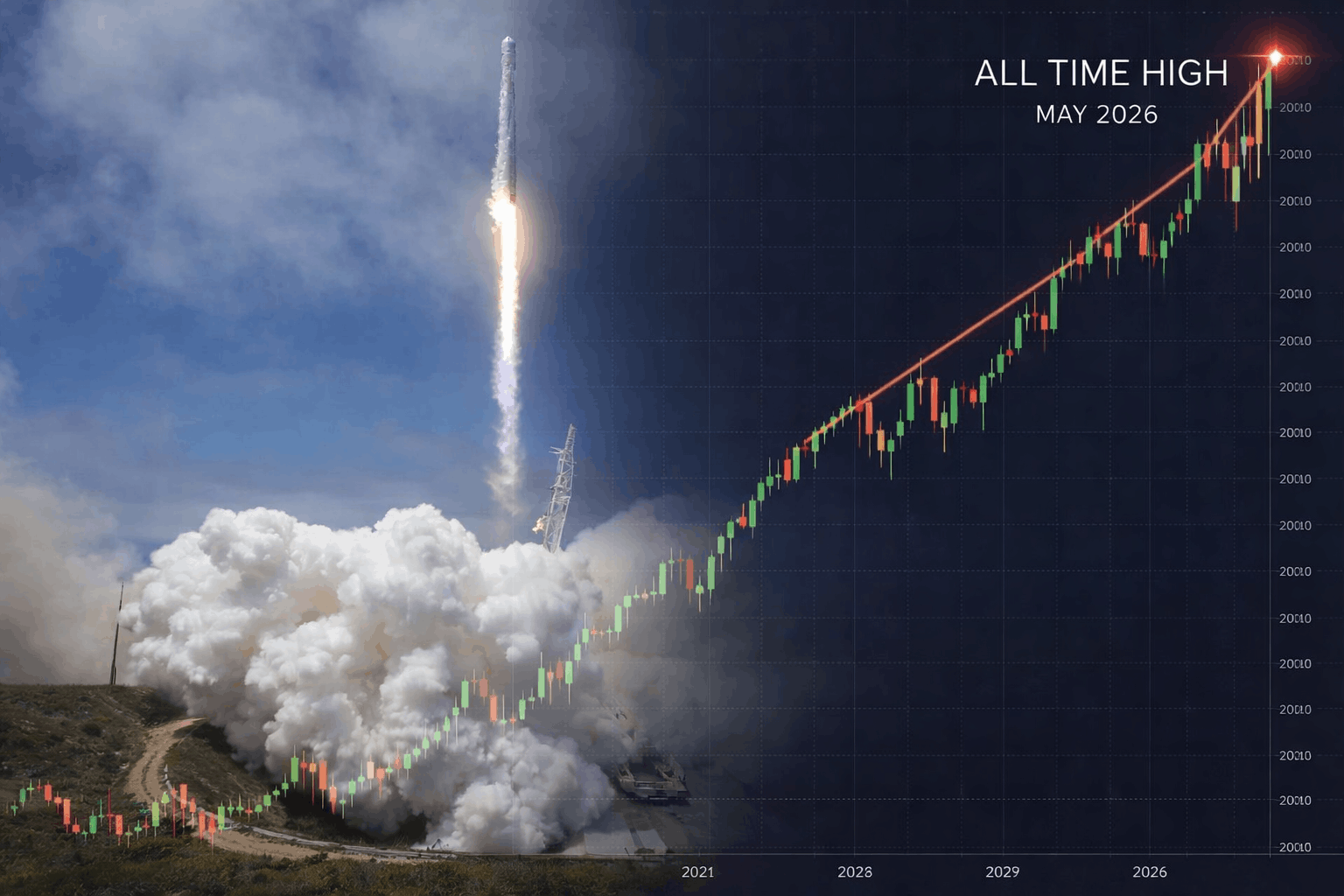
The US-Iran deal is close but not done, the S&P 500 has broken 7,400 for the first time, Bitcoin is down 7% on the month despite institutional buying, SpaceX just filed the most consequential IPO in Wall Street history, and AI is reshaping everything from Apple’s iPhone strategy to global healthcare. Here is what is actually happening — and what it means.
The Iran Deal: “Largely Negotiated” — But Not Done
The biggest geopolitical story on earth right now is unfolding in diplomatic back-channels, and its resolution — or failure — will determine the price of oil, inflation trajectories, and the risk appetite of global markets for the rest of 2026.
Background matters here. On 28 February 2026, the United States and Israel launched coordinated airstrikes on Iran under Operation Epic Fury, targeting military infrastructure, nuclear sites, and leadership. Supreme Leader Ali Khamenei was killed. Iran responded with missile barrages on Israeli cities and US bases across the Gulf — including in the UAE, Qatar, and Bahrain. On 4 March, Iran declared the Strait of Hormuz closed. Tanker traffic — which carries roughly 20% of global oil and 20% of global LNG — dropped first 70%, then to near zero. Oil prices surged. US inflation, already sticky above the Fed’s 2% target, accelerated again.
A fragile ceasefire has held since 8 April, punctuated by skirmishes. This week, negotiations are focused on converting that ceasefire into something more permanent. President Trump told reporters the deal is “largely negotiated” and will be announced “soon.” According to reporting from Axios, the draft framework includes a 60-day ceasefire extension, Iran’s commitment to halt nuclear weapons development and dispose of its enriched uranium stockpile, and a phased reopening of the Strait of Hormuz tied to sanctions relief.
But the sticking points remain sharp. Washington insists frozen Iranian assets will only be unfrozen once the Strait has reopened. Tehran insists discussions on uranium enrichment can only begin after a formal end-of-war memorandum is signed. On Monday, the US launched fresh strikes on Iranian vessels in the Hormuz approaches — a move that one senior diplomat described as leverage, but which others read as a sign the negotiations are more fragile than the White House is letting on.
“THE NAVAL BLOCKADE WILL REMAIN IN FULL FORCE AND EFFECT AS IT PERTAINS TO IRAN, ONLY, UNTIL SUCH TIME AS OUR TRANSACTION WITH IRAN IS 100% COMPLETE”
— Donald Trump, Truth Social (May 2026)
The market’s reaction has been instructive: every hint of progress in talks pushed equity futures up and oil down. Every setback reversed those moves. The deal is the single largest macro variable in play right now, and investors know it.
Markets: The Dow Crossed 50,000. The Numbers Are Real — The Risks Aren’t Priced
The Dow Jones Industrial Average set a new all-time record close of 50,579 on 22 May 2026 — the last trading day before Memorial Day. The S&P 500 stands at 7,473, up 27% year-on-year. Nasdaq sits at 26,343. These are genuine records, extending a recovery that saw the Dow first break the 50,000 milestone back in February before falling sharply during the Iran conflict.
The most visible driver this week was technology: US PC makers surged after Lenovo posted stronger-than-expected earnings, with Dell Technologies hitting an all-time high and HP Inc. climbing over 15% in a single session. Quantum computing stocks saw their largest single-day gains ever after reports that the US government plans to award $2 billion in grants to nine firms — Rigetti Computing jumped 30%, D-Wave surged 22%.
The macro backdrop, however, is not uniformly supportive. The Federal Reserve held its benchmark rate at 3.5%–3.75% at its April meeting — the third consecutive hold — and signalled it is in no rush to cut. Fed minutes from the 28–29 April FOMC meeting noted that “continued elevated inflation readings together with uncertainty related to the duration and economic implications of the Middle East conflict” could necessitate keeping policy tight for longer than markets had assumed. Jerome Powell’s term as Fed Chair expired on 15 May; his replacement has not yet been confirmed, adding a layer of institutional uncertainty to the picture.
The critical underappreciated risk: if the Iran deal collapses, a fresh spike in energy prices could push inflation higher just as the Fed is being asked to ease. Markets are pricing in peace. They may be early.
“Participants generally judged that the continued elevated inflation readings together with uncertainty related to the duration and economic implications of the Middle East conflict could necessitate maintaining the current policy stance for longer than previously anticipated.”
— FOMC Minutes, April 28–29, 2026
Bitcoin: Institutional Buying Can’t Hold the Price Up Alone
Bitcoin is trading at $76,754 as of this morning, down from $82,320 at the start of May — a 7% decline in under four weeks. The broader narrative about institutional adoption is real, but the price data suggests it is not sufficient to overwhelm macro headwinds.
The institutional story is genuinely impressive. Corporate Bitcoin treasury holdings hit a record in early 2026, with institutions buying at 2.8 times the new mining supply. Strategy (formerly MicroStrategy) holds over 214,000 BTC. Spot Bitcoin ETFs — led by BlackRock’s IBIT ($75 billion AUM) and Fidelity’s FBTC (over $20 billion) — collectively manage more than $115 billion. Over 284 public companies now hold Bitcoin on their balance sheets, more than double the figure recorded just months ago.
The disconnect between institutional accumulation and price performance tells a more nuanced story. Bitcoin’s market cap sits at approximately $1.33 trillion, comfortably ahead of Ethereum at $233 billion, but the asset is behaving like a risk-off pressure valve in the current environment: when geopolitical uncertainty rises, liquidity gets pulled. The Iran situation, energy price volatility, and elevated US rates are all headwinds to speculative positioning — which Bitcoin still attracts disproportionately.
What happens if the Iran deal gets done and risk appetite rebounds? The structural case for Bitcoin — supply capped at 21 million, institutional demand accelerating, ETF inflows compounding — suggests a sharp rebound is more plausible than a continued slide. Analysts are projecting a range of $80,500 to $110,000 through the remainder of 2026. The range itself is telling: no one actually knows, and anyone claiming precision is selling something.
SpaceX IPO: Three Companies, One Price Tag, 85% of the Votes
SpaceX filed its IPO prospectus on 20 May 2026, targeting a Nasdaq listing under the ticker SPCX with shares potentially trading as early as 12 June. The company is seeking to raise $75 billion at a valuation of up to $1.75 trillion — more than double the previous IPO record set by Saudi Aramco’s $29 billion raise in 2019. The coverage has been breathless. The S-1, if you read it carefully, tells a more complicated story.
The first thing to understand is that what filed for IPO is not the SpaceX most people have in mind. In February 2026, SpaceX completed an all-stock merger with xAI — Elon Musk’s AI company, which had itself absorbed X (formerly Twitter) in 2025. US accounting rules required SpaceX to recast all historical financials to include all three businesses combined. The result: the $18.7 billion in 2025 revenue and $4.94 billion net loss cited in virtually every headline represents a newly assembled conglomerate, not the rocket-and-satellite company that went to the SEC. Standalone SpaceX generated closer to $15–16 billion in revenue in 2025. The gap is xAI and X — and that gap comes loaded with losses.
The three segments tell three fundamentally different stories. Starlink (Connectivity) generated $11.4 billion in 2025 revenue — 61% of the total — growing 49.8% year-on-year, with $4.4 billion in operating income. It is the only segment producing a GAAP profit, and it is the entire investment case. The Launch segment posted $4.1 billion in revenue but a $657 million operating loss, driven by roughly $3 billion in Starship R&D — a deliberate strategic bet, not a distressed business. The AI segment recorded $3.2 billion in revenue against $6.4 billion in operating losses, with $12.7 billion in capital expenditure for the full year alone. In Q1 2026, AI capex hit $7.7 billion — an annualised pace above $30 billion. SpaceX’s cash fell from $24.7 billion to $15.9 billion in a single quarter. The $75 billion raise looks less like ambition and more like necessity.
There is a warning sign buried in the Starlink numbers too. Subscriber count doubled from 5 million to 10.3 million between Q1 2025 and Q1 2026 — genuinely impressive. But average monthly revenue per user has fallen every year: $99 in 2023, $91 in 2024, $81 in 2025, and $66 in Q1 2026 — a 23% year-on-year decline. Volume is currently outrunning price compression. At 94 times revenue, the direction of that per-subscriber line matters enormously.
One disclosure that has received less attention than it deserves: in May 2026, SpaceX signed Cloud Services Agreements with Anthropic — a direct xAI competitor — for access to its COLOSSUS AI compute infrastructure at $1.25 billion per month through May 2029. That is approximately $15 billion a year. Either party can cancel on 90 days’ notice. xAI built the largest coherent AI training cluster on earth, then started renting spare capacity to a competitor on a very short leash.
On governance: Elon Musk will retain 85.1% of combined voting power post-IPO through a dual-class structure giving Class B shares ten votes each. SpaceX qualifies as a “controlled company” under Nasdaq rules and opts out of several key governance requirements, including an independent-majority board. Public investors are buying financial participation, not influence. The risk factor section runs to 38 pages and is unusually direct about Musk-specific risks: divided attention across Tesla, Neuralink, The Boring Company, and his government advisory role; the 2024 Brazilian asset seizure; and GDPR investigations into Grok’s handling of children’s data.
The space sector more broadly is entering a new phase. Rocket Lab, Firefly Aerospace, and Intuitive Machines are all publicly traded, while the US-China race to the moon and Trump’s “Golden Dome” programme are pumping federal dollars into the sector — about 20% of SpaceX’s 2025 revenue came from US federal agencies. The SpaceX IPO will test whether public markets are willing to pay venture multiples for an optionality story packaged inside a company where shareholders hold one vote for every ten Musk holds.
“It’s less of a space exploration company and more of a satellite communications company that is propping up a deeply unprofitable AI and social networking company.”
— Leo Sun, The Motley Fool, May 2026
For a full breakdown of SpaceX’s S-1 financials — including segment-by-segment analysis, the Starlink ARPU trend, and the five things to watch before June 12 — read our deep-dive analysis.
AI: The Race Is Accelerating — And the Cracks Are Showing
The pace of AI development in May 2026 has been, by any measure, relentless. OpenAI rolled out GPT-5.5 Instant — its new ChatGPT default — claiming a greater than 50% reduction in hallucinations in high-stakes scenarios and expanded integration with Gmail, uploaded files, and personal history. At Google I/O, Gemini was reframed as a full operating system layer: not just an assistant but an autonomous agent capable of managing tasks across the entire Google ecosystem.
Apple made arguably the most strategically significant move of the month, signalling a platform shift for Apple Intelligence that would allow users to select third-party AI providers — including Google and Anthropic — to power Siri and related features across iOS 27. This represents a structural opening of Apple’s walled garden that would have been unthinkable two years ago.
Anthropic, meanwhile, published research on a technique called “dreaming” — a method allowing AI agents to review prior behaviour, identify patterns, and improve performance between sessions without human intervention. And the company separately announced a $200 million, four-year partnership with the Gates Foundation to develop AI tools for healthcare, education, and agriculture in underserved regions.
The counterpoint to the optimism is worth noting. Recent polling shows widespread public concern that AI is advancing too quickly, with bipartisan anxiety about job displacement, environmental costs, and concentration of wealth. Pope Leo, in a major papal document this month, called for the world to “disarm” AI. The White House is preparing an executive order establishing a voluntary framework under which AI developers would provide government access to advanced models 90 days before public release — a modest step toward oversight in a sector that has largely self-regulated.
The structural tension is clear: the economic incentives driving AI development are immense, the regulatory apparatus is nascent, and the public is increasingly uneasy. That combination has not resolved itself in any other technology wave in history. There is no obvious reason to expect it to here.
What to Watch This Week
The Iran deal is the dominant variable. If a formal agreement is signed, expect oil prices to fall sharply, risk assets to rally, and inflation expectations to ease — potentially reopening the door to Fed rate cuts later in 2026. If talks stall or collapse, the reverse is true across every asset class. SpaceX’s IPO roadshow will dominate financial press through early June. Bitcoin’s behaviour in the week after a potential Iran deal will be a cleaner read on its macro sensitivity than any analyst model. And in AI, watch for the White House executive order — if it names specific companies or model thresholds, it will move stocks.
Sources:
- CNN — What’s in the proposed deal that could end the US-Iran conflict?
- NBC News — Trump says he won’t ‘rush into’ a deal with Iran
- Al Jazeera — Trump says ceasefire on ‘life support’
- Washington Post — US and Iran work toward deal to extend ceasefire and reopen Strait of Hormuz
- Axios — What’s inside the Iran deal Trump is close to signing
- CNBC — Trump says Iran deal reopening Strait of Hormuz ‘largely negotiated’
- Wikipedia — 2026 Strait of Hormuz crisis
- Britannica — 2026 Iran war
- Federal Reserve — FOMC Statement, April 29, 2026
- Federal Reserve — FOMC Minutes, April 28–29, 2026
- TheStreet — Stock Market Today, May 15, 2026
- CNBC — Stock Market News, May 21, 2026
- Fortune — Current Price of Bitcoin, May 26, 2026
- CoinReporter — Institutional Bitcoin Accumulation Continues
- Bitcoin Magazine — Corporate Bitcoin Holdings Hit Record High
- CNBC — SpaceX IPO Live Updates
- Al Jazeera — Why the SpaceX IPO is the talk of Wall Street
- NPR — Elon Musk’s SpaceX IPO plans reveal blockbuster spending on rockets and AI
- Fortune — SpaceX stock joins growing constellation of public space companies
- Rubbish Talk — SpaceX Files the Biggest IPO in History: Analysis
- SpaceX S-1 Filing — SEC EDGAR (May 2026)
- The Motley Fool — Here Are 7 Important Things Investors Learned from SpaceX’s S-1 Filing
- Morningstar — Does SpaceX’s Sky-High Valuation Make Sense?
- SatNews — Inside SpaceX’s S-1: Three Companies. One Profit. $1.75 Trillion
- MarketingProfs — AI Update, May 22, 2026
- Medium — AI News: Week of May 18–24, 2026
- National Catholic Reporter — Pope Leo calls to ‘disarm’ AI