
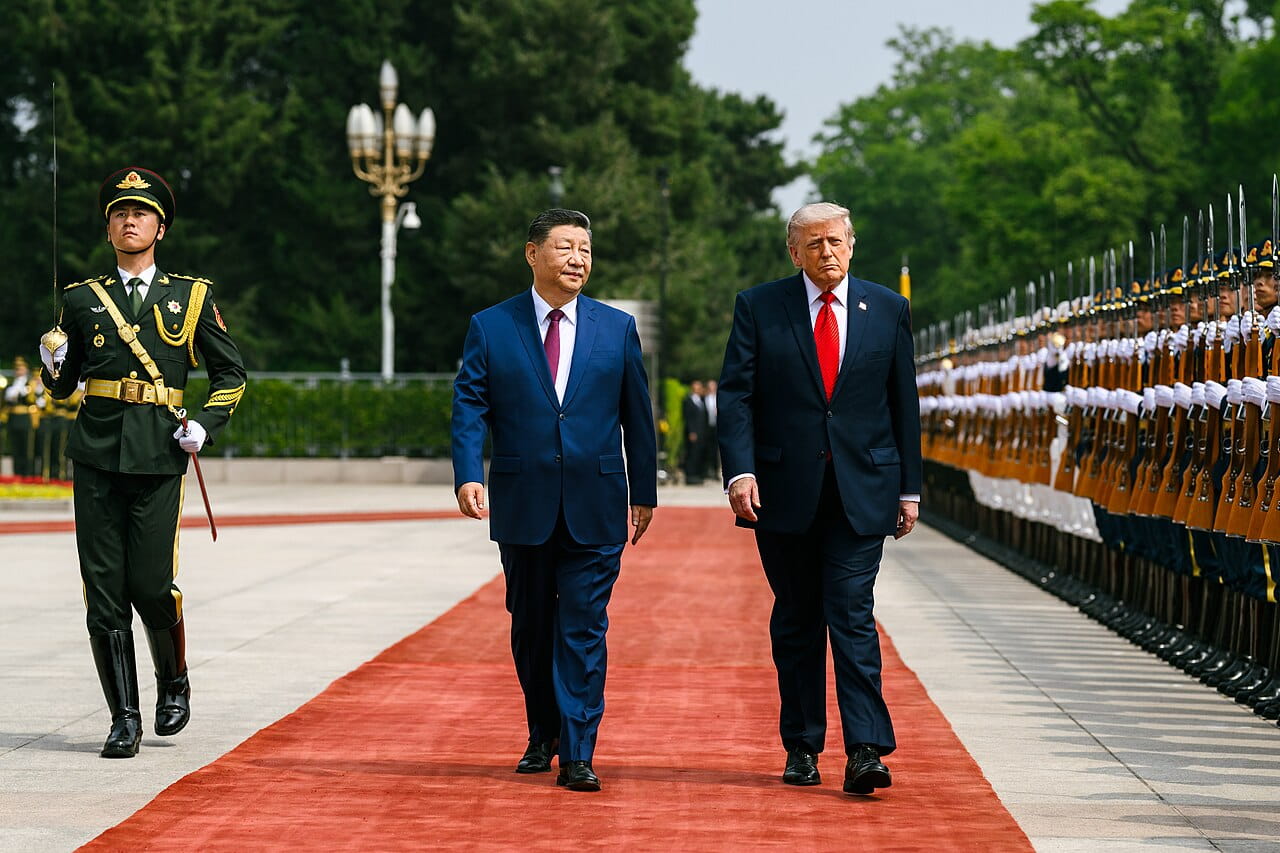
Three days, two leaders, one Boeing deal — and most of what mattered went unresolved. The world’s most consequential diplomatic summit of 2026 closed with warm rhetoric, a headline number on aircraft orders, and China winning the things that actually counted.
The pageantry was flawless. A welcome ceremony at the Great Hall of the People, a tour of the Temple of Heaven, a state banquet for a president flanked by the CEOs of Tesla, Apple, BlackRock, Goldman Sachs, Boeing, and a dozen other American giants. Donald Trump’s May 13–15 state visit to Beijing was the most commercially staged diplomatic event in recent memory — and it was deliberately designed to look that way.
Before Trump boarded Air Force One, we published a breakdown of what to watch: Trump Flies to Beijing With His Billionaires. The piece argued that behind the ceremonial theatre sat a negotiation over Taiwan, semiconductor export controls, and Chinese leverage over the Iran conflict — and that the headline Boeing deal would crowd out the things that actually mattered to both governments. That analysis held up.
The summit is over. Here is what was promised, what was delivered, and what China quietly pocketed while the cameras were rolling.
The Boeing Deal: A Win With Asterisks
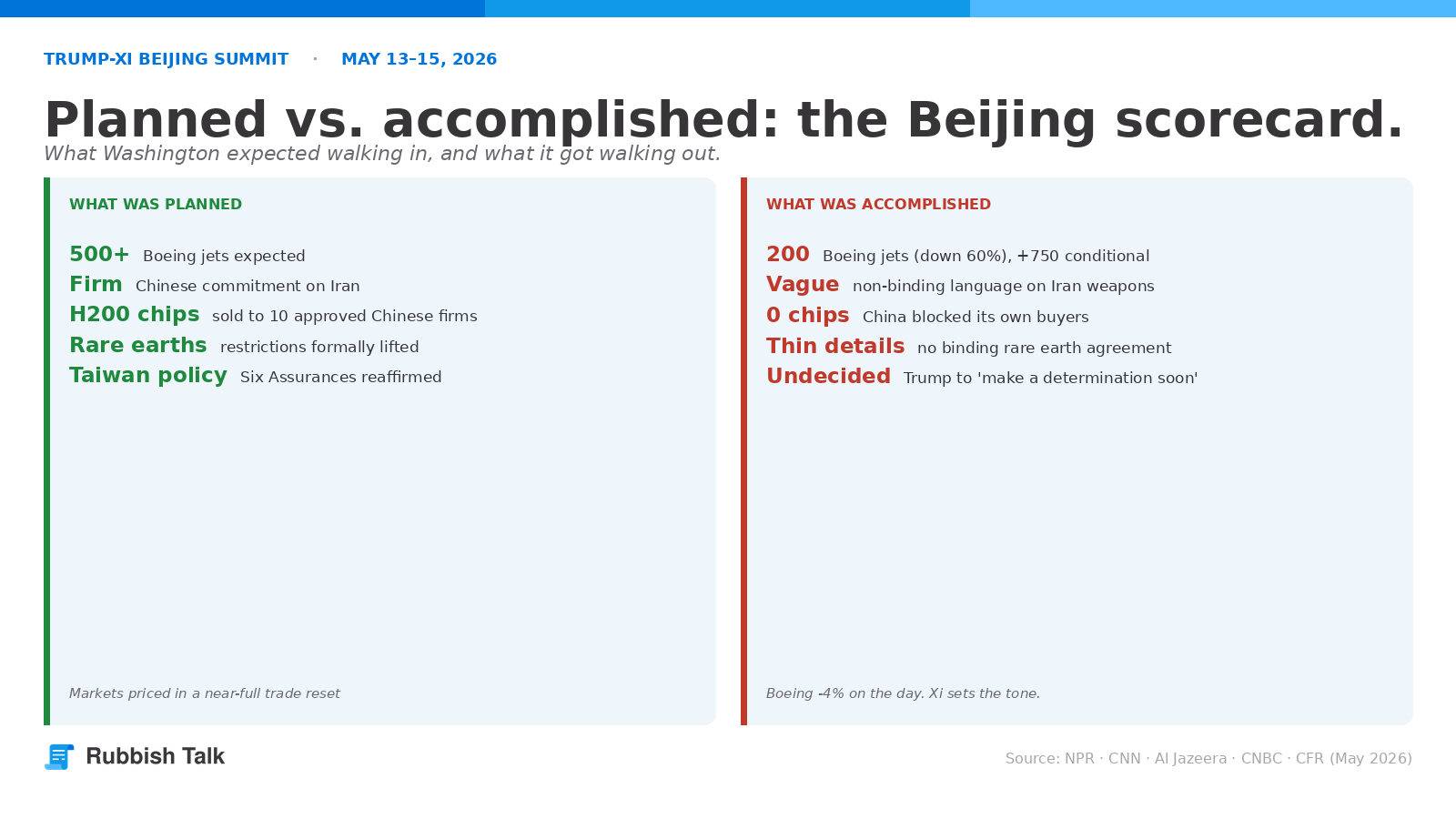
The headline commercial outcome was a Chinese commitment to purchase 200 Boeing aircraft — 737 MAX jets and widebodies equipped with GE Aerospace engines. Trump announced it as a major victory, describing it as “200 planes and a promise of up to 750 if they do a good job.”
It is a real deal, and a genuinely significant one for Boeing, which has been locked out of the Chinese market since 2017. China is the world’s largest aviation market by growth trajectory, and the reopening of that channel carries multi-year revenue implications.
But context matters. Pre-visit reporting had put the potential order at 500 aircraft — a figure circulated widely enough to shape market expectations. The 200-plane confirmation landed well short of that benchmark, and Boeing’s share price fell 4% on Wall Street after the announcement. The “up to 750” framing was immediately flagged by analysts as a conditional and politically useful number rather than a firm commitment. China has used Boeing orders as diplomatic levers before — announcing, then delaying, then resuming based on the state of the bilateral relationship. The absence of a signed contract with delivery timelines means the asterisks matter.
On agriculture and energy, progress was reported but details remained sparse. China expressed interest in increasing purchases of US oil to reduce dependence on Middle Eastern crude, and agricultural commitments were referenced in post-summit briefings. No binding figures were announced.
Iran: Trump’s Top Ask, China’s Vaguest Offer
Before the trip, our analysis identified Iran as Trump’s most pressing ask — and the one where China held the most leverage. With the Iran-Hormuz conflict straining US military logistics and threatening oil flows through one of the world’s critical choke points, Trump needed Beijing to apply pressure on Tehran. China, which depends on Iranian oil, had been careful not to actively pressure Iran while offering private assurances it would not transfer weapons.
The outcome: Trump claimed China agreed not to supply Iran with any military equipment. On the surface, that sounds like a win. In practice, analysts were blunt about what it means.
“The Chinese language on Iran has been vague but useful with regard to de-escalation — but they haven’t really made any commitment to police stability or provide stability.”
— Expert analysis reported by multiple outlets following the summit close
The “contours of that agreement remain completely vague,” according to reporting from KSLA citing summit observers. What China did not commit to: actively pressuring Tehran, facilitating Hormuz access, or cutting off Iran’s financial channels. What it gave Trump was language he could present to domestic audiences as a diplomatic win. The strategic position on Iran is materially unchanged.
Nvidia and Chips: The Most Telling Non-Outcome
Before the trip, Jensen Huang’s absence from the CEO delegation was noted as significant — a signal that AI chip export controls were being deliberately kept off the commercial table. Then, unusually, Huang was added to the delegation at the last minute after Trump called him personally.
The result underscored the limits of presidential dealmaking on technology. The US reportedly approved ten Chinese companies to purchase Nvidia’s H200 AI chips as part of the summit package. But as Trump himself told reporters after the meetings, China “chose not to” approve those purchases — Beijing preferred to develop its own chips rather than buy American. Not a single H200 has shipped to any of the ten approved buyers.
“China chose not to sanction the purchases. They want to develop their own [chips].”
— Donald Trump, speaking to reporters following Beijing summit, May 2026
This outcome is more revealing than a failed deal. It shows that China’s semiconductor self-sufficiency strategy is no longer contingent on US access — Beijing is consciously declining available supply to accelerate domestic capability. The technology decoupling, in other words, is proceeding on China’s timeline, not Washington’s.
On rare earths, China agreed in principle to halt its 2025 export restrictions on rare earth permanent magnets and key materials. The details remained thin in official readouts, and the structural fact — that China controls the dominant share of global rare earth processing — was not addressed.
Taiwan: Where China Won the Summit
This is the most consequential outcome of the visit, and the one receiving the least proportionate coverage.
Before Trump flew to Beijing, we flagged Taiwan as China’s real price — the concession Beijing would extract in exchange for movement on Iran and trade optics. Wang Yi had described Taiwan as “the biggest point of risk” in the bilateral relationship. Analysts at the Council on Foreign Relations had noted that China would have the upper hand because Trump needed a commercial win more than Xi did.
What happened: Xi warned Trump directly that mishandling Taiwan would put the US-China relationship in “great jeopardy” and could push the two countries toward “conflict.” In a striking departure from standard US protocol, Trump declined to confirm ongoing arms sales to Taiwan, saying only that he would “make a determination soon.” Secretary of State Marco Rubio told NBC News that Taiwan “did not feature primarily” in the first day of discussions — a framing Taipei rejected as inconsistent with the documented Xi warning.
“Trump’s meeting with China’s Xi steers the U.S. away from Taiwan again.”
— CNBC headline analysis, May 16, 2026
Taiwan’s government publicly responded to Trump’s hesitation, expressing concern. Regional allies including Japan and South Korea are watching carefully. The Reagan-era Six Assurances — the framework that has governed US-Taiwan arms relationships for four decades — were not publicly reaffirmed. Xi’s September visit to the US is now confirmed; the arms sale “determination” will be a defining test of whether Trump bends further.
The mainstream coverage is focused on Boeing orders. What it is underweighting is that Beijing emerged from this summit with meaningful uncertainty injected into US-Taiwan arms policy — which is precisely what it came for.
The CEO Delegation: Commerce Over Strategy
The corporate constellation around Trump was unprecedented in diplomatic history: Elon Musk, Tim Cook, Larry Fink, David Solomon, Kelly Ortberg, Larry Culp, Stephen Schwarzman, Cristiano Amon, and more. The message to Beijing was clear — American capital is aligned behind engagement, and the White House is the broker.
For the CEOs, the calculation is straightforward. Apple generates roughly 17–18% of its revenue from Greater China and its supply chain runs through it. Tesla’s Shanghai Gigafactory is central to global production. Any improvement in trade terms — lower tariffs, better regulatory access, resumed chip sales — directly benefits their companies.
What the delegation did was lower the transaction costs of the summit and reinforce the optics of a “win.” Whether it changed the strategic calculus of either government is a different question. A government-to-government agreement on Taiwan policy is not concluded by having Larry Fink in the room.
What the Summit Actually Settled
Step back from the individual outcomes and the picture is consistent: the Beijing summit was a stabilisation exercise, not a restructuring.
The tariff architecture is unchanged. US tariffs on Chinese goods sit at 47.5%, China’s tariffs on American exports at 31.9%. The trade truce extended to November 2026 remains the operative framework. The summit produced no new tariff reduction commitment. Both sides chose to protect the truce while preserving their structural positions.
China achieved its primary objectives: it projected itself as an equal to the US on the global stage, it set the tone of the relationship, it extracted genuine uncertainty on Taiwan arms sales, and it declined to make binding commitments on Iran. The Atlantic Council’s post-summit analysis described Beijing as “directing the tone of the relationship” — a verdict consistent with how the three days unfolded.
Trump achieved: a 200-jet Boeing commitment he can present as a jobs story, vague Chinese language on Iran he can frame as a diplomatic breakthrough, and a September Xi visit that extends the summit’s political shelf life.
“Trump’s Beijing visit was more vibes than details. And Xi set the tone.”
— CNN analysis headline, May 16, 2026
What neither side resolved: the structural technology competition, the semiconductor decoupling, the rare earth supply chain vulnerability, and the long-run status of Taiwan. Those are not issues that two-day summits solve. They are measured in decades.
What Comes Next
Three things to watch in the weeks ahead.
The Taiwan arms sale decision. Trump said he would “make a determination soon.” Whether he approves, delays, or scales back the $13 billion package previously suspended will be the clearest signal of what Beijing actually extracted on Taiwan. A further delay is a concession, regardless of how it is framed.
Nvidia H200 deliveries. China blocked the purchases. That is the current position. Whether Beijing reverses course — or whether this confirms that it has no interest in US chips — will tell you more about the technology relationship than any summit communiqué.
The September Xi visit. Xi is expected in the US in September. The framing of that meeting will reveal whether this Beijing summit was a genuine reset or a staging post toward further Chinese gains. If the Taiwan arms sale is still “pending” by then, the answer is the latter.
The spectacle in Beijing was real. The Boeing deal is real. The shift in the strategic landscape, quiet and incremental as it was, is also real. China plays a long game at these summits. It came for Taiwan policy movement, left with genuine uncertainty where there was previously firmness, and gave nothing binding in return. That is a well-executed summit. It just wasn’t Washington’s.
Sources:
- Trump Flies to Beijing With His Billionaires — Rubbish Talk (pre-visit analysis)
- Key takeaways from Trump’s China trip — NPR
- Trump’s Beijing visit was more vibes than details. And Xi set the tone — CNN
- Underwhelming summit outcome in China brings Trump back to reality — Euronews
- Trump says China agreed to buy 200 Boeing planes — Al Jazeera
- Trump concludes Beijing summit with vague Iran commitment from China — KSLA
- Trump’s second meeting with China’s Xi steers the U.S. away from Taiwan again — CNBC
- Trump won’t commit to arms sale to Taiwan after stark warning from Xi — ABC News
- Trump says China is blocking Nvidia H200 purchases — Tom’s Hardware
- Trump-Xi summit revives China tech rally hopes as U.S. reportedly clears Nvidia H200 sales — CNBC
- What did Trump and Xi accomplish? — Atlantic Council
- Trump-Xi Summit: What Wasn’t Announced, and Other Surprises — Newsweek
- Xi warns Trump about “conflicts” if Taiwan isn’t “handled properly” — CBS News
- Trump-Xi Summit in Beijing: Managing the World’s Most Important Relationship — CSIS
- At the Trump-Xi Summit, China Will Have the Upper Hand — Council on Foreign Relations
- Trump shares few details in Boeing, GE Aerospace, agriculture deals with China — The Hill
- Why Taiwan became the defining issue in the Trump-Xi talks — CNBC