
US consumer prices rose 4.2% over the year to May 2026, the largest 12-month increase since April 2023, driven by a 23.5% surge in energy costs. Yet much of the coverage this week has led with “cooling inflation” and “easing pressure,” language anchored to a slightly smaller monthly gain rather than the annual number. At the same time, the Federal Reserve under new Chair Kevin Warsh has scrapped forward guidance, leaving markets with less warning than at any point in years, just as two of the “Magnificent 7” report earnings. Here is what the data actually says, stripped of the spin.
What the numbers actually show
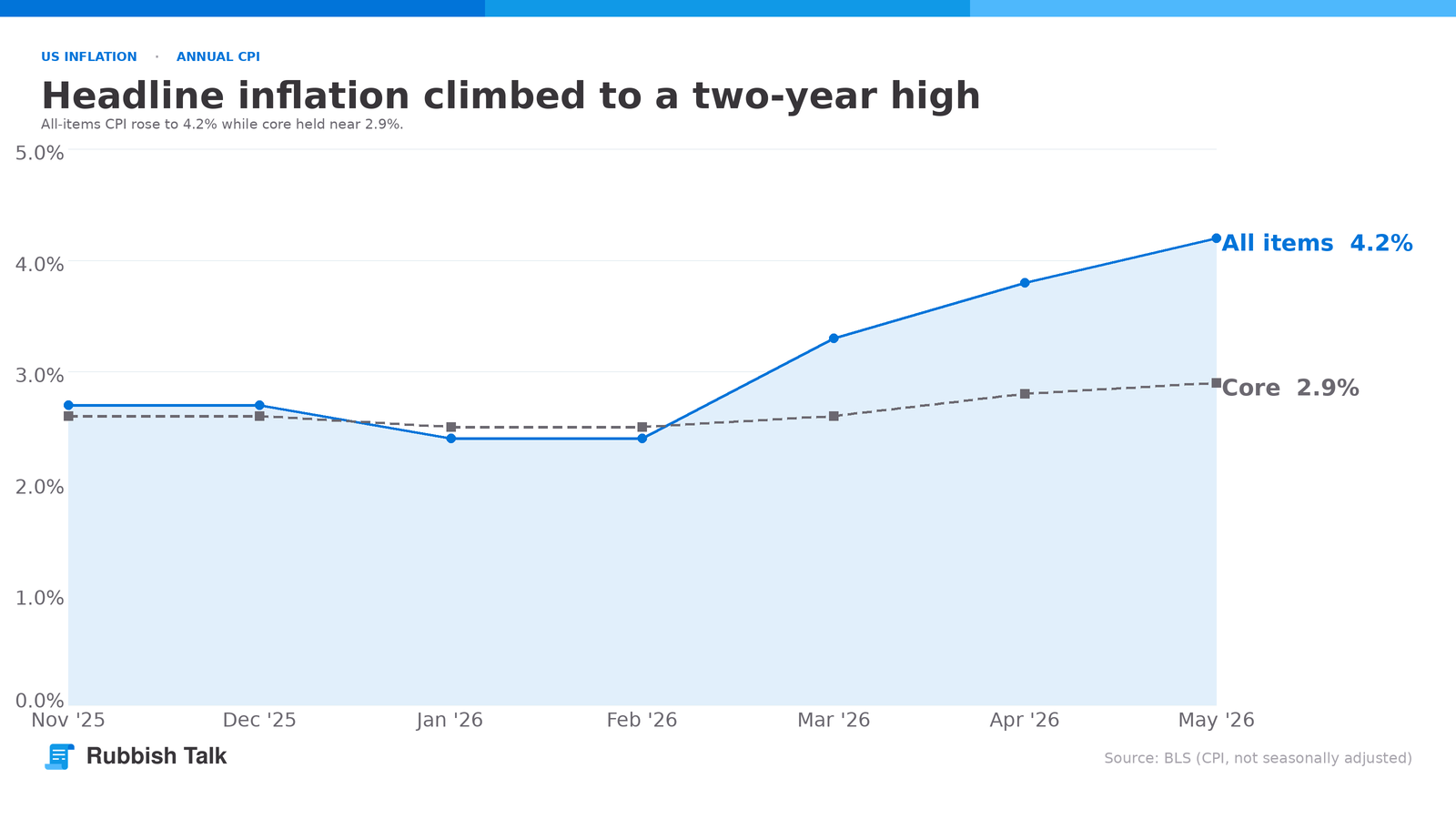
The Bureau of Labor Statistics reported that the all items Consumer Price Index for All Urban Consumers increased 4.2% from May 2025 to May 2026. In the BLS’s own words, “This was the largest 12-month increase since the index rose 4.9 percent over the year ended April 2023.” That is not a rounding-error uptick. Annual CPI has climbed steadily this year: 2.4% in January and February, 3.3% in March, 3.8% in April, and now 4.2% in May.
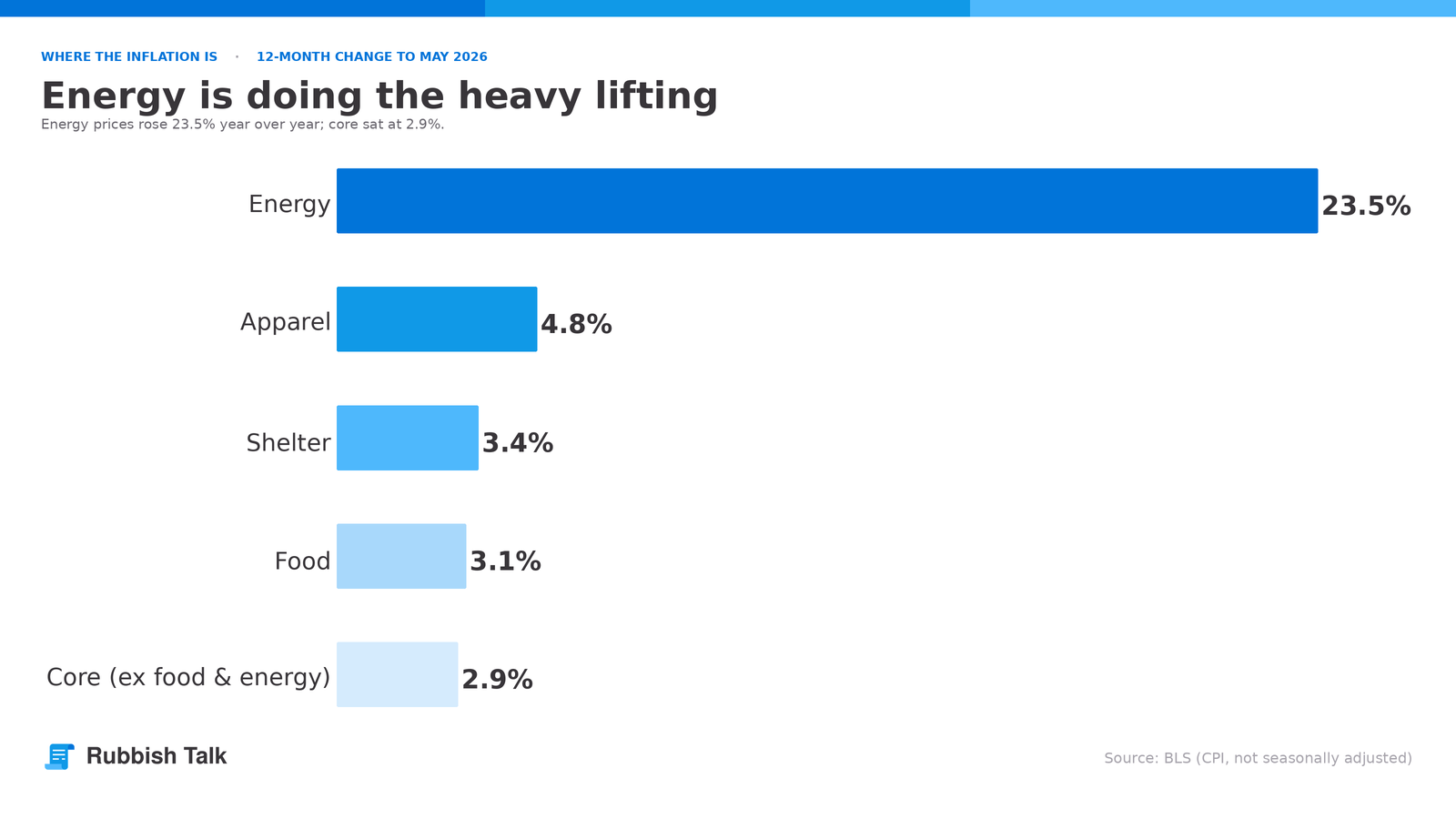
The driver is energy. Energy prices rose 23.5% over the year to May, after a 17.9% annual gain in April. A year earlier, in May 2025, energy prices were falling at a 3.5% annual rate. Food rose 3.1% (food at home up 2.7%, food away from home up 3.5%). Stripping out food and energy, so-called core CPI rose 2.9%, with shelter up 3.4%, apparel up 4.8%, household furnishings and operations up 3.0%, and both medical care and recreation up 2.6%.
There is a real deceleration story too, and it belongs in any honest account. On a seasonally adjusted basis, the monthly increase was 0.5% in May after 0.6% in April, and core rose 0.2% month over month. So the pace of price increases slowed slightly from one month to the next. But the headline that inflation “eased” leans entirely on that monthly comparison while the year-over-year figure, the number most people actually feel, sits at a two-year high.
What much of the coverage said
Scan the finance pages this week and a familiar frame appears: softer inflation, pressure easing, relief for households. One widely syndicated market wrap ran under the banner that inflation pressure was easing as equity futures edged higher. The logic is not fabricated. Month-over-month gains did shrink, the 10-year Treasury yield eased toward 4.5%, and equity markets sat near record highs, with the S&P 500 around 7,570 in mid-July.
The problem is emphasis. A reader who sees “inflation eases” and nothing else would reasonably conclude prices are coming back under control. The annual rate says the opposite: at 4.2%, inflation is more than double the Fed’s 2% target and higher than it has been in over two years. Both facts are true. Only one of them tends to make the headline.
Where the narrative holds up, and where it does not
The strongest defense of the “easing” framing is that the spike is concentrated and possibly temporary. The energy surge traces largely to the conflict involving Iran that began in March 2026 and pushed oil and gas prices sharply higher. If that shock fades, the annual comparisons should improve. J.P. Morgan Wealth Management Chief Investment Strategist Phil Camporeale made exactly that case after the Fed’s June meeting.
“While both the FOMC and investors are divided on whether there will be a rate hike in 2026, we continue to believe the one-time supply shock from oil prices that drove up inflation in the spring will gradually dissipate in coming months, leaving the Fed on hold for the remainder of the year.”
– Phil Camporeale, Chief Investment Strategist, J.P. Morgan Wealth Management (June 18, 2026)
That is a reasonable, evidence-based view. Core inflation at 2.9% is far below the 4.2% headline, and oil prices did fall to their lowest level since March after news of a US-Iran deal. But “temporary” is a forecast, not a fact, and framing a two-year-high inflation print as good news bakes in an outcome that has not happened yet. Households paying 23.5% more for energy do not experience a supply shock as a footnote.
One more piece of context deserves a mention because it is almost never included: there is a hole in the data. The BLS notes that October 2025 CPI figures are “not available due to the 2025 lapse in appropriations.” A government shutdown left a gap in the official inflation record, which makes clean year-over-year comparisons harder and is worth remembering before treating any single monthly reading as gospel.
The Fed just made surprises part of the plan
Into this picture steps a Federal Reserve that has deliberately reduced how much it tells the public. At the June meeting, his first as Chair, Kevin Warsh held the federal funds rate at a target range of 3.50% to 3.75% in a unanimous vote, and stripped forward guidance out of the statement entirely. The statement itself ran less than half the length of his predecessor’s final one, and closed on a blunt line: the committee “will deliver price stability.”
Warsh was explicit about the change at his press conference.
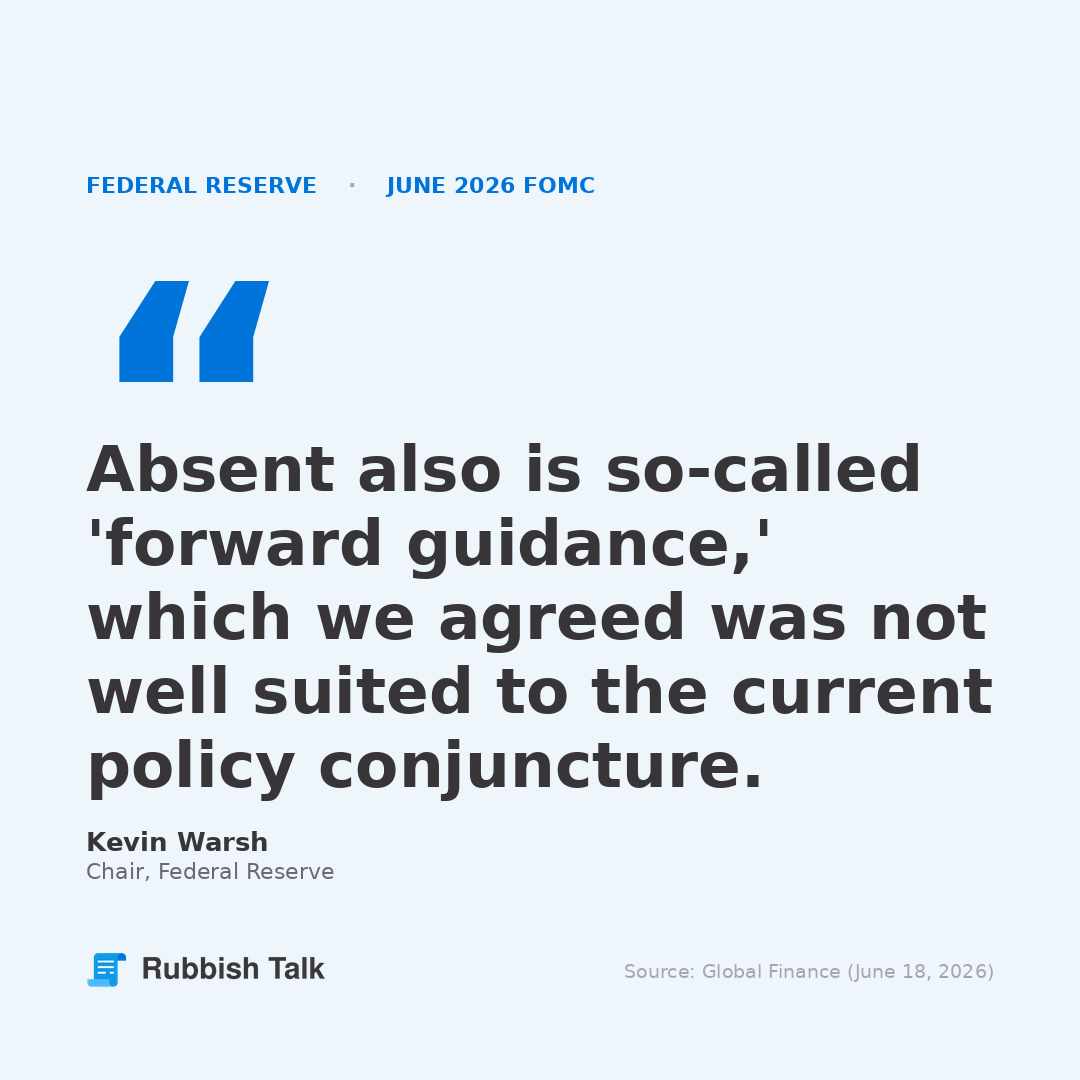
“It’s a bit shorter, a bit simpler, and it dispenses with some of the older language. That statement just gives you the facts as best as we can judge it. Absent also is so-called ‘forward guidance,’ which we agreed was not well suited to the current policy conjuncture.”
– Kevin Warsh, Chair, Federal Reserve (June 17, 2026)
The shift is not cosmetic. For years the Fed telegraphed its intentions to avoid jolting markets. Warsh has decided that predictability is a cost, not a virtue. Derek Tang, CEO of research firm MPA Macro, described the break plainly.
“This is a sea-change from what previous chairs have done, which was to give the market as much of a ‘heads-up’ as they could if they were going to change direction or consider a change on the horizon. Whereas, for Warsh, he’s not shy about wanting to keep the element of surprise as a tool in his back pocket.”
– Derek Tang, CEO, MPA Macro (June 18, 2026)
The June “dot plot” turned hawkish. Nine of the 18 participants who submitted projections saw at least one rate hike in 2026, and the median path put the funds rate at 3.80% for 2026, 3.60% for 2027, and 3.40% for 2028. Warsh declined to submit his own dot at all, telling reporters, “For me, it’s not helpful in the conduct of policy.” He also announced five task forces to re-examine Fed communications, the balance sheet, data sources, the inflation framework, and productivity and jobs in the age of AI, calling the subjects “timely, consequential, and in my view, worthy of a fresh look.” The next decision comes at the July 28-29 meeting.
Who benefits, who is exposed
Less forward guidance shifts risk onto anyone who has to price the future. Bond investors, mortgage lenders, and corporate treasurers all built models around a Fed that hinted before it acted. Remove the hints and the compensation for uncertainty goes up, which can mean higher long-term rates even when the policy rate does not move. Warsh’s wager is that a Fed seen as genuinely committed to killing inflation earns credibility that eventually lowers those same long-term rates. That trade-off is real, and it is unproven.
For households, the exposure is simpler. Wages have lagged inflation, long-term unemployment has been drifting higher, and energy is up nearly a quarter year over year. A framing that treats 4.2% as reassuring is a framing written from the perspective of markets, not kitchen tables. The labor backdrop is still solid, with employers adding 172,000 jobs in May and unemployment at 4.3%, which is precisely why the Fed feels it can prioritize inflation over growth for now.
The earnings test comes this week
The market’s optimism gets a reality check between July 20 and July 24, when a heavy slate of large caps reports second-quarter results. Two members of the “Magnificent 7” are on the calendar. Alphabet reports after the close on Wednesday, July 22, with analysts expecting earnings of $2.90 per share, up 25.5% year over year, on revenue of $116.9 billion, up 21.3%. Tesla reports the same afternoon, with Wall Street looking for revenue of $26.4 billion, up 17.3%, and earnings of 54 cents per share, up 35%.
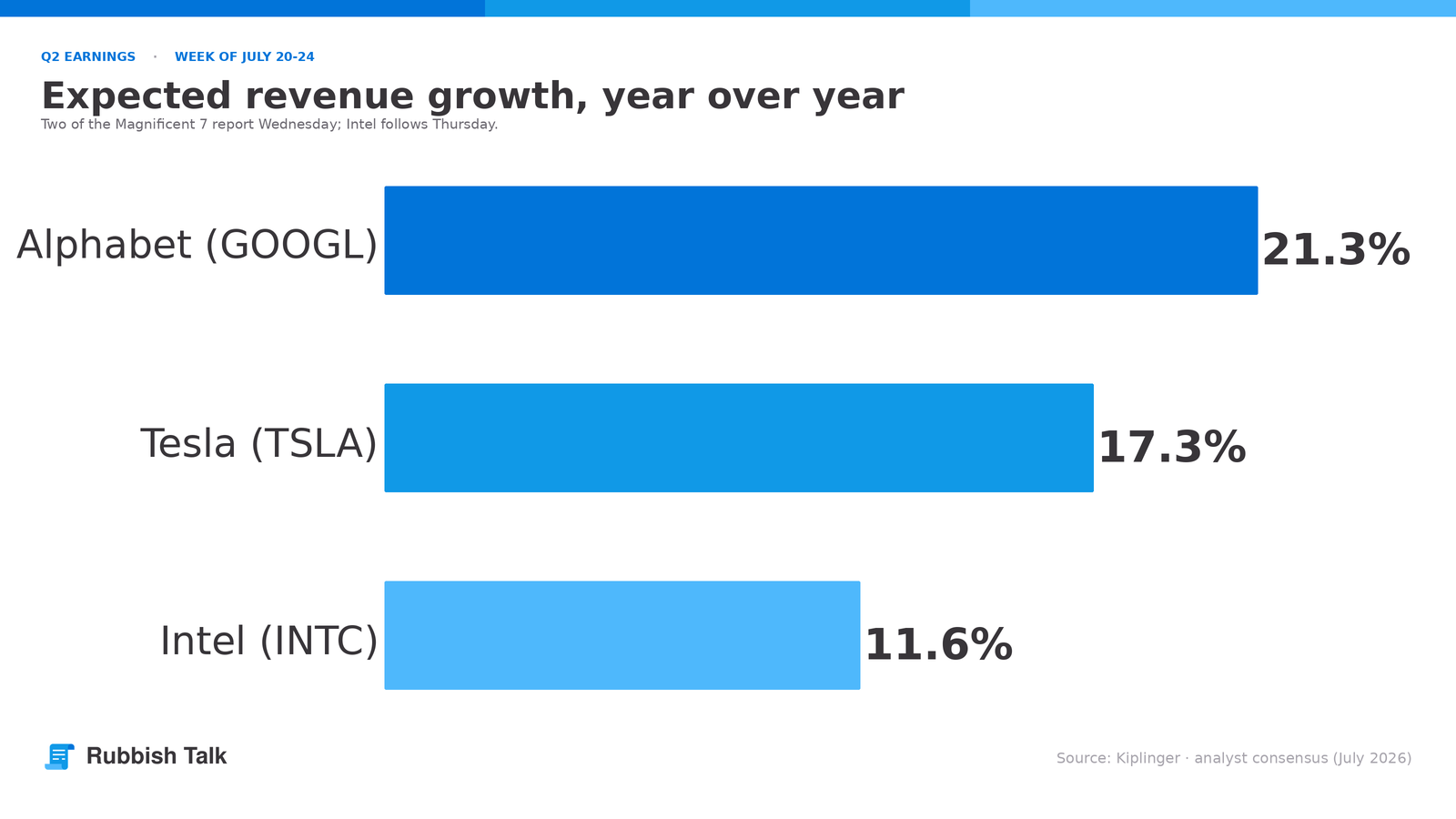
Truist Securities analyst Youssef Squali expects Alphabet’s top line to grow even faster than consensus, at 22%, writing that “Search spend remains strong, fueled by query volume & cost-per-click, even as Gen AI-powered peers are thriving.” On Tesla, BofA Securities analyst Alexander Perry said the focus will be robotaxi deployments, “particularly the pace of fleet scaling and new markets.” Intel reports after Thursday’s close, where analysts expect 22 cents per share against a year-ago loss of 10 cents on revenue of $14.4 billion, up 11.6%; the stock is up more than 150% year to date but has fallen 33% so far this month amid a chip-sector pullback.
Beyond the megacaps, the week is dense with bellwethers across the economy: General Motors, 3M, Charles Schwab and Northrop Grumman on Tuesday; AT&T, CME Group, Moody’s, Philip Morris International, IBM, Texas Instruments and ServiceNow on Wednesday; Honeywell, Blackstone, Comcast, Lockheed Martin, RTX, T-Mobile, Union Pacific and Thermo Fisher on Thursday; and American Express, Verizon, HCA Healthcare, NextEra Energy and SLB on Friday. Together they offer a broad read on whether corporate demand is holding up as prices stay elevated and the Fed keeps its next move to itself.
What to watch next
Three things will decide whether this week’s “easing” story ages well. First, energy: oil has come off its highs since the US-Iran deal, and if that feeds through to the pump, the June and July CPI reports could finally bend the annual line lower. Second, the Fed on July 28-29, where a hawkish dot plot and a Chair who prizes surprise mean the risk is no longer just a hold but a live debate about a hike. Third, earnings breadth: strong results from Alphabet and Tesla can carry an index, but the banks, industrials, and telecoms reporting alongside them will show whether the strength is real or narrow.
The honest one-line version of this week is not that inflation eased. It is that annual inflation hit a two-year high, the monthly pace slowed a touch, and almost everything now hinges on whether an energy shock fades before it hardens into expectations. Anyone telling you it is simpler than that is selling the headline, not the data.
Sources:
- BLS: Consumer prices up 4.2 percent over the year ended May 2026
- BLS: Consumer Price Index news release archive (May 2026)
- Global Finance: Fed Scraps Forward Guidance Under Chair Kevin Warsh
- Chase / J.P. Morgan: 3 Key Takeaways From the June 2026 FOMC Decision
- Kiplinger: Earnings Calendar and Analysis for This Week (July 20-24)
- Yahoo Finance: US stock market today, July 21, 2026
- goMarkets: US markets in July, key data, Fed signals and risks to watch
- Image: The White House, Public domain, via Wikimedia Commons
