
Part Two of the Rubbish Talk Private Equity Series. Read Part One: How Private Equity Bought America’s Essential Services →
The same playbook that captured fire trucks, nursing homes, and ambulances has now reached your screen. Across children’s content, car culture, science education, and streetwear media, private equity firms have quietly bought the channels millions of people watch every week. Some deals are public. Many are not. And the consequences — for editorial quality, creator independence, and what you’re actually watching — follow the same pattern as every other PE acquisition: extraction comes before value creation.
The Scale of the Takeover
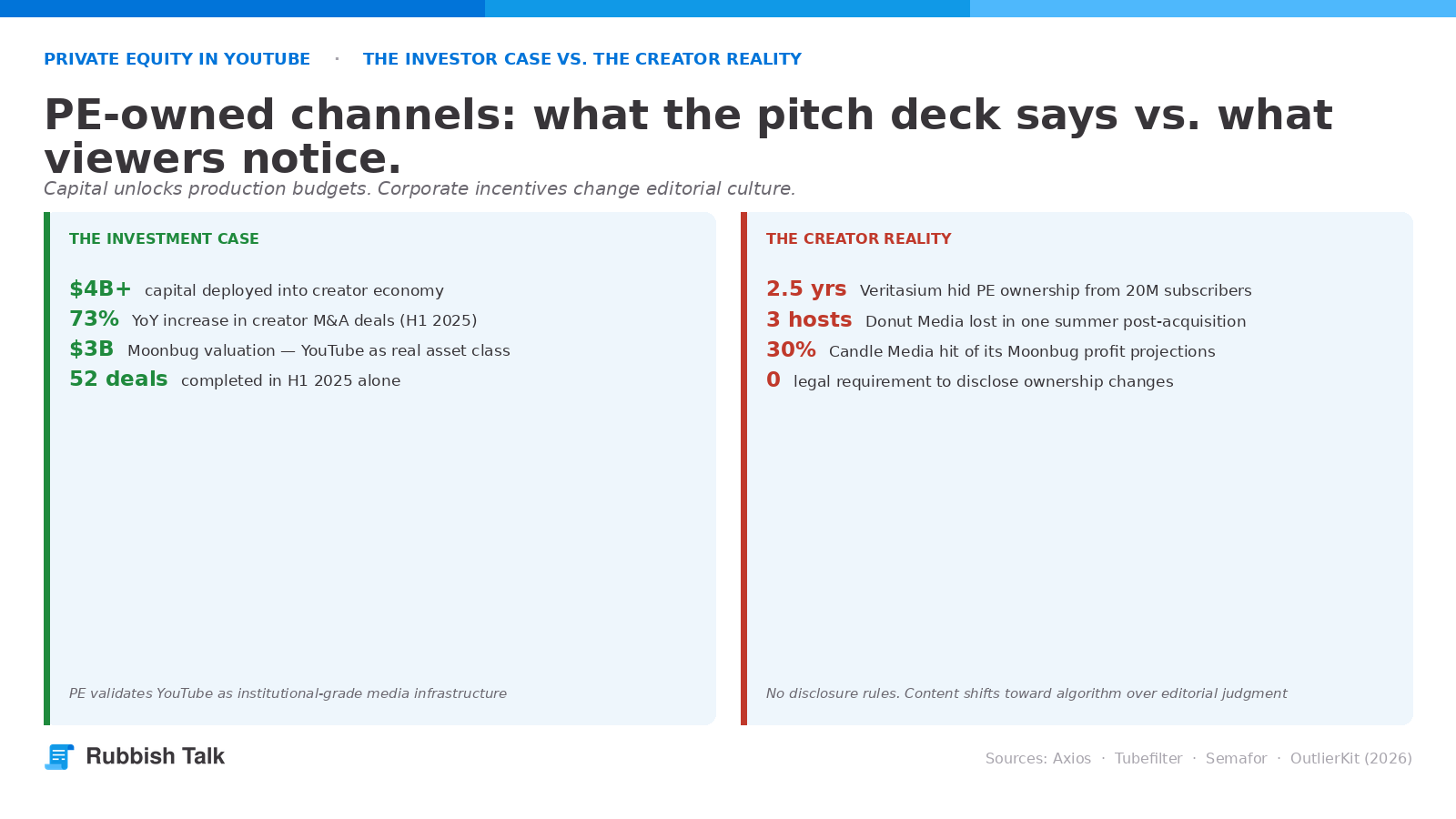
The numbers are bigger than most viewers realise. Collective private equity investment in creator businesses and YouTube channels is estimated at approximately $4 billion. In the first half of 2025 alone, 52 merger and acquisition deals were completed in the creator economy [including YouTube channels, creator-focused software platforms, influencer marketing agencies, and holding companies] — up 73 percent from 30 transactions in the same period of 2024. The channels are not incidental acquisitions: they are the asset. What PE firms are buying is not the content. It is the distribution.
The thesis is simple and, from an investor’s perspective, elegant. A YouTube channel with five million subscribers in a specific niche is worth more than five million paid ad impressions because the audience already trusts the source. That trust compounds. The library of videos published three years ago still generates ad revenue today without any additional production spend. Roll up enough channels in the same category, bundle the advertising, and you have something that resembles a media monopoly — except it was built through financial engineering rather than audience growth.
The result is a wave of acquisitions that has passed largely unnoticed. There is no legal requirement for YouTube channels to disclose a change in ownership. Creators are rarely obligated to tell their audiences. In some documented cases, they did not tell them for years.
The Biggest Deal: Blackstone Buys Preschool
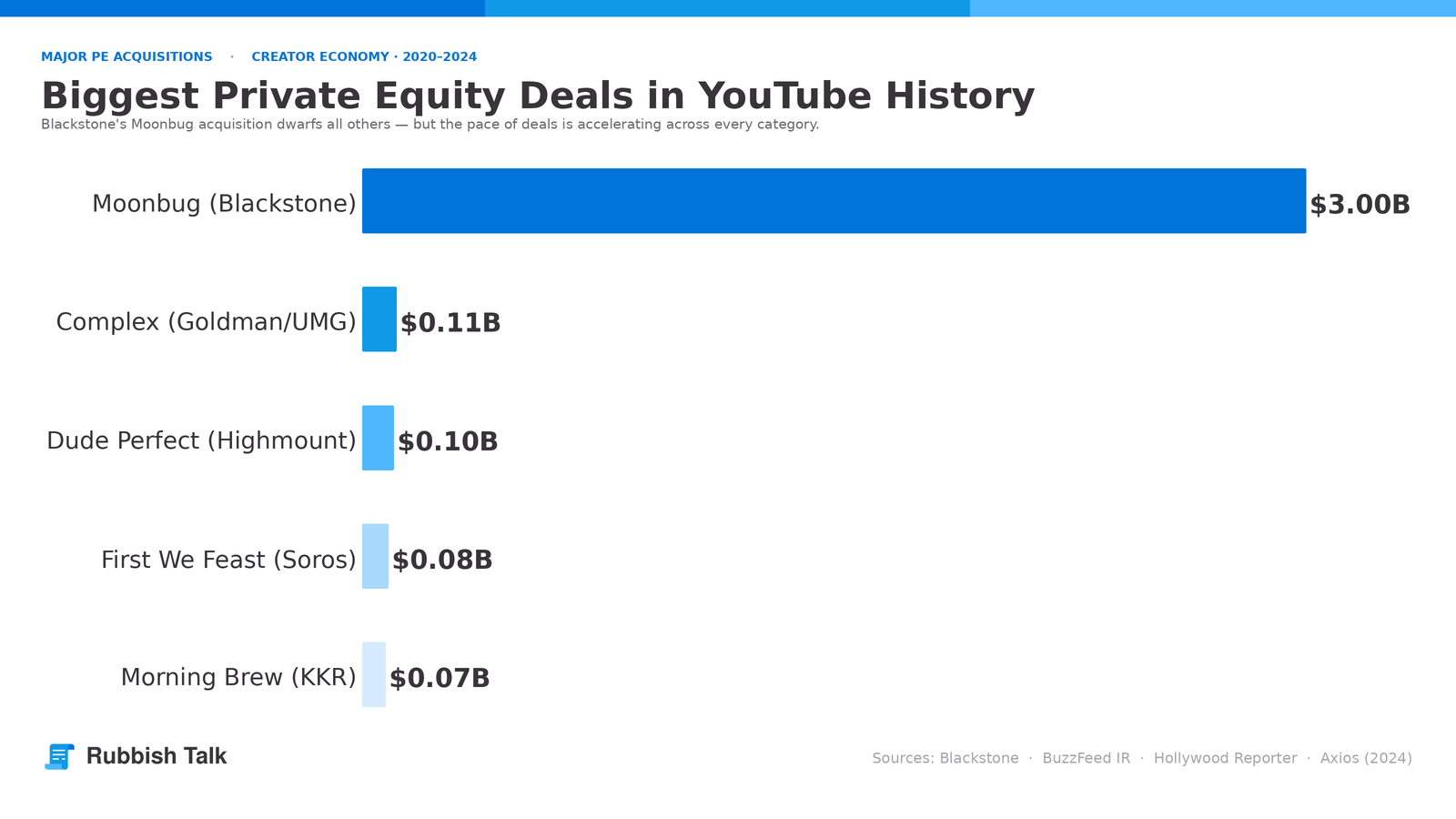
The largest PE acquisition in YouTube history closed in November 2021, when Candle Media — a holding company backed by Blackstone and led by former Disney executives Kevin Mayer and Tom Staggs — purchased Moonbug Entertainment for approximately $3 billion. Inside Moonbug sat the most-watched children’s content on the internet: Cocomelon, Blippi, Little Baby Bum, and Morphle.
Moonbug had itself assembled this portfolio through acquisitions. In July 2020, Moonbug raised $120 million in a funding round led by Goldman Sachs Growth Equity and simultaneously acquired Cocomelon and Blippi — the acquisition price for each property was not publicly disclosed. At the point of the Candle deal, Moonbug was tracking toward $100 million in annual profit and had become the largest network of kids’ programming on YouTube. Blackstone was not buying a startup. It was buying category dominance.
What happened after? By 2023, Candle Media was asking lenders to restructure its debt. Moonbug was expected to hit only 30 percent of its original profit projections. The company cut nearly 30 employees and cancelled several shows in December 2023, concentrating resources on Cocomelon and Blippi at the expense of smaller titles. The content itself kept running — preschool video is among the most algorithm-stable content on the platform — but the ambition of building a children’s media empire beyond YouTube had stalled.
The Blippi situation is particularly instructive. When Stevin John sold the Blippi brand to Moonbug, the character’s identity — the energetic guy in the orange-and-blue striped hat — was separated from the person who created it. Moonbug subsequently introduced a second Blippi actor without a seamless transition, generating significant backlash from parents and children who had formed a parasocial attachment to John specifically. This is the PE logic applied to a children’s entertainer: the brand is the asset, not the person. Whether the audience agrees is a secondary consideration.
Donut Media and the Talent Exodus
Donut Media was one of YouTube’s most distinctive automotive channels: fast-paced, irreverent, genuinely knowledgeable about cars without being inaccessible to people who are not gearheads. Recurrent Ventures, a digital media roll-up backed by North Equity, acquired Donut in November 2021 in a deal where CEO Matthew Levin stayed on to lead Recurrent’s broader video strategy.
The arrangement sounded promising. Recurrent would invest in Donut’s production capacity and expand its model across a portfolio that included Popular Science, Field & Stream, The Drive, and Bob Vila. Within three years, most of the on-screen talent that built Donut’s identity had left.
“It appears that the corporate buyout might be sending them down the same path and fate as Rooster Teeth’s buyout.”
— viewer comment widely cited in coverage of the Donut Media departures, 2024
The departures include Jeremiah Burton and Zach Jobe, who co-founded a new channel called BigTime. In public commentary, both have been careful to avoid attacking Donut directly. But the pattern is consistent with what critics have documented at Recurrent more broadly: from day one, the strategic emphasis at the holding company was on e-commerce, specifically affiliate links and referral commissions attached to product reviews. That is a different editorial culture from the one that made Donut compelling. The channel continued to publish. The audience noticed the shift.
Complex: Sold, Split, Stripped
Complex Networks was built as a voice for streetwear, sneaker culture, hip-hop, and urban fashion. BuzzFeed acquired it in 2021 for roughly $300 million. By February 2024, BuzzFeed sold it to livestream-shopping platform NTWRK for $108.6 million in cash — less than 40 cents on the dollar.
The deal came with a notable carve-out: First We Feast — the studio behind Hot Ones, the interview format built on increasingly spicy wings — did not go to NTWRK. It stayed with BuzzFeed, which then sold it separately in December 2024 to a consortium including Soros Fund Management, Sean Evans himself, Crooked Media, and Mythical Entertainment for $82.5 million.
“First We Feast will become an independent company led by Schonberger, who will assume the role of CEO, and Evans, who is taking on the newly created position of chief creative officer.”
— BuzzFeed press release, December 2024
Hot Ones has 14 million subscribers and four billion views. That it was treated as a separable unit — a pure financial asset to be divested at the most advantageous moment — rather than as part of an editorial identity tells you something about how these conglomerates value content. The show works. The format is the IP. The person asking the questions is, from a financial perspective, a replaceable input.
The new NTWRK-owned Complex is, per its leadership, intended to return to the channel’s roots: fashion, ComplexCon, editorial focus. Time will tell whether that is a genuine editorial commitment or a press-release promise.
The Education Channel Roll-Up: Electrify Video Partners
Away from children’s entertainment and pop culture, a London-based firm called Electrify Video Partners has been quietly acquiring majority stakes in some of YouTube’s most respected educational channels. Since its founding in 2021, Electrify has invested in nine channels. The most prominent are Veritasium (science and mathematics, 20 million subscribers), Fireship (software engineering), Simple History, Mentour Pilot (aviation), and Astrum (space science).
The Veritasium case is particularly noteworthy. Electrify completed a majority investment in the channel in April 2023. Creator Derek Muller did not disclose the acquisition to his audience until December 22, 2025 — more than two and a half years later. Muller retained an ownership stake and became a shareholder in Electrify. The firm’s pitch to creators emphasises editorial independence and production upgrades. Electrify raised $85 million from Capital D in September 2023.
The model is different from the Blackstone or Recurrent approach — there is no roll-up of a category for advertising bundling, and no apparent pressure toward commerce-optimised content. But the structural fact remains: a significant share of the most-watched science and education content on the platform is now majority-owned by a PE-backed firm whose incentive is to generate a return for its limited partners. The channel introducing new hosts — described as reducing “keyman risk” in investor language — is a financial decision dressed in editorial clothes.
Rooster Teeth: The Cautionary Endpoint
If Electrify represents the soft end of the PE spectrum, Rooster Teeth represents the hard end. Founded in 2003, the Austin-based studio was among the earliest and most significant properties built on YouTube and online video. It was acquired by WarnerMedia (later Warner Bros. Discovery) and operated inside the corporate structure of a major media conglomerate.
On March 6, 2024, Warner Bros. Discovery shut Rooster Teeth down after failing to find a buyer. 133 full-time employees were laid off, with dozens of contractors and content creators also losing their positions. The problem, per WBD, was structural: the studio had operated at a loss for the better part of a decade, its subscription base had shrunk from a peak of 225,000 paying members to around 60,000, and the move in autumn 2023 to pull content from YouTube to its own platform — an attempt to force a subscription-driven model — had accelerated audience decline rather than reversing it.
In February 2025, co-founder Burnie Burns acquired the Rooster Teeth brand and remaining intellectual property through his company Box Canyon Productions. The channel that once represented the frontier of creator-led media had gone through corporate ownership, cost extraction, collapse, and partial resurrection in the span of a decade. Several of Rooster Teeth’s flagship shows, including gaming series Funhaus and Achievement Hunter, were not part of Burns’s acquisition. They were simply gone.
What the Audience Isn’t Being Told
The most significant issue in this landscape is not the acquisitions themselves — capital entering a market is a fact of economic life, and some PE involvement has funded genuine production improvements. The issue is disclosure.
There is no legal requirement for a YouTube channel to inform its audience when it changes ownership. Veritasium waited two years and eight months. Donut Media’s viewers pieced together the Recurrent ownership from trade press, not from the channel. The Blippi actor swap happened without any preparation of the audience that had built attachment to the original performer. In each case, the information asymmetry runs in the same direction: investors know exactly what they bought; viewers do not know who is making what they watch.
The parallel to other PE-captured industries is direct. When private equity acquires a nursing home or a fire truck manufacturer, residents and fire departments are rarely told. They learn through outcomes — delayed equipment, degraded service, unexpected bankruptcy. On YouTube, the outcomes are softer but structurally similar: content that shifts toward algorithm optimisation over editorial judgment, talent departures when creative vision conflicts with margin targets, and channels that look like what they were while being run by people whose primary obligation is to generate a return.
The $4 billion in PE capital flowing into creator businesses is not going away. The channels will keep publishing. The question worth asking, each time you press play, is who owns the algorithm and who owns the audience — and whether those are the same people.
Sources:
- Blackstone press release: Moonbug Entertainment acquisition
- Blackstone-backed Candle Media cuts back for a changed reality — Semafor
- Billion-dollar company Candle Media could fall 50% short of its initial financial projections — Tubefilter
- Recurrent Ventures acquires Donut Media — official announcement
- Why So Many Major YouTube Channel Hosts Are Quitting — The Autopian
- Donut Media Loses Three Hosts in One Summer — Distractify
- BuzzFeed sells Complex to NTWRK in $108.6M all-cash deal — Tubefilter
- Hot Ones Studio First We Feast sold to Soros Fund for $82.5M — Variety
- Dude Perfect raises $100M+ from Highmount Capital — Hollywood Reporter
- Electrify Video Partners completes majority investment in Veritasium — Electrify
- Electrify Video Partners raises $85 million from Capital D — Axios
- Creator funding firm Electrify invests in Veritasium — Tubefilter
- Rooster Teeth Is Shutting Down After 21 Years — Variety
- Rooster Teeth returns under co-founder Burnie Burns — Tubefilter
- YouTube Channels Owned by Private Equity (2026 List) — OutlierKit
- The $4 Billion Silent Takeover: PE Firms Are Buying Your Favourite YouTubers — Vipul.io
- Private Equity Firms Accelerate YouTube Channel Acquisitions — Netinfluencer
- Private equity’s quiet takeover of YouTube reshapes online media — Türkiye Today
- KKR and Axel Springer break-up — Axios
- Candle Media — Wikipedia
- Moonbug Entertainment — Wikipedia
- Moonbug raises $120M, acquires Cocomelon and Blippi — Tubefilter
- Creator economy consolidation: 52 M&A deals in H1 2025, up 73% — Tubefilter
- Rooster Teeth laying off 133 employees in company shuttering — KXAN
- Electrify Co-CEO reflects on Veritasium partnership, December 2025 — Electrify