
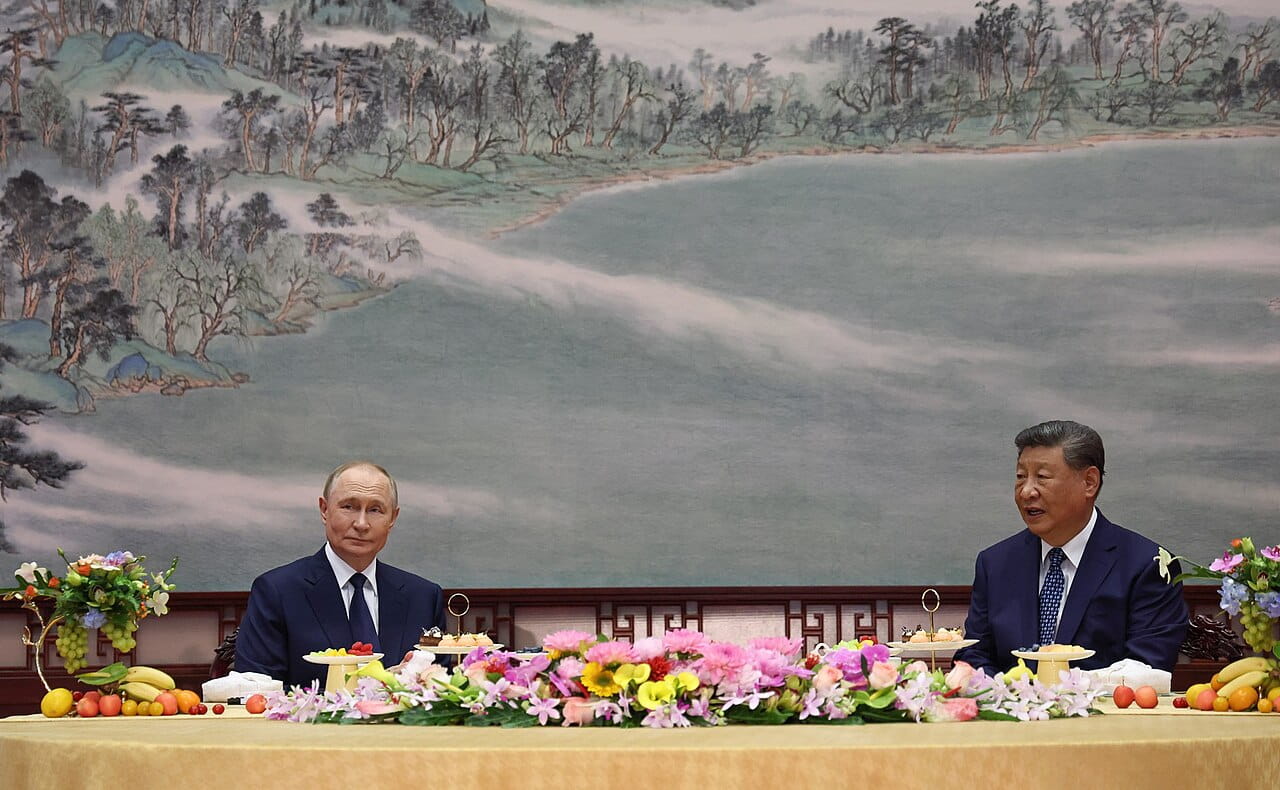
Trump left Beijing on May 15. Putin arrived on May 19. Four days separated the departure of America’s president and the arrival of Russia’s. Xi Jinping never left home. That asymmetry is the story — and it runs deeper than any single agenda item on either summit.
The Setup: Read the Trump Piece First
We covered Trump’s Beijing summit in detail here. The short version: Trump got a Boeing order with asterisks, vague language on Iran, and meaningful uncertainty injected into US-Taiwan arms policy. China directed the tone of the summit, won the things that mattered, and declined to make binding commitments on anything structurally important.
Putin’s visit is a different kind of summit — different agenda, different power dynamic, different set of asks. But it needs to be read as the second half of the same week. Together, the two summits reveal something about China’s position in the emerging world order that neither alone makes fully visible.
What Putin Actually Needs From Beijing
The headline agenda item for Putin’s May 19–20 visit is energy. Specifically, the Power of Siberia 2 pipeline — a proposed 2,600-kilometre conduit running from Russia’s Arctic Yamal gas fields to northeast China, capable of carrying up to 50 billion cubic metres of gas annually. Putin stated ahead of the visit that talks were “at a very advanced stage” and that he hoped to finalise a “serious, substantial step forward in the gas and oil sector” during his stay. Kremlin aide Yuri Ushakov confirmed the pipeline was “on the agenda, and we’re committed to discussing it seriously.”
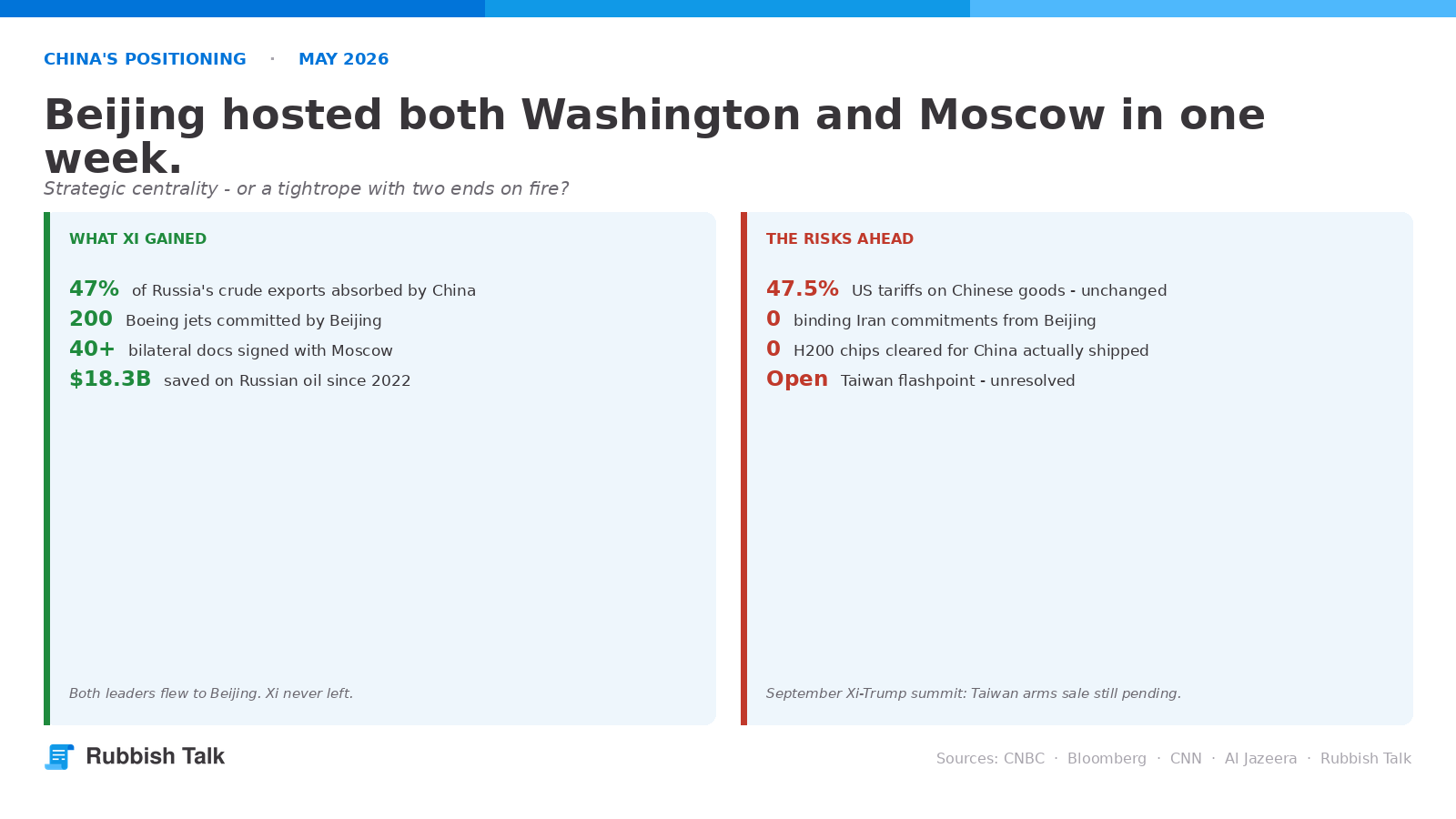
The strategic context for that ask cannot be overstated. After Western sanctions closed off European energy markets in 2022, China became the anchor of Russia’s export economy. China now absorbs 47% of Russia’s crude exports and 43% of all Russian coal. The existing Power of Siberia 1 pipeline delivered approximately 31 billion cubic metres of gas to China in 2024. Power of Siberia 2 would roughly double that capacity — and effectively replace the European volumes Russia lost when the war began.
For Putin, this is not an infrastructure deal. It is the consolidation of Russia’s economic pivot away from the West, locked in for a generation.
China Holds Every Card on the Pipeline
Here is the structural problem for Moscow: Russia needs this deal more than China does. Gazprom has no other customer to negotiate with. The pipeline route runs to northeast China and nowhere else. Beijing knows it — and has been negotiating accordingly.
The main sticking point is pricing. China wants gas priced at rates close to what Russia charges domestically — effectively a long-run subsidy on Chinese energy consumption. Russia wants terms closer to its former European contracts. The Kremlin has been trying to leverage the ongoing Iran war as a bargaining chip, arguing that Middle East energy disruptions should make China more eager to lock in Russian supply. Analysts are skeptical that this changes Beijing’s hand.
“Gazprom has no one else to negotiate with, meaning all the leverage is on the Chinese side.”
— Bloomberg energy analysis, May 2026
This leverage gap defines the Russia-China relationship in a way that the “no limits partnership” rhetoric obscures. Since April 2022, China’s average discount on Russian crude oil has been 7.7% — saving Beijing an estimated $18.3 billion over that period. Russia’s economy was kept functioning by Chinese demand, but on Chinese commercial terms. The lifeline charges interest.
The 40-plus bilateral documents expected to be signed cover trade cooperation zones, joint laboratories, investment in green development, and an education cooperation programme. These are real deliverables, but they are scaffolding around the energy negotiations — not the main event.
Multipolarity as a Declaration, and What It Actually Means
Beyond energy, Xi and Putin are signing a joint declaration on “establishing a multipolar world” and advancing a “new type of international relations.” This is their 43rd meeting since 2013, and it comes on the 25th anniversary of the 2001 Treaty of Good-Neighborliness. Xi reportedly used the meeting to reaffirm that Beijing “will continue to stand by” Russia’s side — and got Putin to co-sign a statement that “nuclear war cannot be won and cannot be fought,” a constraint on Russian nuclear rhetoric that serves Chinese stability interests.
The multipolar declaration will be read by Western capitals as anti-American posturing. That framing is not wrong, but it is incomplete. What Beijing is doing with this summit sequence is more sophisticated than ideological alignment.
China is signalling — to the Global South, to regional partners, and to both Washington and Moscow — that it does not sit in either camp. It sits above both. The sequence is the message: the world’s two most powerful adversaries came to the same host within four days. One came with corporate delegations and Boeing orders; the other came with pipeline negotiations and strategic reassurances. Xi stayed in Beijing for both.
“China is no longer simply balancing between Washington and Moscow — it appears to occupy the centre of the triangle itself.”
— Al Jazeera analysis, May 19, 2026
Comparing the Two Summits: What Each Leader Brought Xi
The contrast between what Trump and Putin brought to Beijing is itself analytically revealing.
Trump came with leverage that is primarily commercial and symbolic. The US market matters to China. American capital aligned behind the summit was a useful signal. But the structural tensions — semiconductor decoupling, rare earth vulnerabilities, Taiwan — were not resolved. Our coverage noted that China won the things that actually counted: it extracted Taiwan policy uncertainty, declined to commit on Iran, and left the tariff architecture (US at 47.5%, China at 31.9%) entirely unchanged.
Putin comes with leverage that is primarily energy-based and geopolitical. Russia’s wartime economy depends on Chinese purchases at Chinese-set prices. The “no limits partnership” declared in February 2022 has deepened into a structural dependency — but one that runs primarily in one direction. Moscow needs Beijing’s market. Beijing does not need Moscow’s gas at any particular price.
What Xi extracted from Trump was uncertainty on Taiwan and the prestige of receiving the American president on Chinese terms. What Xi extracts from Putin is an energy client that has no alternative, a strategic partner willing to co-sign Beijing’s multipolar narrative, and a nuclear power it can influence toward rhetorical constraint.
The Ukraine Question at the Margins
Neither summit was centrally about Ukraine — but the war sits at the edge of both conversations. The US sought Chinese pressure on Russia in the context of ceasefire negotiations; Beijing gave warm language and no commitments. China’s public position backs dialogue and a ceasefire. Its revealed preference, confirmed by Wang Yi’s reported private comments to EU officials, is that Beijing “cannot accept Russia losing its war.”
China’s role in the conflict is best understood as a stabilisation function for Russia’s war economy, not as active facilitation and not as genuine mediation. It purchases Russian commodities at discount, prevents the financial isolation that Western sanctions aimed to create, and avoids public endorsement of the invasion itself. This posture has been stable and serves Chinese interests: Russia remains functional, the war continues to drain Western political capital, and Beijing maintains its claimed neutrality for diplomatic purposes.
The Russia-Ukraine second round of direct talks in Istanbul — where both sides reached agreement on prisoner exchanges — was described by China as a “positive development.” Beijing encouraged further rounds. That is the full extent of China’s concrete contribution to the peace process.
The Angle Being Missed
Most coverage of this week focuses on what Trump and Putin each got from Beijing. The more important question is what Xi got from both of them — and what the week signals about the trajectory of Chinese power.
From Trump: the implicit acknowledgment that Beijing is the indispensable interlocutor for any US engagement with Asia, delivered in the form of a full state visit with ceremonial pageantry and a September return invitation.
From Putin: durable strategic alignment from a nuclear power that has exhausted its Western options, combined with continued energy dependency that gives Beijing long-run commercial leverage over Moscow’s budget.
From the international audience watching both summits: a demonstration that the post-Cold War model of a single hegemonic arbiter is being replaced by something more complex — and that China has engineered itself into an unusually strong position at the centre of it.
The conventional framing of China “balancing” between Washington and Moscow implies risk — that leaning too far toward one damages the relationship with the other. But what this week showed is that Beijing holds leverage in both relationships simultaneously, and that both Washington and Moscow currently need China more than China needs either of them. That is not balance. That is centrality.
What Comes Next
The Power of Siberia 2 outcome is the most concrete thing to watch. If a pricing deal is struck, it is the most consequential energy infrastructure commitment since Nord Stream — locking Russia’s export geography toward China for decades and confirming Beijing’s commercial primacy over Moscow. If talks fail again, it exposes the real limits of the “no limits partnership“: that Chinese commercial interests consistently override Russian strategic preferences.
The September Xi visit to Washington will test whether Trump’s Beijing summit was a genuine reset or a managed truce. Our analysis suggested the former is unlikely — that China won structural concessions on Taiwan policy while giving little on Iran, chips, or tariffs. If that assessment holds, the September meeting will reveal whether Beijing pushes further or consolidates what it already gained.
And for Russia, the question after this summit is whether Chinese backing translates into anything beyond economic survival. Beijing has kept Moscow’s economy functional. It has not — and will not — publicly endorse the war, provide military hardware, or actively block Western-backed ceasefire efforts. Russia has a partner in China, but the terms of that partnership are written in Beijing, not Moscow.
The calendar said it plainly. Washington flew in. Moscow flew in. Xi stayed put.
Sources:
- Putin heads to Beijing days after Trump in test of China’s balancing act — CNBC
- ‘China holds the cards’: Why Putin’s visit to Beijing after Trump matters — Al Jazeera
- Russia’s Putin to visit China following Trump’s trip — Al Jazeera
- Putin China visit: Russian leader set to arrive for meeting with Xi — CNN
- Xi’s double act: Putin set to arrive in China days after Trump’s departure — CNN/KEYT
- 2026 visit by Vladimir Putin to China — Wikipedia
- Putin aims to unlock gas pipeline project to China in Xi talks — Bloomberg
- Power of Siberia 2: How Russia-China Gas Pipeline Plan Benefits From Iran War — Bloomberg
- How the Power of Siberia 2 Deal Could Reshape Global Energy — CSIS
- Power of Siberia 2: Russia’s Pivot, China’s Leverage, and Global Gas Implications — Columbia CGEP
- Russia’s Power of Siberia 2 Pipeline Could Reshape Energy Trade — Modern Diplomacy
- Xi Hosts Putin as China Projects Stability Amid Global Tensions — Modern Diplomacy
- Russia’s Pipeline Gas Exports to China Set for 25% Surge in 2025 — OilPrice.com
- December 2025 Monthly Analysis of Russian Fossil Fuel Exports — CREA
- China-Russia Dashboard: Facts and figures — MERICS
- Kremlin Signals High Expectations Ahead of Putin’s Strategic Visit to China — Pravda
- Trump-Xi Summit in Beijing: Managing the World’s Most Important Relationship — CSIS
- Russia-Ukraine talks: All the mediation efforts, and where they stand — Al Jazeera
- Trump’s Beijing Summit Delivered Optics — Rubbish Talk
- Foto: Kremlin.ru / Lizenz: CC BY 4.0, via Wikimedia Commons