

In 2026, automated traffic overtook human traffic on the open web for the first time in the internet’s history, according to Cloudflare, a milestone the company’s own CEO had not expected until 2027. This is not just a security footnote: bots are also now estimated to write more than half of new web content, while AI chatbots increasingly read, summarize, and answer on behalf of humans who never click through at all. What started as a fringe conspiracy theory on a 2019 imageboard post has become a measurable, dated phenomenon with hard numbers behind it. The uncomfortable part is not that bots exist; it is what happens when bots start talking mostly to each other.
What Is Actually Happening
The numbers are no longer ambiguous. As of early June 2026, Cloudflare’s traffic data put automated HTTP requests at 57.5% versus 42.5% from humans, across the large share of the web that sits behind its network. Matthew Prince, Cloudflare’s co-founder and CEO, had said at SXSW in Austin in March 2026 that he expected bot traffic to overtake human traffic by 2027.
“Welp, that happened faster than I predicted. Thought it would be end of 2027, then early 2027, but agentic traffic growing so fast that bots have now passed human traffic online for the first time in the internet’s history.”
Matthew Prince, co-founder and CEO, Cloudflare, posting on X (June 3, 2026)
Prince himself cautioned that the exact date of the crossover is fuzzy, since the underlying data is “a bit messy,” but said the trend is now unambiguous. It is also worth noting what this figure does and doesn’t measure: Cloudflare only began separately classifying signed AI agents and verified bots within the last year, so its bot/human split does not extend back very far, and it counts HTTP requests, not time spent. Humans still account for the overwhelming majority of time spent online through video, apps, and social feeds, which don’t generate the same volume of rapid page requests as automated agents do.
Imperva’s Bad Bot Report, which measures differently and has a longer run, told a similar story a year earlier: automated traffic surpassed human activity for the first time in the report’s twelve-year history, reaching 51% of all web traffic in 2024, with bad bots (scrapers, credential-stuffing tools, fraud bots) climbing to 37% of all traffic, up from 32% the year before. Cloudflare and Imperva measure different things using different methodologies, but both point in the same direction: the crossover is real, and by most measures it happened faster than expected.
Origins: How a 2019 Forum Post Became a 2026 Benchmark Report
The web was not born automated. The first web crawler, Matthew Gray’s World Wide Web Wanderer, went live at MIT in 1993 to do something almost quaint: count how many web servers existed. By 1995, the entire internet was still small enough that a single grad student’s script could plausibly index it. Bots in this era were tools, not populations.
The “dead internet theory” itself traces to an anonymous post on the imageboard Wizardchan around September 2019, later reposted to 4chan in 2020 and formalized in 2021 on the forum Agora Road’s Macintosh Cafe by a user posting as “IlluminatiPirate.” The claim was that most of the internet is fake: bot-generated content, AI-manufactured engagement, and algorithmic curation standing in for genuine human activity, allegedly to manipulate public perception. The Atlantic covered it as a curiosity in September 2021, under the headline “Maybe You Missed It, but the Internet ‘Died’ Five Years Ago.” At the time, it read as internet folklore.
The traffic data from that same period tells a bumpier story than a straight line to bot domination. Incapsula’s first Bad Bot Report in 2013 found bots already made up 61.5% of all web traffic, split almost evenly between “good” bots like search crawlers (31%) and malicious ones (30.5%). That figure then fell through the mid-2010s as human internet adoption exploded and detection methods matured: Imperva’s 2015 report was titled, without irony, “Humans Take Back the Web.” By 2016, human traffic had climbed to roughly 61%. Bot traffic crept back up through 2017 (42.2%) and hovered in the low 40s through 2020 (40.8%) and 2021 (42.3%), the exact years the dead internet theory was being written down and named.
Then came the inflection point: ChatGPT’s public launch in November 2022. Bad bot traffic alone rose to 30.2% of all web traffic that year, and by Imperva’s count automated traffic overall crossed 51% in 2024, the first time in the report’s history that bots outnumbered humans. By mid-2026, Cloudflare’s separate, newer measure of agentic and bot HTTP requests put the automated share at 57.5%. The line that conspiracy theorists drew freehand in 2019 turned out to roughly match the line statisticians started drawing with real data a few years later, even if the two data series are not directly comparable point for point.
Who Is Writing the Internet Now
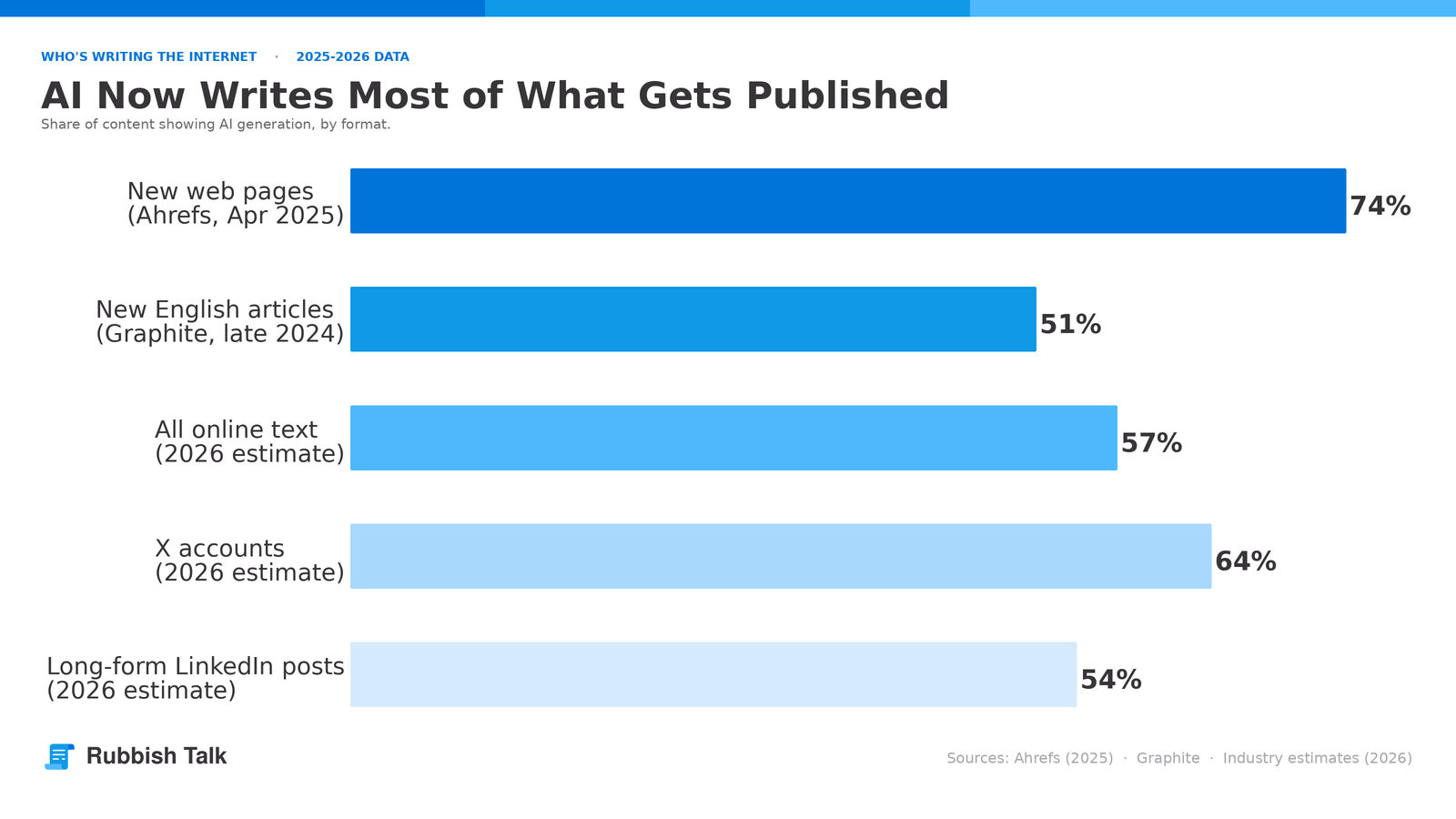
The traffic numbers only tell half the story; the other half is who, or what, is producing what gets browsed. Ahrefs analyzed 900,000 newly detected web pages in April 2025 using its own AI content classifier and found 74.2% contained at least some AI-generated content. That figure needs a caveat the headline number usually loses: only 2.5% of pages were “pure AI,” meaning fully machine-written with no human editing; the bulk of the 74.2%, about 71.7 percentage points of it, was a mix of human and AI writing. Graphite’s separate analysis of more than 60,000 articles published between 2020 and 2025 found that by late 2024, more than half of new English-language articles were primarily AI-written. One widely cited 2026 estimate puts the share of all online text that has been AI-generated or AI-translated at roughly 57%, though this figure is harder to independently verify than the Ahrefs and Graphite studies, which published their methodologies.
Social platforms show the same pattern in a different form. Estimates published in 2026 suggest roughly 64% of accounts on X show some degree of automation, and 54% of long-form LinkedIn posts carry clear AI-generation patterns. This is a different phenomenon from Elon Musk’s 2022 dispute with Twitter over bot accounts, when Musk claimed bots made up 20% or more of the platform’s users against Twitter’s own estimate of under 5%, with one Musk-commissioned analysis landing at 11% and another at 5.3%. That fight was about fake accounts inflating a user count. The 2026 numbers are about something bigger: a majority of the content itself, not just the accounts posting it, being machine-made.
Alexis Ohanian, the Reddit co-founder, has been one of the more prominent voices putting a name to the shift. Speaking on a Wall Street Journal Tech News Briefing podcast in June 2025, Ohanian said he had “long subscribed to the dead internet theory,” describing it as something once dismissed as a decade-old conspiracy theory that is now, in his view, “a very real thing.” He returned to the theme in October 2025, telling the hosts of the TBPN podcast:
“You all prove the point that so much of the internet is now just dead, this whole dead internet theory, right? Whether it’s botted, whether it’s quasi-AI, LinkedIn slop.”
Alexis Ohanian, co-founder, Reddit, on the TBPN podcast (October 13, 2025)
OpenAI CEO Sam Altman made a similar observation around the same time, writing on X in September 2025: “I never took the dead internet theory that seriously, but it seems like there are really a lot of LLM-run Twitter accounts now.”
Who Is Reading, and Increasingly, Who Isn’t
The consumption side of the ledger is arguably more disruptive to the internet’s economics than the creation side. Zero-click search, where a user gets an answer without visiting any website, now accounts for roughly 60% of searches. Google’s AI Overviews cut click-through rates to the top organic result by 34.5% in April 2025 and by 58% by December 2025, a trend that has accelerated rather than leveled off.
Publishers are absorbing the damage directly. Business Insider’s organic search traffic fell 55% between April 2022 and April 2025. The New York Times saw search’s share of its total traffic fall from 44% in 2022 to 37% in 2025. HuffPost lost roughly half its search referrals over the same window. Meanwhile, traffic sent back to publishers by AI platforms like ChatGPT, Claude, Gemini, and Perplexity combined still accounts for only around 1% of total publisher traffic, even as those referrals grow double digits year over year.
The imbalance is structural, not incidental. As Cloudflare has noted, a human might check five websites before making a decision; an AI agent completing the same task might query 5,000. Machines are visiting the open web more often than humans now, largely to extract answers for other machines’ users, not to read in any sense a human would recognize.
Why This Is a Real Problem, Not Just a Statistic
The issue is not that bots exist; search engines, monitoring tools, and accessibility crawlers have always been bots, and mostly useful ones. The issue is the direction of the feedback loop. AI systems are trained on scraped web content. As more of that content is itself AI-generated, AI-summarized, or AI-amplified, models increasingly learn from each other’s output rather than from primary human expression. Researchers, including a team led by Ilia Shumailov whose findings were published in Nature in 2024, have described this as “model collapse”: successive generations of models trained on their predecessors’ synthetic output progressively lose the rare, detailed, human tail of the data distribution, converging toward blander, less accurate, and eventually degraded outputs. Some later work suggests collapse can be avoided if synthetic data accumulates alongside fresh human data rather than replacing it, but that requires human data to keep flowing in at scale, which is precisely the part now shrinking as a share of the total.
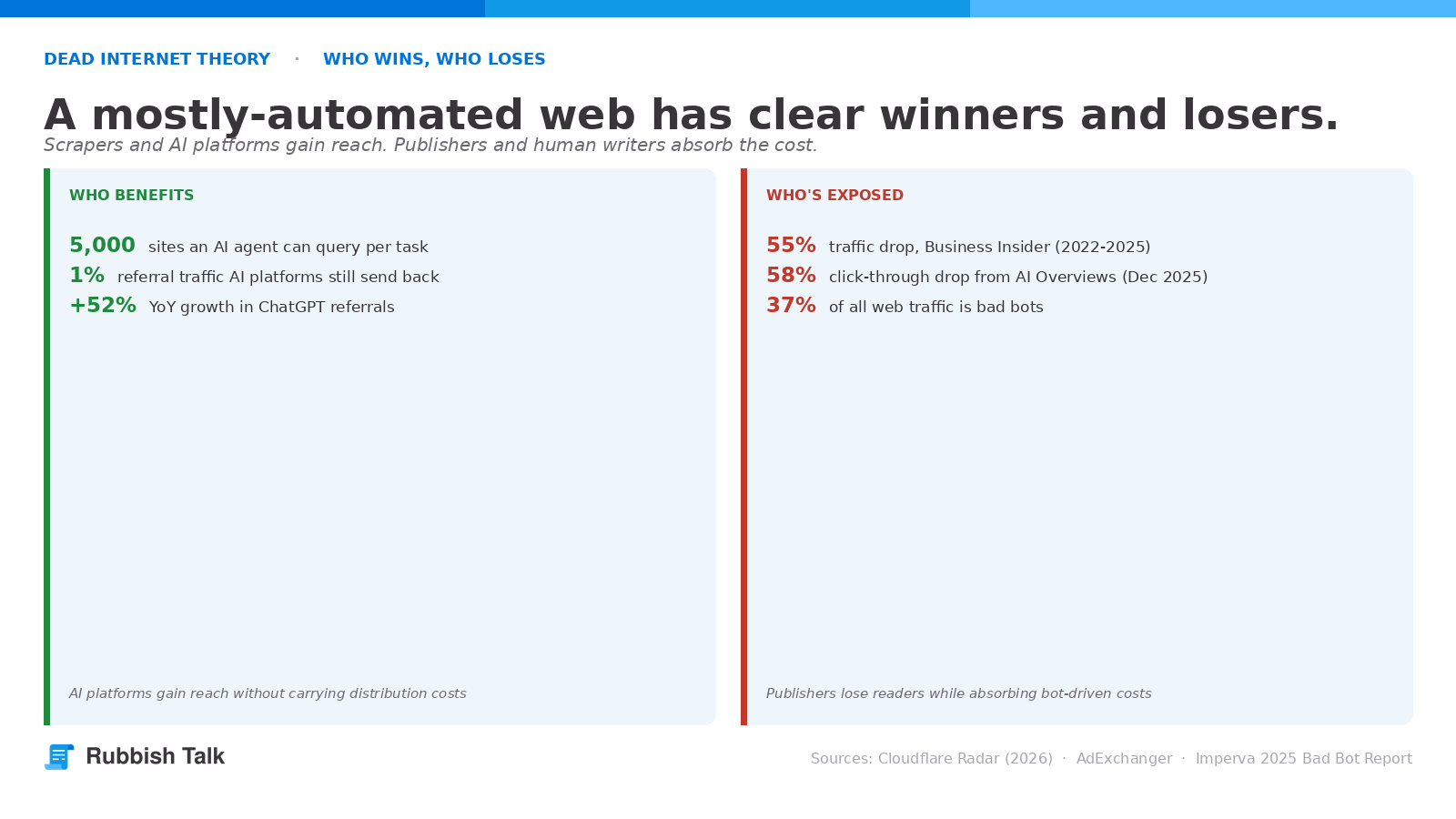
Financially, the incentives point the same direction as the theory’s darkest reading, even without any coordinated conspiracy behind it. Publishers losing traffic face pressure to cut costs, which often means producing more content faster, frequently with AI assistance, which adds to the volume of synthetic material online, which further dilutes the pool of distinctly human writing search engines and AI models can draw from. Advertisers lose money to bot-driven ad fraud, a cost Imperva’s bad-bot data captures indirectly through the 37% “bad bot” share of all traffic. Everyone downstream, from search engines to model builders to ordinary readers trying to tell what is real, inherits a noisier, less legible internet.
What Comes Next
None of this means the internet is “dead” in any literal sense; billions of humans still use it daily, and the theory’s original framing, a coordinated plot to pacify the population, remains unsupported by the traffic and content data now available. What the data does support is narrower and arguably more important: the open web’s default state has flipped from mostly-human to mostly-automated faster than the people building its infrastructure expected, and the content layer is following the same curve roughly two to three years behind the traffic layer.
The near-term fights worth watching are over verification (proving a request or a post came from a human, without simply recreating CAPTCHA’s arms race at agent scale), attribution (whether AI platforms compensate the publishers whose shrinking human traffic still feeds their answers), and data provenance (whether model builders can keep sourcing enough unpolluted human text to avoid the collapse researchers have already demonstrated in lab settings). The dead internet theory started as a conspiracy about intent. What it has become, by 2026, is a description of infrastructure.
Sources:
- Dead Internet theory – Wikipedia
- Dead Internet Theory Explained: The 2026 Guide to Bots, AI Slop, and the Web That Stopped Being Human
- Bot web traffic has overtaken human web traffic, data shows – NBC News
- 2025 Bad Bot Report – Imperva
- 2025 Imperva Bad Bot Report: How AI is Supercharging the Bot Threat – Imperva
- Bad Bot Report 2026: Bots in the Agentic Age – Imperva
- Study claims 61.5 percent of web traffic is generated by bots – Neowin
- 2015 Bot Traffic Report: Humans Take Back the Web – Imperva
- Online bot traffic will exceed human traffic by 2027, Cloudflare CEO says – TechCrunch
- ‘Bots have now passed human traffic online,’ Cloudflare boss laments – Tom’s Hardware
- ‘Dead Internet is here’: Machines, AI bots outnumber humans online, Cloudflare’s report reveals – Jerusalem Post
- What Percentage of Online Content Is AI Generated in 2025?
- 52% of the Internet Is Now AI-Generated – Abhishek Gautam
- Reddit cofounder Alexis Ohanian says ‘so much of the internet is dead’ – Fortune
- The ‘Dead Internet Theory’, Noted By Altman And Ohanian – Forbes
- 74% of New Webpages Include AI Content (Study of 900k Pages) – Ahrefs
- AI models collapse when trained on recursively generated data – Nature (Shumailov et al., 2024)
- Elon Musk commissioned this bot analysis in his fight with Twitter – CNN Business
- The AI Search Reckoning Is Dismantling Open Web Traffic – AdExchanger
- News publishers expect search traffic to drop 43% by 2029 – Search Engine Land
- Model collapse – Wikipedia
- What Is Model Collapse? – IBM
- World Wide Web Wanderer Guide: History, Origin, and More – History-Computer