

Wall Street spent the first half of 2026 celebrating a record IPO haul and the largest capital build in corporate history, and treated both as proof the AI trade is working. The quieter story is the gap underneath: hyperscalers are on track to spend well over half a trillion dollars this year alone, IPO desks booked a record $251 billion in equity sales, and yet the evidence that all this capital is turning into durable profit remains thin. Intel gave the question a live demonstration after Thursday’s close, posting its fastest revenue growth in fifteen years and a headline beat that sent the stock up as much as 13% in after-hours trading, then fading to under 4% within hours as investors looked past the top line to an $11 billion net loss and a foundry unit still bleeding money. It is the perfect test case for the question the market keeps postponing: when does AI actually pay off?
What is actually happening
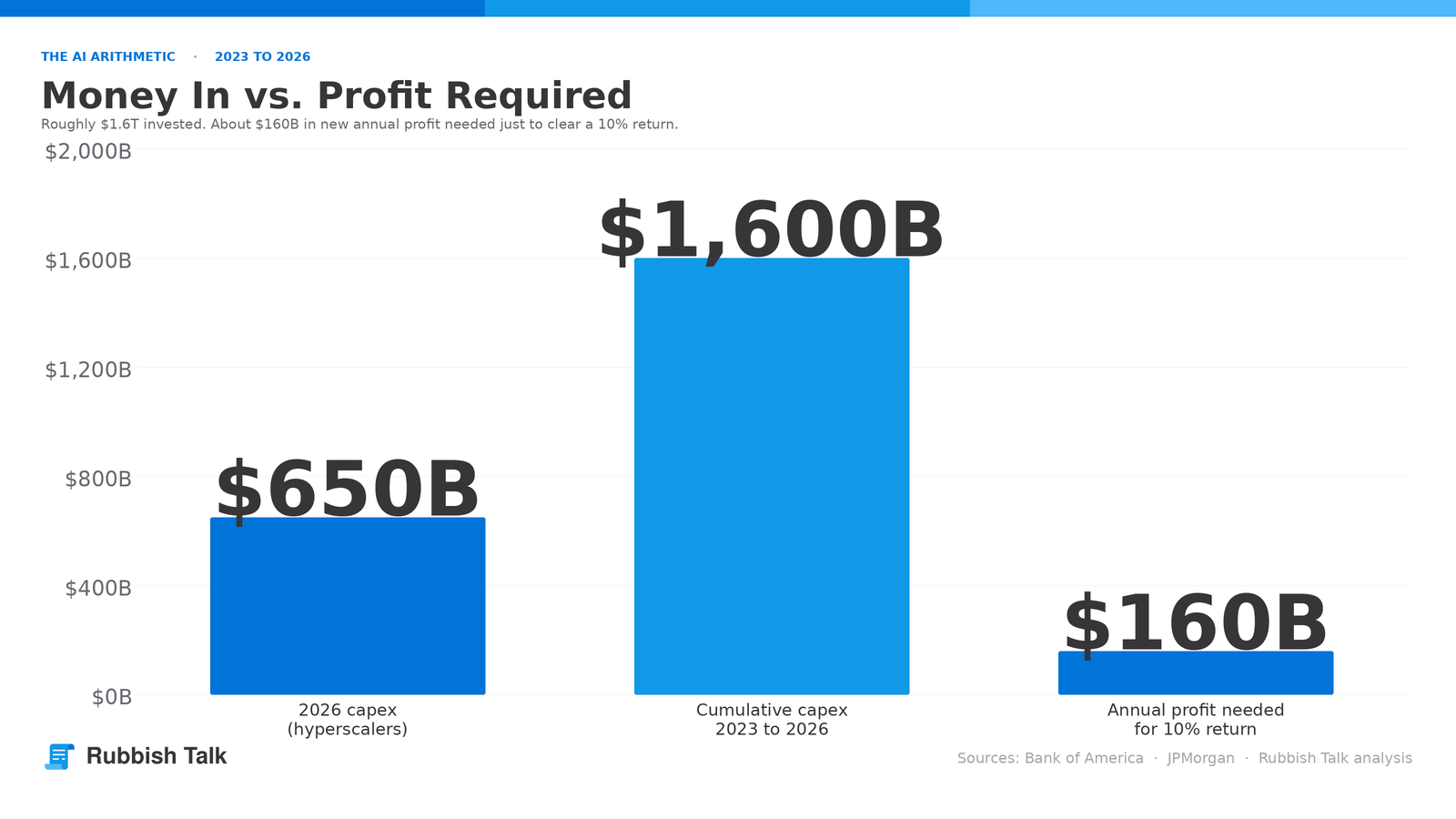
The AI story in mid 2026 is no longer a demand story. Demand is not in doubt. The story now is arithmetic. The four largest hyperscalers are committing somewhere between $575 billion and $725 billion in capital expenditure in 2026, roughly double what they spent in 2025, which was itself nearly double 2024. Bank of America projects the combined figure clears $1 trillion in 2027. JPMorgan puts cumulative global AI-related capex at $5.5 trillion through 2030.
That capital has to earn a return. The cumulative spend from 2023 through 2026 lands near $1.6 trillion. At a modest 10% return threshold, that implies roughly $160 billion in new annual profit, generated by AI, on top of everything these companies already earn. Nobody has yet shown that number arriving. The Philadelphia Semiconductor Index, the cleanest market proxy for the trade, has pulled back more than 20% from its peak. The doubt is not about whether AI is useful. It is about whether the people paying for it will get their money back on the timeline the valuations assume.
What the mainstream narrative says
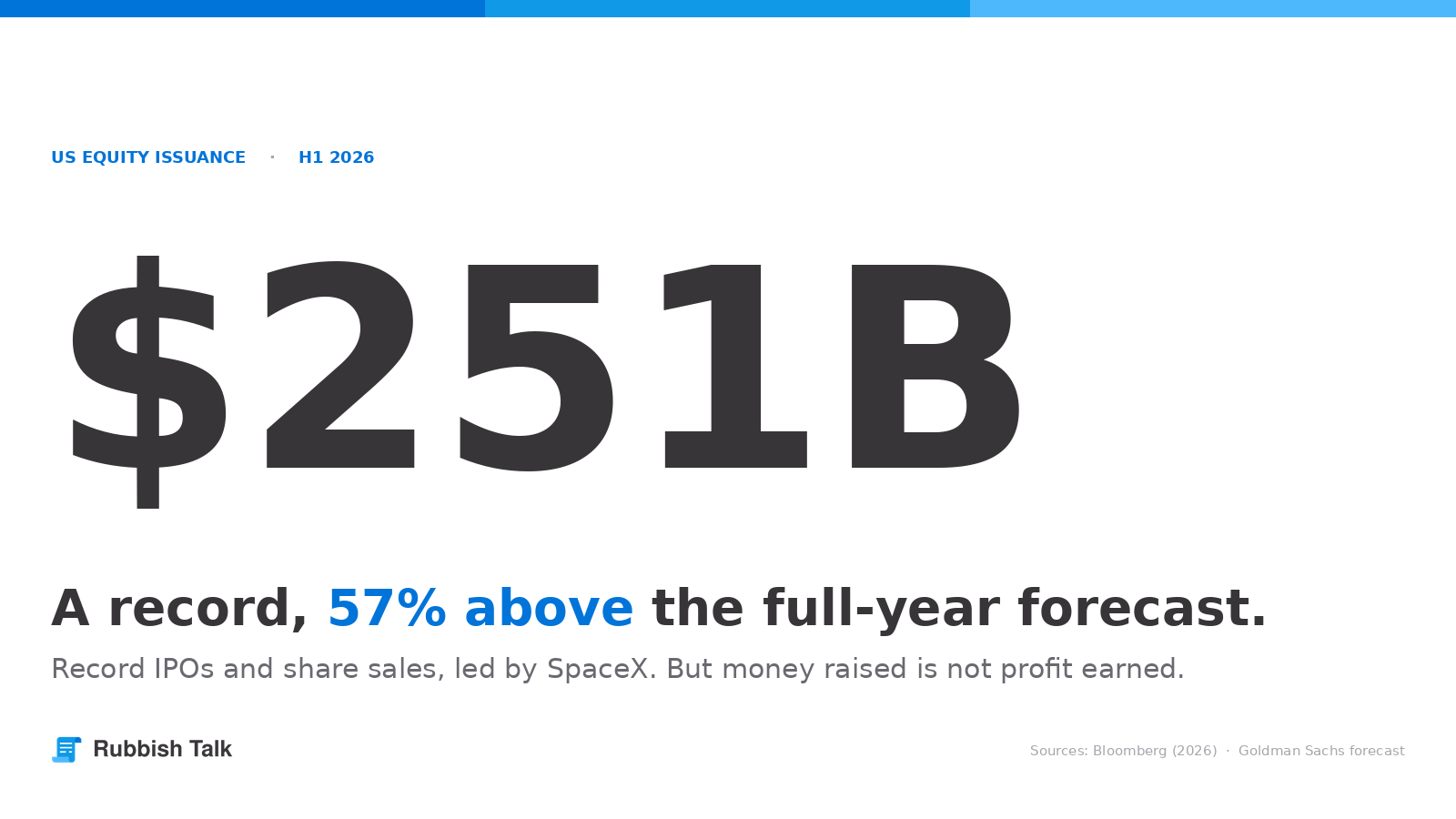
Read the market coverage and the mood is boom, not bust. US companies raised a record $251 billion in equity in the first half of 2026, according to Bloomberg data, blowing past the previous high set during the 2021 mania and past Goldman Sachs’ full-year forecast of $160 billion. Traditional IPO proceeds hit about $114 billion by PwC’s count, more than seven times the same period last year, across 65 deals versus 34. SpaceX’s June debut, the largest IPO in history at roughly $86 billion, sat at the center of it. Alphabet raised $85 billion in equity in the same window, explicitly to bankroll its AI build.
The prevailing read treats all of this as confirmation. Capital is flowing, the IPO window is wide open, and the smartest and best-funded companies on earth are doubling down. JPMorgan has been the loudest institutional voice for the bull case.
“The surge in AI investment is not only durable, but increasingly profitable.”
– JPMorgan Global Research, 2026 outlook (as reported by Fortune, June 2026)
The bank expects hyperscaler operating cash flow to top $900 billion by 2027, more than enough, on its math, to fund the build without strain. On this view, the capex is not a bet. It is a moat.
What the data shows
Here is where the narrative and the numbers part ways. The money going in is easy to count and enormous. The money coming out is harder to find. The most cited piece of evidence on the demand side, enterprise adoption, is also the most uncomfortable. MIT’s Project NANDA, in its 2025 study “The GenAI Divide,” found that roughly 95% of organizations it examined saw no measurable financial return from their generative AI spending, despite an estimated $30 to $40 billion deployed.
“The overwhelming majority are left with stalled pilots and little to no measurable impact on their profit and loss.”
– MIT Project NANDA, The GenAI Divide: State of AI in Business (2025)
That does not mean AI is worthless. Roughly 5% of deployments are producing real value, and the companies selling the picks and shovels, the chipmakers and cloud providers, are booking genuine revenue. But it does mean the demand underwriting a trillion dollars of infrastructure is, for now, concentrated in a narrow band of use cases. The bull case rests on that band widening fast. The bear case is that the spending curve and the payoff curve are diverging, and that the equity issuance boom is partly a mechanism for pushing that risk from private balance sheets onto public shareholders while the window is open.
Intel just gave the litmus test an answer
No single earnings report resolves a trillion-dollar question, but Intel’s, out after Thursday’s close, got closer than most. Intel is the rare name where the AI-payoff gap sits inside one income statement. The stock has run up more than 160% in 2026 on hope that its 18A process and revived foundry business make it a credible domestic alternative to TSMC in the AI supply chain.
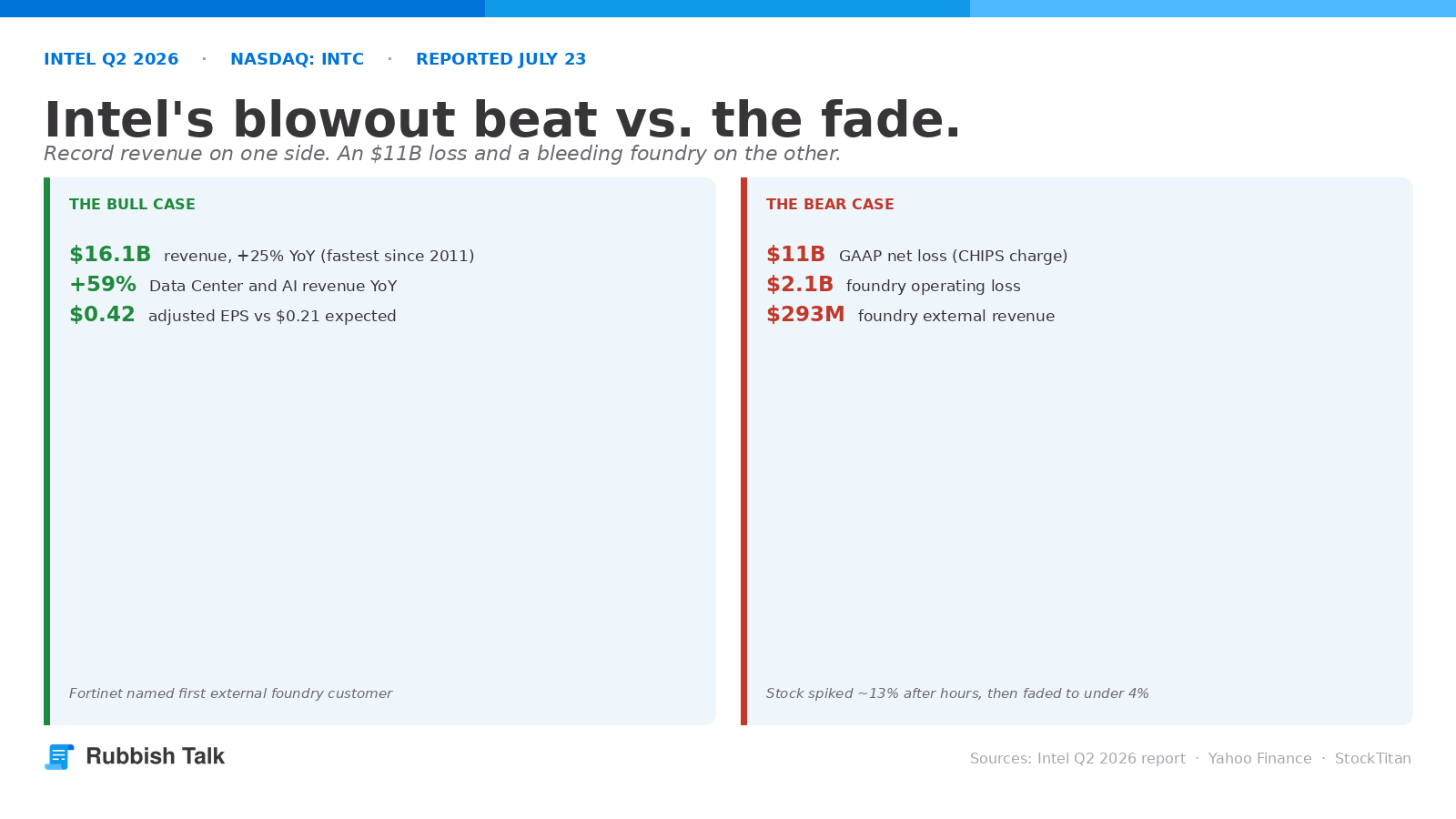
The headline numbers blew past expectations. Revenue landed at $16.1 billion, up 25% year on year, Intel’s fastest growth in more than fifteen years, against a $14.4 billion consensus. Adjusted earnings were $0.42 a share, double the $0.21 Wall Street had penciled in. The Data Center and AI segment jumped 59% to $6.3 billion. On the surface, a clean AI-demand beat.
Look one line down and the picture complicates. On a GAAP basis Intel booked an $11 billion net loss, or $2.16 a share, driven by a $12.5 billion mark-to-market charge on escrowed shares tied to its CHIPS Act deal with the US government. Strip that one-off out and the operating business was profitable, but the foundry unit, the part that is supposed to justify the whole AI-supplier story, is still losing money: a $2.1 billion operating loss, narrowed by $348 million from the prior quarter, on $5.8 billion of revenue of which just $293 million came from external customers. There was genuine progress, Fortinet became the first publicly named foundry customer and an unnamed cloud provider committed to 18A production, but the gap between what Intel spends to build and what outsiders pay to use it is still vast.
The market’s own reaction told the story better than any single figure. Intel closed at $100.23, spiked as high as $113.55 after hours, up roughly 13%, then handed most of it back within hours, cooling to under 4%. A blowout beat, met by a fade. That is the AI-payoff question in miniature: the demand is real and the revenue is real, but the moment investors price in what it costs to earn it, the enthusiasm thins.
Who benefits, who is exposed
Follow the incentives and the picture sharpens. The clearest winners so far are the intermediaries. Goldman Sachs and JPMorgan have emerged as direct beneficiaries of the AI boom, not through their own models but through the fees on the record issuance it is fueling. Underwriters get paid when deals price, regardless of whether the deals perform. Chipmakers and cloud landlords collect capex spend up front, before any downstream customer proves a return.
The exposure sits with two groups. The first is public equity investors buying into an IPO window that is open precisely because private holders and their bankers judge conditions ideal to sell. The second is the hyperscalers themselves, who are converting flexible operating budgets into fixed, depreciating infrastructure. If the payoff arrives on schedule, that infrastructure is a moat. If it arrives late, it is a very expensive anchor of depreciation charges landing on the income statement whether the revenue shows up or not. That is the mechanism by which an investment boom becomes an earnings problem.
What is being overlooked
The framing that dominates coverage is a binary: bubble or not a bubble. That is the wrong question, and it lets both sides dodge the real one. The interesting variable is not whether AI is a bubble. It is timing. Almost everyone agrees the technology is transformative and the long-run demand is real. The disagreement that actually moves prices is about the lag between spending and return, and about who is holding the position when that lag turns out to be longer than the valuations penciled in.
Record IPO proceeds and record capex are being reported as the same bullish signal. They are not. Capex is a company betting its own money on future demand. A record IPO haul is insiders selling to the public at the top of a cycle. Both can be true at once, and when they are, it is usually late in the story, not early. The mainstream take celebrates the flood of capital as vindication. The more useful reading is that a flood of capital in is not the same as profit out, and that the two have rarely been this far apart.
What comes next
Watch three things. First, the hyperscaler earnings that follow Intel over the next two weeks, specifically whether capex guidance keeps climbing while cash-flow commentary starts hedging. A rising spend curve alongside softening return language is the tell. Second, whether Intel’s foundry momentum holds: external customer revenue of $293 million is a start, and Fortinet is a real name on the board, but that figure is the single cleanest read on whether AI infrastructure demand is broadening beyond the companies building it, and it needs to keep climbing. Third, the IPO pipeline into the second half: if the window stays open, the boom has legs; if issuance stalls, the insiders were right to sell when they did.
None of this requires a crash to matter. The AI payoff may well arrive, and JPMorgan may be proved right that the spend is durable and profitable. But the market is currently priced for that outcome to be certain and imminent. The data says it is neither yet. The gap between the money going in and the money coming out is the whole story, and this week, for one company, that gap got a number, and a fade to go with it.
Sources:
- SpaceX Pushes US Share Sales to Record $251 Billion at Midyear, Bloomberg
- SpaceX leads US IPO surge as H1 proceeds top $114B, PwC via CFO Dive
- US IPOs and Share Sales Hit Record $251B in H1 2026, KuCoin
- Intel Q2 2026 earnings: revenue up 25%, fastest growth since 2011, Yahoo Finance
- Intel Corporation posts $16.1B Q2 revenue and guides Q3 EPS (8-K), StockTitan
- Intel Q2 2026 Earnings: Beat, $11B Loss, INTC Stock Reaction, INDmoney
- Intel to Report Second-Quarter 2026 Financial Results, Intel Corporation
- What bubble? JPMorgan says the $5.5 trillion AI capex explosion is profitable, Fortune
- AI Investment ROI Reckoning: Can $750 Billion in Capex Translate to Sustainable Profits, BigGo Finance
- MIT report finds 95% of enterprises see no return on generative AI, Digital Commerce 360
- The AI boom just found two new winners: Goldman Sachs and JPMorgan Chase, CNBC