

On July 4, 2026, the United States turns 250 years old, an age at which, by one famous reckoning, empires tend to run out of road. This is the story of how a farming colony of 2.5 million people became a 30 trillion dollar superpower that spends more on defense than the next nine nations combined, added more than three decades to human life, and rewrote its own definition of who counts as a citizen. It is also the story of the strains now showing beneath the celebration: a 39 trillion dollar debt pile, a shrinking industrial base, a reserve currency slipping from dominance, and a political culture that historians of empire would recognize instantly. The data does not tell a story of collapse. It tells a story of a nation deep into a well-worn cycle, and the numbers reveal exactly where it stands.
Why 250 Years Is Not a Random Number
In 1976, the British soldier and historian Sir John Glubb published a short essay titled “The Fate of Empires.” He studied eight major powers stretching back to Assyria in 859 BC, and found something uncomfortable: from Assyria to Persia to Rome to the Ottomans to the British Empire, each lasted roughly 250 years, about ten generations. Glubb argued that empires move through the same six stages in the same order, beginning with an Age of Pioneers and ending in an Age of Decadence, a phase marked by materialism, celebrity worship, a swelling welfare state, defensiveness, and pessimism.
Decades later the investor Ray Dalio built a data-driven version of the same idea. His framework tracks eight key measures of national power, from education and innovation to military strength and reserve-currency status. On his scorecard the United States still ranks first overall, but it is declining across most of the individual indicators.
“the United States appears to be a strong power in gradual decline.”
Ray Dalio, founder of Bridgewater Associates, in Principles for Dealing with the Changing World Order (2021)
None of this is prophecy. Cycles are tendencies, not laws, and the United States has defied predictions of its decline for a century. But 250 is a useful lens. To understand where America sits on that curve, look at each pillar of national life in turn, from its birth to its present state.
The Economy: From 13 Colonies to a 30 Trillion Dollar Giant
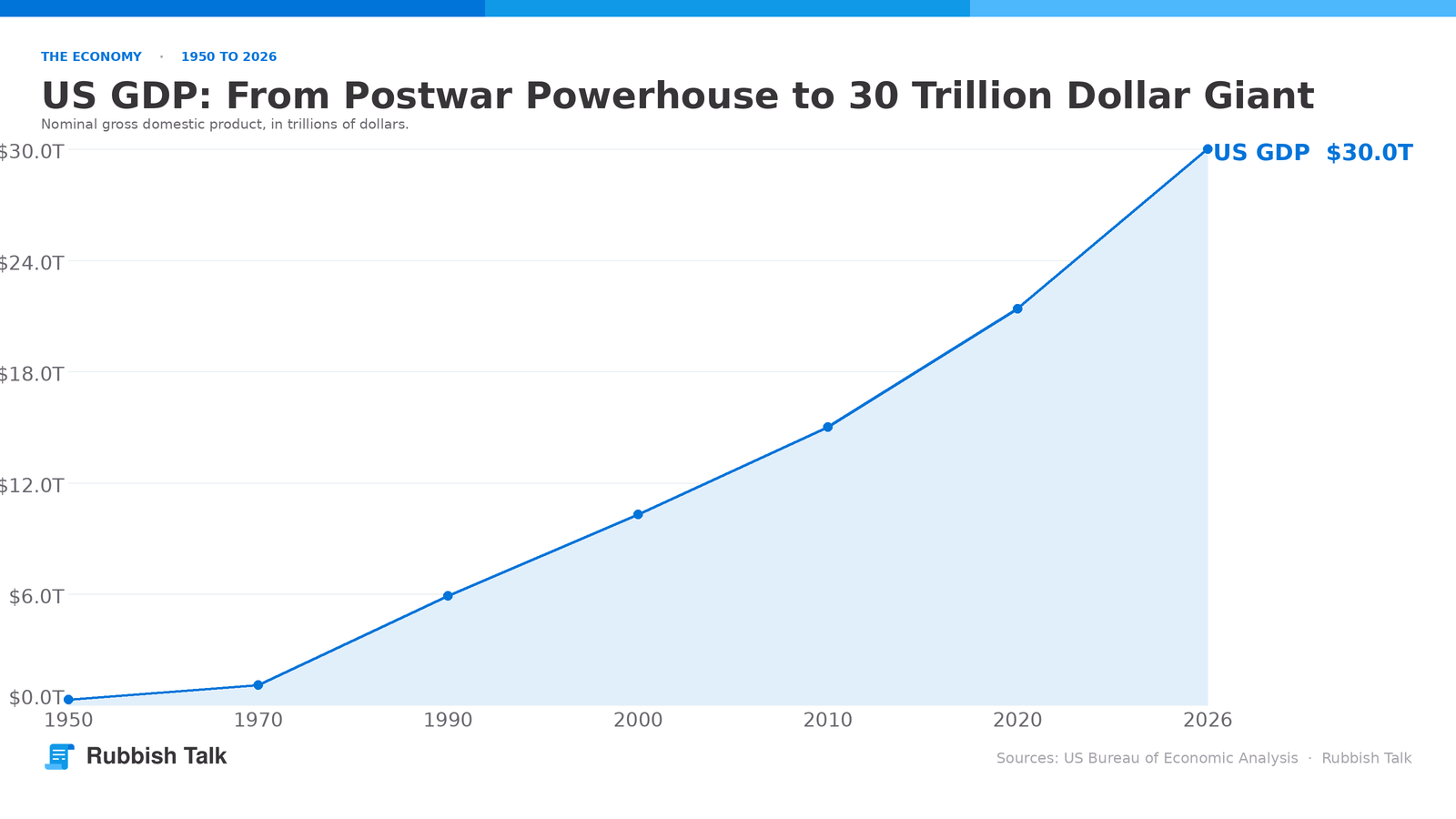
The start. In 1776 the thirteen colonies were an agrarian society of roughly 2.5 million people, most of them farmers, clustered along the Atlantic seaboard. There was no national currency worth the name, no central bank, and no industry to speak of. Economic output per person trailed Britain, and the young republic spent its first decades in debt and financial improvisation.
The development. Two centuries of expansion, immigration, industrialization, and innovation turned that colonial economy into the largest on earth. By the end of the Second World War the United States produced roughly half of global output, its factories untouched by the destruction that flattened Europe and Asia. The dollar became the anchor of the postwar financial system, and American consumers became the engine of global demand.
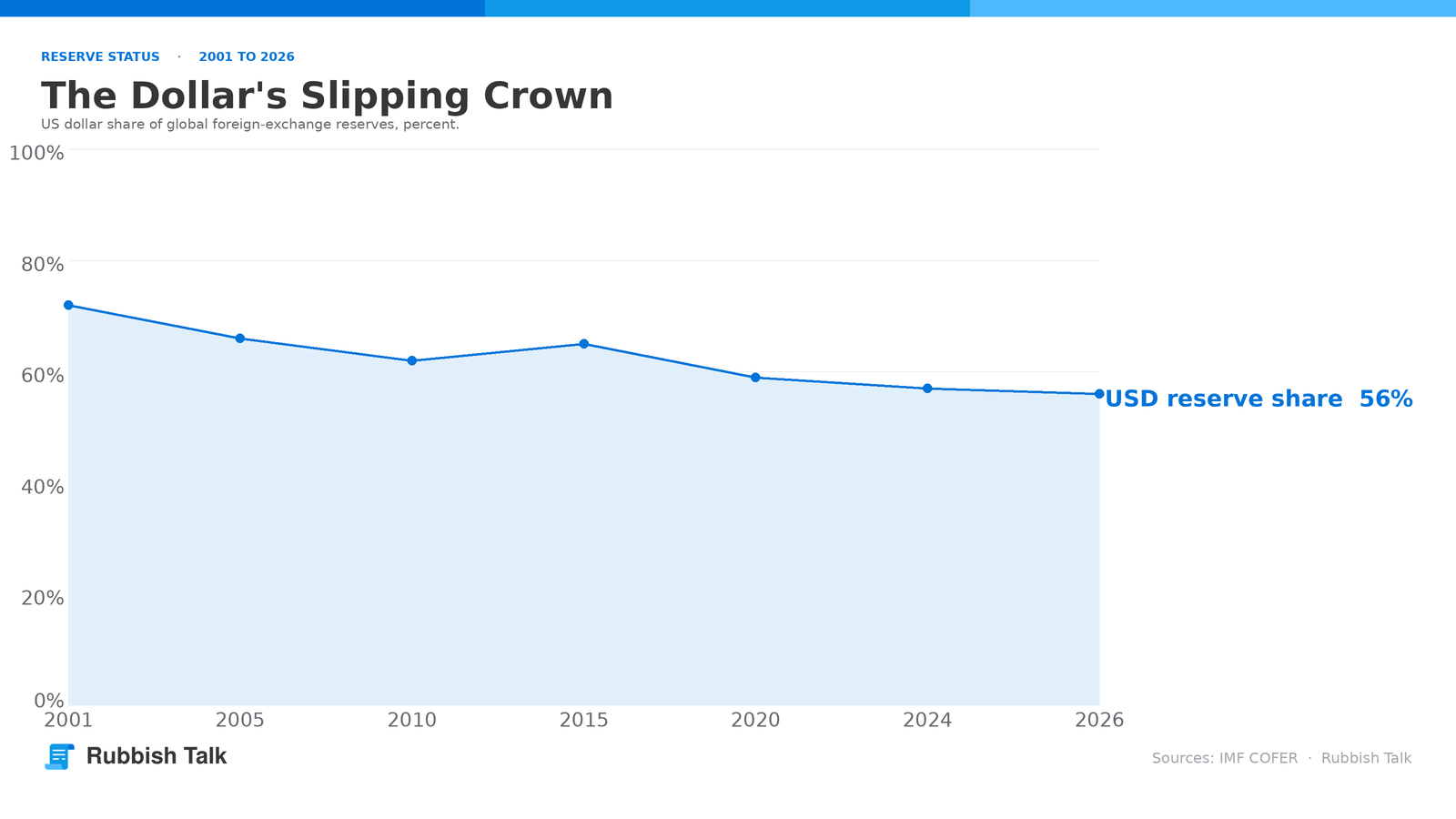
The current state. The United States remains the world’s largest economy, with output around 30 trillion dollars, and it is still growing: real GDP rose at a 2.1 percent annual rate in the first quarter of 2026, according to the Bureau of Economic Analysis. But the foundations look different up close. Federal debt has reached 39.2 trillion dollars, and debt held by the public sits near 101 percent of GDP, a level the Congressional Budget Office projects will climb to 120 percent by 2036. The dollar’s share of global foreign-exchange reserves has fallen from 72 percent in 2001 to 56.3 percent, the lowest since 1995, as central banks diversify and rival blocs build alternative payment systems. The economy is enormous and innovative, but it is also more indebted and less financially dominant than at any point in living memory.
“Federal debt held by the public rises from 101 percent of GDP this year to 120 percent in 2036, surpassing its previous high of 106 percent of GDP in 1946.”
Congressional Budget Office, The Budget and Economic Outlook: 2026 to 2036
Human Rights and Social Development: A Widening Circle
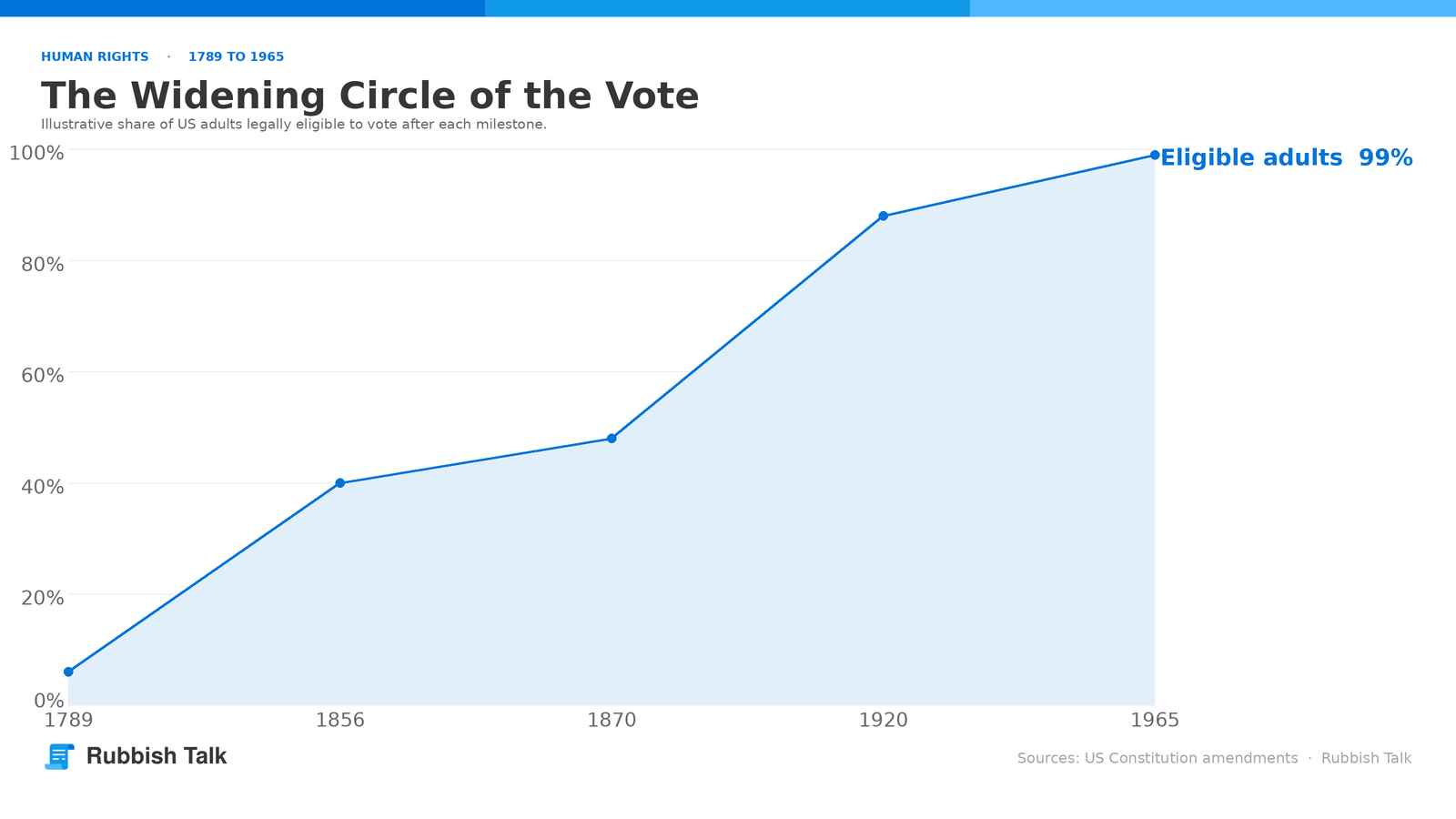
The start. The Declaration of Independence proclaimed that all men are created equal, yet in 1776 that promise excluded most of the people living under it. Slavery was legal in all thirteen colonies. Women could not vote. Voting was often restricted to white men who owned property. The founding ideal and the founding reality were separated by a vast gap.
The development. Closing that gap has been the central drama of American domestic history. The 13th Amendment abolished slavery in 1865. The 19th Amendment gave women the vote in 1920. The Civil Rights Act of 1964 outlawed discrimination by race, color, religion, sex, and national origin, and the Voting Rights Act of 1965 struck down the barriers that had disenfranchised Black Americans for generations. In 2015 the Supreme Court extended marriage rights to same-sex couples nationwide. Each step was contested, and each expanded the circle of who fully counted as an American.
The current state. By the letter of the law, rights in the United States are broader today than at any point in its history. Yet the social fabric shows strain. Political polarization has reached levels that scholars compare to the decades before the Civil War, wealth inequality has widened to Gilded Age extremes, and trust in institutions has fallen sharply. Glubb warned that late-stage empires turn inward and grow fractious, and the domestic mood of 2026, contentious, distrustful, and unequal, fits the pattern more closely than most Americans would like.
Healthcare: Three Decades of Life, at the Highest Price in the World
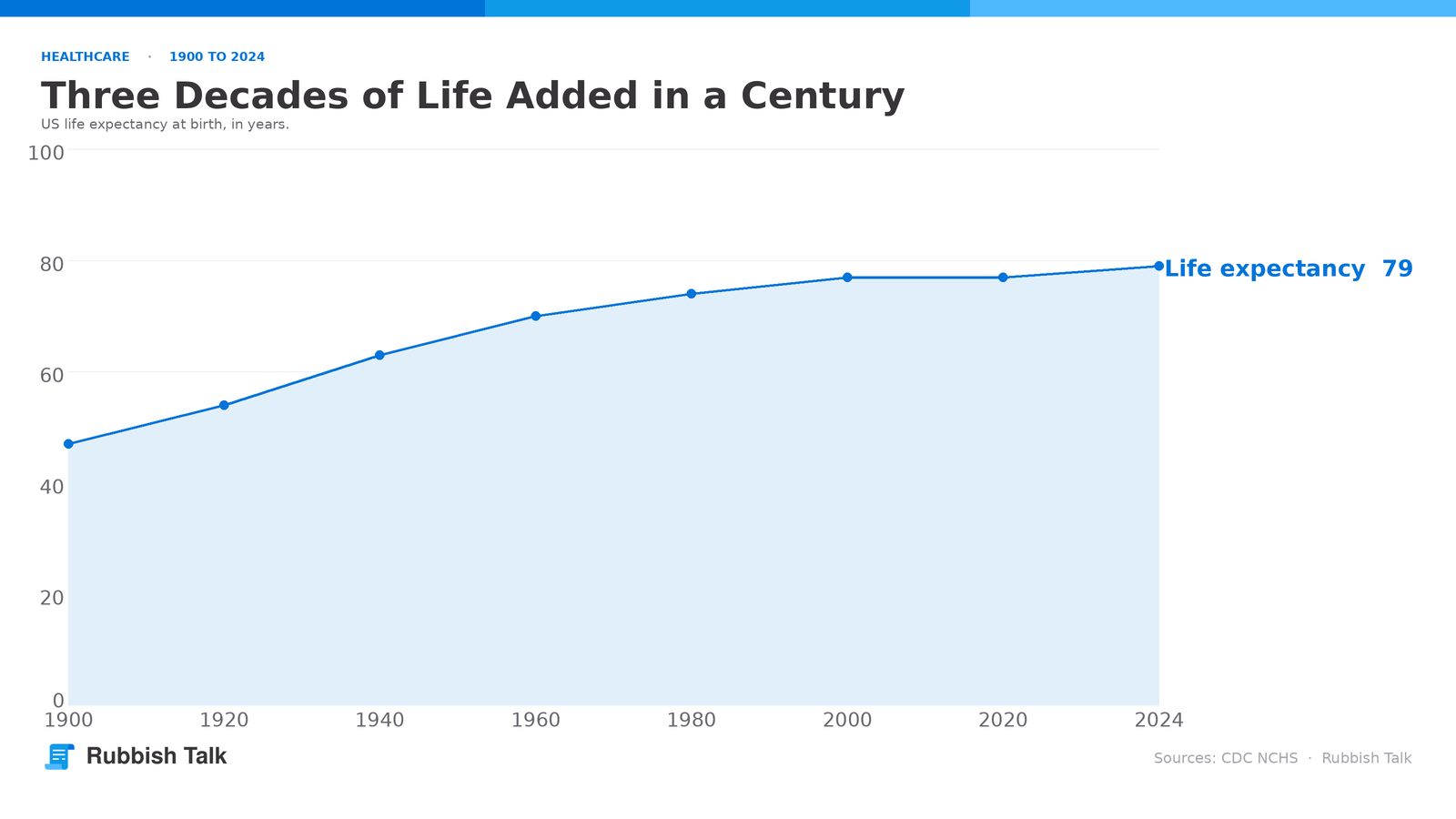
The start. For most of American history, medicine could do little. Around 1900 life expectancy at birth was roughly 47 years, and infectious disease killed indiscriminately across classes. Care was paid for out of pocket, hospitals were often places people went to die, and there was no public role in financing health.
The development. The 20th century transformed all of it. Antibiotics, vaccines, sanitation, and surgery pushed death back decade by decade. In July 1965 President Lyndon Johnson signed Medicare and Medicaid into law, creating public coverage for the elderly and the poor and marking the largest expansion of the American welfare state since the New Deal. The Affordable Care Act of 2010 extended coverage further, cutting the uninsured rate from 14.4 percent in 2013 to under 8 percent by 2023.
The current state. Life expectancy reached 79.0 years in 2024, up from 78.4 the year before, and more than 70 million Americans now rely on Medicaid. But the United States spends nearly 18 percent of its entire economy on healthcare, far more than any other wealthy nation, and gets less for it. Among high-income countries it has the lowest life expectancy, the highest rates of avoidable deaths, and the worst maternal and infant mortality. The uninsured rate held at 8 percent in 2025 and is expected to rise as pandemic-era subsidies expire. American healthcare is a paradox: technologically world-leading, financially unmatched, and yet outperformed on the outcomes that matter most.
“Although the United States spends more on health care than any other country, it consistently underperforms.”
Commonwealth Fund, U.S. Health Care from a Global Perspective, 2026
The Industrial Engine: Rise, Peak, and the Long Handoff
The start. The American industrial story began in the early 1800s with New England textile mills that copied British machinery. It was a follower economy, importing technology and know-how from across the Atlantic while its own workforce still labored mostly on farms.
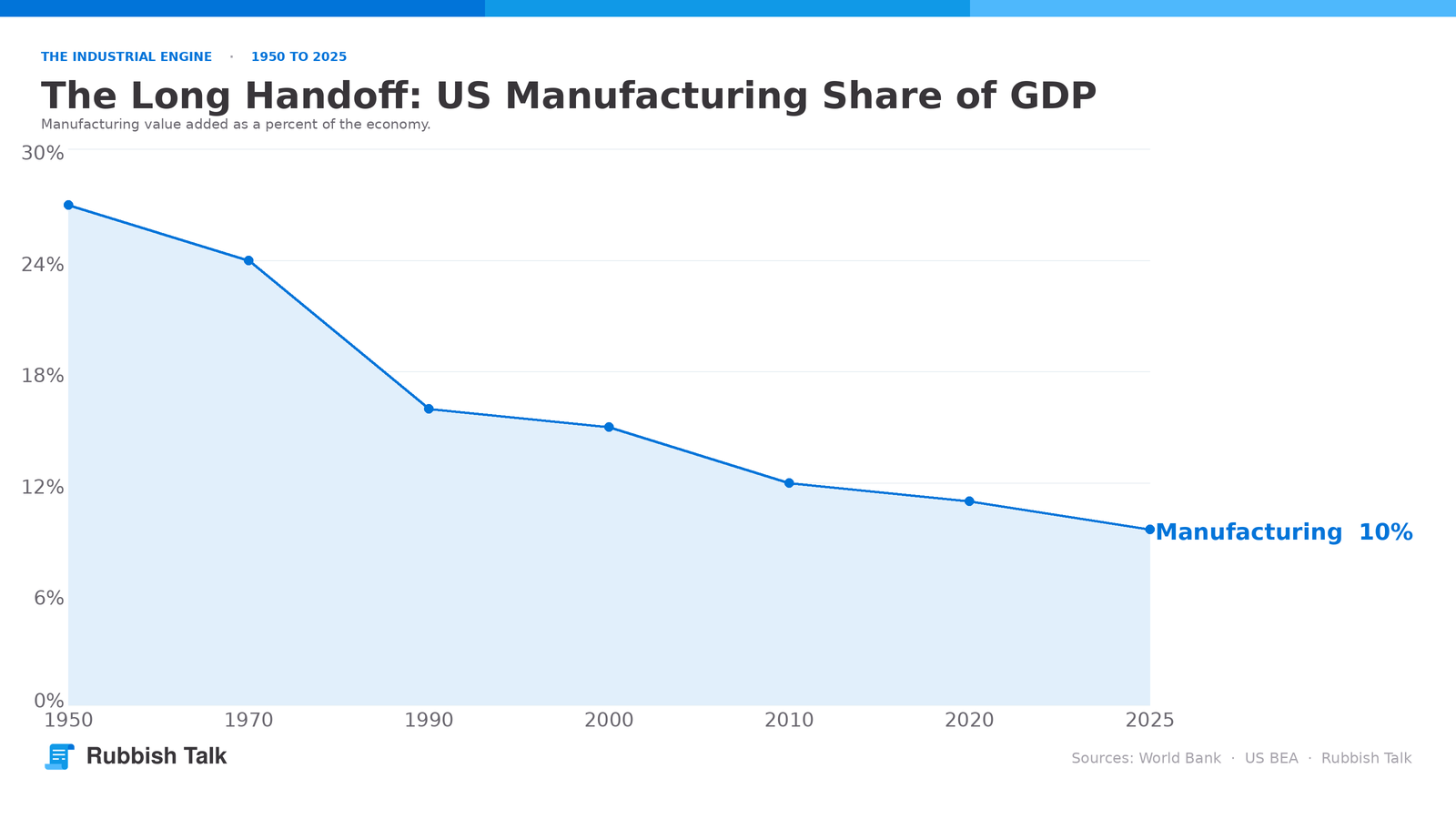
The development. Then came the acceleration. The transcontinental railroad linked the country in 1869. Steel, oil, and electricity built the fortunes of the late 19th century. By the mid-20th century the United States was the workshop of the world, and manufacturing made up more than a quarter of the economy. American factories won the Second World War as much as American soldiers did, out-producing every rival on the planet.
The current state. That engine has been handed off. Manufacturing accounted for 9.5 percent of GDP in 2025, with roughly 2.95 trillion dollars of output, while China’s industrial sector produced about 4.7 trillion dollars and made up a quarter of its economy. One study projects China will command 45 percent of global industrial production by 2030 as the West falls toward 11 percent. Washington is pushing back: tariffs announced in 2025 triggered a wave of reshoring announcements, and private construction spending on new factories tripled to nearly 230 billion dollars between 2021 and 2025. Whether that becomes a genuine industrial revival or a temporary blip is still unclear, since manufacturing employment actually slipped in the year after the tariffs. The country that once built a quarter of everything now builds a tenth, and is spending heavily to claw some of it back.
Sovereignty and War: From Rebel Colony to Global Garrison
The start. The United States was born in war. The Revolutionary War of 1775 to 1783 won independence from the era’s dominant empire, and for its first century the young nation mostly looked inward, fighting the War of 1812, expanding westward, and tearing itself apart in a Civil War that killed more Americans than every foreign conflict combined.
The development. The 20th century made America a global military power. It tipped the balance in the First World War, emerged from the Second as one of two superpowers, and spent the Cold War projecting force across every continent. Korea, Vietnam, the Gulf War, and the post-2001 campaigns in Afghanistan and Iraq extended that reach, at enormous cost in money and lives, and with results that ranged from decisive to disastrous.
The current state. America’s military footprint remains without historical parallel. In fiscal year 2025 the country spent about 919 billion dollars on defense, and it operates roughly 750 bases with more than 165,000 active-duty personnel stationed across some 178 countries. Yet the direction of travel is toward retrenchment. The withdrawal from Afghanistan in 2021 ended the longest war in American history, and by early 2026 US forces had completed a withdrawal from federal Iraqi territory. The pattern echoes Glubb precisely: empires in their later stages defend a vast perimeter they can no longer easily afford, and begin, reluctantly, to pull back. The garrison is still global, but the appetite for using it has visibly cooled.
Where America Sits on the Curve
Line up the pillars and a coherent picture emerges. The economy is the largest on earth but the most indebted in its history, and its currency is slowly losing its throne. Rights are broader than ever, yet the society exercising them is more divided than at any time since the 1860s. Healthcare extends life longer than the founders could have dreamed, at a cost no other nation would tolerate. The industrial base that made America a superpower has been handed to a rival. The military remains supreme, but is quietly retreating from the frontiers it spent 80 years defending. Wealth concentration, cultural focus on celebrity and consumption, a swelling entitlement state, and political fracture are exactly the markers Glubb catalogued in the empires that came before.
That does not mean the story ends here. The United States holds cards no previous empire possessed: the world’s deepest capital markets, the leading position in artificial intelligence and advanced technology, unmatched universities, favorable demographics compared with its rivals, and a capacity for reinvention that has confounded doom-mongers for a hundred years. Rome did not have Silicon Valley. Britain did not have the dollar. Cycles describe pressures, not destinies, and America has repeatedly rewritten its own trajectory.
Where it is headed depends on which force wins. If the debt is stabilized, the industrial base rebuilt, and the political center holds, the 250-year clock becomes a warning that was heeded rather than a prophecy fulfilled. If not, the numbers point the way the numbers have always pointed for great powers this deep into the cycle. Either way, the anniversary is less a finish line than a reading on the dial. At 250, the United States is neither collapsing nor cresting. It is standing, powerful and strained, exactly where history said it would be, and the next quarter century will decide whether it is the exception or the rule.
Sources:
- GDP, 1st Quarter 2026 | U.S. Bureau of Economic Analysis
- National debt of the United States | Wikipedia
- The Budget and Economic Outlook: 2026 to 2036 | Congressional Budget Office
- US Government Debt: % of GDP | CEIC Data
- The 250-Year Cycle: How the United States Mirrors the Rise and Fall of Every Empire | Ray Williams, Medium
- Ray Dalio: The Rise and Fall of Empires | Shortform
- Mortality in the United States, 2024 | CDC NCHS
- U.S. Health Care from a Global Perspective, 2026 | Commonwealth Fund
- U.S. Uninsured Rate Unchanged in 2025 | CDC NCHS
- 15 Years of the Affordable Care Act | SHADAC
- Medicare and Medicaid: 60 Years of Health Care Reform | Medicare Rights Center
- US Manufacturing Statistics 2025-2026 | Manufacturing Lead Generation
- US Share of Global Manufacturing to Fall to 11 Percent by 2030 | ITIF
- US Manufacturing Reshoring Boom | IoT Analytics
- US Defense and Foreign Affairs Fact Sheet | USAFacts
- Global presence: US military stationed in 178 countries | Digital Journal
- Iraq announces full withdrawal of US forces from federal territory | CNN