

Members of Congress outperformed the S&P 500 again in 2024, and the biggest gains often came from trades placed in the names of spouses or through actively managed accounts. Much of the edge traces to concentrated bets on Big Tech and defense names that these same lawmakers help regulate. This piece looks at the largest disclosed trades placed around regulatory and policy events, and measures the results against the indexes, Warren Buffett, and the top hedge funds. Every figure here comes from public filings and the trackers that aggregate them, and every number should be read as an estimate, because lawmakers disclose ranges rather than exact amounts.
What the disclosures actually show
The starting point is the 2012 STOCK Act, which forces federal lawmakers to file a periodic transaction report within 45 days of any trade in a stock, bond, or other security worth more than $1,000. Those filings are the raw material for every claim in this article. They are also famously weak on enforcement: the standard fine for filing late is just $200, which critics note is closer to a parking ticket than a deterrent.
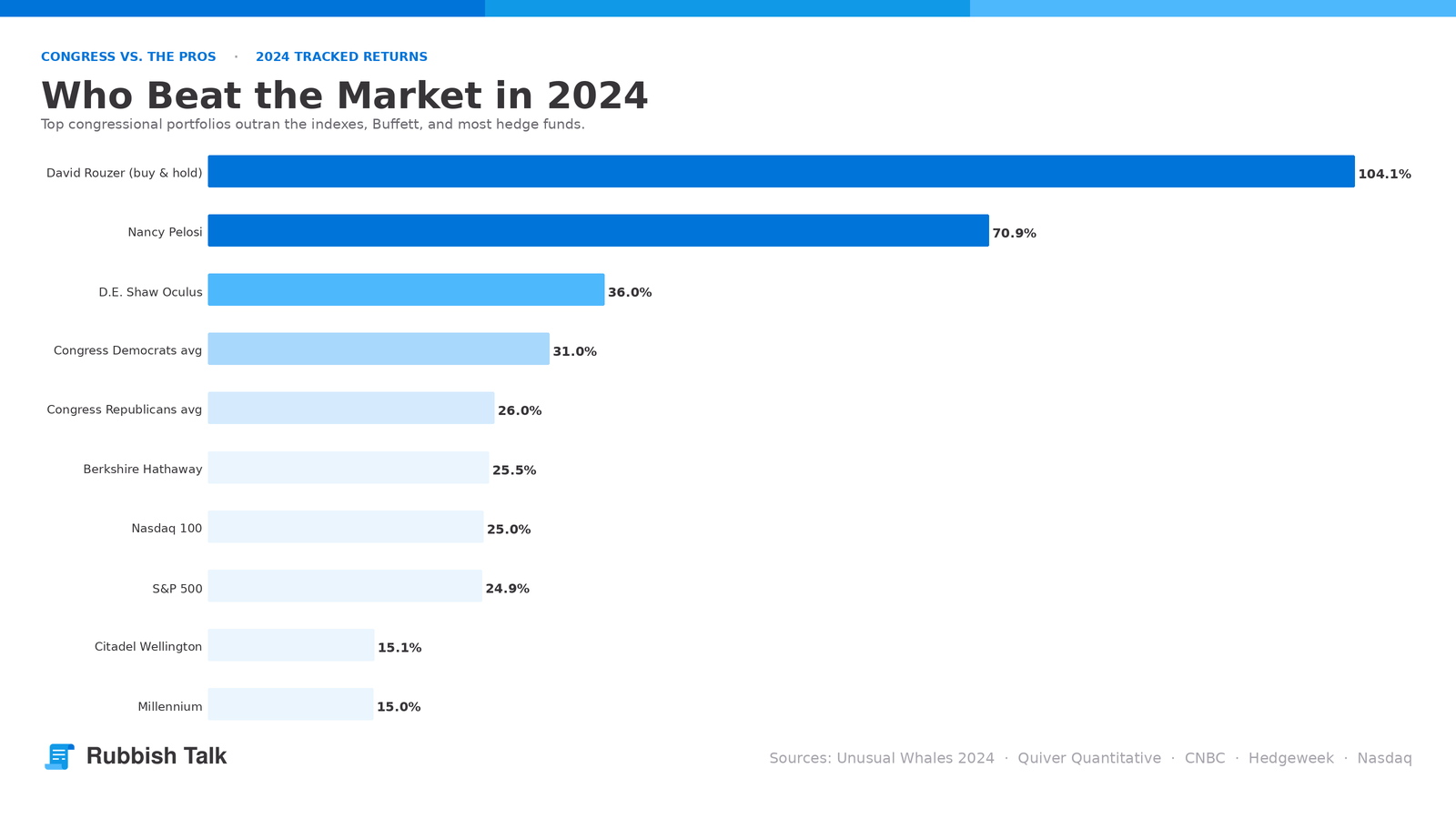
According to Unusual Whales, which compiles the disclosures into an annual scorecard, Democratic lawmakers’ tracked portfolios rose roughly 31% in 2024 and Republicans’ rose roughly 26%, against a 24.9% gain for the S&P 500. The firm is explicit that these are approximations built from disclosed positions between December 29, 2023 and December 30, 2024, not audited returns. Only about 100 members are active traders, and by Unusual Whales’ own count only half of them beat the index. The headline is not that everyone in Congress is a market genius. It is that a concentrated group did very well, and that their winners cluster in sectors they legislate.
Star traders and the buy-and-hold outliers
The single best portfolio in the 2024 analysis belonged to Rep. David Rouzer (R-N.C.), estimated up 104.1%. The important caveat, which Unusual Whales makes itself, is that Rouzer is not an active trader. He holds exchange-traded funds heavy in stock-market darlings like Nvidia and has not bought or sold a single stock since 2022. His return is a story about Nvidia’s run, not about timing.
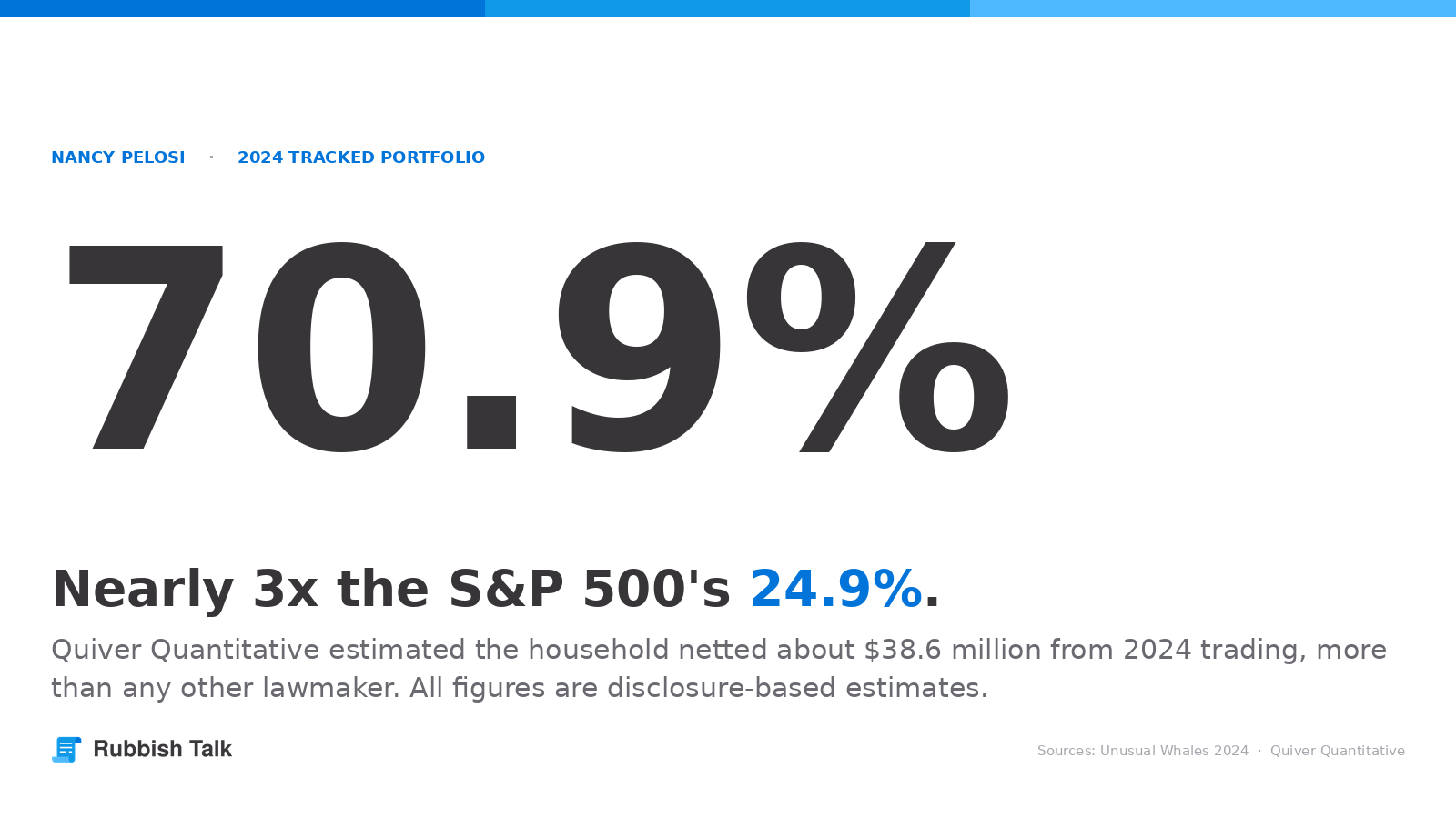
The more interesting cases are the active traders. Rep. Nancy Pelosi (D-Calif.), whose trades are executed in the name of her husband, the investor Paul Pelosi, was estimated up 70.9% for the year. A separate tracker, Quiver Quantitative, estimated her household netted about $38.6 million from all 2024 trading activity, the most profitable year of any lawmaker in its data. Unusual Whales, which is not a fan, still described her in its report as “a skilled options trader” with “an almost cult-like following for her financial disclosures.” That following is real: there are newsletters, screeners, and even exchange-traded funds built to mirror congressional trades.
“Let’s not forget that many of these big tech companies also lobby the very same people that hold company shares. Our politicians may have direct oversight over policy decisions that could financially help or hurt these companies.”
– Unusual Whales, 2024 Congress Trading Report
Trading around the news: Nvidia and Microsoft
The Pelosi household’s Nvidia position is the cleanest example of the pattern. Her November 22, 2023 disclosure showed the purchase of 50 Nvidia call options with a $120 strike price and a December 2024 expiration, valued between $1 million and $5 million. After Nvidia’s 10-for-1 stock split in June 2024, that position became 500 contracts. In December 2024 she exercised them, acquiring 50,000 shares, and disclosed selling 10,000 Nvidia shares at year end valued between $1 million and $5 million. Buying long-dated calls on the defining artificial-intelligence stock a year before it roughly tripled was, in hindsight, an extraordinary trade.
Microsoft is where the timing questions get sharper. Pelosi disclosed selling more than $1 million of Microsoft stock in late July 2024. That November, the Federal Trade Commission opened a wide-ranging antitrust investigation into the company. The pattern is not new. In March 2021, filings show the Pelosis bought Microsoft call options less than two weeks before the U.S. Army announced a contract worth up to $22 billion for Microsoft to supply augmented-reality headsets. Nothing in the public record proves the trades were informed by non-public information, and Pelosi has said she does not own or trade stocks herself. But the sequence of trade, then policy event, is exactly what disclosure rules were written to expose.
The defense desk
The defense sector shows the conflict most plainly, because the people writing military policy are often invested in the companies that win military contracts. A Responsible Statecraft analysis of Quiver Quantitative data found that at least 37 members of Congress and their families traded stocks of the top 100 Pentagon contractors in 2024, worth somewhere between $24 million and $113 million in total. Eight of them sat on the Armed Services or Foreign Affairs committees while doing it.
The most active defense trader was Rep. Josh Gottheimer (D-N.J.), who traded at least $22 million of top-contractor stock, most of it Microsoft, plus names like Northrop Grumman and IBM, while holding a seat on the House Intelligence Committee. Gottheimer has said the trades are handled by an outside firm. Sen. Tommy Tuberville (R-Ala.), who sits on the Senate Armed Services Committee, disclosed between $63,007 and $245,000 of defense-stock trading in 2024 and has held up to $50,000 of Lockheed Martin. Both men say a third party manages their accounts without their input.
“I literally have no idea what they do.”
– Rep. Josh Gottheimer (D-N.J.), on the firm managing his trades, CNBC interview (2022)
How the returns stack up against the professionals
The comparison that matters is against people who invest for a living. In 2024 the S&P 500 returned 24.9% and the Nasdaq 100 gained roughly 25%. Warren Buffett’s Berkshire Hathaway, often treated as the gold standard of long-term investing, returned about 25.5% on its Class A shares. Those are the benchmarks a top congressional trader like Pelosi, at an estimated 70.9%, comfortably cleared.
The hedge-fund elite make the point even sharper. Ken Griffin’s flagship Citadel Wellington fund returned 15.1% in 2024, and Izzy Englander’s Millennium returned 15%, both trailing the index in a strong year for stocks. D.E. Shaw was the standout, with its Composite fund up 18% and its macro-focused Oculus fund up 36%. Only that single Oculus figure, from one of the most sophisticated quantitative shops on earth, came close to the best congressional portfolios. A part-time trader running a seven-figure account beat funds that employ hundreds of PhDs. That should invite scrutiny, not applause.
What the research says, and what comes next
Here the evidence cuts against the easy narrative. Academic work, including a 2022 study out of Dartmouth, has repeatedly found no consistent evidence that members of Congress as a group earn superior investment returns. The aggregate edge is thin, and a chunk of the 2024 outperformance is simply heavy exposure to Big Tech during a Big Tech rally, the same reason a passive Nasdaq holder did well. The strongest results belong to a handful of names, and disclosure ranges are wide enough that point estimates like “70.9%” carry real uncertainty.
That is the honest version, and it still leaves the core problem intact. The issue is not whether the average lawmaker beats the market. It is that specific, powerful members repeatedly traded companies they oversee, near the moments their oversight mattered most, and the public has no way to rule out an information advantage. That is why the reform push keeps returning. The bipartisan ETHICS Act, which would bar members from trading individual stocks, cleared a Senate committee in July 2024 but has not reached a floor vote, and President Biden endorsed a ban in his final weeks in office.
“Lawmakers like me, we’re kind of like umpires in a baseball game, we call balls and strikes. And you definitely don’t let umpires bet on the outcome of the game.”
– Sen. Jon Ossoff (D-Ga.), on introducing the ETHICS Act (2024)
Watch three things from here. First, whether any stock-trading ban actually reaches a vote, given that the practice enjoys quiet bipartisan support among the members who benefit. Second, whether enforcement gets teeth, because a $200 late fee changes no one’s behavior. Third, the disclosures themselves, which remain the only real window ordinary investors have into what their representatives are buying, and when.
Sources:
- Members of Congress once again outperformed the stock market in 2024 – Fortune
- Congress Trading Report 2024 – Unusual Whales
- Top defense stock traders in Congress in 2024 – Responsible Statecraft
- Nvidia Stock Hits All-Time Highs: Nancy Pelosi’s Call Options – Benzinga
- Ken Griffin’s flagship hedge fund at Citadel climbs 15.1% in 2024 – CNBC
- Millennium posts 15% 2024 gain but lags S&P 500 – Hedgeweek
- D.E. Shaw to return billions to investors after strong 2024 performance – Hedgeweek
- Berkshire Hathaway (BRK.A) Stock Topped the S&P 500 in 2024 – Nasdaq
- Summary of PTR Requirements (STOCK Act) – FLRA
- Sen. Ossoff announces bipartisan progress to ban congressional stock trading