
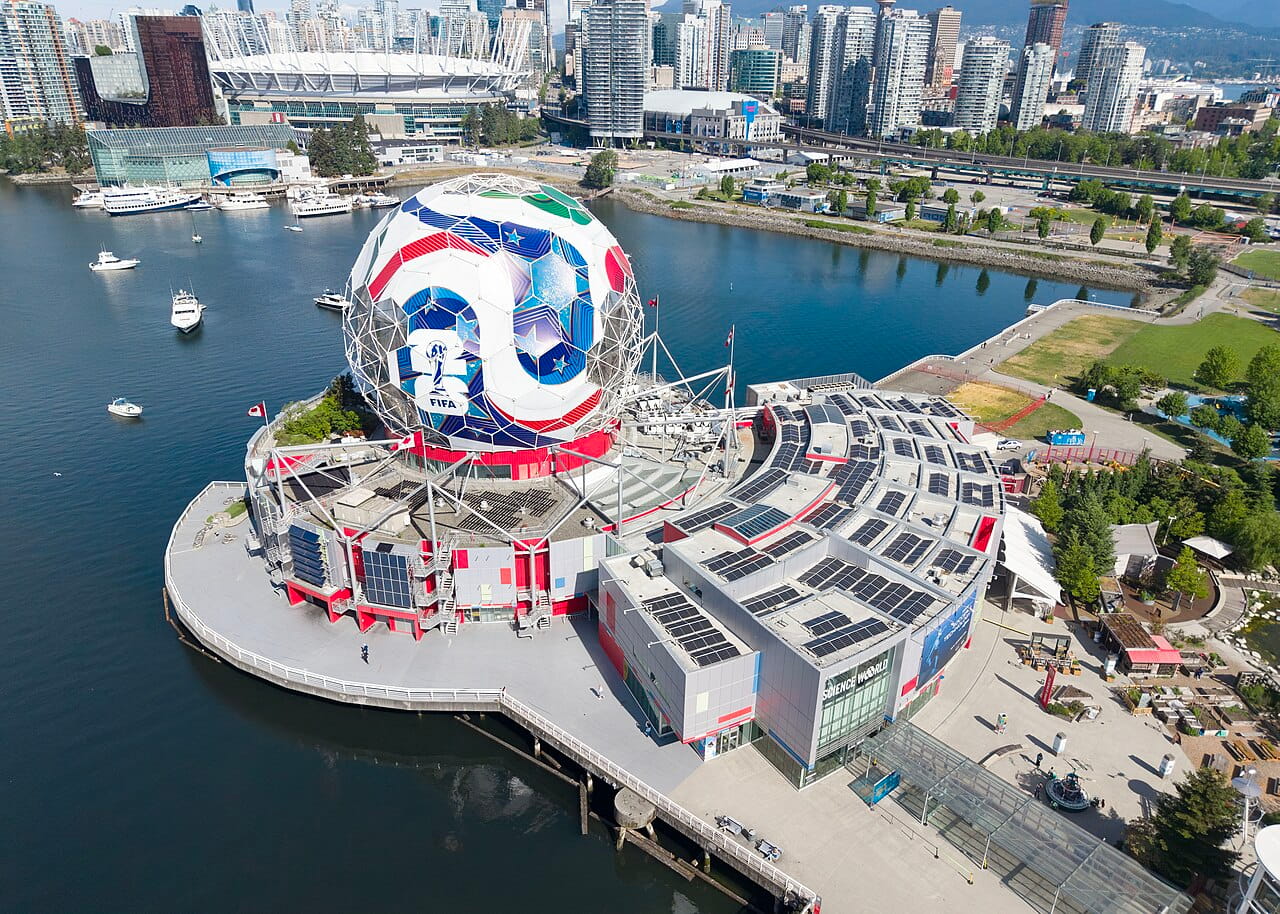
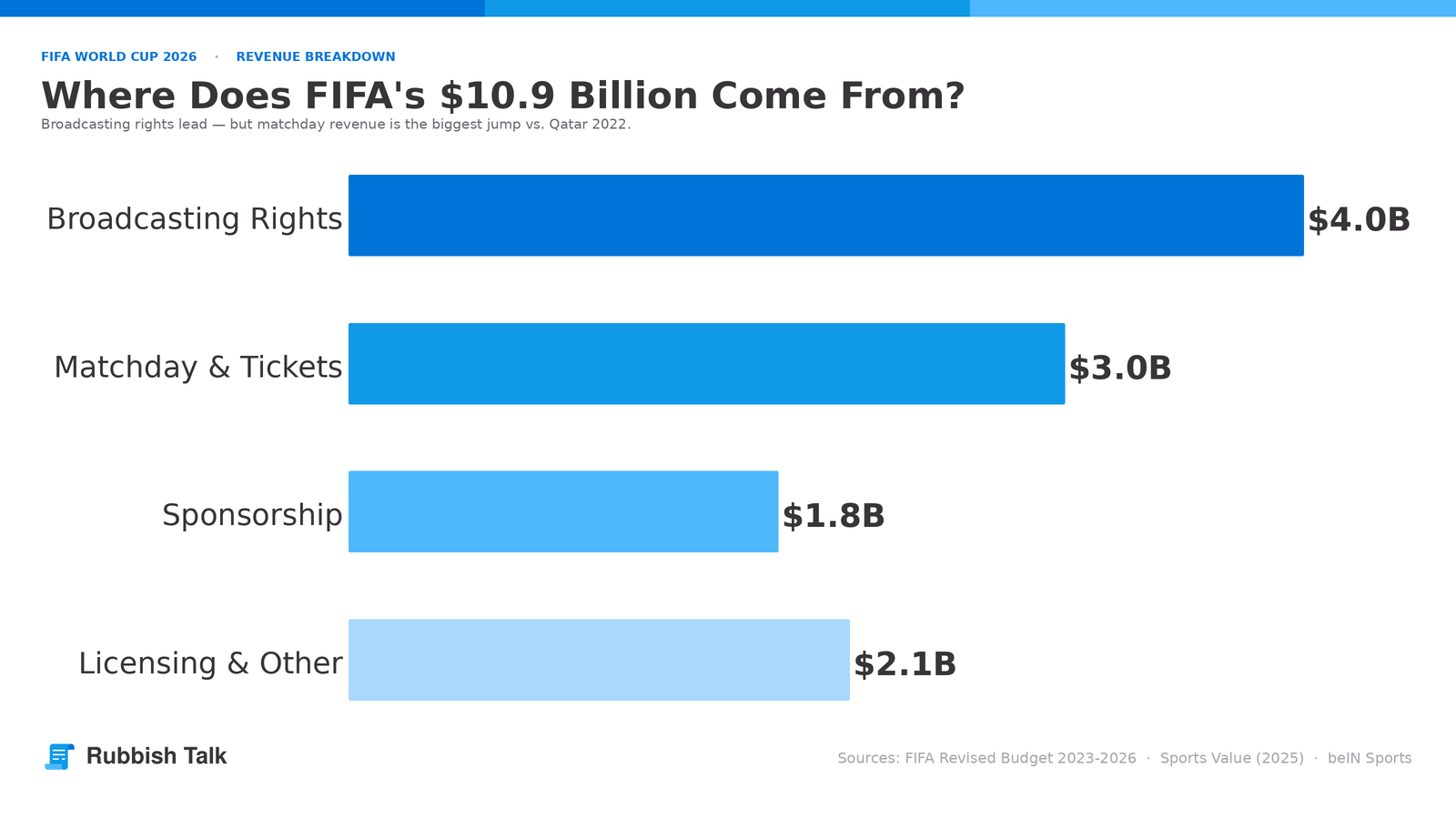
The 2026 FIFA World Cup — spread across the United States, Canada, and Mexico — is on track to be the most commercially lucrative tournament in football history, with FIFA projecting revenues exceeding $10.9 billion for the cycle. But while FIFA and its corporate partners are poised to capture extraordinary windfalls, the full financial picture is more complicated. Host cities are absorbing $100–$200 million each in costs, governments are forfeiting hundreds of millions in tax revenue, and fans are spending thousands just to attend a single match. The $30 billion “economic impact” figure being cited widely is FIFA’s own projection — and history suggests a considerable gap between that headline and what actually materialises.
The Revenue Machine: How FIFA Prints Money Every Four Years
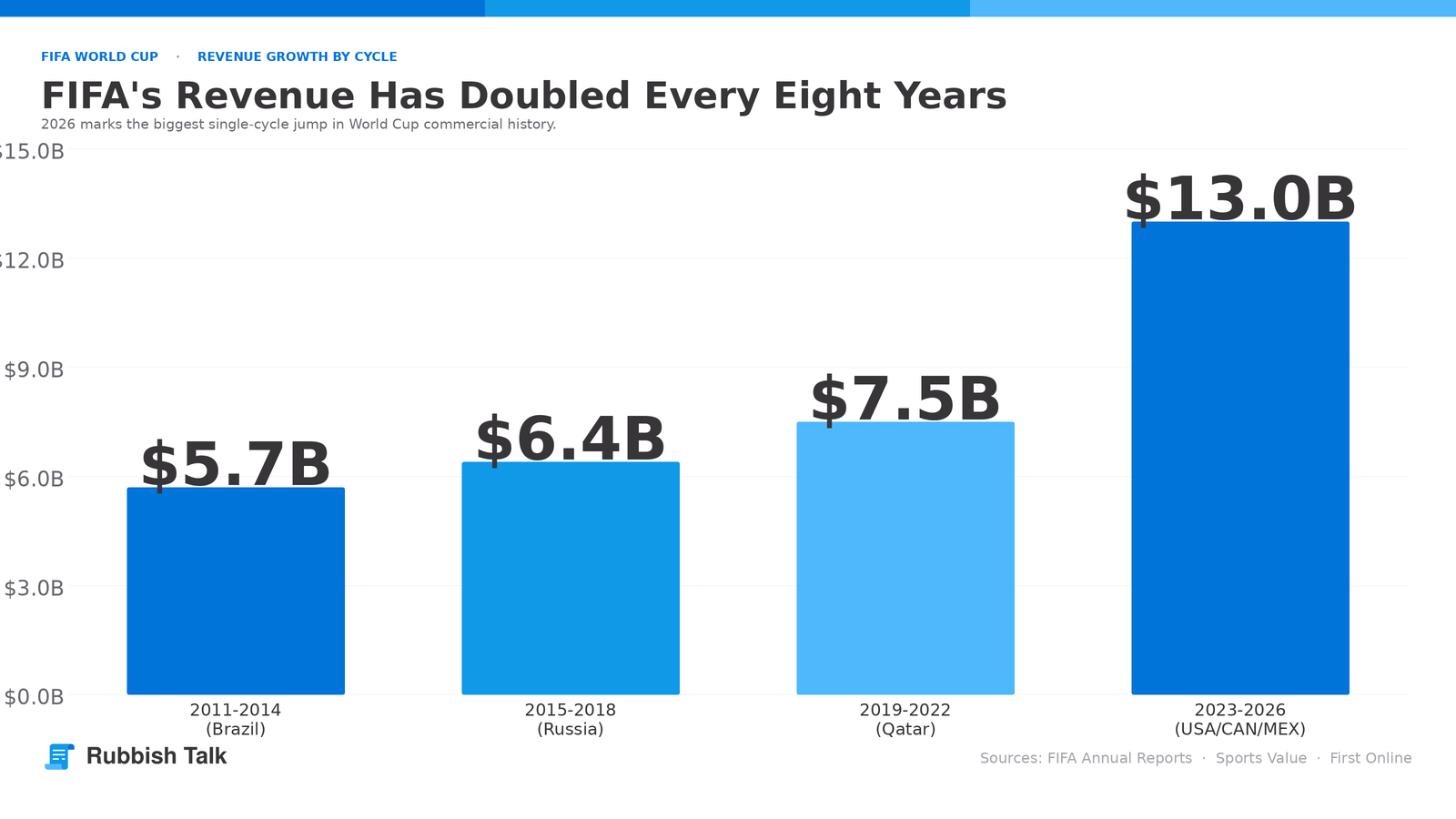
FIFA’s revenue for the 2023–2026 cycle is projected at approximately $13 billion — a 72% increase over the Qatar 2022 cycle, and more than double the 2015–2018 period. Of that total, roughly $8.9 billion is attributed directly to the US-Canada-Mexico tournament. The model is straightforward: FIFA controls the global intellectual property, sells rights territory by territory, and takes in the vast majority of the upside while offloading operational costs to host nations.
Broadcasting rights are the largest revenue line, expected to surpass $4.2 billion for the first time. Sponsorship revenues are projected to exceed $2.8 billion — a record for FIFA — boosted by new commercial partnerships including a deal with Saudi Aramco. Matchday revenues — ticket sales, hospitality, and in-stadium commerce — could reach as high as $3 billion, up dramatically from the $950 million generated in Qatar, which had limited fan capacity and a smaller domestic market. Prize money distributed to participating federations totals $871 million, with the champion taking $50 million and even first-round exits guaranteed $10.5 million.
What It Actually Costs a Fan to Attend
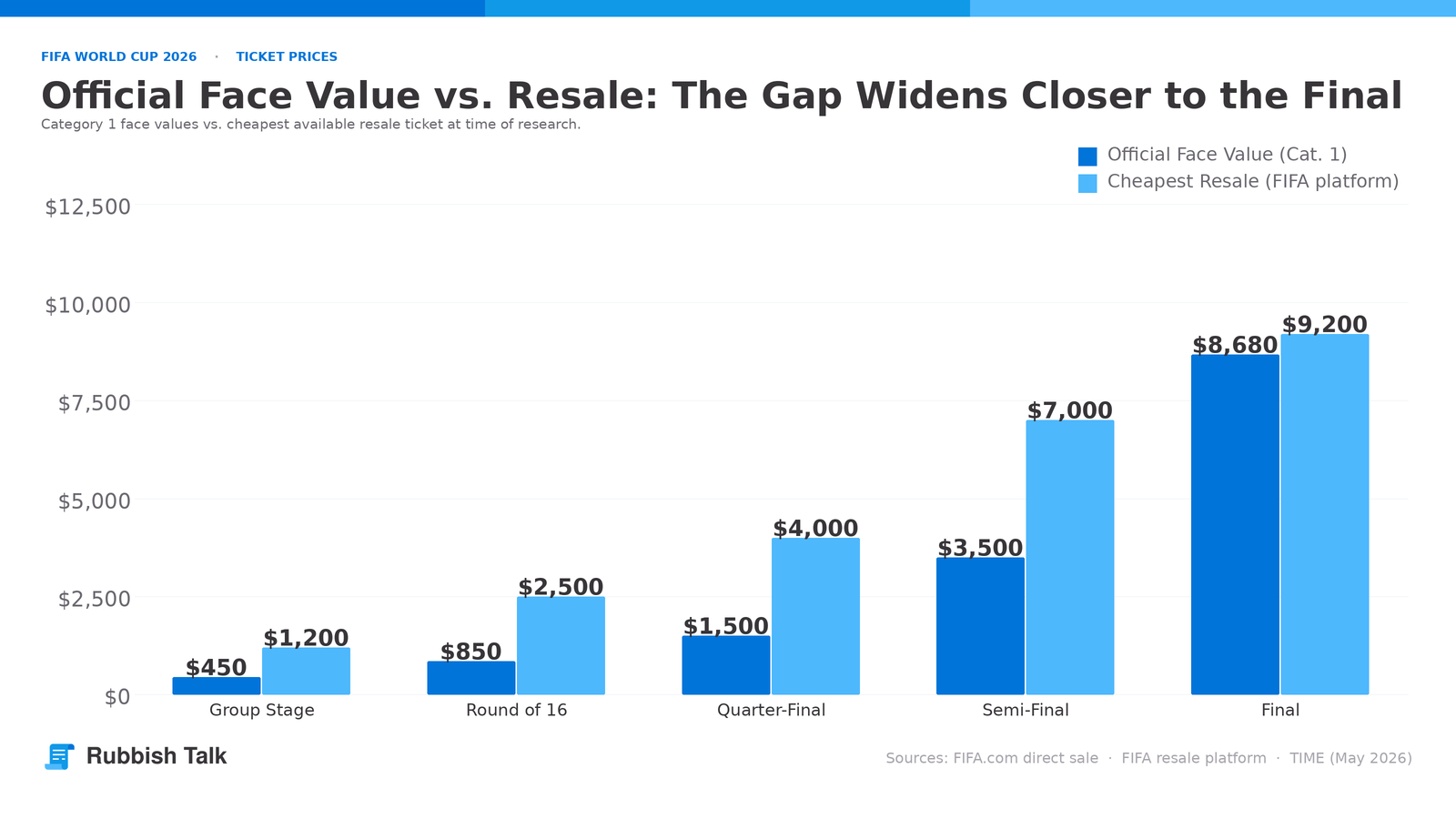
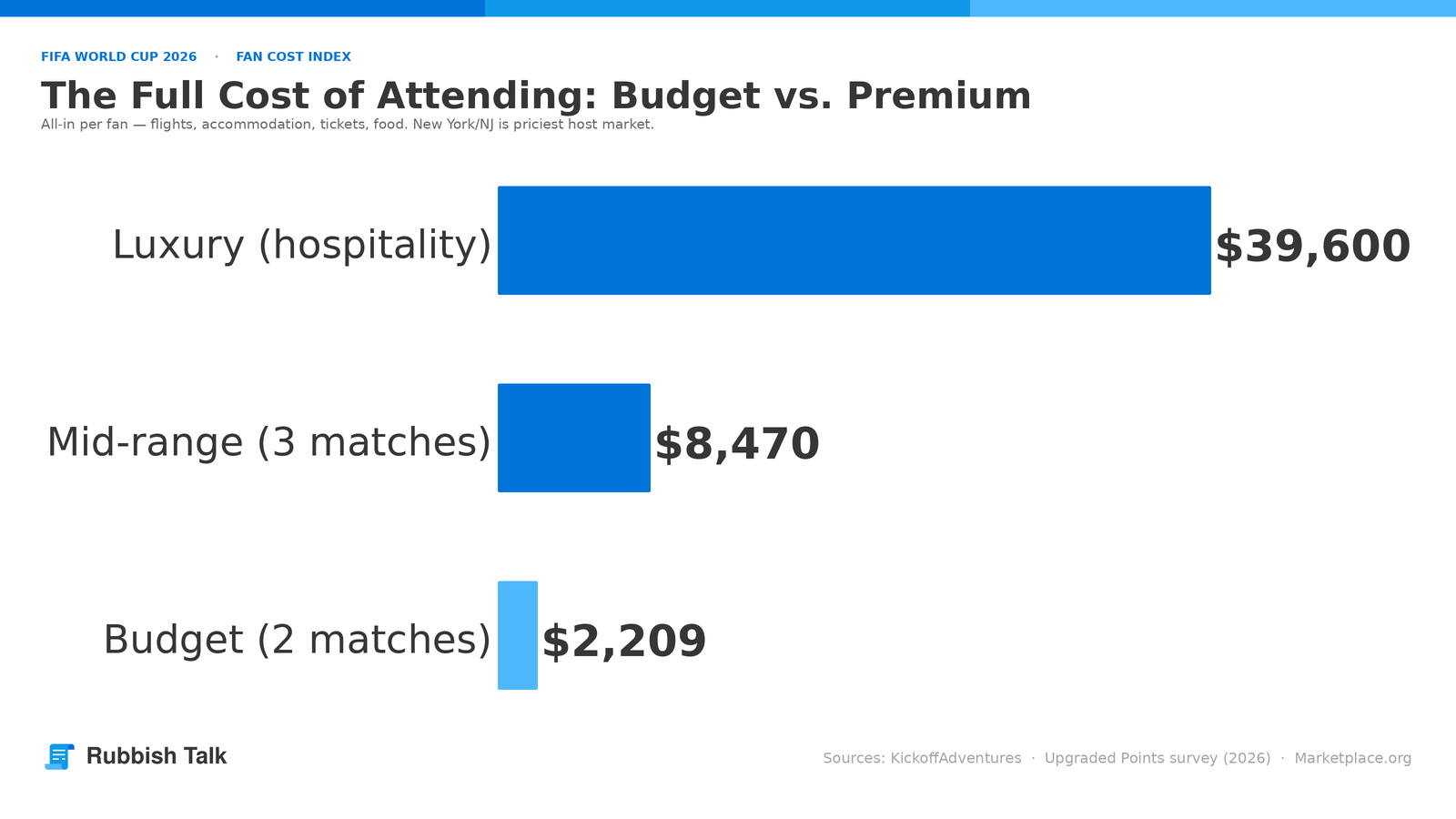
The gap between “attend the World Cup” and “afford the World Cup” has never been wider. Official FIFA tickets launched with a nominal floor of $60 per match — a headline-grabbing figure that obscures the reality. Category 1 tickets (lower bowl, midfield) for group stage matches start around $450. A seat to the final at MetLife Stadium was priced at $8,680 face value, with the cheapest resale ticket on FIFA’s own platform sitting at $9,200 in mid-May 2026. A US Open-style seat for the US-Paraguay opener at SoFi Stadium cost $1,940 at face value in the upper tier.
Once you add travel, accommodation, and daily costs, the picture sharpens further. Surveys and travel estimates put the average cost of attending two group stage matches at approximately $2,200 for a budget traveller staying in a hostel — and $8,470 for a mid-range experience across two cities with a Round of 16 included. A premium multi-city experience with hospitality packages runs close to $40,000. Domestic flights between host cities have surged: a New York-to-Dallas route normally priced at $180–$250 is selling for $400–$600 on World Cup dates. International fares from Europe and South America are, somewhat counterintuitively, running at or below normal peak-summer prices.
Host city cost differentials are significant. New York/New Jersey is the most expensive market to attend in, while Atlanta, Kansas City, and Houston are considerably cheaper — with estimated per-match attendance costs under $1,756 all in.
Broadcasting Rights: A Global Patchwork of Deals — and One Very Public Standoff
FIFA’s approach to selling broadcast rights is territorial, not global — each market negotiates its own deal, resulting in wildly different costs and access arrangements. In most major markets, the identity of the rights-holder is known; the price paid usually is not.
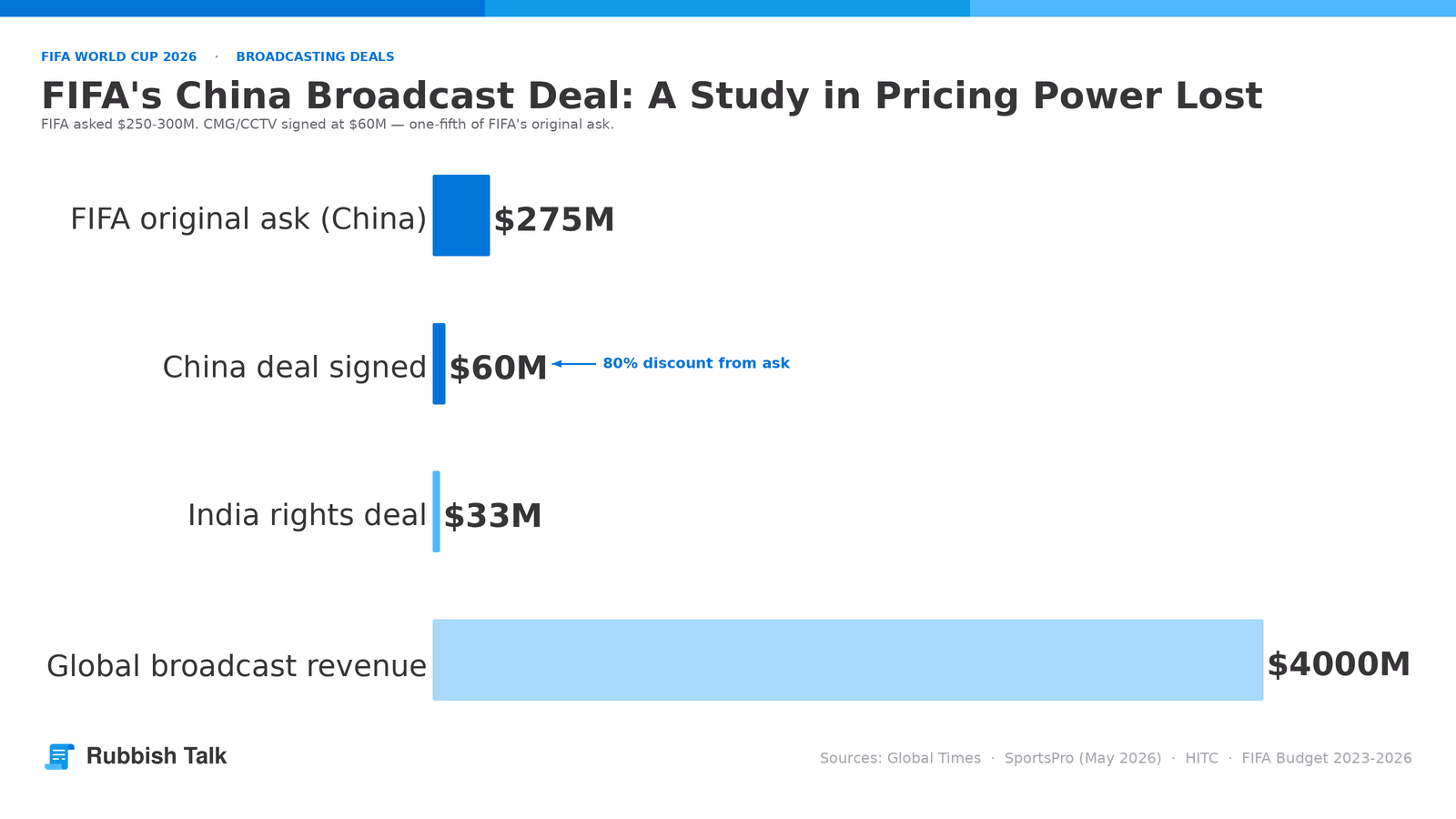
What made news in 2026 was China. FIFA initially sought $250–300 million from China Media Group (CMG/CCTV) for rights covering the 2026 and 2030 World Cups and both Women’s World Cups. CMG countered at $60–80 million. After months of public standoff — with Chinese media openly mocking the price — FIFA reportedly lowered its ask to $120–150 million. The deal eventually closed at approximately $60 million: one-fifth of FIFA’s original target, and a figure that some analysts described as a $240 million loss relative to FIFA’s ambitions.
In the United States, Fox Sports (English) and NBCUniversal Telemundo (Spanish) hold the rights, with Fox’s new streaming service charging $19.99/month and Peacock Premium at $10.99/month for streaming access. In the United Kingdom, BBC and ITV are splitting all 104 matches free-to-air — a meaningful contrast to the US paywall model. In Australia, SBS continues its free broadcast tradition, carrying every match live. India’s deal came in at an estimated $30–35 million, well below FIFA’s initial expectations.
The China situation underscores a structural tension in FIFA’s revenue model: the biggest rights packages are increasingly contested, with broadcasters in major markets unwilling to absorb FIFA’s aggressive pricing when tournament time zones are unfavourable and consumer enthusiasm is uncertain.
The Sponsorship Frenzy: $10 Billion in Brand Ad Spend
The 2026 World Cup has triggered one of the largest concentrated bursts of advertising spending in commercial history. Brands are expected to pour an additional $10.5 billion in global ad spend into Q2 2026 alone, drawn by the tournament’s projected cumulative audience of six billion viewers across 104 matches.
Official FIFA sponsorship deals average $60–100 million, with top-tier partners exceeding $100 million. Anheuser-Busch InBev is spending over $110 million on advertising and FIFA sponsorships combined, positioning Michelob Ultra alongside the tournament’s prestige. Adidas has already sold approximately $292 million in 2026 World Cup merchandise before the final whistle. Coca-Cola updated a Van Halen track for its anthem campaign. Lego’s activation generated 314 million Instagram views within 24 hours of launch.
The scale of brand investment reflects both the unique reach of football and a broader trend: as live sports audiences fragment across streaming platforms, the World Cup remains one of the few remaining “shared” media events capable of driving mass reach in a single concentrated window. For advertisers spending nine figures, that scarcity has a clear price.
The Hidden Bill: What Host Cities Are Really Paying
FIFA’s standard host city agreement requires each city to absorb security, transport, stadium preparation, fan zones, and local logistics — costs estimated at $100–$200 million per city across 16 US host cities, plus venues in Canada and Mexico. The US federal government allocated $625 million for safety and security across host cities, plus $100 million for transit operations. In Canada, the Parliamentary Budget Officer estimated total government support at C$1.066 billion — about C$82 million per match across the 13 Canadian fixtures.
The tax concessions are equally striking. FIFA requires full income and commercial tax exemptions for itself and affiliated entities throughout the tournament. Host states that didn’t legislate exemptions on match ticket sales saw pushback: Georgia expects to forgo up to $25 million in state and local sales tax from Atlanta’s matches alone; Florida will lose approximately $7.4 million from Miami games; Missouri stands to miss $11 million across Kansas City matches. In total, US taxpayers in three states alone are projected to absorb $58 million in foregone sales tax revenue.
This structure — FIFA captures commercial upside, governments absorb operating and fiscal costs — is not new. ITEP’s analysis of 14 World Cups hosted since 1966 found that 12 resulted in financial losses for host nations, with an average return on investment of negative 31% across the last three tournaments. According to ITEP, FIFA additionally requires host cities to provide it with office space equipped with state-of-the-art amenities, free of charge. The 2026 tournament benefits from not requiring new stadium construction, which was the primary driver of Brazil 2014’s estimated $15 billion in government spending. But the fundamental asymmetry between FIFA’s revenues and hosts’ costs is unchanged.
The $30 Billion Impact Figure — and Why It Deserves Scrutiny
FIFA’s own economic impact analysis projects the 2026 World Cup will generate $30.5 billion in economic output, contribute $17.2 billion to US GDP, support 185,000 jobs, and produce $9.4 billion in government tax revenues. These are the numbers making headlines. They warrant caution.
Economic impact figures produced by event organisers systematically overstate benefits by ignoring substitution effects (tourists who would have visited anyway, domestic spending displaced by crowds), displacement of local businesses, and long-term infrastructure underutilisation. Independent economists have consistently found that mega-events like the World Cup produce economic impacts 50–90% below official projections. A CNBC report published at tournament kickoff noted the anticipated travel boom “hasn’t materialized yet” for US businesses — an early warning sign that the $30 billion figure may not translate into measurable local GDP growth.
What is not in doubt: FIFA’s own revenues will be the highest in history. The gap between FIFA’s certified gains and the host nations’ actual economic returns is the unreported story of every World Cup — and 2026 is unlikely to be the exception.
What Comes Next
With 104 matches across three countries, 48 teams, and a final at MetLife Stadium on July 19, the 2026 World Cup is structurally unlike any previous tournament. The expansion to 48 teams — introduced partly to generate more matches, more ticket revenue, and more broadcast windows — has been commercially successful by FIFA’s metrics. Whether it produces better football is a separate question the governing body is less interested in answering.
For investors and brands, the key data points to track are: whether advertising attribution studies confirm the $10.5 billion Q2 ad spend translated into measurable sales lift; how the China broadcast situation evolves for future cycles; whether host city fiscal shortfalls trigger political backlash against FIFA’s tax terms ahead of the 2030 bid process; and whether FIFA’s own revenue projections hold as the tournament’s ratings data comes in. Six billion projected viewers is an extraordinary number — it is also a FIFA-sourced number, and the gap between projection and post-tournament audits has historically been wide.
The 2026 World Cup will make FIFA’s balance sheet look remarkable. The question is who else’s it makes better — and whether the answer, as in 11 of the last 14 tournaments, is “not many.”
Sources:
- Economics of the World Cup — Ticket Prices, Revenue, Costs & Social Impact
- FIFA’s biggest payday: The economics behind Football World Cup 2026 — Business Standard
- The 2026 World Cup Is Expected To Generate $13 Billion — Where Does All That Money Come From?
- FIFA World Cup 2026 Socioeconomic Impact Analysis (PDF)
- The 2026 FIFA World Cup will be the most lucrative in history — Sports Value
- 2026 FIFA World Cup, $13 billion in revenue: costs and figures for the largest World Cup in history — FIRSTonline
- Why Tickets to 2026 FIFA World Cup Cost So Much — TIME
- FIFA World Cup 2026 new ticket pricing tier introduced — FIFA.com
- World Cup 2026 costs, concerns & fan sentiment survey — Upgraded Points
- From tickets to airfare to lodging, fans prepare for a pricey World Cup — Marketplace
- World Cup travel boost hasn’t materialized for US businesses — CNBC
- China’s state broadcaster secures FIFA World Cup rights after protracted negotiations — Global Times
- FIFA strikes ‘$60m’ CCTV deal to avoid China blackout — SportsPro
- Why FIFA endured a $240 million loss on China broadcast deal — HITC
- Not-So-Free Kick: How the 2026 FIFA World Cup Will Cost Cities Millions — ITEP
- US taxpayers in three states set to miss out on $58m thanks to FIFA World Cup tax loophole — Yahoo News
- FIFA World Cup 2026 Host City Agreement: A Legal Analysis — OAL Law
- World Cup 2026 Prize Money: FIFA’s Record $871 Million Pool — Telecom Asia
- FIFA Council approves record-breaking FIFA World Cup 2026 financial contribution — FIFA Inside
- Brand Innovators FIFA World Cup Ad Tracker 2026
- World Cup Advertising 2026: Ad Spend, Streaming Trends & Media Strategy Insights — Global Brands Magazine
- Revised FIFA Budget 2023–2026 — FIFA Inside
- Kansas City area boosted infrastructure for FIFA World Cup — Kansas Reflector
- Foto: Quintin Soloviev / Lizenz: CC BY 4.0, via Wikimedia Commons