
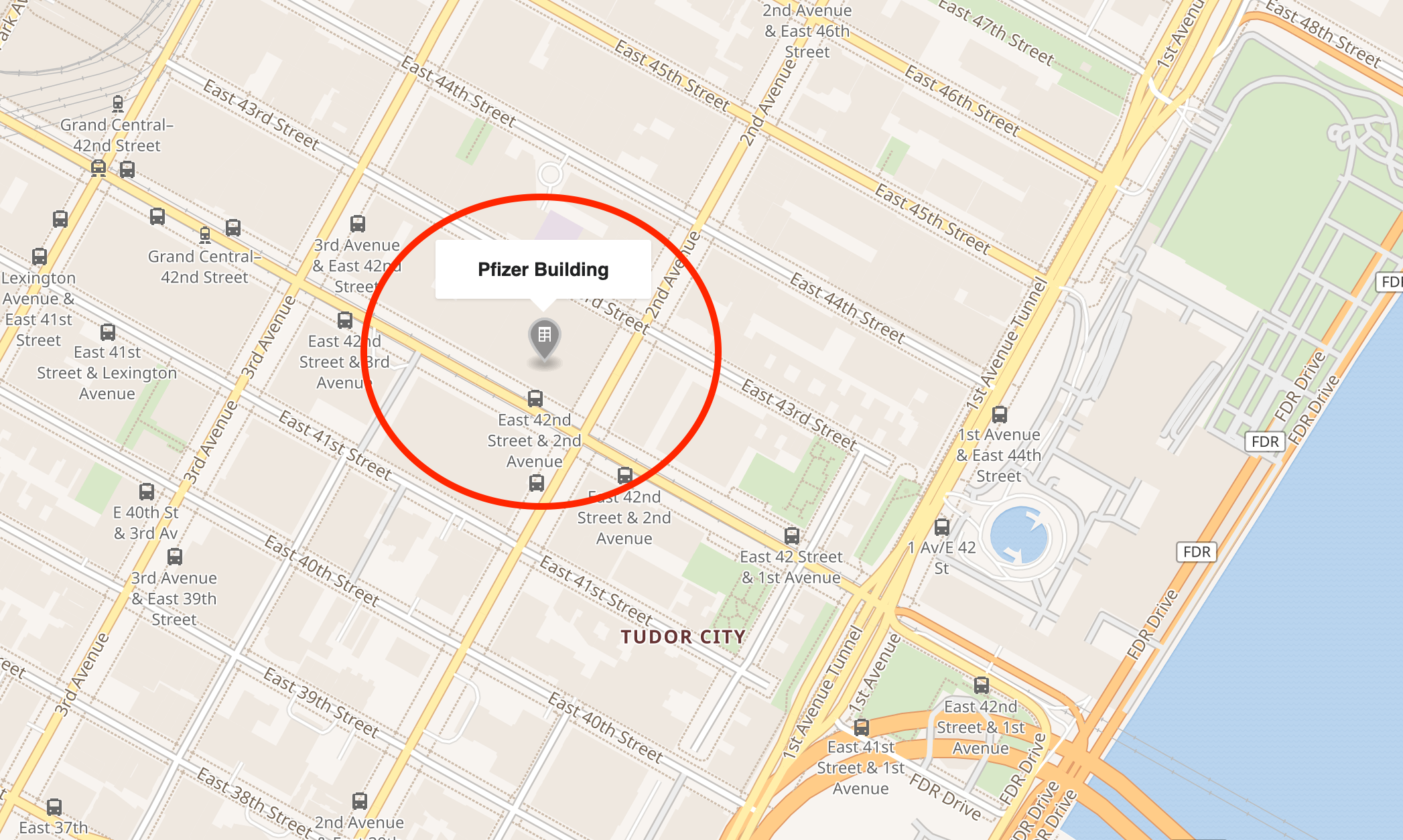
On July 7, 2026, two structural columns buckled on the 21st floor of 235 East 42nd Street, the former Pfizer headquarters that Metro Loft Management is converting into New York City’s largest office-to-residential project. Sagging floors and evacuations of nine nearby buildings followed, though no one was hurt. The developer calls it a “freak accident,” but city records show the site racked up seven safety violations in 2025 and drew repeated complaints about falling debris and unsafe conditions long before the columns gave way. This is the story of what actually failed, who was building it, and why the warning signs were there in writing.
What actually happened at 235 East 42nd Street
At about 8 a.m. on Tuesday, July 7, 2026, the FDNY responded to 235 East 42nd Street in Midtown Manhattan, near Grand Central Terminal, after reports of bricks falling from the high-rise. When crews arrived, they found something worse than loose masonry. Two structural support columns on the 21st floor had buckled, and several floors on the upper levels were visibly sagging. City officials ordered the evacuation of construction workers and nine surrounding buildings as a precaution. No injuries were reported.
The building is the former global headquarters of Pfizer. Metro Loft Management, led by Nathan Berman, is converting it in partnership with investor David Werner into roughly 1,600 rental apartments across 1.3 million square feet, combining 235 East 42nd Street with the neighboring 219 East 42nd Street. It is the largest office-to-residential conversion in New York City history. The plans added new floors to the complex as part of the redesign, and it was on one of the reworked upper floors that the columns failed.
By the following day, July 8, crews had installed temporary shoring and beams to stabilize the structure. Mayor Zohran Mamdani said no additional movement had been observed, and the frozen zone around the building began to shrink.
“As we await the arrival of materials that will stabilize the building, DOB engineers have been investigating with FDNY drones. DOB inspectors and engineers are managing an incredibly complex situation.”
Zohran Mamdani, Mayor of New York City (July 7, 2026 press conference)
The developer says it was a fluke
Metro Loft moved quickly to calm the alarm. Nathan Berman told The Real Deal that reports of an impending collapse had been “blown a little bit out of proportion,” that the building “was never at risk of collapse,” and that the damage was “fixable.” He described the affected area as a roughly 20-by-20-foot section at the building’s northwest corner and said the structure sits on a “huge base that is as stable as anything in the city.”
His explanation for the failure was blunt. Added construction weight, he said, met a column that could not carry it.
“It’s very simple. You add more load to something that can’t support it, it’ll give way, and that’s what happened, and now it just needs to be fixed.”
Nathan Berman, Metro Loft Management (July 2026)
Berman framed the event as bad luck rather than bad building, suggesting the team may have hit “a faulty column, which may have been cracked before, and it went undetected.” He insisted the work “was well designed, and approved by structural engineers,” and said his crews were experienced enough to replace the two columns, raise the sagging floors, and keep the project on track for its 2027 completion.
What the record shows
The “freak accident” framing runs into a documented paper trail. The New York City Department of Buildings issued seven violations at the site in 2025, carrying $32,530 in penalties, according to records reported by The Real Deal and The City Reporter. All but one of those violations were classified as immediately hazardous. Notably, records show no money was actually paid on the 2025 violations; the contractor instead filed certificates of correction that the DOB accepted.
The violations were not abstract paperwork. One described a worker who fell six feet from a ladder that was not on a flat, level surface, carrying a $10,000 penalty. Another related to a metal panel that fell from the 33rd floor onto the sidewalk. A third involved excavation in the cellar that did not conform to the approved construction documents. In December, the entity behind the conversion was cited for failing to notify the DOB of a construction incident that resulted in a fatality or injury, a $10,000 penalty on its own.
Complaints from workers and passersby paint an even sharper picture. In August 2025, work briefly stopped after someone “concerned for the workers” reported smoke at the site; Metro Loft denied a fire had occurred. An October complaint was more specific.
“Today a large item fell and broke through 5 floors and almost hit someone. There are gas machines without proper ventilation. These are hazardous conditions for the workers.”
From a Department of Buildings complaint filed in October 2025
That same complaint cited sparks hitting workers due to a lack of safety blankets, unlicensed welders, and chipping-gun work without protection from falling debris. Multiple complaints over the previous two years flagged falling debris. Several construction workers seriously injured at the site over roughly 18 months have filed lawsuits alleging that those in charge knowingly put them in danger by cutting corners.
Not enough steel, or a freak accident?
The most direct challenge to Berman’s account came from the trades. Cliff Johnsen of Steamfitters Local 638 told reporters that the builders had not used enough steel to support the added weight. A worker quoted by the New York Post described the crucial beams inside the building “bending like cigarettes.” Berman rejected the union’s claim outright.
“Total nonsense. This was well designed, and approved by structural engineers. This is a freak accident that something occurred with these two specific columns that either were not reinforced or were not reinforced sufficiently, and they gave way.”
Nathan Berman, Metro Loft Management (July 2026)
Read carefully, Berman’s own words leave the door open. Columns that “were not reinforced or were not reinforced sufficiently” for the load they were given is, in plain terms, a description of steel that did not match the weight above it. Whether that traces to the design, the approved plans, the execution on site, or a pre-existing crack is exactly what the DOB says it is now investigating. The city’s buildings commissioner, Ahmed Tigani, stressed that the project had already cleared extensive review.
“This is a building that was going through an office-to-residential conversion. It went through plan review and has gone through an extensive, exhaustive review with DOB over the past two years. What is happening now is an investigation of what is the cause of why the undermining happened.”
Ahmed Tigani, DOB Commissioner (July 7, 2026 press conference)
Who was actually building it
One detail deserves more attention than it has received. The general contractor named on the seven 2025 violations is 235 GC LLC, and the individual attached to that entity is Robert Travis, whose public LinkedIn profile lists him as a senior project manager at Metro Loft. In other words, the general contractor holding the safety citations is not an arm’s-length outside builder but an entity closely tied to the developer itself. The design architect on the project is Gensler, one of the largest architecture firms in the world.
That structure matters for accountability. When a developer also controls the construction entity, the checks that an independent general contractor might provide, pushing back on schedule pressure or flagging a shortcut, sit inside the same organization that benefits from finishing early. Berman noted the team was running two and a half months ahead of schedule before the columns buckled.
Does Metro Loft have a history of cutting corners?
Here the evidence needs to be handled honestly. Berman is widely regarded as a pioneer of office-to-residential conversion, having reshaped Financial District towers such as 63 Wall Street, 67 Wall Street, and 20 Exchange Place since the 1990s and 2000s. There is no comparable public record of structural failures at those completed buildings.
What the recent record does show is financial strain, not proven quality failure, at his other sites. Metro Loft defaulted on a senior loan at its 180 Water Street conversion in late 2024 and faced a pre-foreclosure action over a $265 million loan in April 2025. It lost its 20 Broad Street building to its lender in October after being unable to repay a $250 million loan. Financial pressure is not the same as bad construction, but it is the backdrop against which the 42nd Street corner-cutting allegations should be read: a portfolio under strain, a flagship project running ahead of schedule, and a safety record that regulators repeatedly flagged.
The fair conclusion is narrow and factual. The documented pattern of violations, complaints, and worker lawsuits alleging cut corners belongs to this specific project. It is real, it is on the public record, and it predates the buckling by nearly a year.
What comes next
The DOB investigation into why the columns failed is the event to watch. Its findings will determine whether this was, as Berman insists, an isolated pair of faulty columns, or a symptom of load and reinforcement decisions across the redesign. The worker lawsuits will test the corner-cutting allegations in court. And the outcome carries weight far beyond one address.
New York is betting heavily on office-to-residential conversion. The policy was a centerpiece of the City of Yes zoning overhaul and has been embraced by the Mamdani administration, whose SPEED task force aims to cut conversion permitting timelines by roughly five months. More than 17,432 conversion units were announced between 2020 and March 2025, according to a report by former Comptroller Brad Lander. The second and third largest conversions, at 111 Wall Street and 25 Water Street, logged 10 and 8 safety violations respectively since the start of 2025. Speeding up approvals for a construction type that involves cutting new floors into old steel frames raises an obvious question that 235 East 42nd Street just made concrete: what gets skipped when everyone is in a hurry.
Sources:
- Buckling ex-Pfizer HQ hit with multiple DOB violations last year, The Real Deal
- “Freak accident”: Pfizer building developer denies risk of collapse, The Real Deal
- Meet the developers behind the Pfizer building conversion, The Real Deal
- “Dangerous” structural problems eyed at Midtown skyscraper, NY1
- Midtown Tower Had Safety Issues Before Emergency Evacuation, Records Show, The City Reporter
- Buckling Manhattan high-rise deemed “stable” for now after evacuations ordered, NBC News
- Manhattan high-rise at risk of partial collapse (live), CNN
- Stabilization work continues on buckled columns at NYC high-rise (live), CNN
- Midtown Manhattan buildings evacuated after columns found buckling, ABC7 New York
- Buckled Midtown tower shored up by crews, shows no new movement, amNewYork
- Crucial beams inside buckling NYC building bending “like cigarettes,” worker says, New York Post
- Metro Loft hit with pre-foreclosure complaint at 180 Water Street, The Real Deal
- Nathan Berman’s Metro Loft faces default at 180 Water Street conversion, The Real Deal
- Robert Travis, Senior Project Manager at Metro Loft (LinkedIn)
- MetroLoft 219-235 East 42nd Street Conversion, Gensler