
In a single 48-hour window in early July 2026, four labs shipped new frontier-class AI models. The coverage framed it as a sprint for the smartest system. The published price sheets tell a different story: the flagship tier costs exactly what last year’s flagship cost, while the real movement is a collapse in the price of a given unit of work. This is not primarily a capability race. It is a price war over unit economics, and the labs are saying so in their own launch copy.
What actually happened
Between July 8 and July 9, 2026, four AI builders put new models on the market almost on top of each other. xAI released Grok 4.5 on July 8. The next morning, OpenAI made its GPT-5.6 family generally available in three tiers named Luna, Terra and Sol, Meta shipped Muse Spark 1.1, and Zhipu’s GLM-5.2 arrived in the same window. Four frontier-class launches inside two days is not a coincidence of the calendar. It is what a market looks like when every seller is afraid of being undercut.
The prices, per one million tokens of input and output, are public and checkable on each vendor’s pricing page. GPT-5.6 Luna lists at $1 input and $6 output. Terra is $2.50 and $15. Sol, the flagship, is $5 and $30. Grok 4.5 lists at $2 and $6. Meta’s Muse Spark 1.1 came in lower still, listed around $1.25 input and $4.25 output. For reference, Anthropic’s Claude Opus 4.8 sits at $5 and $25, and Claude Fable 5 at $10 and $50.
The narrative: a race to be smartest
Most coverage of the week led with benchmarks. OpenAI’s own announcement leaned hard on a long-horizon agent test, and the headline number was a capability claim, not a price.
“We trained GPT-5.6 to get more useful work from every token. On Agents’ Last Exam, an evaluation of long-running professional workflows across 55 fields, GPT-5.6 Sol sets a new high of 53.6, eclipsing Claude Fable 5 (adaptive reasoning) by 13.1 points.”
OpenAI, GPT-5.6 launch statement (July 9, 2026)
Read at face value, that is a story about intelligence. Sol is the smartest model OpenAI has shipped, it beats the strongest competitor on a hard agent benchmark, and the release notes are full of new capabilities: programmatic tool calling, native sub-agents, explicit prompt caching. The trade press ran with the frame the labs handed them. The race, as told, is about who can climb the benchmark ladder fastest.
What the pricing data actually shows
Look at the same announcement one sentence further and the frame changes. OpenAI did not stop at “smartest.” It went out of its way to attach a cost multiplier to the claim, and to say the quiet part in plain language.
“Even at medium reasoning, it beats Fable 5 by 11.4 points at roughly one-quarter the estimated cost. That efficiency extends to smaller models, which are essential to making intelligence more abundant and affordable: GPT-5.6 Terra and GPT-5.6 Luna outperform Fable 5 at around one-sixteenth the cost.”
OpenAI, GPT-5.6 launch statement (July 9, 2026)
That is not a capability pitch. It is a unit-cost pitch. The selling point is not that the model is smarter than anything before it, but that it delivers last generation’s frontier-level work at one-quarter to one-sixteenth of the price. “Abundant and affordable” is the language of a commodity producer competing on cost, not a monopolist competing on quality.
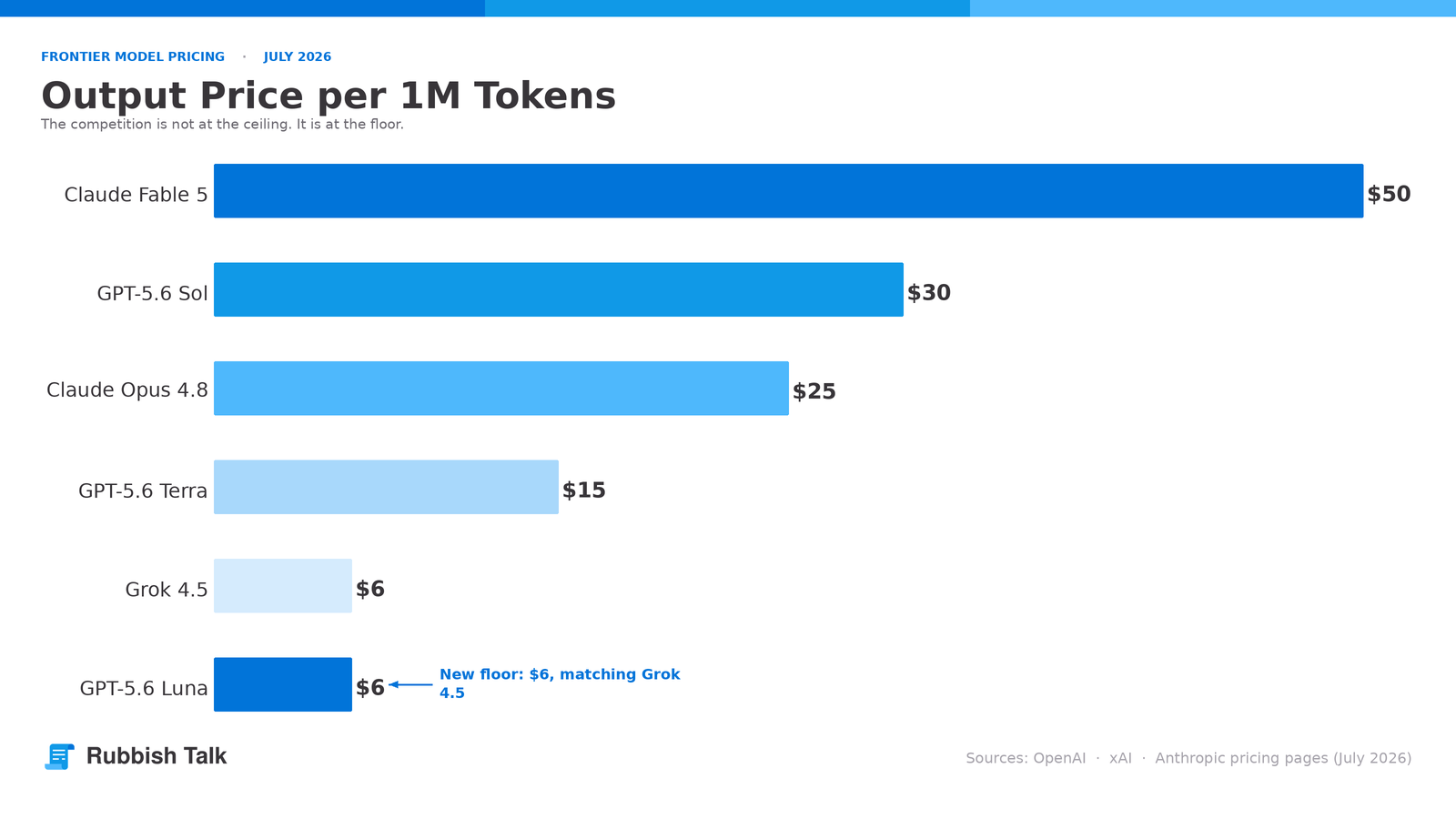
The clearest tell is at the top of the range. GPT-5.6 Sol, the new flagship, lists at $5 and $30 per million tokens. The previous flagship, GPT-5.5, listed at exactly $5 and $30. The headline price of the best model OpenAI sells did not move at all. Everything that moved, moved underneath it: the price of getting a fixed amount of useful work done fell hard, because the cheaper Luna and Terra tiers now do work that used to require a top-tier model. Grok 4.5 arriving at a $6 output price, matching GPT-5.6 Luna, is the same signal from a different seller. The competition is not at the ceiling. It is at the floor, and the floor is dropping.
The deflation curve is the real trend line
Token prices for a given capability level have fallen steeply and repeatedly. GPT-5 launched with output priced at $10 per million tokens. A generation later, GPT-5.6 Luna delivers comparable or better real-world results at $6, and does so while OpenAI publicly claims it beats an even stronger prior model at a fraction of the cost. The pattern across two years is consistent: raw benchmark scores creep up, but the cost of a fixed unit of output falls by multiples.
This is what commoditisation looks like in software. When four sellers can each deliver a good-enough version of the same product within 48 hours of one another, pricing power erodes and the basis of competition shifts from “who is best” to “who is cheapest per job.” The labs know this, which is why the launch copy now foregrounds cost efficiency rather than pure capability. A benchmark lead that lasts a week is not a moat. A structural cost advantage might be, and that is the ground everyone is now fighting on.
Who benefits and who is exposed
The clear winner is the buyer. Any business running large volumes of AI inference is watching the cost of its core input fall while quality holds or improves. A company that budgeted for GPT-5.5 at $30 output a year ago can now do the same work on a cheaper tier and redeploy the savings. For application builders, agent developers and anyone paying per token at scale, this is a straightforward deflationary tailwind.
The exposed party is the model builders themselves, and their investors. Falling prices per unit of work collide with the largest capital-spending cycle in the industry’s history. Data-centre build-outs, chip orders and energy contracts are being signed against revenue that is priced in a market racing toward the floor. If the price of the product keeps halving while the cost of building it keeps rising, the gap has to be closed somewhere, by volume, by lock-in, or by a consolidation that leaves fewer sellers standing. Premium-priced models sit in an awkward spot: Claude Fable 5 at $10 and $50 is roughly eight times the output price of GPT-5.6 Luna, which forces a harder question every quarter about what exactly the premium buys.
What is being overlooked
Two things get lost in the benchmark-versus-price framing, and honesty requires flagging both.
First, headline token prices are an incomplete measure. As developer Simon Willison noted the day GPT-5.6 shipped, “price-per-million tokens doesn’t tell us much now that the number of reasoning tokens can differ so much between models for the same task.” A model that is cheaper per token but burns many more reasoning tokens to finish a job can end up more expensive in practice. The real unit to watch is cost per completed task, not cost per token, and that number is harder to see on a pricing page. It is a caveat that cuts against a lazy “cheapest wins” read.
Second, the benchmarks doing the persuading are themselves contested. On the same day it was touting its scores, OpenAI published a critique of a rival coding benchmark, SWE-Bench Pro, on which Claude Fable 5 beat GPT-5.6 Sol by a wide margin.
“In light of these results, we estimate that ~30% of SWE-bench Pro tasks are broken, and advise that model developers carefully examine results.”
OpenAI, benchmark audit note (July 8, 2026)
That may be a fair technical finding. It is also a reminder that when a lab is losing on a metric, one available move is to attack the metric. Willison, who had early access to Sol, was measured about the capability claims: “it’s definitely very competent, though so far it hasn’t struck me as better than Fable at the kind of complex coding tasks I’ve been using with Anthropic’s model.” The benchmark war and the price war are running at the same time, and the marketing wants you focused on the first while the second is what actually changed.
What comes next
Watch three things. First, whether flagship prices finally break from the $5 and $30 line that has held across two OpenAI generations; the day the top tier drops is the day the price war reaches the ceiling. Second, whether the premium-priced labs hold their pricing or are forced to follow the floor down, which would confirm that capability alone no longer commands a premium. Third, the capex-to-revenue gap: an industry cutting the price of its product this fast while spending record sums to produce it is running a math problem that resolves eventually, in one direction or another.
The story of the week was sold as a contest of intelligence. The receipts, printed on every vendor’s own pricing page and written into their own launch copy, describe something more ordinary and more consequential: a commodity market forming in real time, competing on cost, and telling you so out loud.
Sources:
- GPT-5.6: Frontier intelligence that scales with your ambition | OpenAI (official launch, July 9, 2026)
- Separating signal from noise in coding evaluations | OpenAI
- Top Tech News Today, July 20, 2026 | Tech Startups
- The new GPT-5.6 family: Luna, Terra, Sol | Simon Willison
- GPT-5.6 Pricing (July 2026): Sol $5, Terra $2.50, Luna $1 per 1M | AI Pricing Guru
- Grok 4.5, GPT-5.6, Muse Spark: The Week of the Price Shift | cloudmagazin
- Model Router: Grok, GPT, Muse, GLM and the API Price War | OpenNash
- Grok API Pricing (July 2026) | BenchLM.ai
- AI Model Pricing in 2026: GPT-5.6, Grok 4.5, Muse Spark, and Claude Fable 5 Compared | MindStudio
- Claude Fable 5 Pricing: $10/$50 per M Tokens | AY Automate
- Muse Spark Pricing: $1.25/$4.25 API Costs (2026) | TechJack Solutions