
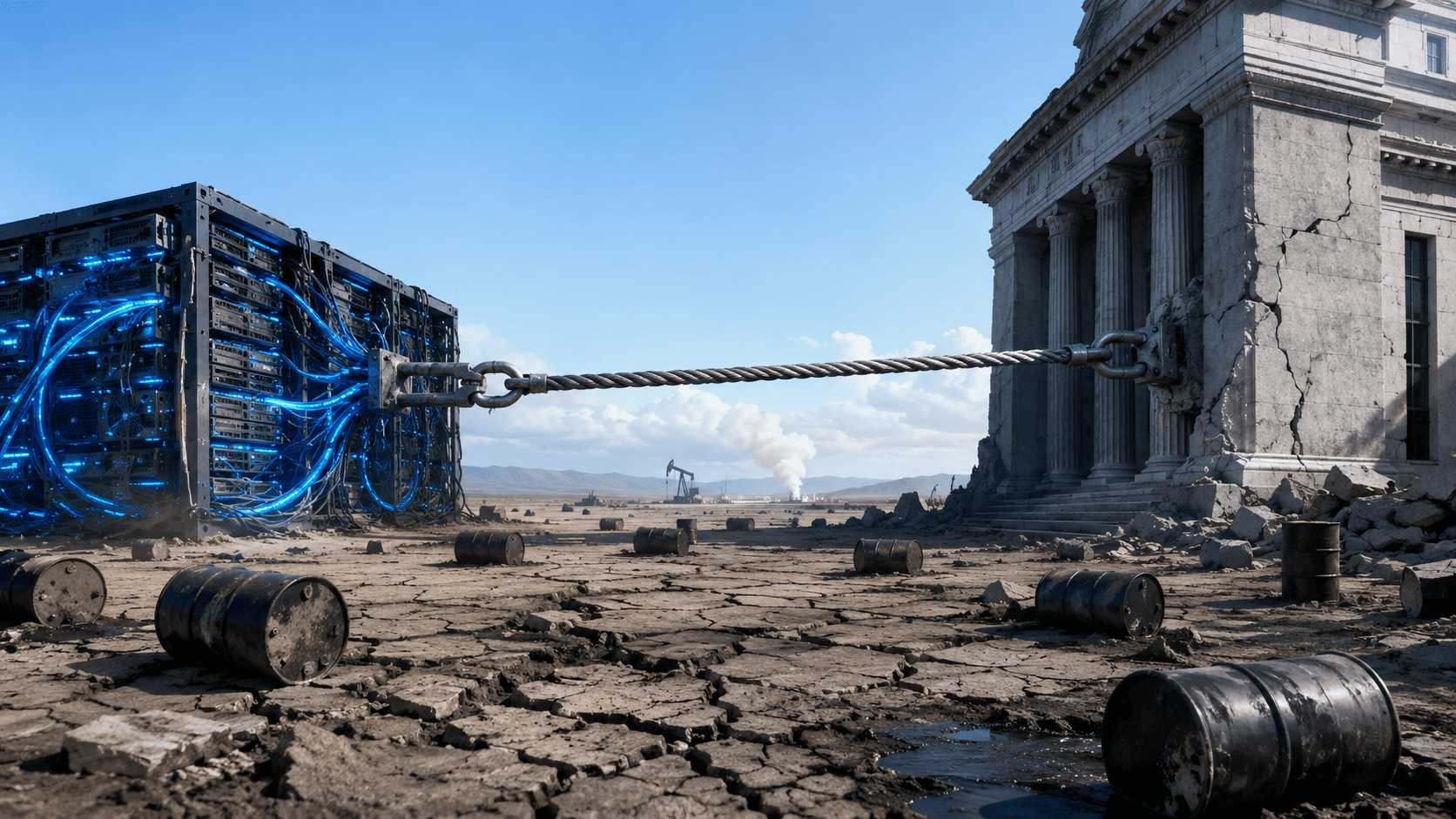
The past week delivered two stories that most outlets covered as if they were unrelated, and they are not. On Wednesday, Nvidia reported the largest quarterly revenue in its history and guided even higher, cementing the AI supercycle narrative. Two days later at Jackson Hole, new Federal Reserve Chairman Kevin Warsh told the world that inflation has stopped falling and that the next move in interest rates might be up, not down. Markets repriced a September rate hike from a long shot to a coin flip in a single afternoon. The mainstream take led with Nvidia and treated Warsh as background noise. That has it backwards. The more important development this week was the central bank quietly admitting the disinflation story has stalled, at the exact moment the market is betting everything on cheaper money and infinite AI demand.
Get your headlines checked for spin. This is exactly the kind of story most mainstream coverage waves through. The Rubbish Talk app runs the day’s news through our Rubbish-meter and scores each headline for spin, from 1 (the plain, unspun fact) to 10 (pure rubbish), so you can see what is being downplayed before it moves the market. Download it on the App Store: Rubbish Talk News.
What actually happened
Start with the numbers, stripped of spin. Nvidia’s fiscal second quarter, reported August 26, showed revenue of 96.2 billion dollars, up 106 percent from a year earlier. Data center revenue alone was 89.0 billion dollars, up 117 percent. Gross margin held at 75.0 percent, GAAP net income came in at 59.688 billion dollars, and the company guided the current quarter to 108.0 billion dollars, plus or minus 2 percent. These are not normal figures for a company this size. They are the financial signature of a genuine capital expenditure boom.
Then came Friday. At the Kansas City Fed’s Jackson Hole symposium, Chairman Warsh delivered a speech built entirely around one message: prices, not jobs, are now the Fed’s problem. He noted that the 12-month change in the PCE price index stands at 3.7 percent, while the six-month change is running at 4.1 percent. In plain terms, inflation is not just above target, it has been reaccelerating in the more recent data. The July core PCE reading released the same week confirmed the drift, with core prices up 3.3 percent year over year and coming in hotter than economists expected.
“Inflation is running above our 2 percent target. So the Fed’s predominant focus right now should be on prices.”
Kevin Warsh, Chairman, Federal Reserve (Jackson Hole, 2026)
The narrative the market wanted
For most of the summer, the consensus trade was simple and comforting. Inflation was supposedly beaten, the Fed was supposed to start cutting, and the AI buildout would carry equities regardless. Heading into Jackson Hole, plenty of Wall Street strategists still expected the symposium to tee up a September cut. The financial press framed the week around Nvidia’s blowout as proof that the AI trade justifies any valuation, and treated the inflation data as a rounding error on the way to easier policy.
There is a reason this narrative is popular. A cutting Fed plus an AI capex boom is the best possible backdrop for stocks, and almost everyone is positioned for it. The S&P 500 sat near record territory going into the week, closing Friday at 7,711.76 even after the Warsh scare, and still finished the week higher. The story sells because the audience is already long.
What the data actually shows
Here is where the comfortable version breaks down. Warsh did not sound like a man about to cut. He pointed out that of the goods and services in the PCE basket, 49 percent showed annualized price increases above 3 percent over the past six months. That is not a narrow, fixable inflation problem driven by one or two categories. That is broad. And he was explicit that the burden of proof now runs the other way.
“We must be confident that underlying inflation is moving to our objective, clearly and at sufficient speed. Otherwise, we have work to do.”
Kevin Warsh, Chairman, Federal Reserve (Jackson Hole, 2026)
The market understood him instantly. Fed funds pricing for a 25 basis point hike in September jumped to 57 percent, up sharply from about 35 percent the day before. The 10-year Treasury yield rose to 4.72 percent and the rate-sensitive 2-year climbed roughly 8 basis points. The Nasdaq fell 0.52 percent on the day. This was not a soft landing being confirmed. It was a repricing of the single assumption underneath the entire bull case: that money is about to get cheaper. Warsh’s own framing was that he is committed “to a discipline, not to a decision,” which markets correctly read as a warning that cuts are off the table and hikes are back on it.
The connection nobody is drawing
The lazy read is that Nvidia and the Fed are two separate stories, one bullish and one bearish, that happened to land in the same week. They are the same story. The AI buildout that produced Nvidia’s 89 billion dollars of data center sales is one of the most inflationary forces in the real economy right now. Those chips go into facilities that consume enormous amounts of electricity, strain power grids, and compete for construction labor, transformers, copper, and cooling. When Jensen Huang says compute is now revenue, he is also describing a bidding war for physical inputs that shows up, eventually, in prices.
“AI has reached its inflection point. It’s doing useful work. Its tokens are productive and profitable. Now, compute is revenue.”
Jensen Huang, CEO, NVIDIA (Q2 FY2027 results, 2026)
Layer on the geopolitical backdrop and the picture sharpens. Brent crude sits near 88 dollars a barrel, still up roughly 31 percent from a year ago in the aftermath of this summer’s conflict in the Gulf, with flows through the Strait of Hormuz only partially recovered to around 15 to 16 million barrels a day versus 22 to 24 million before the war. On the trade side, Washington is still threatening steep tariffs, including a 50 percent levy on Canadian goods and duties on more than a dozen trading partners. Cheaper energy, open shipping lanes, and free trade are what usually kill inflation. This week the economy had less of all three, and a capex boom pouring fuel on demand. That is why Warsh is nervous, and it is the part of the story the AI cheerleading skipped.
Who benefits, who is exposed
Follow the incentives. Nvidia and the hyperscalers buying its chips benefit from the AI narrative regardless of what the Fed does, at least until the capex cycle turns. The exposed party is everyone positioned for rate cuts: long-duration growth stocks priced for falling discount rates, highly leveraged borrowers rolling debt, commercial real estate, and any investor who assumed the only direction for policy was down. Banks and money market funds do fine with higher-for-longer. Ordinary households do not, because the same PCE basket Warsh described is their grocery bill, rent, and insurance premium.
There is also a political dimension worth naming plainly. A Fed that hikes into an election-cycle economy, against a market that desperately wants cuts, invites enormous pressure. Warsh’s insistence on discipline over decisions is partly a signal that he intends to resist that pressure. Whether he actually does is the question that will define the next two quarters.
What to watch next
Three things. First, the September Fed meeting: a hike would be a genuine shock to a market only 57 percent priced for it, and even a hawkish hold would keep yields elevated. Second, the next inflation prints. If the six-month PCE trend at 4.1 percent does not roll over, Warsh has told you what happens. Third, AI capex discipline. Nvidia guiding to 108 billion dollars means its customers are still spending; the moment one major hyperscaler signals a pause, the inflationary demand and the equity narrative wobble together.
The tidy version of this week was AI wins, inflation is yesterday’s problem, cuts are coming. The honest version is that the most powerful company in the market just confirmed a spending boom that makes the Fed’s job harder, and the Fed responded by taking rate cuts off the table. Those two facts are not in tension by accident. They are the same trade, and this was the week the market was forced to notice.
Sources:
- Keynote remarks by Chairman Warsh at the 2026 Jackson Hole Economic Policy Symposium, Federal Reserve Board
- NVIDIA Announces Financial Results for Second Quarter Fiscal 2027, NVIDIA Newsroom
- NVIDIA Q2 Fiscal 2027 press release, Investor Relations
- Fed’s preferred inflation gauge shows core prices rose 3.3% annually in July, CNBC
- Stock market today: indexes end week lower as rate-hike bets jump after Warsh speech, Yahoo Finance
- Analysis: Kevin Warsh sharpens inflation warning at Jackson Hole, signaling possible rate hike, CNBC
- Nvidia earnings takeaways: Huang forecasts strong fiscal 2028 revenue growth, CNBC
- Brent crude oil price and Strait of Hormuz context, Trading Economics
- A Geopolitical August, The Conference Board