
The idea of charging ships to pass a narrow strait is not new, and it is not radical. It is one of the oldest revenue models in history. For more than four centuries Denmark got rich doing exactly that, and the guns of Kronborg Castle stood ready to sink anyone who refused to pay. The modern order tried to bury the toll under the principle of free navigation. It never fully worked. Today the toll has simply changed hands: instead of a king collecting duties at Elsinore, it is insurers, canal authorities, and the physics of a 3,500 mile detour around Africa that decide the price of passage. When people ask whether Iran could “charge a toll” on the Strait of Hormuz, they are asking a question the world answered, and unanswered, several times already.
Where the world narrows
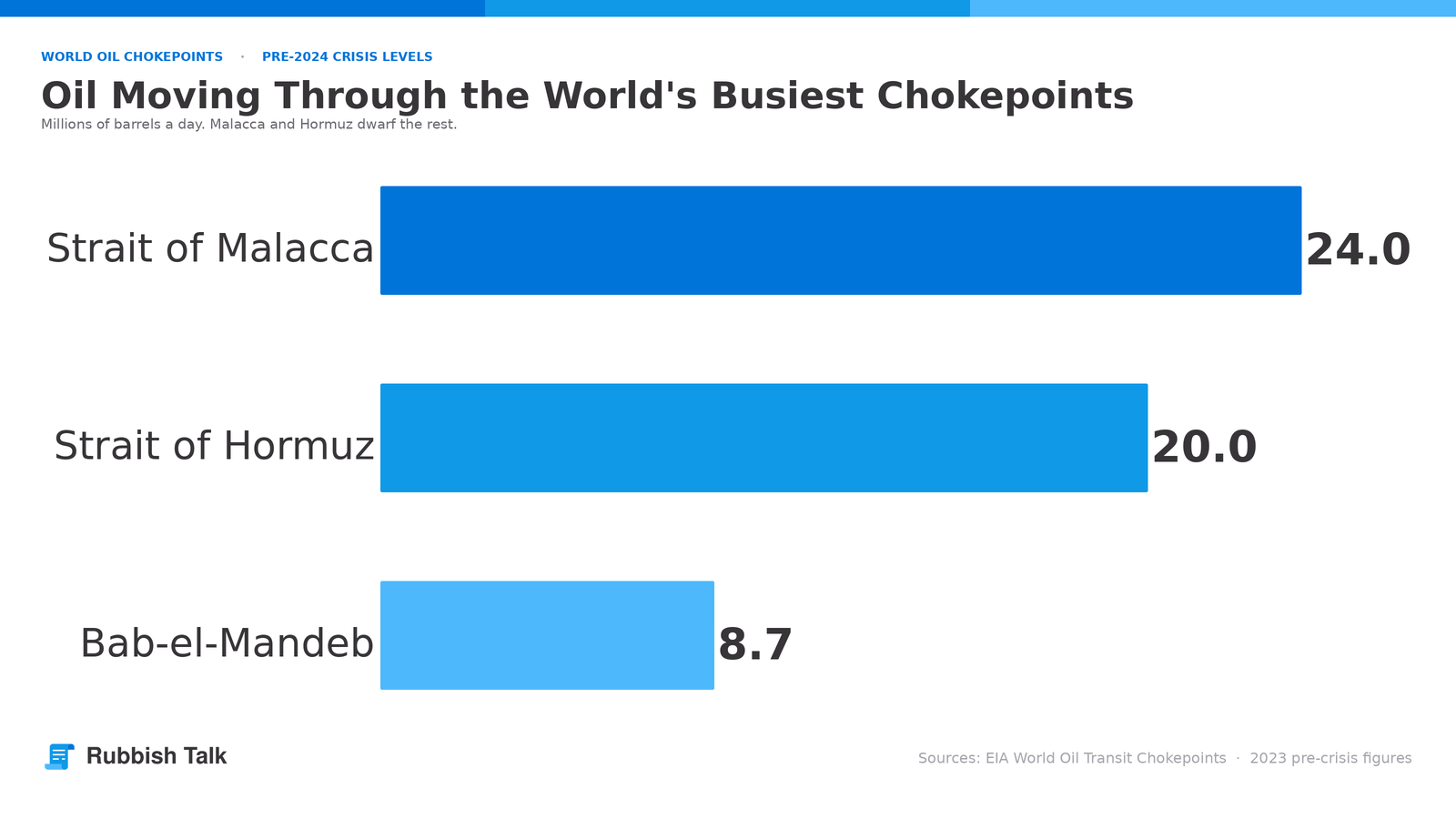
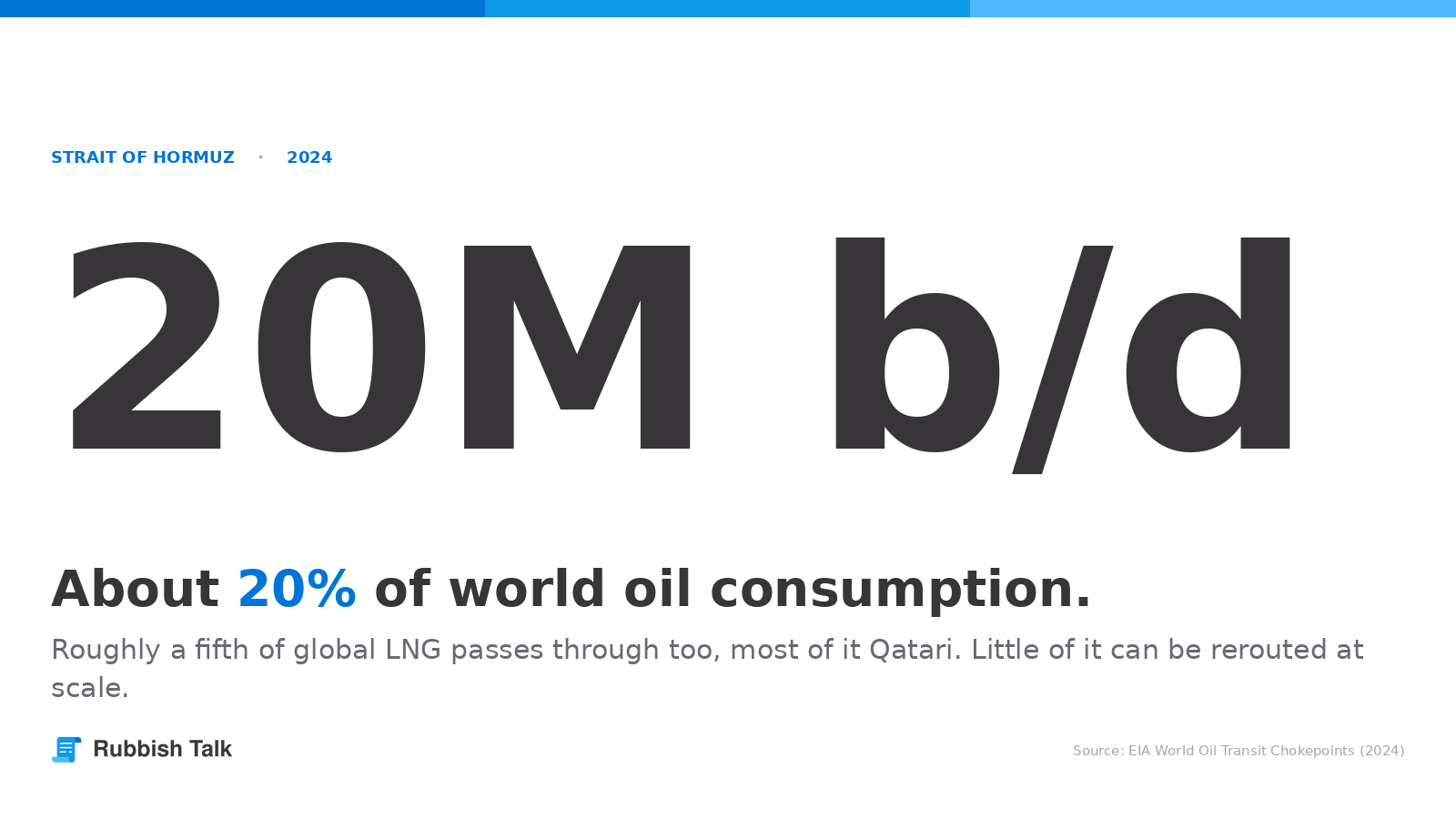
A chokepoint is any passage narrow enough that closing it, or taxing it, reshapes global trade. A handful matter more than all the rest combined. The Strait of Hormuz carried roughly 20 million barrels of oil per day in 2024, about 20 percent of global petroleum liquids consumption, and close to a fifth of the world’s liquefied natural gas, most of it Qatari. The Strait of Malacca, the funnel between the Indian Ocean and the South China Sea, saw a record 102,525 transits in 2025, the first time it has ever cleared 100,000, and carries an estimated 22 percent of global maritime trade. The Suez Canal, Bab-el-Mandeb at the mouth of the Red Sea, the Bosphorus and Dardanelles, and the Panama Canal round out the list. Each is a place where geography does the work that no navy could: it forces the world’s cargo into a line.
“The Strait of Hormuz is the world’s most important oil chokepoint because of the large volumes of oil that flow through the strait.”
U.S. Energy Information Administration, World Oil Transit Chokepoints analysis
The reason chokepoints command attention is that alternatives are expensive or nonexistent. There are pipelines that bypass Hormuz, but they cannot carry the full Gulf volume. There is a long way around Malacca through the Lombok or Sunda straits, but it adds days. And there is the Cape of Good Hope, the fallback for the Red Sea, which adds roughly 3,500 nautical miles and ten to fourteen days to a Europe to Asia voyage. The detour is always available. That is precisely why the toll, in one form or another, is always collectable: the passage is worth paying to keep.
The original toll: Denmark’s four centuries at the gate
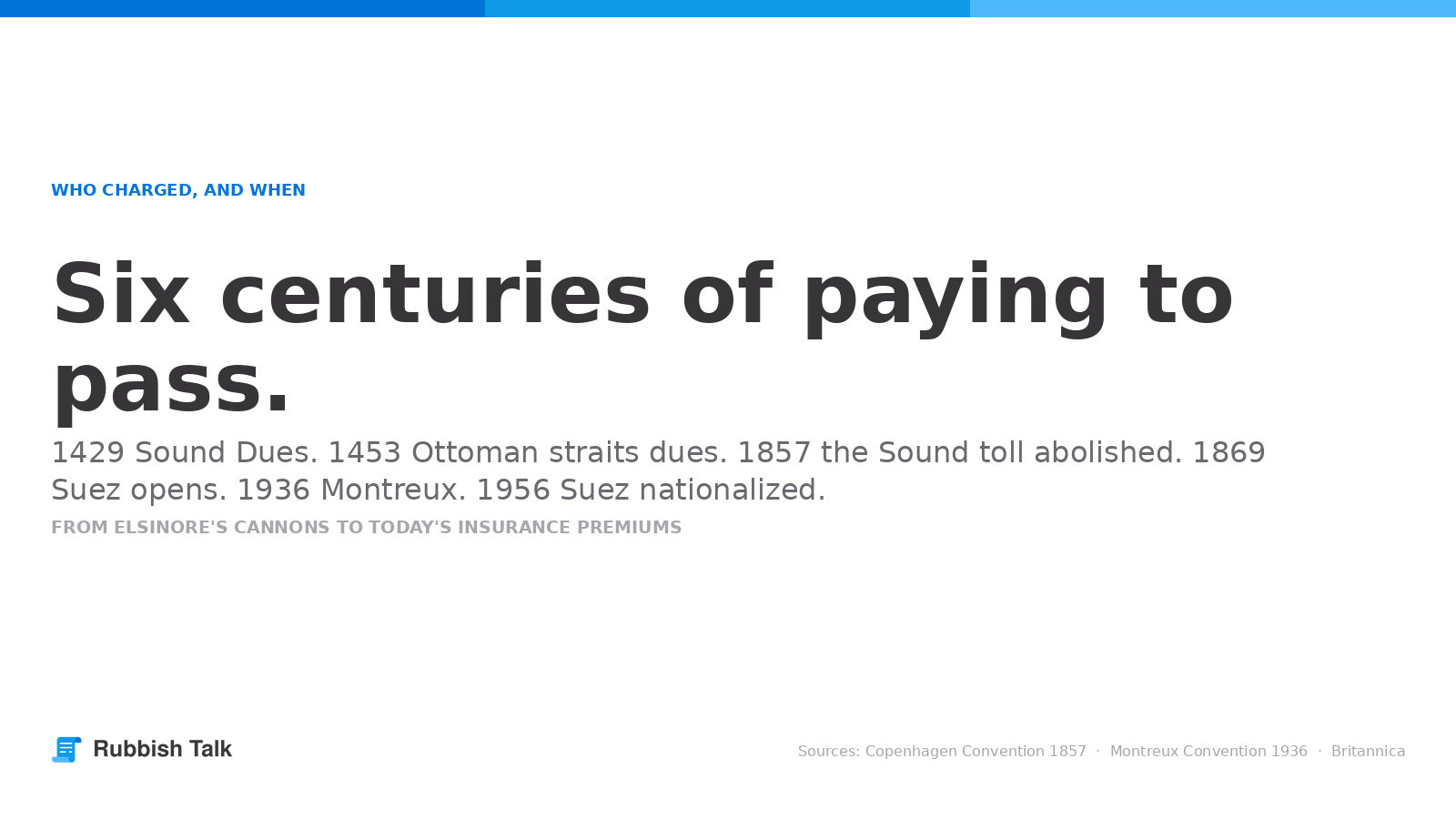
The purest example of a chokepoint toll is also one of the oldest. In 1429 King Eric of Pomerania imposed a levy on every foreign ship passing through the Oresund, the narrow strait between what is now Denmark and Sweden. The Sound Dues, as they became known, required every vessel to stop at Elsinore and pay the Danish Crown. Refusal was not an option in any practical sense: cannons at Helsingor and Helsingborg could open fire and sink a ship that tried to run the gate.
This was not a minor tariff. At its height in the sixteenth and seventeenth centuries the Sound toll supplied up to two thirds of the Danish state’s income. In 1567 the Crown switched from a flat charge per ship to a duty of one to two percent of cargo value, which tripled the take. A single strait, taxed at the point of maximum leverage, effectively funded a kingdom. The Dues survived until 1857, when, under commercial and diplomatic pressure and in the aftermath of the Crimean War, Denmark agreed at the Copenhagen Convention to abolish them in exchange for a one time compensation of 33.5 million rix-dollars from the maritime powers. In that single treaty the Danish straits became international waterways, free to all shipping. It was the moment the modern principle of free passage began to win.
The other gatekeeper: the Ottomans and the Turkish Straits
While Denmark taxed the north, the Ottomans taxed the crossroads. When Constantinople fell in 1453 and both shores of the Bosphorus came under Ottoman control, foreign ships needed a voyage permit, had to lower their sails, submit their cargo to inspection, and pay a duty. For centuries access to the Black Sea was a gift the Sultan granted or withheld, and the “Straits Question” became one of the great recurring crises of European diplomacy, pulling in Russia, Britain, and France repeatedly across the nineteenth century. The London Straits Convention of 1841 was the first real crack in that absolute control, opening the straits to merchant ships of all nations while keeping foreign warships out in peacetime.
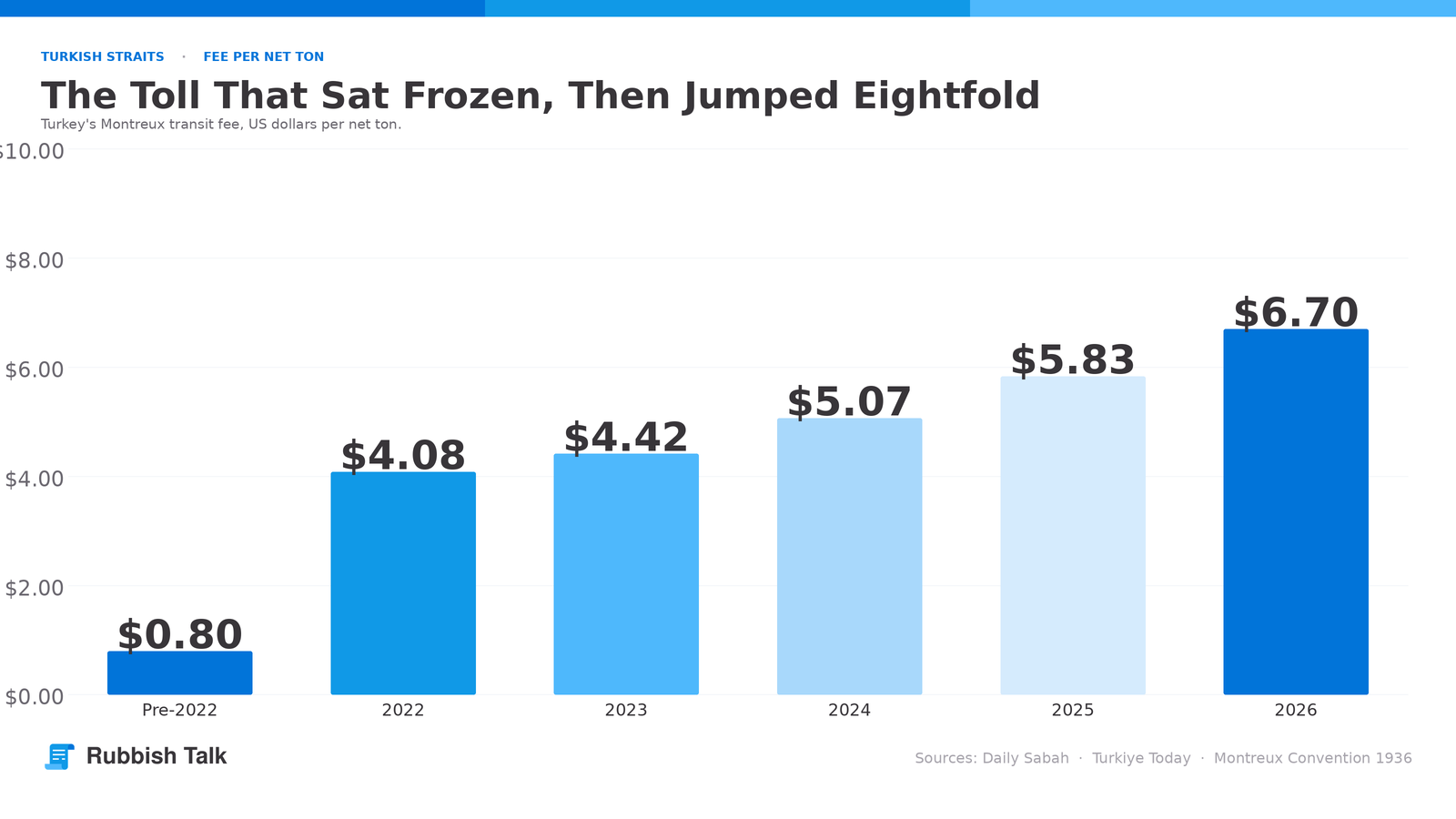
The Turkish Straits are the one place where the old model never fully died, and they are worth studying because they show what a legal, modern toll looks like. The 1936 Montreux Convention, still in force today, gives Turkey the right to charge passing ships for lighthouse, rescue, and sanitary services. For thirty nine years the fee sat frozen at about 80 cents per net ton. Then, starting in 2022, Turkey began raising it aggressively: to 4.08 dollars per net ton, then 4.42, then 5.07, then 5.83, and to 6.70 as of July 2026. In 2024 alone, 51,058 vessels paid these fees, generating around 227 million dollars. It is a cost recovery charge dressed in treaty language, but functionally it is a toll, and it is legal precisely because a specific treaty says so.
Canals are different, and that difference is the whole point
There is a crucial legal line running through this story. Natural straits like Hormuz and Malacca fall under the law of the sea, which guarantees ships the right of transit passage. The coastal state cannot lawfully charge a toll or block innocent traffic. Artificial canals are the opposite: they are built, owned, and operated, so charging for them is uncontroversial. That distinction is why the two great canals have always had tolls, and why they have always attracted armies.
The Suez Canal opened in 1869, built by Ferdinand de Lesseps and operated by a French and British controlled company, with Britain buying the largest single shareholding in 1875. Tolls were the entire business model. In 1956 Egypt’s Gamal Abdel Nasser nationalized the canal and announced that its toll revenue would fund the Aswan Dam, triggering the Suez Crisis when Britain, France, and Israel invaded to seize it back. They were forced to withdraw under American and Soviet pressure, and the episode marked the end of European imperial control of the waterway. The Panama Canal follows the same logic: built by the United States, handed to Panama in 1999, and run today as a toll operation. When drought cut Lake Gatun to critical lows in 2023 and 2024, the canal authority slashed daily transits from 36 to 24 and auctioned scarce slots, pushing the cost of a single passage above one million dollars for some vessels and raising reservation fees sharply for 2025.
“The fees being charged by Panama are ridiculous, especially knowing the extraordinary generosity that has been bestowed to Panama by the U.S. This complete ‘rip-off’ of our Country will immediately stop.”
Donald Trump, Truth Social, December 21, 2024
That statement is the Sound Dues argument in reverse. For six hundred years the complaint was that the gatekeeper charged too much. Now a shipping nation is threatening the gatekeeper over price. The politics of the toll have not changed at all. Only the accents have.
The wars were always about the gate
Every major chokepoint has a war attached to it, because controlling the narrows has always been worth fighting for. The Suez Crisis of 1956 was fought over who collected the tolls. The Gallipoli campaign of the First World War was an attempt to force the Dardanelles. And the closest modern parallel to today’s tensions is the Tanker War of 1984 to 1988, when Iran and Iraq attacked each other’s shipping in the Gulf. Iran laid naval mines and harassed Kuwaiti and Saudi tankers with fast boats. Kuwait asked for protection, and in 1987 the United States launched Operation Earnest Will, reflagging Kuwaiti tankers under the American flag and escorting them through Hormuz. One of them, the Bridgeton, struck an Iranian mine that July.
The most important lesson from the Tanker War is what Iran did not do. It threatened repeatedly to close the Strait of Hormuz, and it never did, for the simple reason that its own economy depended on exporting oil through the same water. That constraint still holds. A country that closes the strait strangles itself first, and China, Iran’s largest oil customer, would be among the hardest hit. This is why, despite decades of threats, Hormuz has never actually been shut. The gate is too valuable to the gatekeeper to slam.
Today’s toll has no toll booth
Here is the part most coverage misses. The formal toll on natural straits was abolished, but the cost of passage never went to zero. It simply stopped flowing to a sovereign and started flowing to insurers, shipowners, and the detour itself. When the Houthis began attacking ships in the Red Sea in late 2023, they did not levy a fee. They did something more effective: they made passage dangerous enough that the market imposed the toll on its own.
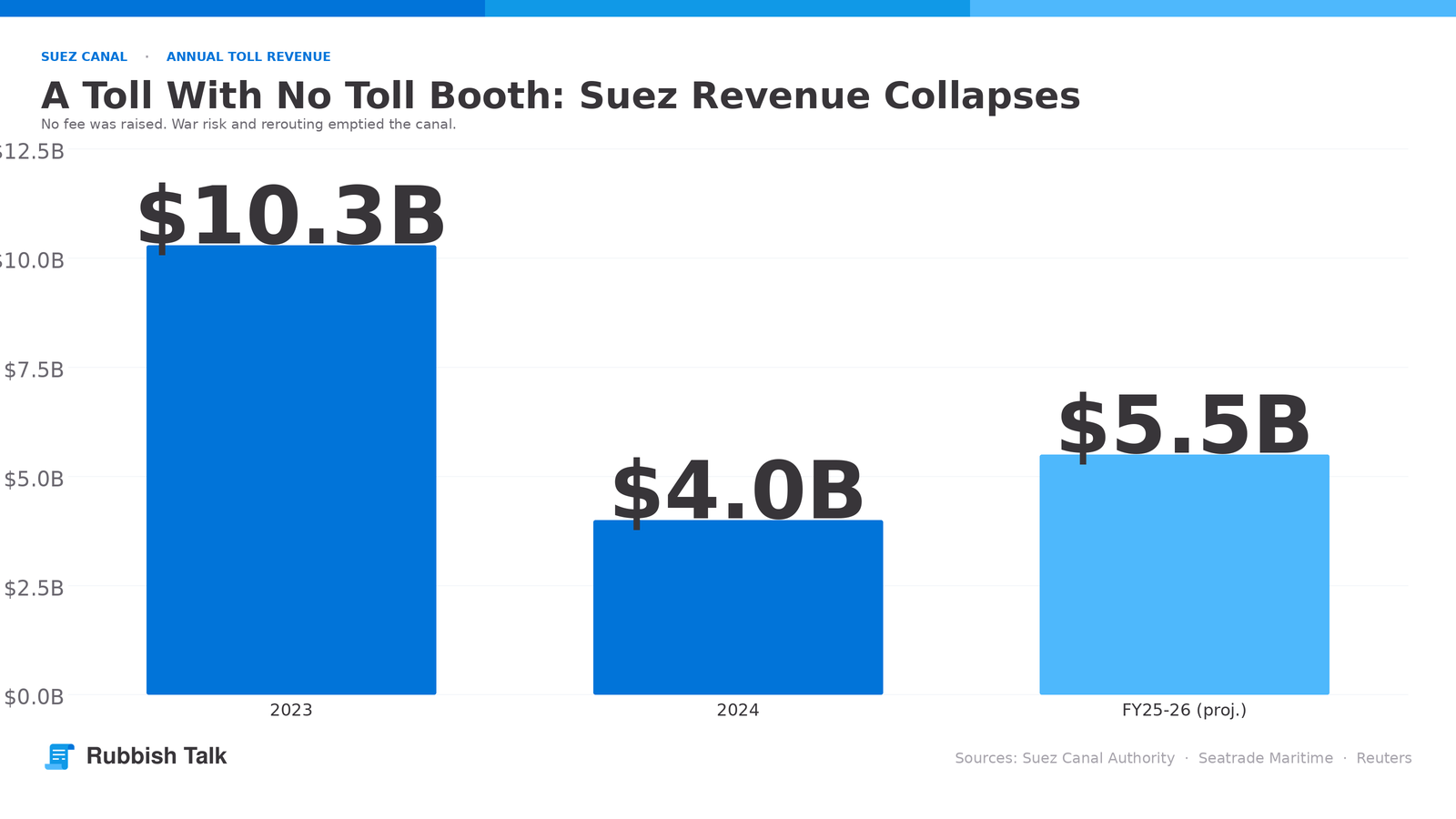
The numbers are stark. Oil flows through Bab-el-Mandeb fell from about 8.7 million barrels per day in 2023 to roughly 4.0 million in the first eight months of 2024, a drop of more than half, while traffic rerouting around the Cape of Good Hope surged. Suez Canal revenue collapsed from a record 10.3 billion dollars in 2023 to about 4 billion in 2024, a fall of roughly 60 percent, as ship transits dropped from over 26,000 to 13,213. Egypt lost around 7 billion dollars in a single year, not because anyone raised its tolls, but because a militia with drones and missiles made the alternative route cheaper than the risk. That is a toll. It is paid in war risk insurance premiums, longer voyages, and higher freight rates, and it is collected by everyone except the country whose canal sits empty.
What to watch
The evergreen truth of chokepoints is that leverage sits with whoever can raise the cost of passage, whether by treaty, by cannon, or by drone. Watch three things. First, the legal line between canals and natural straits will keep getting tested: expect more pressure on Panama’s tolls and more loose talk about “charging” for Hormuz or Malacca that ignores the law of the sea. Second, the real toll to track is not published rates but war risk insurance and rerouting volumes, the invisible tariff that spikes the moment a strait feels unsafe. Third, watch who is insulated. Nations building pipelines, stockpiling reserves, and diversifying routes are quietly buying their way out from under the gate. The chokepoint has been a tollbooth for six hundred years. The only thing that ever changes is who holds the key, and how they choose to charge for it.
Sources:
- EIA: World Oil Transit Chokepoints analysis
- EIA: Strait of Hormuz is chokepoint for 20% of world’s oil
- IEA: Strait of Hormuz oil security overview
- Britannica: How Much Oil Passes Through the Strait of Hormuz
- Seatrade Maritime: Malacca Strait vessel traffic at record levels in 2025
- NBR: Geoeconomic Crossroads, the Strait of Malacca
- havneguide.dk: The history of the Sound Tolls
- Wikipedia: Copenhagen Convention of 1857
- Britannica: Straits Question
- Wikipedia: London Straits Convention
- Daily Sabah: Turkiye hikes strait transit fees
- Turkiye Today: Passage fees for Bosphorus and Dardanelles to rise July 1
- Britannica: Suez Crisis
- History.com: Egypt nationalizes the Suez Canal
- Seatrade Maritime: Suez Canal revenue drops by almost half due to Red Sea crisis
- gCaptain: Oil flows through Bab-el-Mandeb plummet by over half in 2024
- CNN: Trump wants to reclaim the Panama Canal facing crisis
- Al Jazeera: Trump threatens to take back control of Panama Canal over fees
- Argus Media: Trump Panama tiff highlights rising transit cost
- Britannica: Tanker War (1984 to 88)
- Strauss Center: Strait of Hormuz, Tanker War
- Center for Maritime Strategy: US Naval Mine Warfare in the Persian Gulf
- Hero image: AyyanD, CC BY-SA 3.0, via Wikimedia Commons
.jpg)