
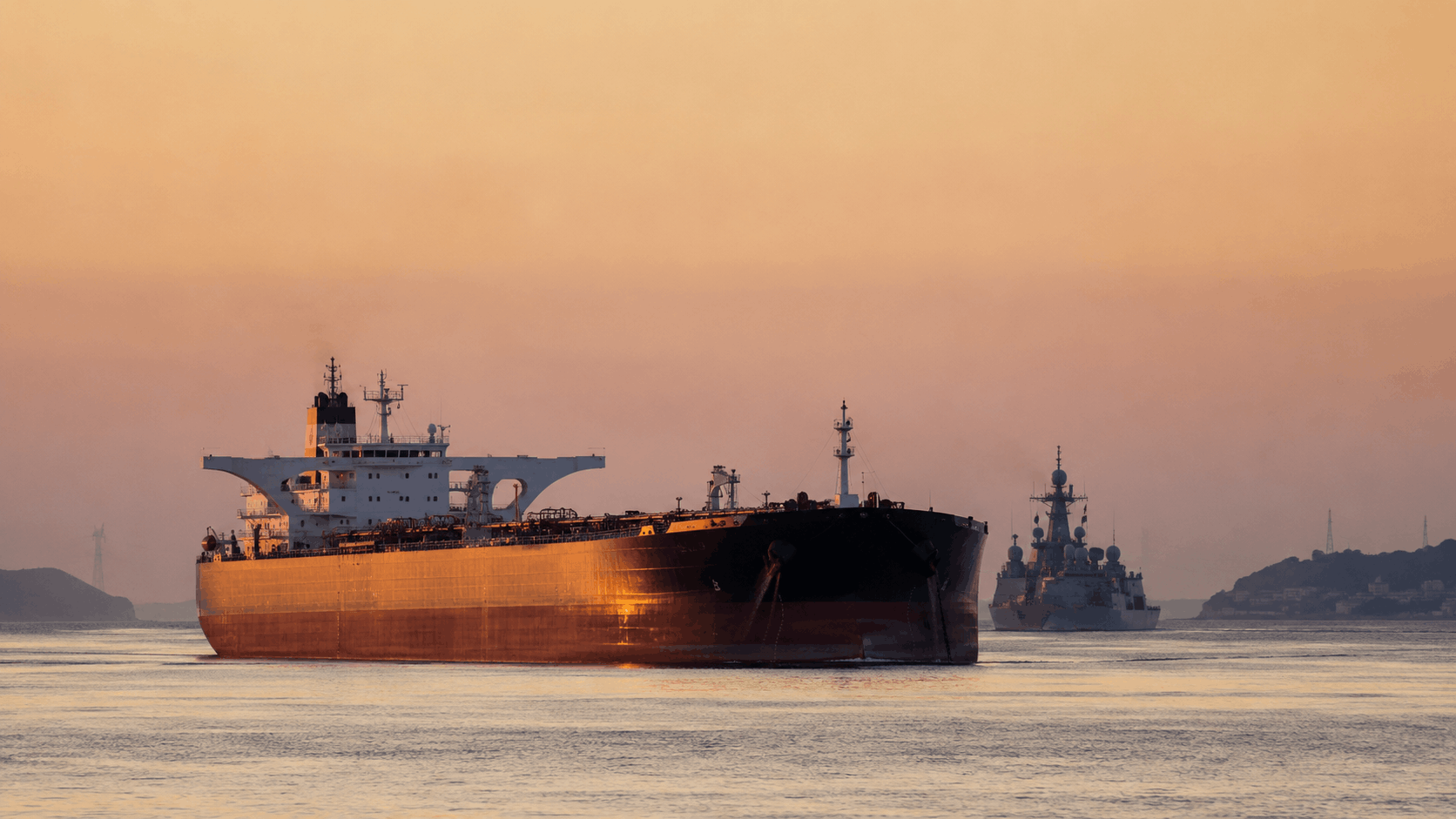
Iran-backed Houthis declared a naval blockade of Saudi Arabia and struck two Saudi oil tankers in the Red Sea, sending Brent crude above $100 a barrel for the first time since late May and dragging global stocks and bonds down with it. President Trump warned of “major military punishment” against Iran, framing the Houthis as a proxy. Mainstream coverage is reporting this as “geopolitical tensions weighing on sentiment,” but the real story is narrower and sharper: a single non-state actor is holding two of the world’s most important shipping chokepoints hostage, and markets that spent a year pricing a permanent ceasefire are being repriced in hours.
What is actually happening
On Monday, Houthi military spokesman Yahya Saree announced in a video statement that the group would immediately impose a maritime blockade of Saudi Arabia. Within days the threat became action: the Houthis said they struck two Saudi oil tankers, the Layla and the Encelia, in the Red Sea with drones and missiles, with a fire reported on one of the vessels. At least seven ships changed course to avoid transiting the Bab el-Mandeb Strait, the narrow gateway between the Red Sea and the Gulf of Aden.
This is not happening in isolation. The Red Sea attacks landed on top of an already live crisis in the Strait of Hormuz, where Iran has spent months threatening and harassing commercial vessels. After three ships were attacked on 6 and 7 July, Trump declared the June truce over, and the exchange of fire escalated from there. On the same day the Saudi tankers were hit, Kazakhstan halted crude exports through the Caspian Pipeline Consortium terminal following drone attacks, pulling yet another supply artery offline.
The market response was immediate and broad. Brent crude spiked above $100 a barrel, its first move through that level since late May, with US benchmark WTI topping $90. Oil has now climbed more than 30% in July alone. The S&P 500 fell roughly 1.2%, a gauge of megacap technology stocks was set for its worst day since the April 2025 tariff selloff, and Treasury yields pushed to their highest levels of the year as traders repriced inflation risk.
What the mainstream narrative says
Most outlets are running a familiar frame: heightened Middle East tensions are denting investor sentiment, oil is up on supply fears, and markets are cautious ahead of earnings. The story is technically accurate and almost entirely bloodless. Headlines lead with “sentiment,” “caution,” and “jitters,” language that treats a shooting war over the world’s most important oil routes as a mood swing.
There is a second thread in the coverage that muddies the picture further: the idea that today’s selloff is really about artificial intelligence. Investors, the argument goes, are nervous about whether the enormous AI capital spending of the past two years will ever pay off, and that anxiety is what is dragging megacaps lower. Both things can be true at once, but the sequencing matters, and much of the coverage blurs them into a single vague risk-off narrative.
“The US will hold Iran responsible, in that the Houthis are a surrogate and/or proxy of Iran, and major military punishment will be inflicted upon Iran and, of course, the Houthis themselves.”
– Donald Trump, President of the United States, on the Red Sea tanker attacks (July 2026)
What the data shows
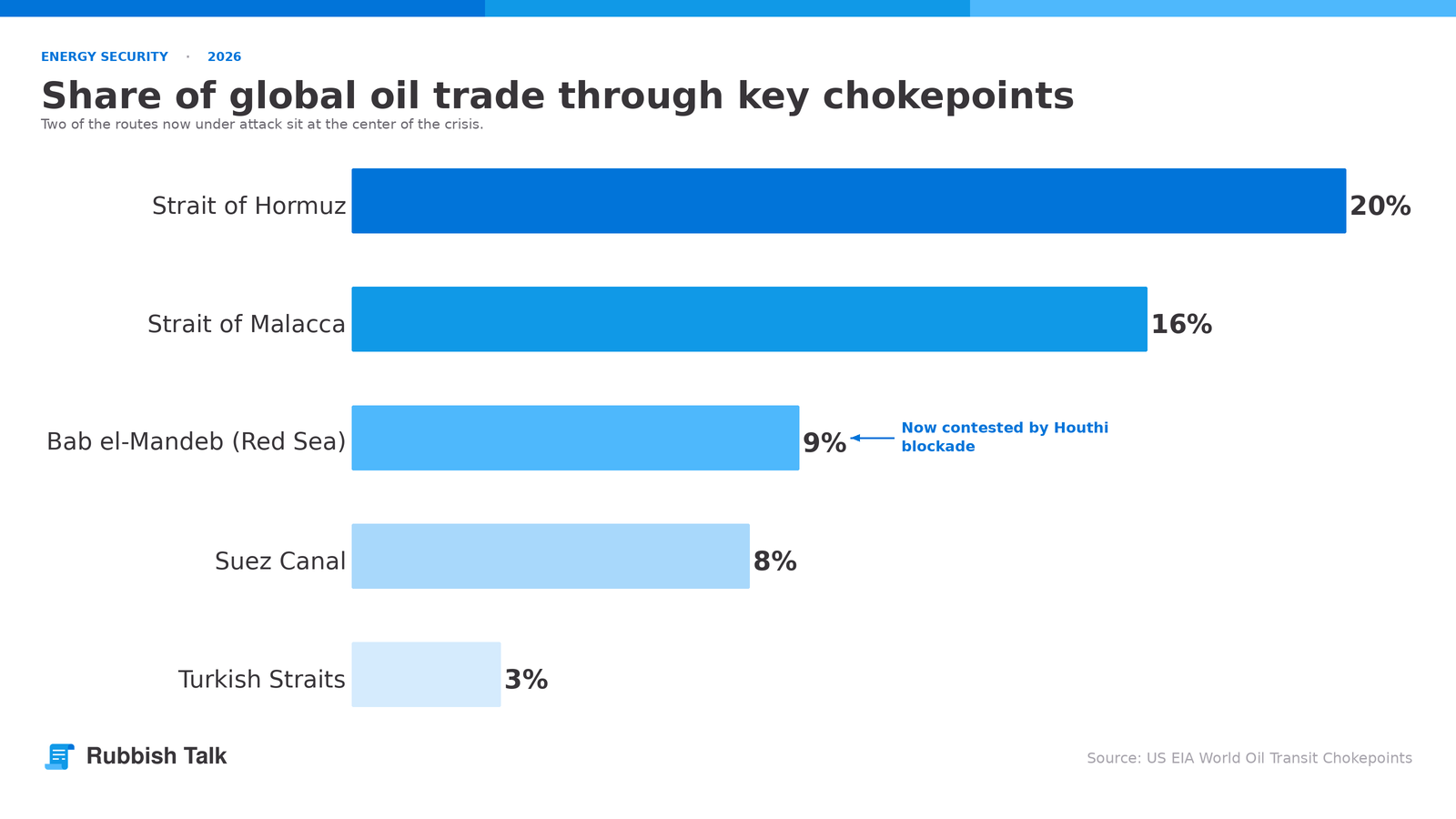
Strip out the mood language and the mechanism is concrete. The Strait of Hormuz normally carries around a fifth of the world’s traded oil, roughly 20 million barrels a day, through a channel whose shipping lanes are only a couple of miles wide. Bab el-Mandeb, now also contested, is the other end of the same supply spine feeding Europe and Asia. When ships reroute or stop, the cost is not sentiment, it is freight, insurance, and physical barrels that do not arrive. The 30% move in oil this month is the market pricing that reality, not a vibe.
The AI explanation deserves the same scrutiny. It is real, but it is a slower-burn structural worry, not the thing that moved the tape today. Global IPO volume hit $194 billion in the first half of 2026, roughly triple the same period a year earlier, led by AI and technology debuts including SpaceX’s $86 billion offering. That froth is a genuine vulnerability. But froth does not spike oil 7% in a morning or drive Treasury yields to yearly highs. The oil-and-bonds move points squarely at the Red Sea, and the AI selloff is riding on top of it, not driving it.
The tell is in the correlation. On an ordinary AI-jitters day, bond yields fall as money moves to safety. Today yields rose, because the shock is inflationary at its source: higher energy costs feed straight into prices, which caps how much the Federal Reserve can cut. That is an oil-shock signature, not a tech-valuation signature.
Historical context
Markets have a long habit of underpricing chokepoint risk until it detonates. Hormuz has been a flashpoint before, in the 1988 Operation Praying Mantis clashes during the Iran-Iraq war, again in the 2011 to 2012 standoff, and once more in 2019. Each time, the consensus assumption was that the strait was too important to close, that mutual economic pain would deter any real disruption. That assumption held right up until it did not.
The June 2026 memorandum of understanding that was supposed to end the war followed the same pattern of optimism. Within weeks Iran was again restricting the strait, the US continued its naval blockade, and by early July the truce had collapsed entirely. Investors who treated the ceasefire as durable, and repriced risk premia out of oil and equities accordingly, are now paying for that assumption in a single compressed repricing.
The lesson from every prior Hormuz scare is that the danger is not a clean, announced closure. It is the slow strangulation: enough attacks and reroutes to make insurers balk and shipowners hesitate, without any single event dramatic enough to force a decisive military response. That is exactly the posture Iran and its proxies are running now.
Who benefits, who is exposed
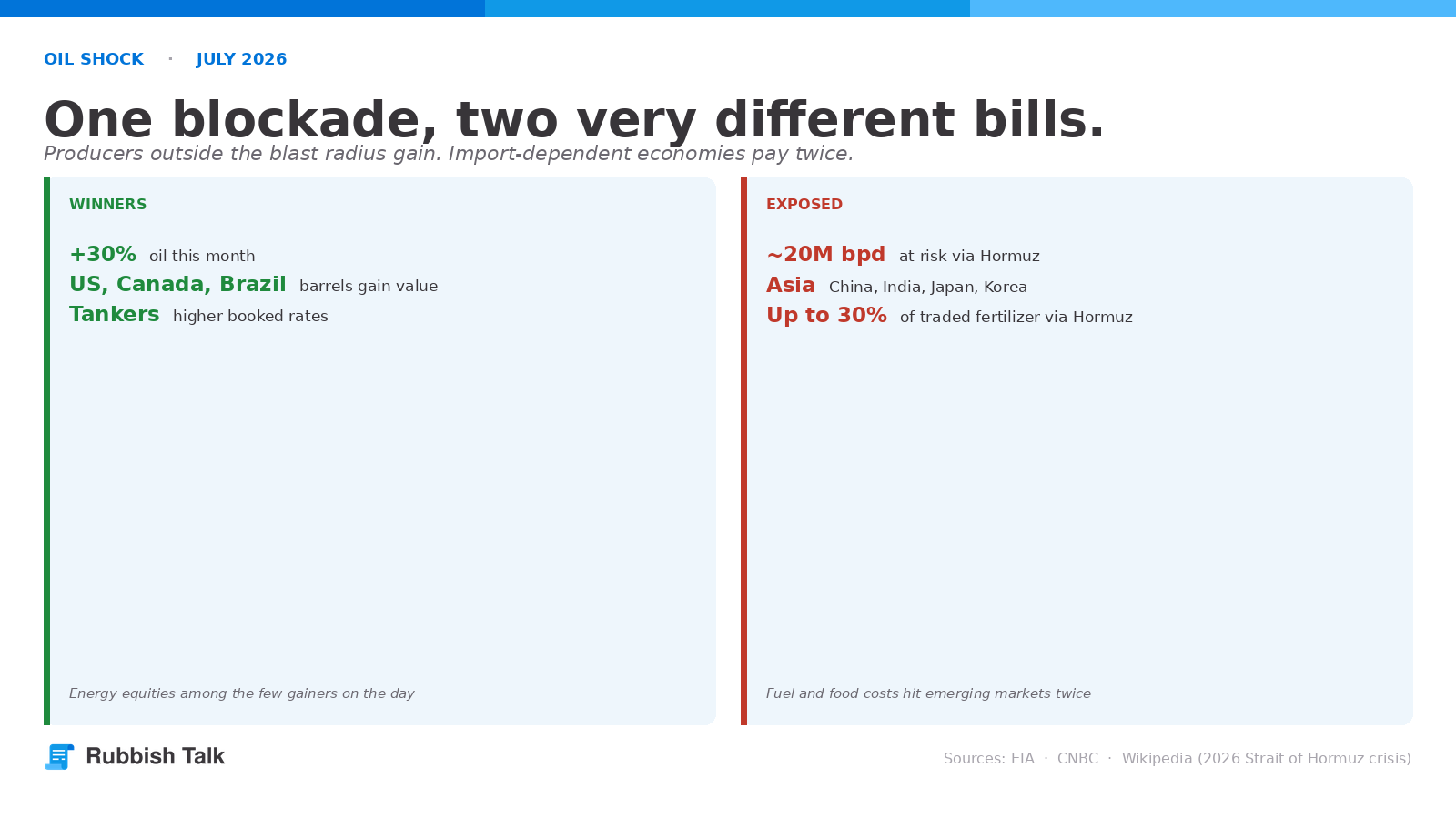
The immediate winners are oil producers outside the blast radius. US shale, Canadian, Brazilian, and West African barrels all become more valuable as Gulf supply looks shakier, and energy equities have been among the few green patches on the screen. Defence contractors and tanker owners with vessels already booked at higher rates also gain. Anyone long volatility has had a good week.
The exposed list is longer. Asia is the most vulnerable region, with China, India, Japan, and South Korea all heavily dependent on Gulf crude routed through Hormuz. Europe, still rebuilding its energy mix after the shocks of the early 2020s, faces a fresh inflation impulse at an awkward moment for its central banks. And import-dependent emerging markets get hit twice, once through fuel and once through fertilizer: the Gulf accounts for up to 30% of internationally traded fertilizers moving through Hormuz, so a sustained disruption threatens food costs a season or two out, well beyond the petrol pump.
What is being overlooked
The most underreported angle is the asymmetry of it all. A non-state militia with cheap drones and missiles is imposing costs on the global economy that vastly exceed the price of the weapons involved. A blockade declaration and a handful of strikes on tankers have added tens of billions to the world’s energy bill and rattled every major asset class. That asymmetry is the actual strategic story, and it is barely mentioned in coverage fixated on the daily index moves.
The second overlooked point is that this hands the Federal Reserve a genuine dilemma that the “AI selloff” framing obscures entirely. An oil-driven inflation spike arriving while growth is wobbling is the textbook definition of a supply shock, the one scenario where the central bank’s tools work against each other. Cut rates to support growth and you risk feeding energy-led inflation; hold to fight inflation and you tighten into a slowdown. The bond market grasped this today even as the equity headlines were still talking about technology multiples.
What comes next
Watch three things. First, insurance and freight rates for Gulf and Red Sea transit: war-risk premiums are the real-time gauge of whether this is a scare or a structural rerouting, and they move before the oil price fully catches up. Second, whether Trump’s “major military punishment” warning translates into direct strikes on Iran rather than the Houthis, which would mark a decisive escalation and a very different oil path. Third, Chinese and Indian buying behaviour, because the largest Gulf customers rerouting or drawing down strategic reserves will tell you how the physical market is actually clearing.
The base case is not a clean resolution. It is a grinding, high-premium standoff in which oil stays elevated and volatile, inflation expectations creep back up, and every headline out of the Red Sea moves the tape. The market spent a year betting the ceasefire would hold. The more useful question now is not whether tensions will “weigh on sentiment,” but how much of the global economy a few hundred dollars of drone can hold to ransom, and for how long.
Sources:
- Trump says U.S. will hold Iran responsible for Houthi attacks after oil tankers targeted in Red Sea, CNBC
- Trump threatens Houthis with ‘major military punishment’ after strikes on Saudi tankers in Red Sea, Euronews
- U.S. oil tops $90, Brent above $98 after tankers struck off Saudi Arabia, CNBC
- Crude Oil Price Today: July 23, 2026, Forbes Advisor
- Oil Rises as US-Iran War Intensifies, TradingEconomics
- 2026 Strait of Hormuz crisis, Wikipedia
- 2026 Iran war, Britannica
- Oil surges as US strikes Iran, reversing return to pre-war prices, Al Jazeera
- Stock Market News for July 23, 2026, Yahoo Finance
- Live updates: Oil tops $100 a barrel as Red Sea attacks mark new escalation in Iran conflict, CNN