
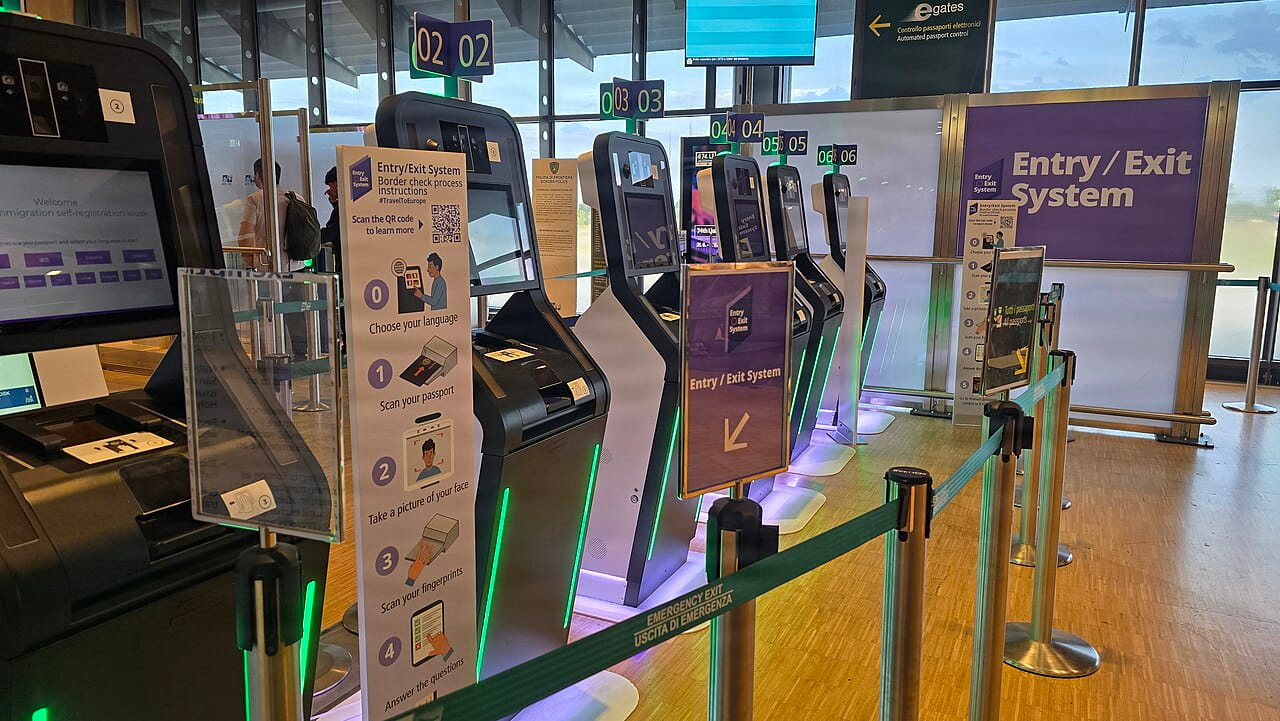
The EU has switched off passport stamps for non-EU visitors and replaced them with a biometric database called the Entry/Exit System (EES), fully operational across 29 countries since 10 April 2026. A second scheme, the ETIAS travel authorisation, is due in the last quarter of 2026 and will add a 20 euro fee for most visa-free travellers. Officials frame this as modernisation and better security. The data on the ground shows something messier: multi-hour queues, member states quietly pausing checks, and the EU’s own border agency warning the disruption could last two more years.
What is actually happening
For decades a non-EU traveller entering the Schengen Area got a physical stamp in their passport. That system is gone. In its place is the Entry/Exit System, a centralised digital register that records every short-stay entry, exit, and refusal of entry for non-EU nationals. On first arrival, travellers now hand over four fingerprints and a facial image, which are stored and linked to their travel document. Children under 12 are registered but exempt from fingerprinting. On later trips the biometrics are reused, and under the rules they are re-registered every three years, with the record held for three years and one day after the last exit.
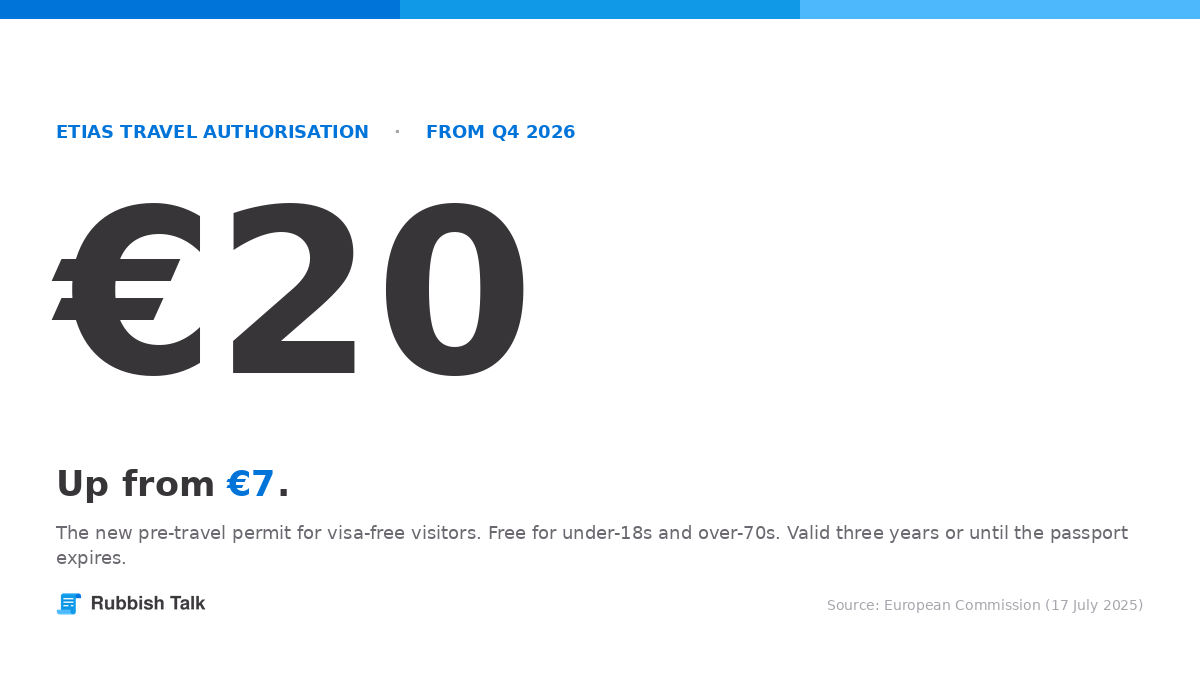
The system began operating on 12 October 2025 with a phased introduction, and became fully operational on 10 April 2026. It applies in 29 European countries: the 25 EU states inside Schengen plus Iceland, Liechtenstein, Norway, and Switzerland. Two EU members sit outside it and still stamp passports, namely Ireland and Cyprus. The rules cover anyone from outside the EU on a short stay of up to 90 days in any 180-day period, whether they normally need a visa or not. That sweeps in visitors from the United States, United Kingdom, Canada, Australia, and roughly 60 other visa-free countries.
The second system: ETIAS and the 20 euro fee
EES is only half of the picture. The European Travel Information and Authorisation System (ETIAS) is a separate, pre-travel online permission that visa-free visitors will need before they board. It is not a visa. It is an advance screening tied to a passport, valid for three years or until the passport expires, whichever comes first.
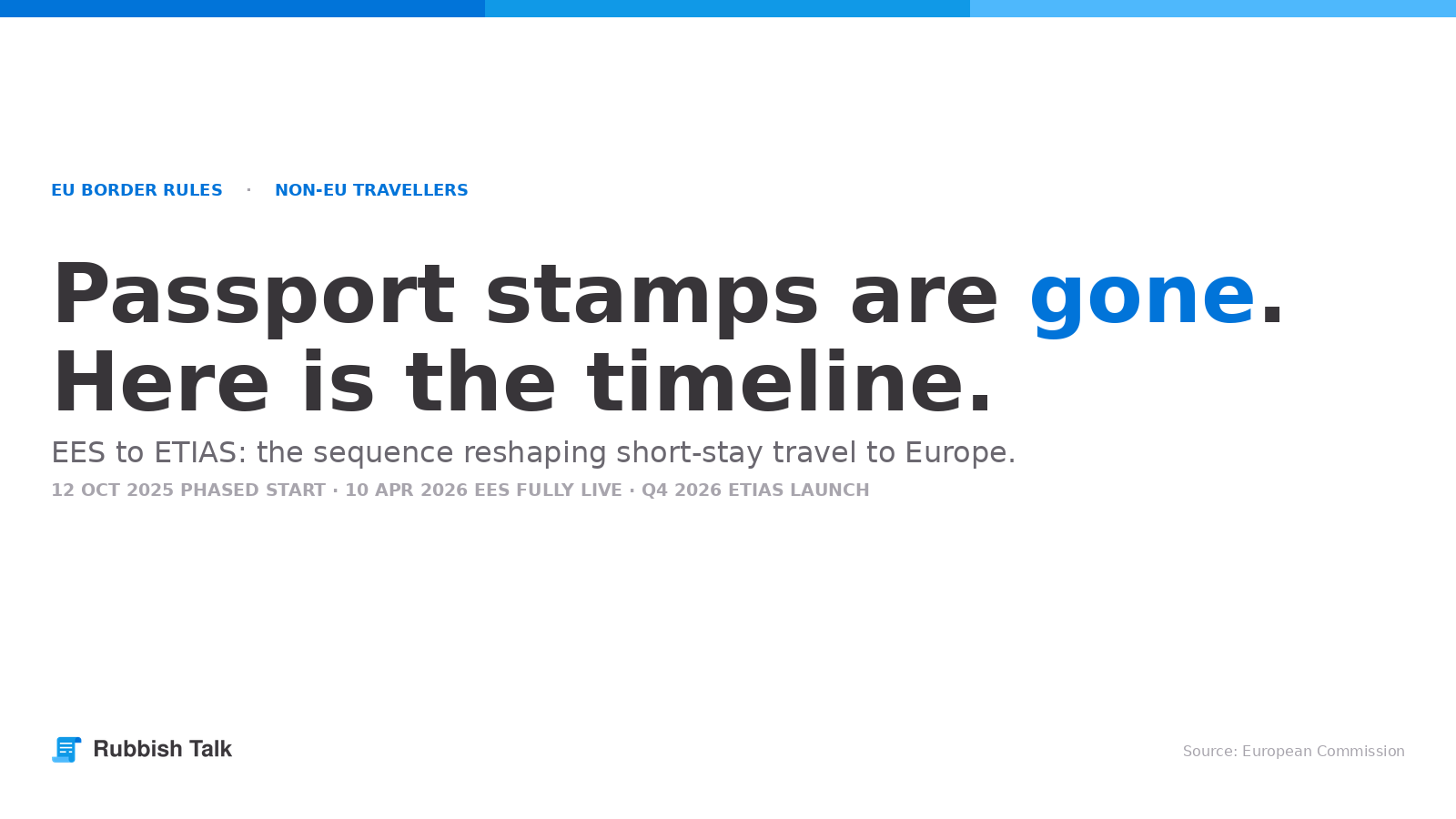
The headline change is the price. The European Commission confirmed on 17 July 2025 that the ETIAS fee will be 20 euros, not the 7 euros written into the original 2018 legislation. The Commission amended Article 18 of Regulation (EU) 2018/1240 to set the figure, citing inflation since 2018, added running costs, and alignment with comparable schemes such as the US ESTA and the UK ETA. Applicants under 18 or over 70 still need an approved authorisation but pay nothing. ETIAS is expected to go live in the last quarter of 2026, and by design it cannot start until EES is fully running, a dependency that has already pushed the launch back repeatedly.
What the official narrative says
Brussels presents both systems as an upgrade. The Commission calls 10 April 2026 “a significant milestone in European border security,” arguing that digital records are more accurate than ink stamps, harder to forge, and better at catching people who overstay their 90 days. In principle the technology should eventually speed things up, because a returning visitor with biometrics already on file can be processed faster than one being stamped by hand.
That is the theory. The official messaging leans heavily on the long-term promise of smoother, safer borders and tends to describe the current problems as temporary teething issues that clever pre-registration apps and extra kiosks will iron out.
What the data shows
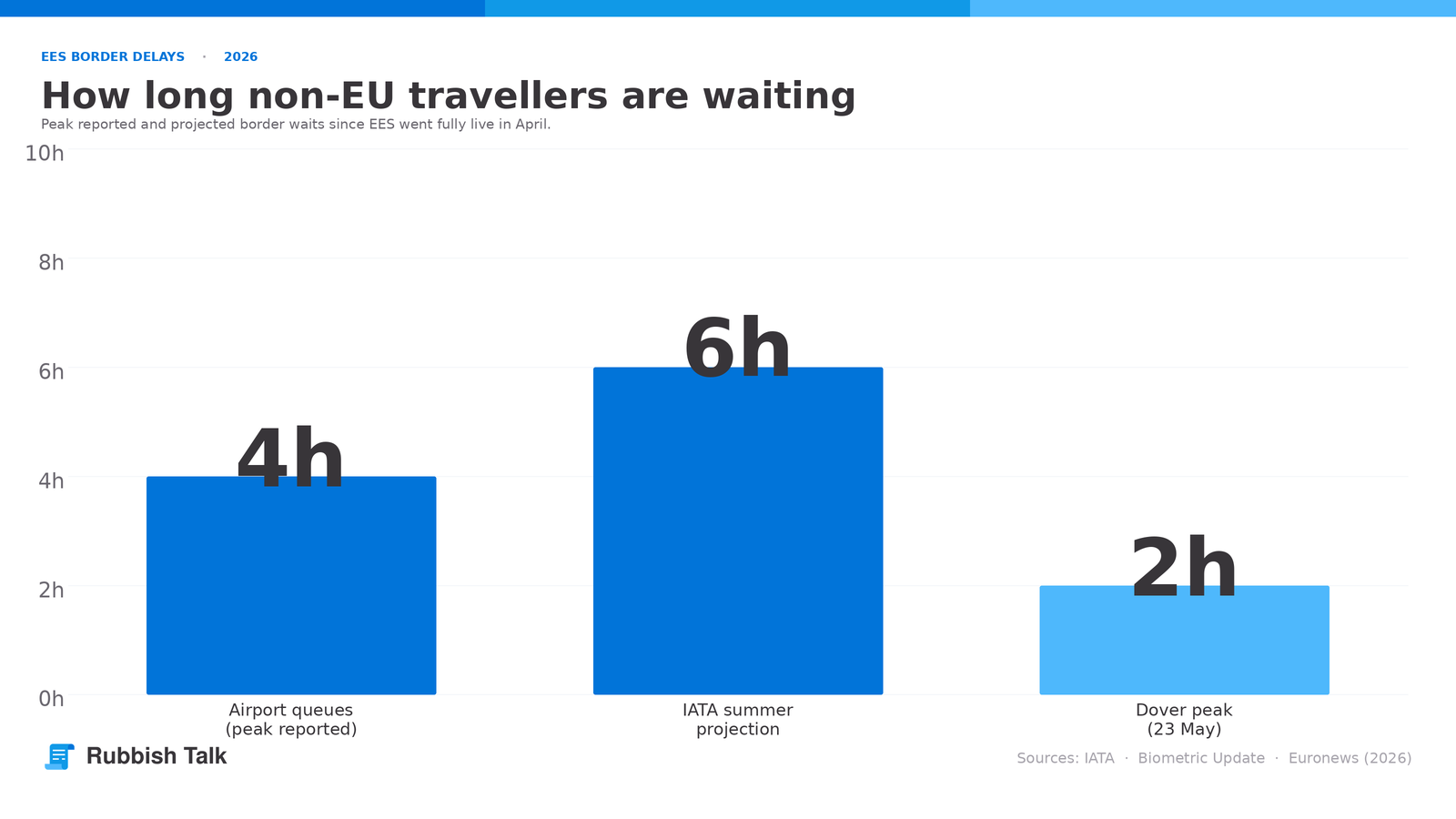
The near-term reality has been queues, and long ones. Since the full rollout in April, travellers have faced waits of two to four hours at major airports and crossings. The International Air Transport Association warned that passport-check waits this summer could reach six hours at some points. The friction is significant enough that the EU quietly built in an escape hatch: it allowed all 29 participating countries to partially suspend EES processing during busy periods over the summer to stop lines from spiralling.
Several governments used that flexibility, and some went further. Greece briefly signalled it would exempt British visitors from biometric registration for the summer, then walked it back after the Commission made clear no country can carve out a single nationality. Croatia faced similar rumours and clarified that relief can only be applied for a maximum of six hours in extraordinary congestion, and even then a traveller file must still be created. At the Port of Dover, extra EES checks were temporarily suspended on 23 May after passengers hit waits of around two hours during a holiday peak. As of June 2026, despite kiosks installed at St Pancras, Folkestone, and Dover, most cross-Channel passengers were still being processed manually while the French side worked through technical problems.
The EU’s own border agency is blunt about the timeline. Frontex deputy executive director Uku Sarekanno told a UK travel-industry event that the disruption will not clear quickly.
“We expect the situation will stabilize in one or two years because the most challenging part is the first enrolment.”
says Uku Sarekanno, deputy executive director, Frontex (ABTA event, June 2026)
That admission landed badly with an industry already braced for a difficult summer.
“If the EU’s own expectation is that queues will last up to two years, that’s not a teething problem, that’s a serious policy failure.”
says Tim Alderslade, chief executive, Airlines UK (speaking to The Times, June 2026)
Who benefits and who is exposed
Follow the incentives and the picture sharpens. The EU gains a permanent, searchable record of who enters and leaves, tighter overstay enforcement, and a new revenue stream once the 20 euro ETIAS fee begins. Border-technology vendors supplying kiosks, cameras, and fingerprint readers across roughly 1,700 air, land, and sea checkpoints are clear winners.
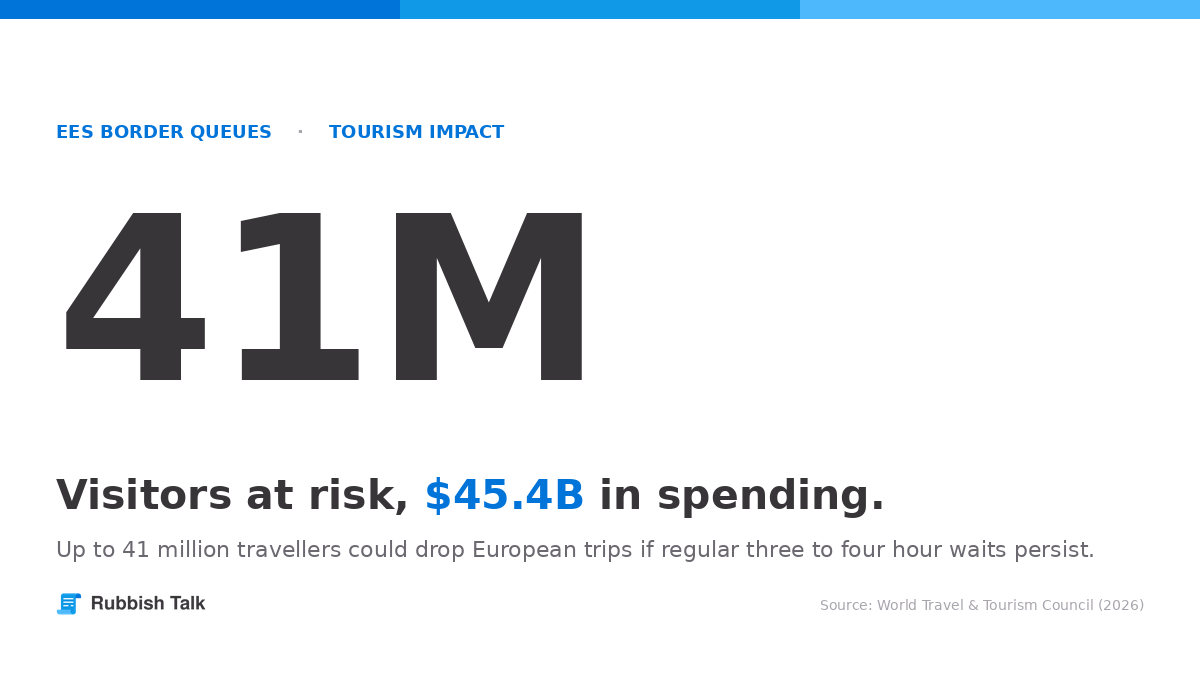
The exposed parties are travellers and the tourism economy that depends on them. The World Travel and Tourism Council estimates that up to 41 million visitors could abandon European trips because of the queues, putting around 45.4 billion US dollars of spending at risk. In a survey of more than 2,500 travellers from the UK, US, Canada, and Australia, roughly one in three said they would give up plans to visit the Schengen Area if they faced regular waits of three to four hours. Southern tourism hotspots such as Spain, France, Portugal, and Greece, the very countries with the longest queues, have the most to lose.
“By making greater use of digital pre-registration tools, improving traveler communications and ensuring operational readiness at border crossing points, Europe can reduce friction and deliver the seamless experience travelers expect.”
says Gloria Guevara, president and chief executive, World Travel and Tourism Council (2026)
What is being overlooked
Most coverage treats the queues as the story. The bigger question is what happens after September. The summer suspensions were a temporary release valve, and Frontex has signalled the EU does not plan to soften the regime once that window closes, even though its own official says stabilisation is one to two years away. Industry bodies including ABTA are lobbying to extend the contingency measures, but as their public-affairs lead put it, that is ultimately a political decision for the Commission and member states.
There is also a quieter inconsistency worth naming. The rules say biometrics are re-registered every three years, yet since the launch many border points have been collecting fingerprints and facial images on every single entry. That gap between the written rule and the practice on the ground is part of why first-entry enrolment, the slowest step, keeps repeating and the queues keep forming.
What comes next
Three things are worth watching. First, the September cliff-edge: if the summer flexibility ends on schedule and volumes stay high, autumn could bring fresh bottlenecks rather than relief. Second, the ETIAS start date. A last-quarter-2026 launch is the official line, but it depends on EES running smoothly first, and the history here is one of repeated slippage. When it does arrive, expect a grace period during which travellers without an authorisation are not immediately turned away. Third, the money. Once ETIAS is live, the 20 euro fee becomes a real cost and a real revenue line, and its rollout will test whether the pre-registration apps the EU is banking on actually shorten the lines or simply move the wait somewhere else.
The ambition behind Europe’s smart border is not unreasonable. Digital records genuinely are harder to forge than a rubber stamp. But a system whose own architects concede it may take two years to work as intended, launched into peak travel season across 1,700 checkpoints, is being judged less on its ambition than on the hours people are spending in line. For now, the data is winning that argument.
Sources:
- Entry/Exit System (EES) is fully operational | European Commission, Migration and Home Affairs
- The Entry/Exit System will become fully operational on 10 April 2026 | European Commission
- The European travel authorisation ETIAS will cost EUR 20 | European Commission
- European Travel Information and Authorisation System (ETIAS) | European Commission
- Regulation (EU) 2025/1411 amending the ETIAS fee | EUR-Lex
- Frontex warns EES border queues could persist for another two years | Biometric Update
- Europe’s chaotic Entry/Exit System could take up to two years to stabilise, EU official warns | Euronews
- EES: The new European border Entry/Exit System goes live on 10 April 2026 | France Diplomatie
- ETIAS will start operations in the last quarter of 2026 | BAL Immigration News
- The EU Entry/Exit system and EU travel authorisation system | House of Commons Library
- Image: U.S. Army USAG-V by Randall Jackson, Public domain, via Wikimedia Commons