
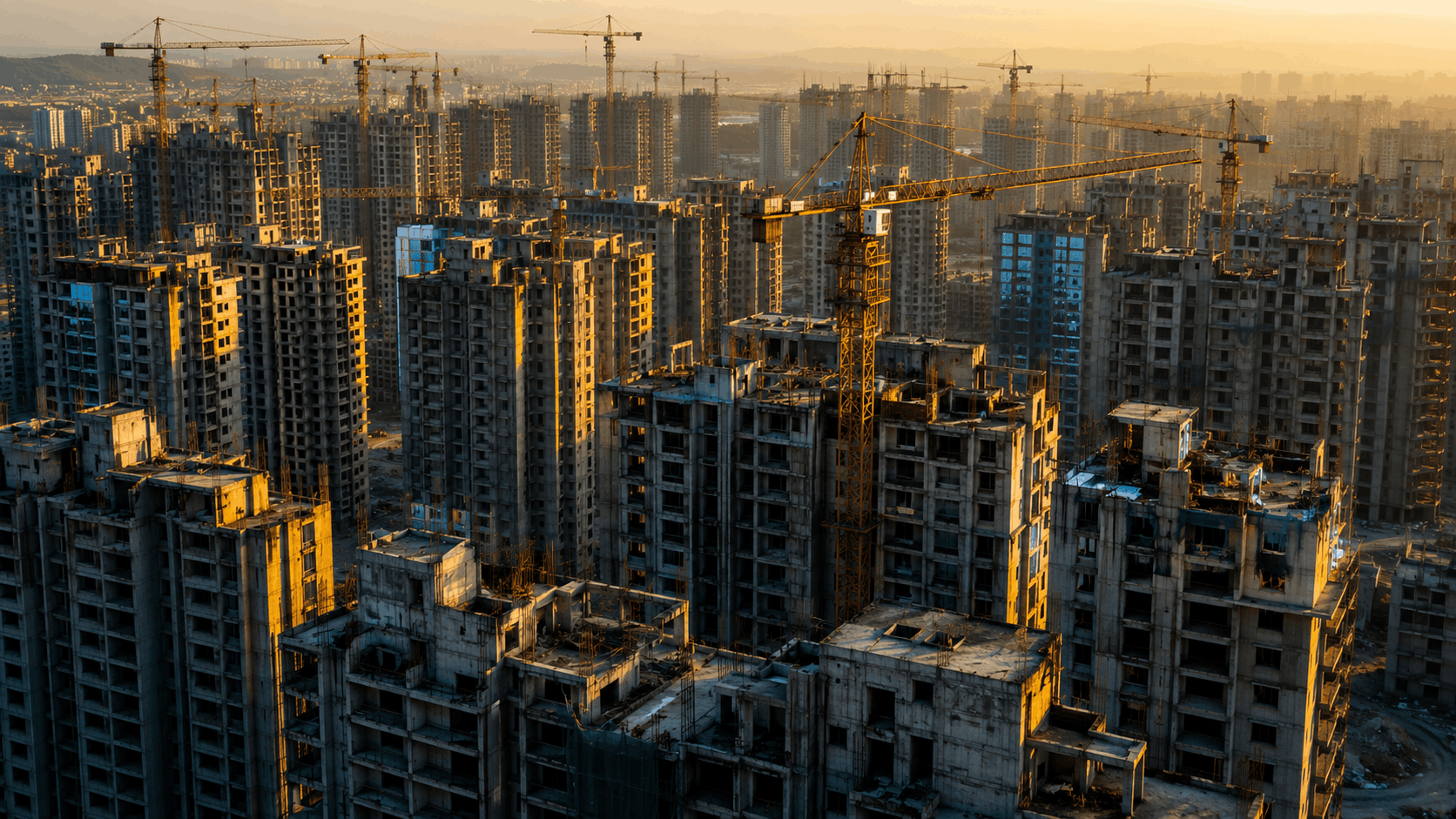
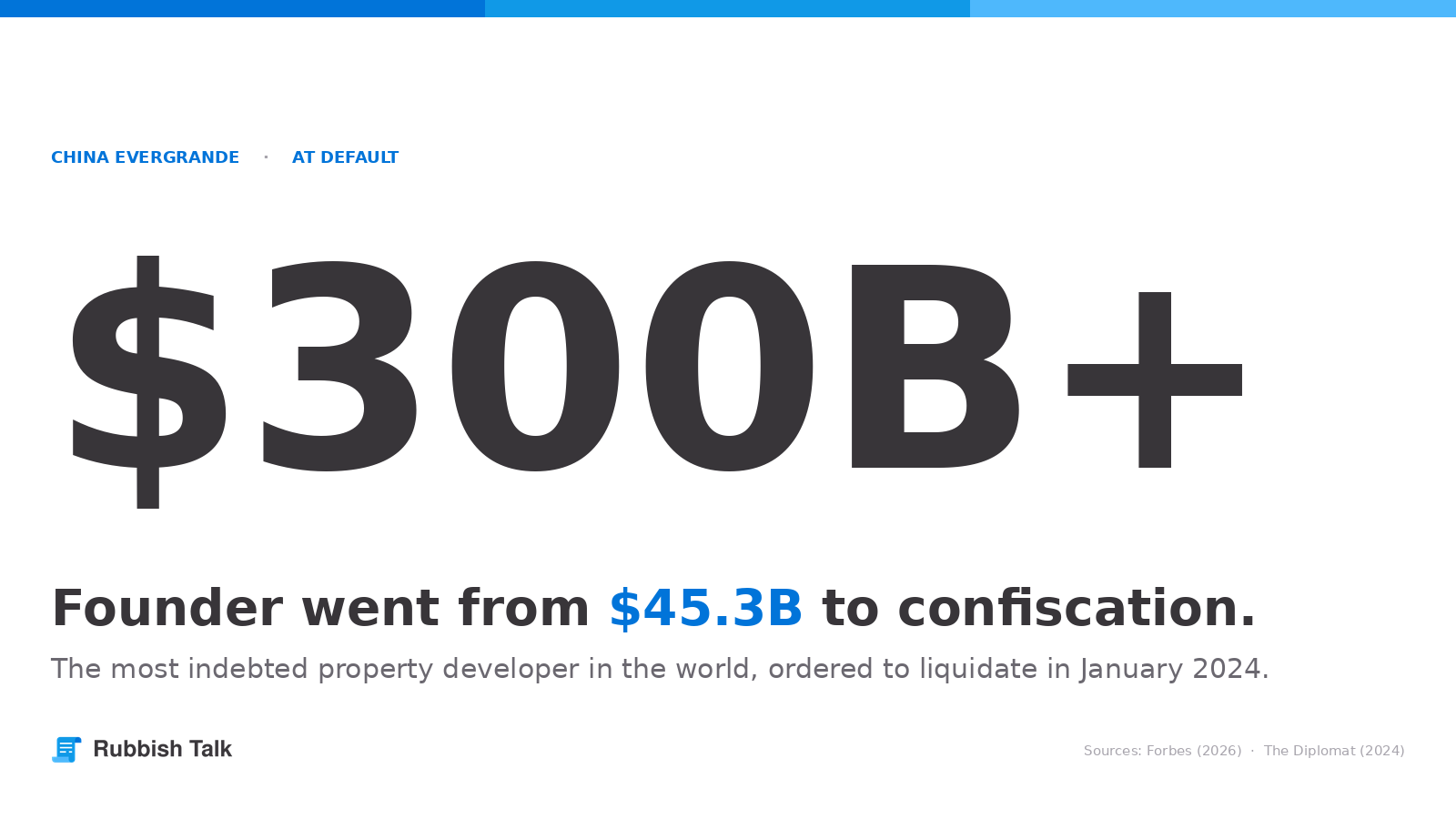
On 20 August 2026, a court in Shenzhen sentenced Hui Ka Yan, the man who built China Evergrande into the most valuable property developer on earth, to life in prison. Nine years earlier he was Asia’s richest man, worth 45.3 billion dollars. The company he founded defaulted on roughly 300 billion dollars of debt, left more than a thousand projects unfinished across some 280 cities, and was ordered into liquidation in January 2024. The mainstream story is now clean and simple: a greedy tycoon lied, got caught, and paid. That story is comforting, and it is incomplete. Evergrande was not a rogue operator. It was the purest expression of a growth model that Beijing designed, blessed, and rode for two decades.
Get your headlines checked for spin. This is exactly the kind of story most mainstream coverage waves through. The Rubbish Talk app runs the day’s news through our Rubbish-meter and scores each headline for spin, from 1 (the plain, unspun fact) to 10 (pure rubbish), so you can see what is being downplayed before it moves the market. Download it on the App Store: Rubbish Talk News.
From cement salesman to Asia’s richest man
Hui Ka Yan founded the company in Guangzhou in 1996, at the exact moment China was privatising urban housing and unleashing the largest migration into cities in human history. The formula was elegant and it printed money. Buy land on credit from local governments that were desperate for the revenue. Presell apartments to buyers before a single floor was poured. Use those deposits and more borrowing to buy the next parcel of land, and repeat. As long as prices kept rising and buyers kept queuing, the wheel spun faster every year.
It worked spectacularly. Evergrande listed in Hong Kong in October 2009, raising 722 million dollars. By 2017 it was China’s second largest developer by sales, and in 2018 it was briefly the most valuable real estate company in the world, sitting on a land bank of 565 million square metres. Hui became Asia’s richest man in 2017 and extracted billions in dividends along the way, much of it flowing to himself as majority shareholder. He bought the Guangzhou football club and won the Asian Champions League with it, launched a bottled water brand, an electric vehicle company that barely made cars, theme parks, insurance, and a wealth management arm that sold high-yield products to the company’s own staff and suppliers.
The machine: presell, borrow, repeat
The genius of the model was also its fatal flaw. Every apartment sold before it was built is a promise, and every promise is a liability. Evergrande was not really a homebuilder that happened to carry debt. It was a debt machine that happened to build homes. By the end of 2022 its liabilities reached 2.43 trillion yuan, around 340 billion dollars, making it the most indebted property developer in the world.
The whole structure depended on one assumption: that the music never stops. When Chinese authorities decided in 2020 that it should, the model had no way to survive.
“Houses are for living, not for speculation.”
Xi Jinping, opening speech, 19th National Congress of the Communist Party (October 2017)
The mainstream narrative: one bad apple
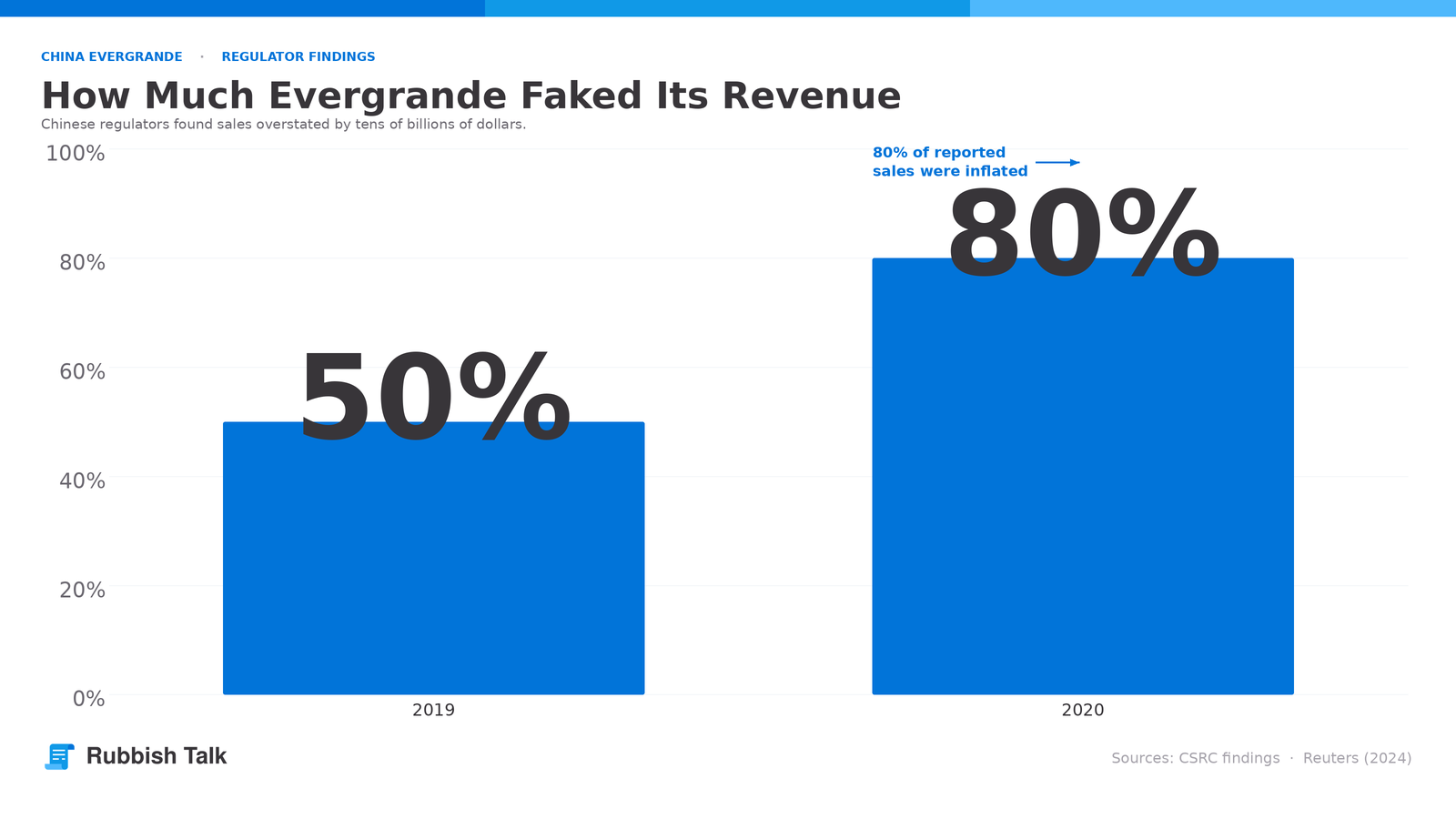
The official line, in Beijing and echoed in much of the global press, is that Evergrande failed because Hui Ka Yan was reckless and dishonest. There is truth in this. Chinese regulators found the company had overstated its revenue by around 78 billion dollars, inflating sales by roughly 50 percent in 2019 and 80 percent in 2020. The court that jailed Hui called the amounts involved “exceptionally large” and the conduct “particularly heinous.”
But the fraud narrative does a lot of convenient work. It locates the disaster in one man’s character rather than in the system that made his behaviour rational and rewarded it for twenty years. Every incentive in Chinese real estate pushed developers to borrow more, build faster, and presell harder. Local governments funded themselves through land sales and cheered the leverage on. Banks lent freely because property was assumed to be a one-way bet with an implicit state backstop. Hui did not break the game. He played it better than anyone, right up until the rules changed.
Not one bad apple: the whole orchard
If Evergrande were an isolated case of individual greed, its collapse would have stayed contained. It did not, because the problem was structural. In August 2020, Beijing introduced the “three red lines,” caps on developer leverage measured against cash, equity, and assets. By October 2021, fourteen of China’s thirty largest developers had breached at least one line. The credit spigot closed for all of them at once, and the dominoes fell in sequence.
Fantasia defaulted in October 2021. Sinic days later. Kaisa, the second largest holder of offshore developer debt after Evergrande, suspended trading in December 2021. Then came Sunac, Shimao, and in October 2023 Country Garden, a company that had been China’s largest developer by sales with roughly four times as many projects as Evergrande. This was not a series of unlucky accidents. It was one bet, placed by an entire industry, going wrong at the same moment.
“The amount involved in the crimes is exceptionally large, and the deeds are particularly heinous.”
Shenzhen court statement on Hui Ka Yan (August 2026)
The scale of the overhang is hard to overstate. Real estate and related activity accounted for close to a quarter of China’s GDP at the peak, falling toward 19 percent by 2024 as the sector contracted. Estimates in 2023 put the number of empty apartments in China at 60 to 80 million. Bloomberg Economics has estimated property debt defaults worth around 12 percent of GDP. Jailing one founder does not touch any of that.
Who pays, and who does not
Follow the money and the story sharpens. Hui pulled billions out in dividends during the good years, much of it before the collapse. His companies were fined and his personal assets confiscated, but the losses did not land on him. They landed on ordinary people. More than a thousand unfinished projects meant families who had paid deposits, and often full mortgages, on apartments that were never delivered. In 2022, buyers on hundreds of stalled projects launched a mortgage boycott, refusing to pay for homes that did not exist. Suppliers and construction firms went unpaid and some collapsed in turn. Retail investors who bought Evergrande’s wealth products, including its own employees, were left holding paper.
Meanwhile the state extracted its pound of flesh from the individual while protecting the system. Hui and 56 others, including his two sons, received sentences ranging from 22 months to life. It is a dramatic, visible act of accountability. It is also a way of drawing a line under the crisis without confronting the local-government land dependence, the presale model, and the leverage culture that produced it. The man is in prison. The machine that made him is still, in its essentials, the way Chinese property was financed.
What comes next
China has quietly walked back the three red lines and rolled out stimulus, rate cuts, and support for unfinished projects, trying to engineer a soft landing rather than a crash. Prices have kept sliding in much of the country and developers that survived 2021 face fresh maturities that could trigger new defaults. The deeper question is whether China can wean an economy off a growth engine that once drove a quarter of output without either a lost decade or a political reckoning.
For readers outside China, the lesson is not schadenfreude. It is a reminder of how a debt model can look like a miracle for twenty years and a fraud in the twenty-first. The warning signs were in the balance sheets the whole time. What was missing was anyone with an incentive to look. Hui Ka Yan will spend the rest of his life in prison for building exactly the company his country asked him to build. Watch what Beijing does next, not what it says, and watch whether the presale model that turned homebuyers into unsecured creditors is ever actually reformed. That, not one man’s sentence, is the real verdict.
Sources:
- Once Asia’s Richest Man, Evergrande Founder Hui Ka Yan Sentenced To Life In Prison (Forbes)
- Former chairman of real estate giant China Evergrande sentenced to life (UPI)
- China Evergrande Group (Wikipedia)
- Chinese property sector crisis, 2020 to present (Wikipedia)
- Evergrande Debt Crisis Timeline: Default, Restructuring and Founder’s Life Sentence (Global Banking and Finance)
- Houses are for living, not for speculation (Wikipedia)
- China Evergrande, Facing $300 Billion in Debt, Has Been Ordered to Liquidate (The Diplomat)
- China Faces Property Debt Defaults Worth 12% of GDP, BE Says (Bloomberg Law)
- Hui Ka Yan Tops 2017 Forbes China Rich List (Forbes)